 Since the dawn of science, man has always tried to account for his activities or his behaviour through external phenomena among which lunar attraction, barometric pressure and the amplitude of ocean tides were given priority. Even today, a gardener will tell you that he sows during « the rising moon period » and that he plants during « the waning moon period » ; those who suffer from asthma find it more difficult to breathe when air pressure is high ; many a fisherman associates the quality of his catch with the coefficient of the tide ; and many other similar examples could undoubtedly be found round the world…
The world of volcanoes itself does not lie beyond this tradition. However, the subject of this study will be confined to the possible correlation between atmospheric pressure and eruptive activity on strombolian-type volcanoes. At one time, I was going to associate atmospheric pressure and fumarolian intensity ; actually, in the course of my frequent visits to Vulcano (Aeolian Islands – Italy), I realised that the density of the gas clouds was related more to the degree of hygrometry of the air than to its pressure, though there may occasionally exist a relationship between both phenomena. Nevertheless, at Vulcano, the density of the fumarolian clouds, essentially observed in the morning, very rarely corresponds with a fluctuation in atmospheric pressure.
1. Personal approach.
At Stromboli, the correlation between weather conditions and eruptive activity has existed for a very long time. In 1862, in a book entitled Volcanoes, G. P. Scrope wrote that « the inhabitants of Stromboli positively make use of their volcano as a weather-glass ». Even today, most inhabitants do observe ‘their’ volcano to forecast the weather, relying on the perception or non-perception of the explosions from the villages. Yet, we may believe that, more than barometric pressure, it is the direction of the wind that leads the Strombolians’ forecasts. Indeed, the explosions in the craters are mainly audible when the wind blows from the west, where most disturbances come from, not forgetting however that they are accompanied by a fall in barometric pressure.
Among the people at Stromboli, those who know the volcano best are the guides. One evening, I was chatting with one of them – Antonio Aquilone – on the Cima, while the activity at the craters was quite normal and sustained. Suddenly, a fog shrouded the top of the mountain and the eruptive explosions stopped at the same time. I won’t forget Tonio’s remark : « See, he (meaning the volcano) has understood the weather was changing ». During the (cold) hours that followed, the eruptive activity remained remarkably low. When the fog eventually cleared up around 5 a .m., the explosions started anew. My personal barometer had recorded a fall in pressure that coincided with these observations.
One day of April 1995, I witnessed a similar phenomenon, with a sudden fall in barometric pressure (10 mBars or so) late in the afternoon, together with a coming of clouds from the north and a strong decrease of explosive activity. I then obtained the following diagrams :
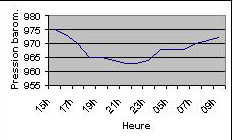
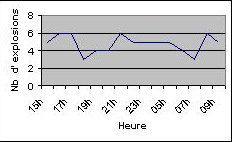
Such observations are confirming others performed at Stromboli over 12- to 18-hour periods, in relation with studies of explosive frequency.
2. Scientific approach.
As far as I know, scientific reports on the possibility of a relationship between eruptive activity and atmospheric pressure are very few and apart from some excerpts from Acta Vulcanologica, there is little scientific literature on the subject. Professor S. Falsaperla (Volcanological Institute of Catania) and Professor E. Schick (Geophysical Institute of Stuttgart) are apparently the only people in Europe to have published noteworthy articles.
In a letter, Prof. Falsaperla told me that her « personal opinion was that both on Stromboli and on whatever volcano a relationship exists, although it can be more or less important with reference to the internal state of the volcanic system. As many physical and chemical parameters may play a role in the rate of explosive activity, the influence of pressure is not easy to model even in a relatively ‘simple’ volcano as Stromboli ».
Between January and April 1983, Prof. Falsaperla took part in a workshop about barometric pressure and the frequency of seismic events at Stromboli. The complete results have been collected in Volume 3 of IAVCEI Proceedings in Volcanology edited in 1992 and been summed up in the following diagrams :
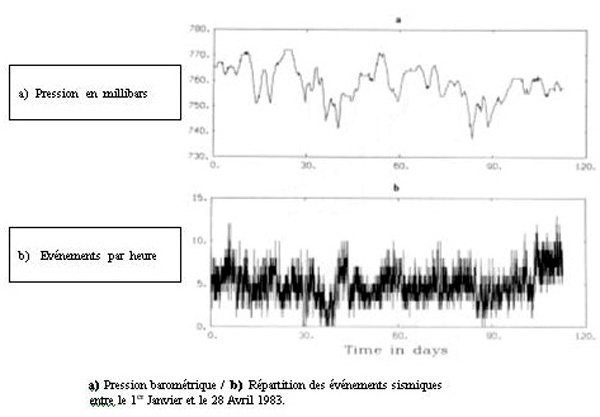
The positive side of these diagrams is to clearly show the whole situation over a given period (January-April) ; however, the compactness of the graphs does not allow us to see certain punctual occasions when a sudden and brutal fall (10 mBars or more) in atmospheric pressure seems to cause a change in eruptive activity [ see 1st part of this study]. Such a phenomenon would more clearly appear in a daily or even a weekly diagram.
Nevertheless, studying Prof. Falsaperla’s diagrams, we may reasonably assert that if common points do exist, they are not numerous enough to let us conclude with certainty that there exists a systematic coincidence at Stromboli between seismic (namely eruptive) activity and barometric pressure.
Besides, Pr. Falsaperla remarks that, in order to study the relationship between atmospheric pressure and the hourly occurrence of eruptive shocks, another variable – the dynamic behaviour of magma – should be taken into account. Indeed, some vulcanologists (for instance B. Martinelli in 1991) admit that the mixture of magma and gases is an unstable thermodynamic equilibrium that may undergo a transformation (explosive degassing or overpressure) following disturbances – should they be slight – in the magmatic conduits ; such disturbances might be caused by variations in tides or barometric pressure. Prof. Falsaperla seems to approve this theory since she concludes her study by writing that other external phenomena such as tidal forces, wind, rainfall loading, sea-wave surges etc… are likely to act as a complement to atmospheric pressure.
As far as tides are concerned, again very few studies have been published. The most interesting was performed in 1983 by a team led by Prof. Emter ; after 5,000 hours of observations corresponding with 30,000 explosions, these scientists did not find any tangible sign of the influence of tides on the triggering process of eruptions.
Among scientists themselves, opinions may diverge. French vulcanologist Haroun Tazieff wrote me that after 30 years of visits to Sicilian volcanoes he « could neither establish a correlation between eruptive activity and atmospheric pressure, nor with tides, nor with lunar attraction ». Moreover, he was « extremely sceptical about Prof. Falsaperla’s suggestions », leaning on the fact that « his own observations about that hypothetical correlation had not only been made at Stromboli, but on many prolonged activities ranging from Kituro or Nyiragongo to Erta’Ale or Capelinhos ».
3. Hygrometry.
During the latest observations, an additional parameter – hygrometry – has been taken into account. Indeed, in most cases, a drop in atmospheric pressure is paralleled by an increase in humidity.
It should be noted (not only about Stromboli) that such a change in hygrometry may lead to considerable changes in the morphology of the plumes escaping from active vents or fumarolic fields. Therefore, one has to be very careful before making a link between density of the plume and eruptive activity.
This remark has been confirmed during observations on various sites such as La Fossa di Vulcano, Mount Etna and Stromboli.
4. Conclusion.
On comparing scientific opinion with my own observations, I have arrived at the following conclusions :
As far as large-scale volcanic systems are concerned (I mean those that have very powerful feeding conduits, such as Kilauea or Nyiragongo, and involve huge magmatic and degassing forces), if barometric pressure has any influence over the eruptive process, it is negligible compared to the forces coming from the inner of the earth and so is not detected.
On the other hand, when eruptive activity is more reduced, or even sporadic – as is often the case at Stromboli – it is easier to apprehend that phenomenon, to observe it and to measure it, above all when it is occasional or punctual. This remark confirms B Martinelli’s (see above) about external factors liable to cause a disequilibrium in the mixture of magma and gases.
Anyway, even though this parameter may seem interesting, it does not look as if the correlation between eruptive activity and barometric pressure is an essential factor to volcanic approach. Other more prolonged observations ought to be performed to shed light on this phenomenon.
++++++++++++++
I would like to thank J. M. Bardintzeff, S. Falsaperla, H. Tazieff and the Stromboli guides who, through their collaboration, allowed me to achieve this study.
++++++++++++++
R E F E R E N C E S
Acta Vulcanologica. Vol 3. (1993.)
IAVCEI Proceedings in Volcanology, vol 3. (1992).
Emter D., Zuern W., Schick R.., Lombardo G. : Search for tidal effects on volcanic activities at Mt Etna & Stromboli. (1986).
Falsaperla S., Neri G. : Seismic monitoring of volcaoes : Stromboli (Southern Italy).(1986).
Martinelli B. : Fluidinduzierte Mechanismen für die Entstehung von vulkanischen Tremor-Signalen. (1991).
Schick R., Mueller W. : Volcanic activity and eruption sequences at Stromboli during 1983-1984. (1988)
Scrope G. P. : Volcanoes (1862) Ed.. Longmans & Roberts, London.
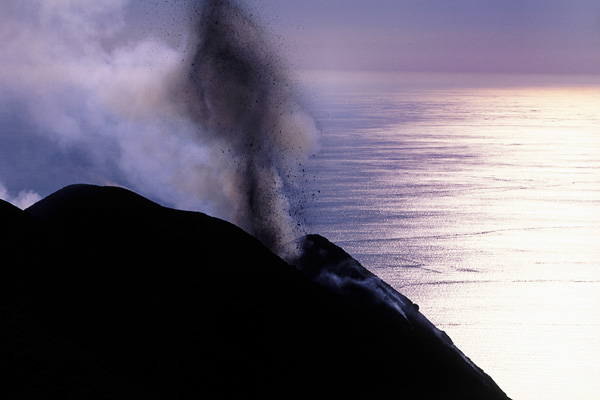
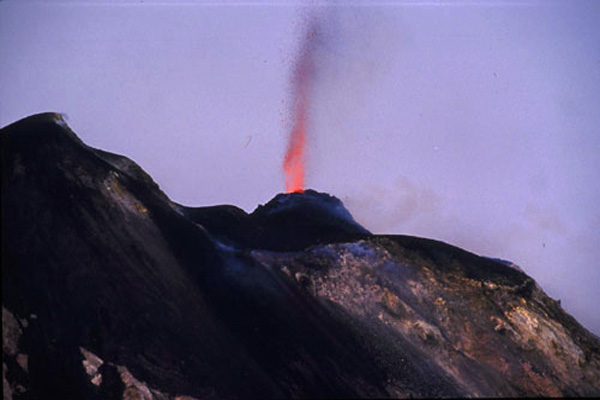
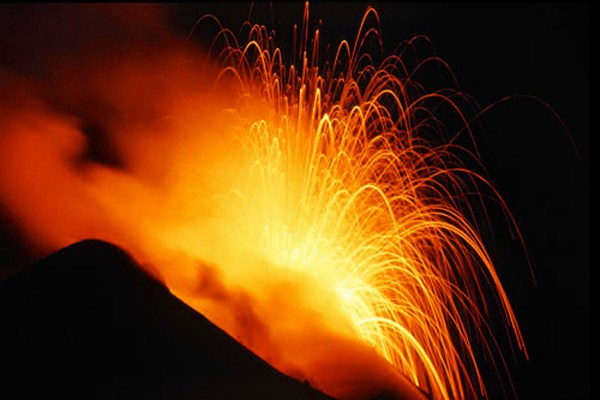
Photos: C. Grandpey
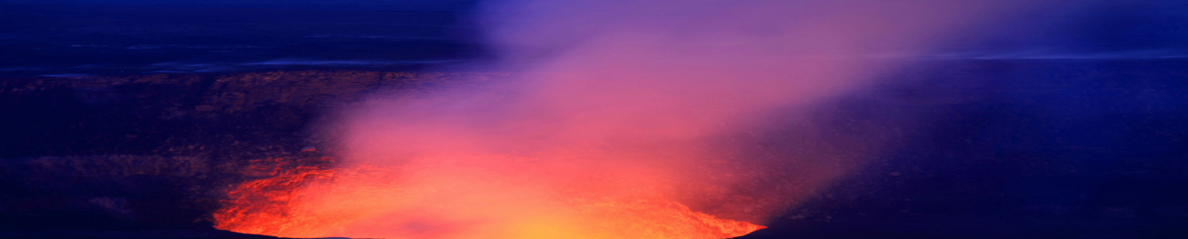
 Comme je l’ai écrit dans une note précédente, l’activité du Popocatepetl a augmenté au cours des derniers jours, avec la fermeture ponctuelle de l’aéroport de Puebla en raison de retombées de cendre sur les pistes. Toutefois, contrairement à ce qu’on peut lire dans certains articles de presse alarmistes, la situation est loin d’être exceptionnelle. Les explosions avec projections de matériaux incandescents ont probablement été causées par la destruction d’un dôme de lave récemment formé dans le cratère. La plupart du temps, le CENAPRED décrit les habituelles « exhalaisons » de gaz et de vapeur. Le niveau d’alerte n’a pas changé: Jaune, Phase 2.
 As I put it in a previous note, activity at Popocatepetl has been increasing in the past days with the punctual closure of Puebla airport because of ashfall on the runways. However, contrary to what can be read in some alarming press articles, the situation is by no means exceptional. The explosions with ejections of incandescent material were probably caused by the destruction of a recently formed lava dome within the crater. Most of the time, CENAPRED describes the usual vapour and gas “exhalations”. The alert level is not changed: Yellow, Phase 2.



 Claude Grandpey : Volcans et Glaciers