
 On a recensé une vingtaine de super volcans sur terre, avec des éruptions majeures qui se produisent en moyenne une fois tous les 100 000 ans. Si une telle éruption se produisait aujourd’hui, l’une des plus grandes conséquences serait la famine, avec un long hiver volcanique qui pourrait empêcher notre civilisation d’avoir suffisamment de vivres pour nourrir la population actuelle. En 2012, les Nations Unies ont estimé à 74 jours les réserves alimentaires dans le monde.
Lorsque les scientifiques de la NASA ont étudié le problème, ils ont conclu que la solution la plus logique serait simplement de « refroidir » un super volcan. Un volcan de la taille de Yellowstone est avant tout un gigantesque générateur de chaleur, l’équivalent de six centrales industrielles. Yellowstone laisse échapper actuellement dans l’atmosphère environ 60 à 70% de la chaleur stockée dans les profondeurs, via l’eau qui s’infiltre dans la chambre magmatique par des fissures. Le reste s’accumule à l’intérieur du magma, ce qui lui permet de dissoudre de plus en plus de gaz volatils et de roches environnantes. Une fois que cette chaleur atteint un certain seuil, une éruption explosive est inévitable.
Les scientifiques de la NASA pensent que si une grande partie de cette chaleur pouvait être extraite, le super volcan n’entrerait jamais en éruption. Ils estiment que si une augmentation de 35% du transfert de chaleur pouvait être obtenue à partir de sa chambre magmatique, Yellowstone ne constituerait plus une menace. La seule question est de savoir quelle est la solution pour y parvenir.
Une solution serait d’augmenter la quantité d’eau à l’intérieur du super volcan, mais il sera probablement impossible de convaincre les hommes politiques de cautionner une telle initiative. Construire un grand aqueduc dans une région montagneuse serait à la fois coûteux et difficile et la population n’accepterait pas que l’eau soit utilisée de cette façon. On manque d’eau potable partout dans le monde et un tel projet consistant à utiliser de l’eau pour refroidir un super volcan serait forcément très controversé.
Au lieu de cela, la NASA a imaginé un plan très différent. La solution la plus envisageable serait de forer jusqu’à 10 km de profondeur à l’intérieur du super volcan et d’injecter de l’eau à haute pression. En circulant, l’eau remonterait à une température d’environ 350°C, tout en extrayant lentement, jour après jour, la chaleur du volcan. Un tel projet, dont le coût atteindrait environ 3,46 milliards de dollars, pourrait décider les hommes politiques à risquer un tel investissement. Yellowstone laisse échapper actuellement environ 6GW sous forme de chaleur. Avec un tel forage, cette chaleur pourrait être utilisée dans une centrale géothermique qui génèrerait de l’énergie électrique à un prix extrêmement compétitifs estimé à environ 0,10 dollars par kWh. Au final, en forant un peu plus profondément, on aurait rapidement un retour sur investissement et une électricité qui pourrait alimenter la région autour du super volcan pendant une période de plusieurs dizaines de milliers d’années. L’avantage sur le long terme est que l’on empêche une éruption du super volcan qui serait un désastre pour l’humanité. Toutefois, le forage à l’intérieur d’un super volcan n’est pas sans risques et pourrait déclencher l’éruption que l’on veut éviter à tout prix !
Une autre solution serait de démarrer le forage en dehors des limites du Parc National de Yellowstone et d’extraire la chaleur de la partie inférieure de la chambre magmatique. De cette façon, on empêche la chaleur qui vient d’en bas d’atteindre le haut de la chambre, là même où se trouve la véritable menace. Cependant, ceux qui défendent un tel projet ne verront jamais si c’est une réussite au cours de leur vie. Le refroidissement de Yellowstone de cette manière interviendrait à raison d’un mètre par an et il faudrait donc des dizaines de milliers d’années pour que la roche soit refroidie.
Même si ce dernier projet semble peu réaliste, il mérite réflexion et pourrait faire partie des solutions pour éviter une catastrophe. Un tel plan pourrait être appliqué à tous les super volcans actifs de la planète et les scientifiques de la NASA espèrent que leurs idées encourageront une discussion scientifique et un débat pour s’attaquer à cette menace.
Source: La BBC.
——————————————-
 There are around 20 known supervolcanoes on Earth, with major eruptions occurring on average once every 100,000 years. One of the greatest threats an eruption may pose is thought to be starvation, with a prolonged volcanic winter potentially prohibiting civilisation from having enough food for the current population. In 2012, the United Nations estimated that food reserves worldwide would last 74 days.
When NASA scientists came to consider the problem, they found that the most logical solution could simply be to cool a supervolcano down. A volcano the size of Yellowstone is essentially a gigantic heat generator, equivalent to six industrial power plants. Yellowstone currently leaks about 60-70% of the heat coming up from below into the atmosphere, via water which seeps into the magma chamber through cracks. The remainder builds up inside the magma, enabling it to dissolve more and more volatile gases and surrounding rocks. Once this heat reaches a certain threshold, then an explosive eruption is inevitable.
But if more of the heat could be extracted, then the supervolcano would never erupt. NASA estimates that if a 35% increase in heat transfer could be achieved from its magma chamber, Yellowstone would no longer pose a threat. The only question is how to proceed.
One possibility is to simply increase the amount of water in the supervolcano. But from a practical perspective, it would likely be impossible to convince politicians to sanction such an initiative. Building a big aqueduct uphill into a mountainous region would be both costly and difficult, and people do not want their water spent that way. People are desperate for water all over the world and so a major infrastructure project, where the only way the water is used is to cool down a supervolcano, would be very controversial.
Instead NASA have conceived a very different plan. They believe the most viable solution could be to drill up to 10 km down into the super volcano, and pump down water at high pressure. The circulating water would return at a temperature of around 350°C, thus slowly day by day extracting heat from the volcano. And while such a project would come at an estimated cost of around 3.46 billion dollars, it could convince politicians to make the investment. Yellowstone currently leaks around 6GW in heat. Through drilling in this way, it could be used to create a geothermal plant which generates electric power at extremely competitive prices of around $0.10/kWh. In the end, by drilling somewhat deeper, you would pay back your initial investment and get electricity which can power the surrounding area for a period of potentially tens of thousands of years. And the long-term benefit is that you prevent a future supervolcano eruption which would devastate humanity. But drilling into a supervolcano does not come without certain risks. Namely triggering the eruption you are intending to prevent.
Instead, the idea is to drill in starting outside the boundaries of Yellowstone National Park, and extracting the heat from the underside of the magma chamber. This way you are preventing the heat coming up from below from ever reaching the top of the chamber which is where the real threat arises. However those who instigate such a project will never see it to completion, or even have an idea whether it might be successful within their lifetime. Cooling Yellowstone in this manner would happen at a rate of one metre a year, taking of the order of tens of thousands of years until just cold rock was left.
But to prevent a catastrophe, such long-term thinking and planning may be the only choice. Such a plan could be potentially applied to every active supervolcano on the planet, and NASA’s scientists are hoping that their blueprints will encourage more practical scientific discussion and debate for tackling the threat.
Source : The BBC.
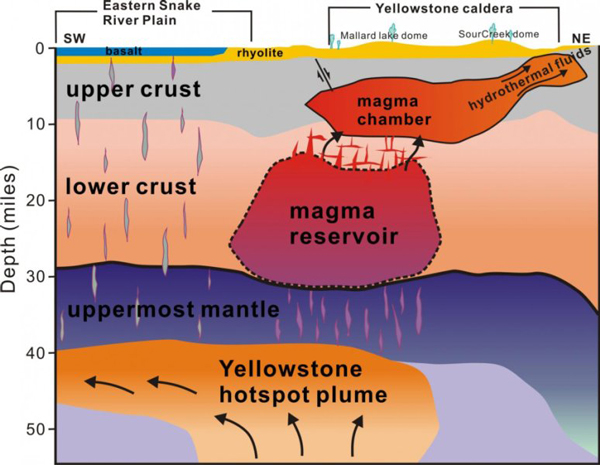
Cette coupe sud-ouest / nord-est sous Yellowstone a été obtenue grâce à l’imagerie sismique. (Source: University of Utah)
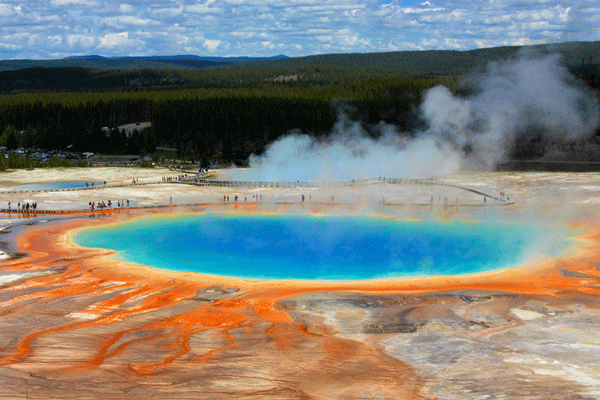
Un forage à Yellowstone, n’est-ce pas jouer avec le feu et risquer de saccager un site d’une beauté exceptionnelle? (Photo: C. Grandpey)


