Nouveau site web sur les glaciers islandais // New website about Icelandic glaciers

Un nouveau site web, islenskirjoklar.is, contenant des informations sur les glaciers islandais a été lancé à Perlan, le dôme de verre de Reykjavík, le 20 mars 2022. Il offre des informations sur les études effectuées et les changements survenus sur les glaciers islandais au cours des dernières décennies.
Malheureusement, les informations sont en islandais (espérons qu’elles le seront bientôt en anglais !), mais ses créateurs affirment que même si les visiteurs ne parlent pas islandais, le site est utile à tous ceux qui souhaitent accéder à une carte de tous les glaciers et regarder les nombreuses photos. Il sera possible de comparer la morphologie des glaciers il y a des décennies avec les paysages d’aujourd’hui.
On peut également voir les contours des glaciers à différents moments. Ce travail a été effectué par des scientifiques en se référant à des photos aériennes, des images satellites ou des cartes.
La collection de photos est censée être unique en son genre. Elle comprend des panoramas, avec des vues d’avion de presque tous les glaciers d’Islande, à l’exception des plus petits.
Le site web devrait intéresser à la fois la communauté scientifique et le grand public. Vous pouvez y accéder en cliquant sur ce lien :
https://islenskirjoklar.is/#/page/map
Source : Iceland Monitor.

———————————————–

A new website, , islenskirjoklar.is, with information about Iceland’s glaciers was introduced at Perlan, Reykjavík’s glass dome, on March 20th, 2022. It offers information about research and changes that have occurred in Icelandic glaciers in recent decades.

Unfortunately, the information is in Icelandic (let’s hope it will be in English soon!), but its creators say that even if visitors don’t speak Icelandic, the website is useful to anyone who wants to access a map of all the glaciers and take a look at the numerous quality photos provided. In many cases, you can compare what the glaciers used to look like decades ago to what they look like now.

One can see the outlines of glaciers at different points in time. Those have been drawn by scientists, based on aerial photos, satellite pictures, or maps.

The photo collection is said to be unique. It includes panoramas, taken from airplanes, of almost every single glacier in Iceland, except for the very smallest ones.

The website is expected to be useful to the scientific community, as well as to the public. You can access it by clicking on this link :

https://islenskirjoklar.is/#/page/map

Source : Iceland Monitor.

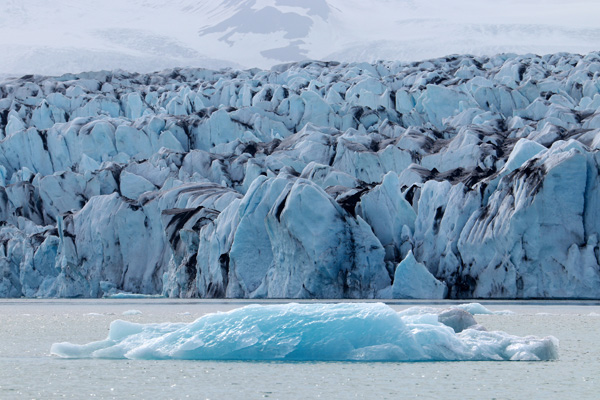
Vue du Vatnajökull (Photo : C. Grandpey)

Fire & Iceland

Le 19 mars 2022, tout juste un an après le début de l’éruption de Fagradalsfjall, aura lieu à Reykjavik la première projection publique d’un documentaire intitulé Fire & Iceland. Le film, réalisé par Art As Air Project, a été réalisé au cours de l’éruption, qui s’est terminée le 18 septembre 2021. Il est produit et réalisé par April Anderson.
Selon le communiqué de presse qui accompagne la sortie du documentaire, les cinéastes interrogent des personnes de différents horizons en Islande. Ainsi, les membres des équipes de secours expliquent qu’elle ont du gérer des fractures et autres problèmes cardiaques chez des touristes qui avaient sous-estimé leurs capacités avant d’emprunter le sentier escarpé conduisant au volcan.
Une pilote d’hélicoptère, qui a effectué des allers-retours sur le site plusieurs fois par jour avec des touristes qui assistaient pour la première fois à une éruption volcanique, raconte son expérience.
Ensuite, il y a des témoignages d’artistes – un auteur-compositeur parmi eux – qui expliquentent comment l’éruption les a inspirés.
L’entrée à la projection est gratuite, mais les places sont limitées,
Le documentaire est déjà disponible sur Amazon Prime au Royaume-Uni et aux États-Unis.
Vous pouvez regarder la bande-annonce ci-dessous :

https://youtu.be/iM-oH0DUADI

Source: Iceland Review.

—————————————-

On March 19th, 2022 in Reykjavik, a year after the start of the Fagradalsfjall eruption, the premier of a documentary film entitled Fire & Iceland will take place in the Icelandic capital. The documentary, made by the Art As Air Project, was filmed over the course of the eruption, which ended on September 18th, 2021. The documentary was produced and directed by April Anderson.

According to press release, the film makers interview people from several different walks of life in Iceland. Members of rescue teams talk about dealing with the daily broken bones and heart attacks that were always a possibility with tourists who underestimated their capabilities on the difficult trail to the volcano.

A helicopter pilot, who flew back and forth to the site several times every day with tourists who were seeing a volcanic eruption for the first time in their lives, describes her experience.

Then there are artists – a songwriter among them – who detail how the eruption inspires them.

Admission is free to the event, but seating is limited,

The documentary is already available on Amazon Prime in the UK and the US.

You can watch the trailer below:

Source: Iceland Review.

Fire & Iceland

Un documentaire intitulé « Fire & Iceland », tourné en Islande l’année dernière lors de l’éruption du Fagradalsfjall est désormais disponible sur Amazon Prime au Royaume-Uni et aux États-Unis.
La présentation du film aura lieu le 19 mars 2022 à 18h30 au théâtre Bíó Paradís de Reykjavik ( entrée gratuite).

Le documentaire fait revivre l’éruption de 2021 et fait apparaître les personnes qui vivent et travaillent « à l’ombre des volcans ».
Le film a été réalisé par April Anderson et Martin Chytil. Vous verrez la bande-annonce ci-dessous. Le documentaire a l’air bon, mais il y a eu tellement de vidéos de cette éruption qu’il aura peut-être un goût de déjà vu !

———————————————

A documentary entitled ‘Fire & Iceland’ that was filmed in Iceland last year during the Fagradalsfjall eruption is now available on Amazon Prime in the UK and the U.S.

The World Theatrical Premiere will take place on March 19th, 2022 at the Bíó Paradís theater in Reykjavik at 18:30.The admission is free of charge.

The documentary follows the 2021 Fagradalsfjall eruption, featuring the people who live and work ‘in the shadows of volcanoes’.

The film was directed by April Anderson and Martin Chytil. You will see the trailer here below. it looks good but there have been so many videos of this eruptioon that it may have a taste of déjà vu!

Les risques liés aux intrusions magmatiques sur la Péninsule de Reykjanes (Islande) // The hazards of magma intrusions on the Reykjanes Peninsula (Iceland)

Dans une interview accordée aux médias locaux, le géologue islandais Páll Einarson a expliqué que les intrusions magmatiques sous forme de dykes sur la Péninsule de Reykjanes sont susceptibles d’endommager d’importantes infrastructures, tant sur la péninsule que dans la région de Reykjavik, la capitale. Le scientifique a ajouté que ces intrusions, qu’elles débouchent ou non sur une éruption volcanique, pourraient avoir un impact sur les systèmes géothermiques qui alimentent les réseaux d’eau et de chauffage, ainsi que sur les centrales géothermiques. L’une de ces intrusions a été observée en décembre 2021 et on craignait qu’une nouvelle éruption se produise sur la Péninsule de Reykjanes. Cependant, un tel événement ne s’est jamais produit. La sismicité qui a accompagné l’intrusion a considérablement diminué, et on pense que le magma s’est solidifié sous terre.

Selon la définition la plus répandue, un dyke – aussi orthographié dike – est une forme d’intrusion magmatique, « un filon de roche ignée vertical ou à fort pendage » qui se forme « lorsque le magma se fraye un chemin vers la surface en utilisant des fractures dans la roche ».
Páll Einarson a expliqué aux journalistes qui l’interviewaient qu’il y a eu des intrusions magmatiques à trois ou quatre endroits dans la région de la Péninsule de Reykjanes, sans toutefois causer des problèmes sérieux. Cependant, une intrusion au mauvais endroit pourrait provoquer des dommages permanents aux infrastructures. Actuellement, rien n’indique qu’un tel événement soit imminent, mais Páll Einarson explique que la récente éruption de Fagradalsfjall fait partie d’une chaîne complexe d’événements sur la péninsule.
Divers scénarios sont possibles à l’avenir, notamment une activité volcanique sur terre ou en mer, ou l’apparition d’une d’intrusion magmatique autour des sites géothermiques de Krýsuvík et Svartsengi, de la zone de conservation de Heiðmörk à la périphérie de Reykjavík ou des montagnes de Bláfjöll.
Les éruptions sur la Péninsule de Reykjanes ont tendance à être de type fissural, de faible ou moyenne importance, mais la capitale peut connaître des séismes intenses liés à cette activité sur la péninsule. Le problème est qu’il n’y a aucun moyen de prévoir quand de tels événements peuvent se produire.
Source : Iceland Review.

———————————————-

In an interview with the locan news media, Icelandic geologist Páll Einarson said that dike intrusions on the Reykjanes peninsula could potentially damage important infrastructure, both on the peninsula and in the capital area. The scientist explained that regardless of whether they lead to a volcanic eruption or not, such intrusions could impact the geothermal systems that feed water and heating utilities, as well as geothermal power plants. One of these intrusions was observed in December 2021 and there were fears that a new eruption might occur on the Reykjanes Peninsula. However, such an event never occurred. The seismicity that accompanied the intrusion decreased significantly, and it is believed that the magma solidified underground.

According to the usual definition, a dike (also spelled dyke) is a kind of magma intrusion, a “vertical or steeply-dipping sheet of igneous rock” that forms “as magma pushes up towards the surface through cracks in the rock.”

Páll Einarson told interviewers that there have been magma intrusions in three or four places in the area of the Reykjanes Peninsula that have not caused any serious problems. However, one intrusion in the wrong place could do permanent infrastructural damage. Currently, there is no sign that such an event is imminent but Páll explains the recent eruption of Fagradalsfjall is part of a complex chain of events on the Peninsula.

A variety of scenarios are possible in the future, including volcanic activity on land or at sea, or intrusion activity around the Krýsuvík and Svartsengi geothermal areas, the Heiðmörk conservation area on the outskirts of Reykjavík, or the Bláfjöll mountains.

Eruptions on the Reykjanes Peninsula tend to be small to medium fissure eruptions, and the capital may yet experience intense earthquakes as part of this ongoing activity on the Peninsula. The problem is that there is no way to say when these might occur.

Source: Iceland Review.


Différents types d’intrusion magmatique (Source : USGS)


Exemple de dyke à Tenerife (Iles Canaries)