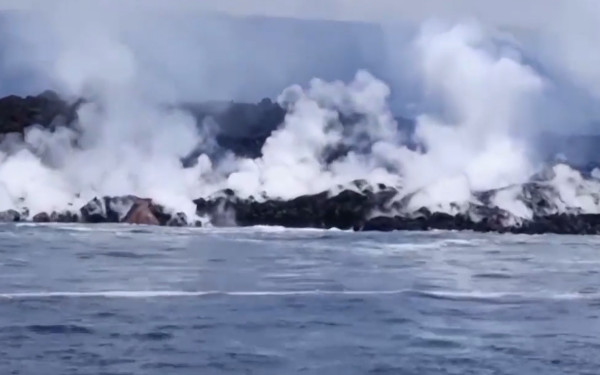
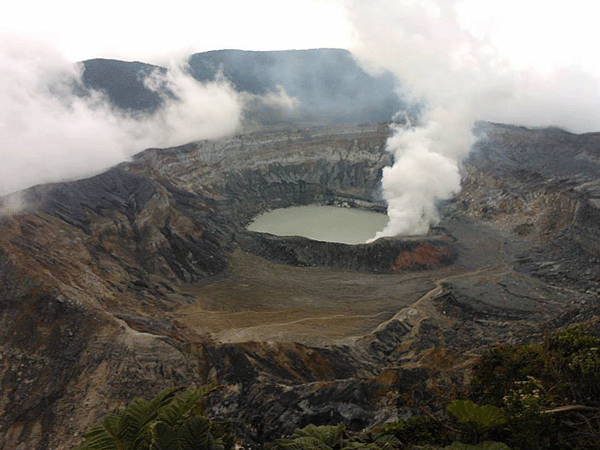
Voici quelques nouvelles de l’activité volcanique dans le monde :
Une série de puissantes éruptions a été observée sur le Ruang, le volcan le plus méridional de l’arc des îles Sangihe, dans la province de Sulawesi du Nord (Indonésie). L’éruption a commencé aux premières heures du 17 avril 2024. La couleur de l’alerte aérienne est passée au Rouge et le niveau d’alerte volcanique a été relevé à 3 sur une échelle de 4 niveaux. Les autorités locales ont évacué plus de 800 personnes vivant sur l’île à titre préventif. Elles craignaient que le volcan s’effondre dans la mer et déclenche un tsunami, comme cela a déjà eu lieu en 1871. Selon le VAAC de Darwin, le panache de cendres s’est élevé jusqu’à 13,7 km au-dessus du niveau de la mer.
L’éruption s’est à nouveau intensifiée pendant la nuitdu 17 au 18 avril, poussant les autorités à relever le niveau d’alerte au maximum sur une échelle de quatre niveaux. L’aéroport international de Manado situé à plus d’une centaine de kilomètres du volcan a été fermé. Des évacuations massives, s’ajoutant à celles du 17 avril, ont été décrétées dans la région. 11 000 habitants étaient concernés dans la zone proche du volcan, qui comprend l’île de Tagulandang, où vivent environ 20 000 personnes.
Le Ruang, à ne pas confondre avec Raung sur l’île de Java, n’est pas le volcan indonésien le plus connu. C’est le volcan insulaire le plus méridional des îles Sangihe. Il se trouve dans un étroit détroit au sud-ouest de l’île Tagulandang.
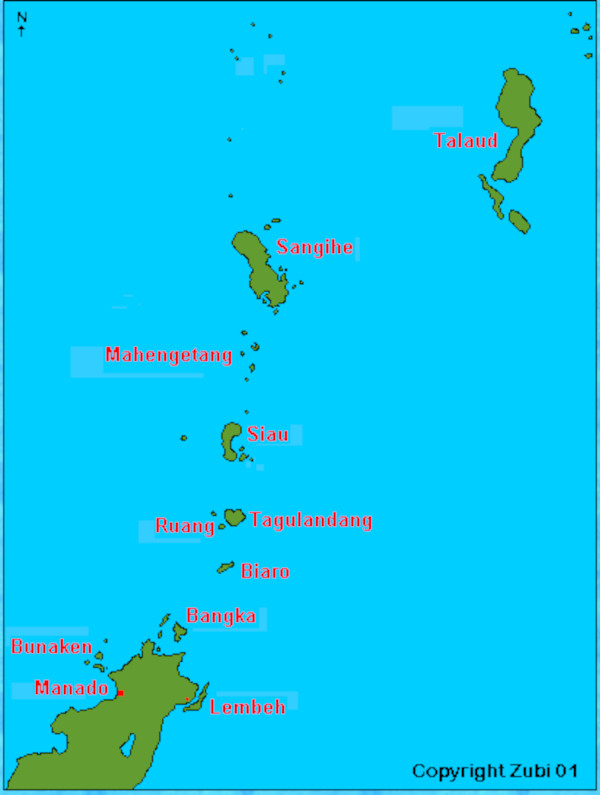
Le sommet présente un cratère partiellement occupé par un dôme de lave qui s’est formé en 1904. Le dernier épisode éruptif de ce volcan remonte à septembre 2002, avec un VEI 4. Les éruptions explosives se sont souvent accompagnées de formation de dômes de lave et de coulées pyroclastiques qui ont endommagé des zones habitées.
Source : PVMBG, Jakarta Post, Smithsonian Institution.
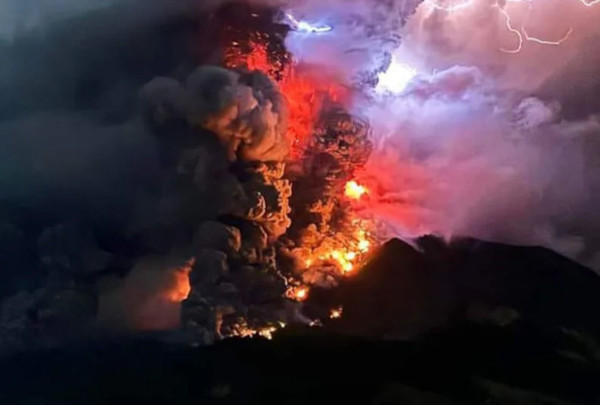
Vue de l’éruption dans sa phase initiale (Crédit photo : PVMBG)
Dernière minute (19 avril 2024) : l’éruption du Ruang continue de provoquer des perturbations dans l’espace aérien. L’aéroport international Sam Ratulangi de Manado, situé à environ 95 kilomètres du Ruang, reste fermé au moins jusqu’à aujourd’hui 19 avril.
Le port de Tagulandang est actuellement opérationnel pour gérer les évacuations et la distribution de l’aide aux localités touchées.
Après l’éruption qui a débuté le 16 avril, les réseaux d’électricité et de communication ont été interrompus dans le village de Laing Patehi sur l’île de Ruang, tandis que dans le village de Lumbo sur l’île de Tagulandang, les réseaux de communication ne fonctionnent pas de manière optimale.
Selon les données du BPBD, 272 foyers, soit 838 personnes, ont été déplacées sur l’île de Tagulandang. Dans le même temps, l’évacuation des habitants se poursuit sur l’île de Tagulandang, en particulier du côté ouest face à l’île de Ruang. La collecte de données en cours par le gouvernement local indique l’évacuation de 6 045 personnes.
Le Ruang est actuellement visible mais partiellement recouvert de brume. Le cratère principal émet des panaches blancs d’intensité modérée à forte, à environ 50-100 mètres au-dessus du sommet.
Le niveau d’alerte est maintenu à 4, le maximum.
Source : Jakarta Globe.
°°°°°°°°°
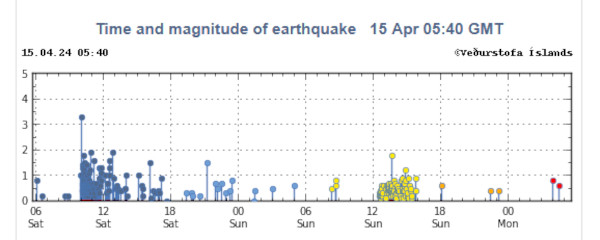
Toujours dans les îles Sangihe, à environ 150 km au nord du Ruang, une hausse de la sismicité volcanique a été enregistrée sur l’Awu le 22 mars, puis à nouveau du 10 au 15 avril 2024, ainsi qu’une inflation de l’édifice volcanique. Le niveau d’alerte est passé à 3 (sur une échelle de 1 à 4) et le public est prié de rester à au moins 5 km du cratère.
La dernière période éruptive de l’Awu a duré de juin à août 2004 avec un VEI 2. L;histoire montre que le volcan est très actif, avec des éruptions dévastatrices en 1711, 1812, 1856, 1892 et 1966. Elles ont produit d’importantes coulées pyroclastiques et des lahars, conduisant à la mort de plus de 8 000 personnes.
Source : PVMBG, Jakarta Post, Smithsonian Institution.

Sismicité sur l’Awu entre août 2023 et avril 2024 (Source: PVMBG)
++++++++++
Une hausse de la sismicité à faible profondeur est enregistrée sur le Kuchinoerabujima (Îles Ryukyu / Japon) depuis début avril. Le nombre et la magnitude de ces événements restent élevés. Le niveau d’alerte est passé à 3 (sur une échelle de 1 à 5) le 13 avril 2024. Le public a été prévenu que des blocs éjectés et des coulées pyroclastiques peuvent impacter les zones proches du sommet.
Source : JMA.
++++++++++
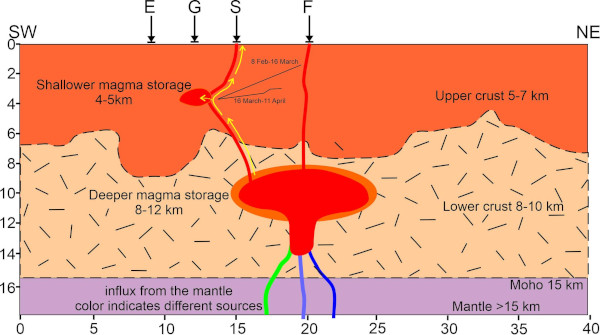
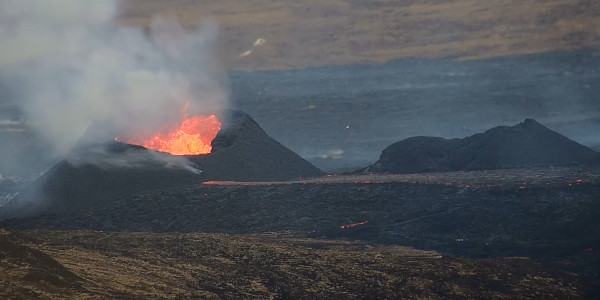
En Islande, cela fait un mois que l’éruption a débuté sur la chaîne de cratères de Sundhnúkagígar, sur la péninsule de Reykjanes. Il s’agit de la plus longue éruption de la série qui a commencé en décembre 2023, et de la deuxième plus longue des éruptions sur la péninsule de Reykjanes depuis 2021. Cette dernière éruption a débuté dans la soirée du 16 mars 2024 sur une fracture de près de 3 km de long.
Au début, la lave s’est dirigée principalement vers le sud et le sud-est, le long des digues de terre en direction de la Suðurstrandarvegur, et vers le nord-ouest en direction de la Grindavíkurvegur. Environ quatre heures après le début de l’éruption, la lave a recouvert la Grindavíkurvegur. L’éruption est désormais stable mais le Met Office indique qu’elle diminue très lentement. Dans le même temps, on observe une hausse du soulèvement du sol dans le secteur de Svartsengi, ce qui est tout à fait cohérent avec le fait que le débit de l’éruption diminue. Une partie du magma provenant des profondeurs s’accumule sous Svartsengi car le cratère qui s’est ouvert sur la fracture éruptive ne peut pas absorber la totalité du magma en provenance des profondeurs.
Source : MetOffice.

Image webcam de l’éruption le 16 avril 2024
++++++++++
L’activité éruptive se poursuit sur le Poás (Costa Rica). Des bouches au fond sec du cratère émettent des panaches de gaz et de vapeur. Le nombre d’événements phréatiques a commencé à augmenter le 10 avril 2024 avec des panaches qui se sont élevés de 500 m de hauteur. La population de plusieurs localités a signalé une odeur de soufre. Une petite explosion le 14 avril a produit de l’incandescence et une émission de cendres qui s’est élevée à moins de 300 m de hauteur.
Source : OVSICORI.
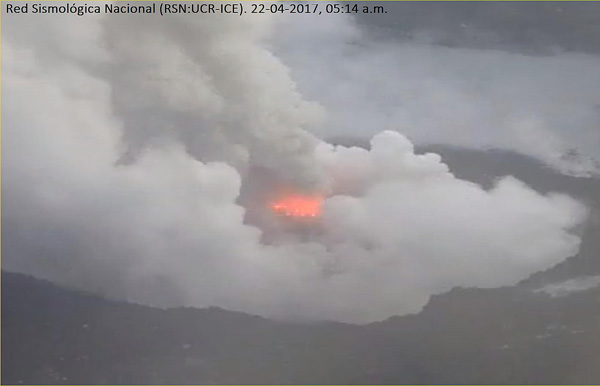
Exemple d’incandescence dans le cratère du Poás le 22 avril 2017 (Crédit photo: OVSICORI)
++++++++++
Une nouvelle éruption phréatique s’est produite sur le Taal (Philippines) le 12 avril 2024, avec un panache de vapeur qui s’est élevé à 2,4 km au-dessus du niveau de la mer. Quatre autres éruptions phréatiques ont produit des panaches qui s’élevaient de 100 à 300 m de hauteur. Des éruptions de moindre intensité ont suivi ces événements qui provenaient d’une nouvelle bouche sur le côté sud-ouest du Main Crater. Le niveau d’alerte reste à 1 (sur une échelle de 0 à 5) et il est rappelé au public que l’ensemble de Volcano Island est une zone de danger permanente.
Source : PHIVOLCS.
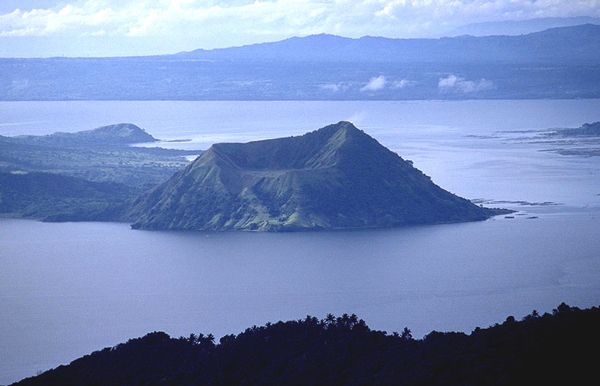
Volcano Island dans le cratère du Taal (Crédit photo: Wikipedia)
++++++++++
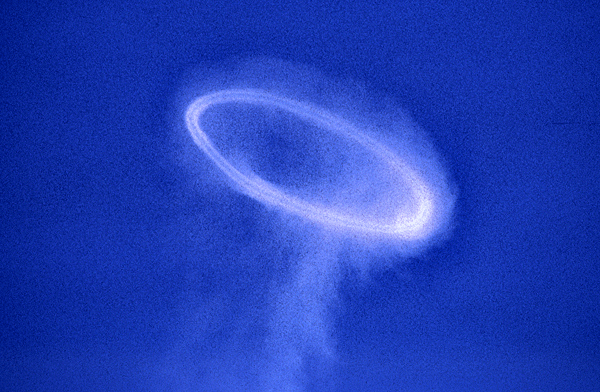
L’éruption du Sabancaya (Pérou) se poursuit avec une moyenne de 44 explosions quotidiennes. Les panaches de gaz et de cendres s’élèvent jusqu’à 3 km au-dessus du sommet. Le niveau d’alerte reste Orange (niveau 3 sur une échelle de quatre couleurs) et le public est prié de rester en dehors d’un rayon de 12 km autour du sommet.
Source : Instituto Geofísico del Perú (IGP)

Eruption typique du Sabancaya (Crédit photo: IGP)
++++++++++
Il n’y a actuellement aucune activité éruptive sur le Kilauea (Hawaï), ce qui n’est pas une bonne nouvelle pour le tourisme volcanique sur l’archipel. Une faible sismicité continue d’être enregistrée sous le sommet du Kilauea et dans la zone du rift sud-ouest. Le nombre quotidien de séismes reste bien inférieur à ce qu’il était lors de l’intrusion de janvier à février ou avant les récentes éruptions sommitales.
Le niveau de déformation du sol reste faible et stable.
Les émissions de SO2 sont peu importantes depuis octobre 2023 avec une moyenne de 60 tonnes par jour le 27 mars 2024.
Source : HVO.

Calme plat dans le cratère de l’Halema’uma’u (Image webcam)
++++++++++
Sur l’Ile de la Réunion, l’Observatoire Volcanologique du Piton de la Fournaise (OVPF) indique qu’aucune activité éruptive n’a été observée au cours du mois de mars 2024. Pour mémoire, la dernière éruption a pris fin le 10 août 2023, après avoir débuté le 2 juillet de cette même année
L’OVPF précise que le mois de mars 2024 aura été marqué par une augmentation de la sismicité sous le sommet à partir du 5 mars, passant de 1 séisme volcano-tectonique superficiel par jour en début du mois à 4 à 5 événements en milieu de mois, pour redescendre à 1 séisme par jour
en fin de mois. La plupart de ces séismes étaient de faible magnitude, mais 17 d’entre eux ont pu être localisés sous le cratère Dolomieu.
L’inflation sommitale qui s’était arrêtée fin novembre 2023 a repris en février 2024. Elle est liée à une mise en pression du réservoir magmatique superficiel localisé à 1,5-2 km de profondeur sous le cratère Dolomieu.
Dans la conclusion de son rapport pour le mois de mars, l’Observatoire rappelle que le processus de pressurisation du réservoir superficiel peut durer plusieurs jours à plusieurs semaines avant que le
toit du réservoir ne se fragilise et ne se rompe, donnant ainsi lieu à une injection de magma vers la surface et à une éruption. Le phénomène peut également s’arrêter sans donner lieu – à brève échéance – à une éruption.
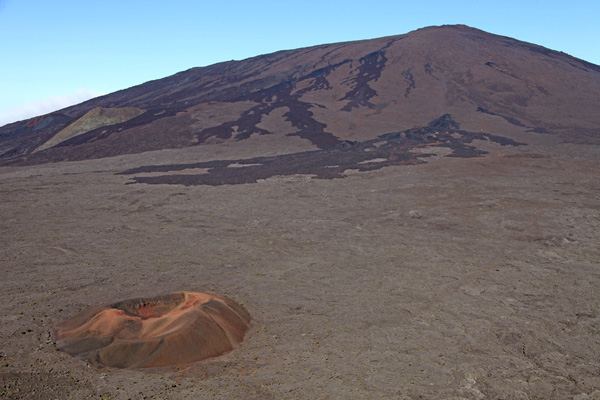
Photo: C. Grandpey
++++++++++
L’activité reste globalement stable sur les autres volcans mentionnés dans les bulletins précédents « Volcans du monde ». .
Ces informations ne sont pas exhaustives. Vous pourrez en obtenir d’autres en lisant le rapport hebdomadaire de la Smithsonian Institution :
https://volcano.si.edu/reports_weekly.cfm
°°°°°°°°°°
Flux RSS
Petit rappel : on me demande parfois comment il est possible de recevoir et lire mes articles au moment de leur parution. Pour cela, rendez-vous en haut de la colonne de droite de mon blog où figure le flux RSS qui permet de recevoir automatiquement des mises à jour du blog.
Vous pouvez également cliquer sur « Suivre Claude Grandpey : Volcans et Glaciers ».
——————————————-
 Here is some news of volcanic activity around the world :
A series of powerful eruptions took place at Ruang, the southernmost volcano in the Sangihe Island arc, in the North Sulawesi province (Indonesia). The eruption started in the early hours of April 17th, 2024. The Aviation Color Code was raised to Red, the Volcano Alert Level to 3 out of 4, and local authorities started evacuating more than 800 people living on the island as a preventive measure. There were fears the volcano could collapse into the sea and trigger a tsunami, as this happened in 1871. According to the Darwin VAAC, the ash plume rose up to 13.7 km above sea level.
The eruption intensified again during the night of April 17th-18th, prompting authorities to raise the alert level to the maximum on a scale of four levels. The Manado international airport located more than a hundred kilometers from the volcano was closed. Massive evacuations, in addition to those of April 17th, were ordered in the region. 11,000 residents were affected in the area near the volcano, which includes the island of Tagulandang, where around 20,000 people live.
Ruang, not to confuse with Raung on Java, is not the best known Indonesian volcano. It is the southernmost island volcano in the Sangihe Islands. It is located across a narrow strait SW of the larger Tagulandang Island. The summit contains a crater partially filled by a lava dome initially emplaced in 1904. The last eruptive episode at this volcano was in September 2002, with a VEI 4. Explosive eruptions have often been accompanied by lava dome formation and pyroclastic flows that have damaged inhabited areas.
Latest (April 19th, 2024) : Mount Ruang’s eruption, is still causing airspace disruptions until at least April 19th, 2024. . Consequently, Sam Ratulangi International Airport in Manado City, which is about 95 kilometers from Mount Ruang, stays closed for now.
The Tagulandang Port is currently operational for evacuation mobilization and distribution of aid to affected communities.
After the explosive eruption that started on April 16th, electricity and communication networks were disrupted in Laing Patehi Village on Ruang Island, while in Lumbo Village on Tagulandang Island, communication networks are not functioning optimally. According to BPBD data, there are 272 households or 838 people displaced on Tagulandang Island. Meanwhile, evacuation of residents is also carried out on Tagulandang Island, especially on the west side facing Ruang Island. The data collection is still ongoing by the local government, with temporary data totaling 6,045 people.
Mount Ruang is currently visible but partly covered in mist. The main crater is emitting white plumes with moderate to thick intensity, about 50-100 meters above the summit.
The alert level is kept at 4, the highest on a 4 colour scale.
Source : Jakarta Globe, PVMBG, Jakarta Post, Smithsonian Institution..
°°°°°°°°°
Still in the Sangihe Islands, about 150 km north of Ruang, an increase in both deep and shallow volcanic earthquakes at Awu were recorded on March 22nd and again during April 10th-15th, 2024, together with an inflation of the volcano. The Alert Level was raised to 3 (on a scale of 1-4) and the public is asked to stay at least 5 km away from the crater.
The last eruptive period at Awu lasted from June to August 2004 with a VEI 2. Historically, the volcano has been highly active, with devastating eruptions in 1711, 1812, 1856, 1892, and 1966 that produced significant pyroclastic flows and lahars, leading to over 8 000 deaths.
Source : PVMBG, Jakarta Post, Smithsonian Institution.
++++++++++
Shallow volcanic earthquakes at Kuchinoerabujima (Ryukyu Islands / Japan) have been recorded since the beginning of April. The number and magnitude of the earthquakes remains elevated. The Alert Level was raised to 3 (on a scale of 1-5) on April 13th , 2024. The public has been warned that ejected blocks and pyroclastic flows may impact areas close to the summit area.
Source : JMA.
++++++++++
In Iceland, it is a month since the eruption started on the Sundhnúkagígar crater row on the Reykjanes Peninsula. It has been the longest of all in this series of eruptions and the second-longest of the eruptions on the Reykjanes peninsula since 2021. The event started in the evening of March 16th, 2024 on a fissure that was nearly 3 km long.
At the beginning, lava flowed mostly to the south and southeast, along the defense walls toward the Suðurstrandarvegur road, and to the northwest toward Grindavíkurvegur road. About four hours after the eruption began, lava flowed across Grindavíkurvegur road. The eruption now is stable but the Met Office indicates it is very slowly decreasing. At the same time, there is an increase in the inflation underneath Svartsengi, which is entirely consistent with the fact that the flow of the eruption is decreasing. Part of the magma coming from depth accumulates underneath Svartsengi, but the crater cannot handle the entire flow.
Source : Met Office.
++++++++++
Eruptive activity continues at Poás (Costa Rica).Vents on the dry crater floor emit gas and steam plumes and the number of phreatic events began to increase on April 10th, 2024. The plumes rose 500 m. Residents in several communities reported a sulfur odor. A small explosion on April 14th produced a pulse of incandescence and an ash emission that rose less than 300 m.
Source : OVSICORI.
++++++++++
A new phreatic eruption occurred at Taal (Philippines) on April 12th, 2024, with a steam plume that rose 2.4 km above sea level. Four other phreatic eruptions produced steam plumes that rose 100-300 m. More minor eruptions followed these events which originated from a new vent on the SW side of Taal Main Crater. The Alert Level remains at 1 (on a scale of 0-5), and the public is remindes that the entire Taal Volcano Island is a Permanent Danger Zone.
Source : PHIVOLCS.
++++++++++
The eruption at Sabancaya (Peru) continues with an average of 44 daiky explosions. Gas-and-ash plumes rise as high as 3 km above the summit. The Alert Level remains at Orange (level 3 on a four-color scale) and the public is askedto stay outside a 12-km radius from the summit.
Source : Instituto Geofísico del Perú (IGP)
++++++++++
There is currently no erutive activity at Kilauea (Hawaii), which id not good news for volcanic tourism on the archipelago. Low-level seismicity continues beneath the summit of Kilauea and the Southwest Rift Zone. The number of daily earthquakes remains well below those detected during the January–February intrusion or prior to recent summit eruptions.
Rates of ground deformation remain low and stable.
SO2 emissions have remained at low levels since October 2023 with an average of 60 tonnes per day recorded on March 27th, 2024.
Source : HVO.
++++++++++
On Reunion Island, the Piton de la Fournaise Volcanological Observatory (OVPF) indicates that no eruptive activity was observed during the month of March 2024. For the record, the last eruption ended on August 10th 2023, after starting on July 2nd of that same year
OVPF specifies that the month of March 2024 was marked by an increase in seismicity beneath the summit from March 5th, going from 1 shallow volcano-tectonic earthquake per day at the start of the month to 4 – 5 events in the middle of the month, and then to 1 earthquake per day
at the end of the month. Most of these earthquakes were of low magnitude, but 17 of them could be located under the Dolomieu crater.
Summit inflation which stopped at the end of November 2023 resumed in February 2024. It is linked to a pressurization of the shallow magmatic reservoir located at a depth of 1.5-2 km beneath the Dolomieu crater.
In the conclusion of its report for the month of March, the Observatory explains that the pressurization process of the surface reservoir can last several days to several weeks before the roof of the reservoir weakens and ruptures, causing an injection of magma towards the surface and triggering an eruption. The phenomenon can also stop without causing an eruption in the short term.
++++++++++
Activity remains globally stable on other volcanoes mentioned in the previous bulletins « Volcanoes of the world ». .
This information is not exhaustive. You can find more by reading the Smithsonian Institution’s weekly report:
https://volcano.si.edu/reports_weekly.cfm
°°°°°°°°°°
RSS feed
Quick reminder: I am sometimes asked how it is possible to receive and read my posts when they are published. Just go to the top of the right column of my blog where you can see the RSS feed. It will allow you to automatically receive updates from the blog.
You can also click on “Suivre Claude Grandpey: Volcans et Glaciers”.