
 Des archéologues et des chercheurs qui travaillent sur le site de Pompéi (Italie) ont utilisé pour la première fois l’intelligence artificielle (IA) pour reconstituer numériquement le visage d’un homme tué lors de l’éruption du Vésuve en 79 après J.-C. Cette reconstitution offre une nouvelle perspective sur l’une des catastrophes naturelles les plus célèbres de l’histoire.
Le portrait réalisé à l’aide de l’IA représente un homme dont les restes ont été découverts alors qu’il tentait de fuir la ville et courait vers vers la côte pendant l’éruption. Les chercheurs pensent que l’homme est mort au début de la catastrophe, enfoui sous une épaisse couche de débris volcaniques.
La reconstitution a été réalisée dans le cadre du Parc archéologique de Pompéi qui précise sur son site web qu’elle a été effectuée en collaboration avec l’Université de Padoue et à partir des données de prospections archéologiques récoltées près de la nécropole de Porta Stabia, juste à l’extérieur des remparts de la ville antique.
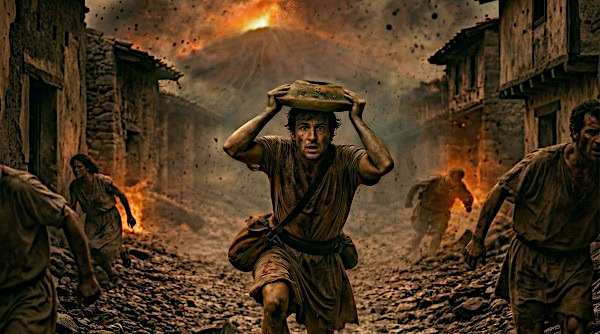
La page web du Parc archéologique présente l’illustration générée par l’IA. Avec le Vésuve à l’arrière-plan, on voit l’homme courir le long d’une route en mauvais état et jonchée de débris, tenant un grand récipient au-dessus de sa tête ; il s’en sert comme bouclier pour essayer de se protéger contre la pluie de matériaux volcaniques.
Pompéi fut ensevelie sous les cendres et la pierre ponce lors de l’éruption du Vésuve il y a près de 2 000 ans. L’accumulation de matériaux a protégé la ville et les restes de milliers de ses habitants et fournit aujourd’hui un témoignage remarquable de la vie romaine à cette époque.
Les archéologues ont découvert l’homme tenant un récipient en terre cuite dont il se servait probablement pour se protéger la tête des lapilli qui s’abattaient sur lui pendant l’éruption. D’anciens récits, notamment ceux de Pline le Jeune, confirment cette hypothèse et expliquent que les habitants de Pompéi utilisaient divers objets pour se protéger.
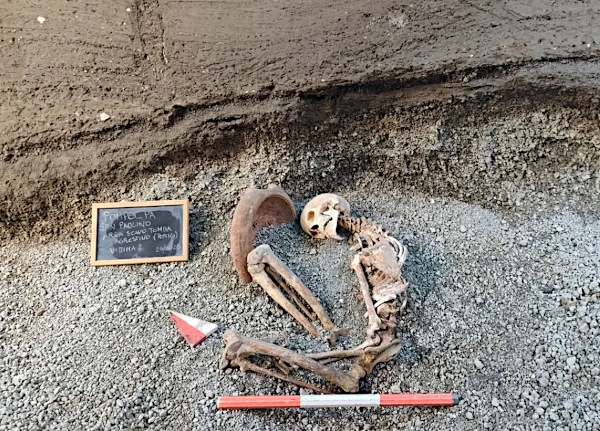
L’homme portait également une lampe à huile, un petit anneau de fer et dix pièces de bronze et des objets personnels. Ils nous éclairent sur ses derniers instants ainsi que sur la vie quotidienne à Pompéi avant la catastrophe. On peut lire sur le site web du Parc archéologique que « la reconstitution numérique a été créé grâce à l’intelligence artificielle et à des techniques de retouche photo conçues pour transformer les données squelettiques et archéologiques en une représentation humaine réaliste. » Selon son directeur, la quantité de données obtenues par les chercheurs est telle que seule l’intelligence artificielle est en mesure de les protéger et de les valoriser correctement. « Bien utilisée, l’IA peut contribuer au renouveau des études classiques. »
Source : Associated Press via Yahoo News, Parc archéologique de Pompéi.
————————————————
 Archaeologists and researchers at the ancient Roman site of Pompeii have used artificial intelligence (AI) for the first time to digitally reconstruct the face of a man killed in the AD 79 eruption of Mount Vesuvius that smothered the city, offering a new way to understand one of history’s most famous natural disasters.
The digital portrait represents a man whose remains were discovered as he attempted to flee the city toward the coast during the volcanic eruption. Researchers believe the man died early in the disaster, during a heavy fall of volcanic debris.
The reconstruction was developed by the Pompeii Archaeological Park, which announced on its website that it was done in collaboration with the University of Padua and based on archaeological survey data from excavations near the Porta Stabia necropolis, just outside the walls of the ancient city.
The announcement shows the AI-generated illustration of what the man could have looked like. He is shown running along a rough, debris-covered road, holding a large, shallow bowl over his head and using it as a shield while Mount Vesuvius is seen erupting in the background. (see image above)
Pompeii was buried under ash and pumice when the Vesuvius erupted nearly 2,000 years ago, preserving the city and the remains of thousands of its inhabitants in remarkable detail.
Archaeologists found the man holding a terracotta mortar, which they interpreted as an improvised attempt to shield his head from falling small volcanic stones that rained down during the eruption.
Ancient accounts, including those of Pliny the Younger, describe Pompeii’s residents using objects to protect themselves as ash and debris blanketed the city.
The man was also carrying an oil lamp, a small iron ring and 10 bronze coins, personal objects that offer insight into his final moments as well as into daily life in Pompeii before the catastrophe. (see photo above)
The digital portrait was created using AI and photo-editing techniques designed to translate skeletal and archaeological data into a realistic human likeness.According to the Pompeii park director, the vastness of archaeological data is now such that only with the help of artificial intelligence will we be able to adequately protect and enhance them. « If used well, AI can contribute to a renewal of classical studies. »
Source : Associated Press via Yahoo News, Pompeii Archaeological Park.

