L’éruption qui a commencé en Islande le 22 août 2024 continue le long de la fracture qui s’est ouverte sur la péninsule de Reykjanes. Contrairement à ce que racontent les médias, il ne s’agit pas d’une éruption comme celle de volcans comme l’Etna ou le Stromboli, avec la lave qui s’échappe d’un cratère sommital. En Islande, la lave est souvent émise par des fractures, une situation liée à la position de l’île sur la dorsale médio-atlantique.
Au début de l’éruption, la fracture présentait une longueur d’environ 4 kilomètres, mais aujourd’hui, l’activité se limite à 3 ou 4 bouches dans sa partie septentrionale. En avançant sur le terrain, la lave déclenche des incendies de végétation, essentiellement de mousse, ce qui fait naître d’épais nuages de fumée.
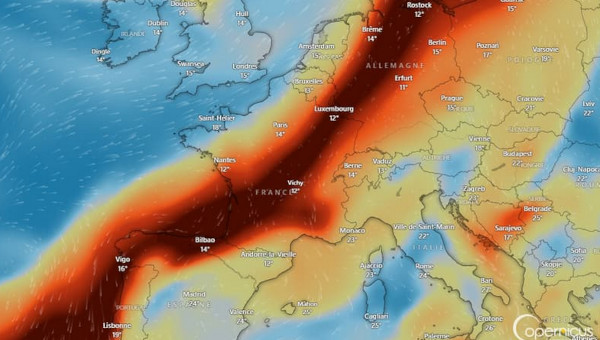
S’ajoutant aux gaz (essentiellement du dioxyde de soufre – SO2) qui s’échappent de l’éruption, ces nuages sont emportés par le vent et ils sont en train de traverser la France où certaines personnes ont cru percevoir une odeur de soufre. On remarquera par ailleurs que le ciel présente un aspect bleu laiteux.
C’est l’orientation du flux au nord-ouest qui a permis aux nuages de gaz générés par l’éruption islandaise d’atteindre les îles britanniques et le nord-ouest de la France. Le phénomène devrait durer jusqu’au jeudu i29 août et ne présente pas de risque réel pour la santé. En concentrations plus importantes, il pourrait occasionner de légères gênes au niveau des voies respiratoires et des irritations des yeux. Personnellement, j’adore l’odeur du soufre ; allez savoir pourquoi….
A noter que le trafic aérien n’est absolument pas perturbé par l’éruption.
Modélisation du nuage de gaz au-dessus de la France (Source : Copernicus)
L‘Observatoire des Volcans d’Hawaï (HVO) publie régulièrement des articles dans le cadre d’une série baptisée « Volcano Watch » dont le but est d’informer sur les observations et les mesures effectuées par les scientifiques en poste à l’Observatoire. C’est aussi un travail de vulgarisation qui informe le public sur les risques volcaniques.
L’un des derniers articles « Volcano Watch » est consacré à la mesure des gaz volcaniques, un paramètre essentiel, que ce soit pour la sécurité du public ou pour la compréhension de l’activité volcanique. Le HVO explique dès le début de l’article que la technologie repose avant tout sur le vent.
Panache de gaz émis par le cratère de l’Halema’uma’u (Photo : C. Grandpey)
Le HVO exploite actuellement 19 stations permanentes de mesure des gaz et 7 instruments portables pour analyser les éruptions du Kilauea. L’ensemble de ces instruments peut être divisé en deux catégories : (1) ceux qui analysent les concentrations de gaz ; et (2) ceux qui étudient les taux d’émission.
Les instruments qui analysent les concentrations de gaz comprennent des stations multi-gaz qui mesurent un ensemble de gaz (CO2, H2O, SO2 et H2S) et des stations haute résolution capables de mesurer un seul gaz (le SO2, par exemple) jusqu’à de très faibles concentrations. Ces instruments prélèvent des échantillons de panaches volcaniques pour indiquer quels gaz sont présents et les rapports de ces gaz les uns par rapport aux autres, ce qui est important pour comprendre le système volcanique.
Les instruments qui analysent les taux d’émission mesurent l’absorption de la lumière ultraviolette du soleil par le panache via la télédétection. Cela permet aux scientifiques du HVO de déterminer la quantité de SO2 émise par le volcan, mais uniquement pendant la journée.
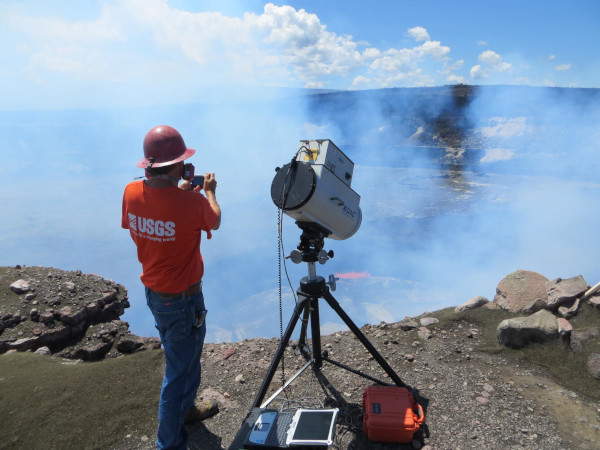
Un géochimiste du HVO mesure les gaz émis par le Kilauea à l’aide d’un spectromètre infrarouge à transformée de Fourier (FTIR), un instrument qui détecte la composition des gaz sur la base de la lumière infrarouge absorbée. (Crédit photo : HVO)
Tous ces instruments nécessitent une bonne coopération des gaz. Cela signifie que le panache doit passer à proximité ou au-dessus de l’instrument pour qu’une mesure soit effectuée.
Le panache volcanique ne bouge pas tout seul. Il dépend du vent pour le transporter dans une direction donnée. Le travail des scientifiques spécialisés dans la mesure des gaz volcaniques consiste à rechercher et à mesurer cette formation de gaz changeante et transitoire, ce qui n’est pas une tâche facile. En effet, les instruments ne fonctionnent pas dans certaines conditions météorologiques. Ils ont besoin que le vent souffle dans la bonne direction et à la bonne vitesse pour effectuer une mesure utile.
Sur le Kilauea, les alizés sont les vents dominants, ce qui signifie que les vents proches de la surface soufflent du nord-est la majeure partie de l’année. Pour cette raison, les stations permanentes de mesure des gaz du HVO sont positionnées au sud-ouest (sous le vent) de l’Halema’uma’u, le cratère sommital.
Si la direction du vent s’inverse par rapport aux alizés (une situation appelée « vents de Kona »), les scientifiques se trouvent en difficulté car le vent éloigne les gaz des capteurs permanents. De même, si le vent est trop lent (en dessous d’environ 4 mètres par seconde), le panache peut alors s’élever verticalement et se trouver hors de portée des capteurs. Dans le cas contraire, si le vent est trop fort, il dilue le panache, l’étale et rend difficile la mesure par les capteurs.
Une autre difficulté est que les volcans n’entrent pas en éruption toujours au même endroit. Lors de l’éruption la plus récente du Kilauea, des fissures se sont ouvertes dans la partie supérieure de la zone de rift sud-ouest, sous le vent de la quasi-totalité du réseau de mesure des gaz. Un seul instrument, une station à haute résolution – la HRPKE – était située à proximité des bouches éruptives, à quelques centaines de mètres à l’ouest-nord-ouest des fissures. Le problème, c’est que le vent soufflait du nord ce jour-là et emportait l’épais panache éruptif vers le sud, loin de la station HRPKE qui a dû se contenter d’un filet de gaz plusieurs heures après le début de l’éruption. Par la suite, le vent a tourné plus à l’est et dirigé le panache vers la station.
Created with GIMP
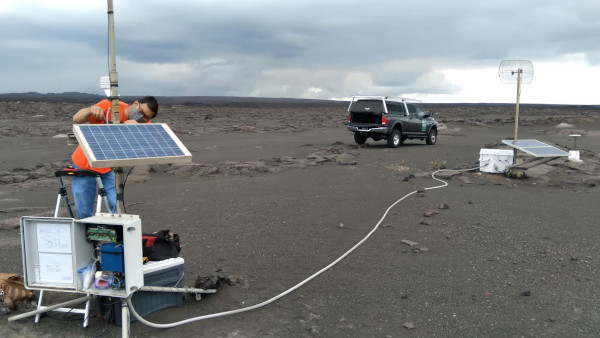
Station HRPKE installée au sud-ouest du sommet du Kīlauea, dans l’Upper Southwest Rift Zone. L’instrument mesure les concentrations de SO2 dans l’air, ainsi que des données météorologiques telles que la vitesse et la direction du vent, et les précipitations. (Crédit photo : USGS)
Pour parvenir à des mesures de gaz efficaces, il faut la combinaison de quatre éléments : la direction et la vitesse du vent, parfois la lumière du jour, et toujours beaucoup de chance. Les chercheurs en charge de la mesure des gaz volcaniques à l’USGS ne cessent de mettre au point de nouvelles technologies pour être plus efficaces et pouvoir informer le public sur ce risque volcanique.
Source : HVO / USGS.
—————————————————–
The Hawaiian Volcano Observatory (HVO) regularly publishes articles as part of a series called “Volcano Watch” whose aim is to inform about the observations and measurements performed by scientists stationed at the Observatory . It is also popularization work which informs the public about volcanic hazards.
One of the latest « Volcano Watch » articles is dedicated to the measurement of volcanic gases which is critical for both public safety and understanding volcanic activity. HVO explains from the beginning that the technology relies on the wind.
HVO currently operates 19 permanent gas monitoring stations and 7 portable instruments for eruption response on Kilauea. These can be divided into two categories : (1) gas concentrations; and (2) emission rates.
Gas concentration instruments include multi-GAS stations that measure a combination of gases (CO2, H2O, SO2, and H2S) and high-resolution stations that can measure a single gas (SO2) down to very low concentrations. These instruments draw in samples of volcanic plumes to indicate which gases are present and the ratios of these gases to each other, which is important for understanding the volcanic system.
Emission rate instruments measure the plume’s absorption of ultraviolet light from the sun via remote sensing. This allows HVO scientists to determine how much SO2 is coming out of the volcano, though only during daylight hours.
All these instruments require cooperation from the gases themselves: the plume must pass by or over the instrument for a measurement to be made.
The volcanic plume, however, doesn’t move on its own. It relies on the wind to carry it in any given direction. The job of volcano gas scientists is to chase around and measure this shifting, transient gas claoud, which is not an easy task. Indeed, gas instruments do not work in certain weather conditions. They need the wind to be in the right direction and the right speed to make a useful measurement.
At Kilauea volcano, the dominant trade winds mean that near-surface winds blow from the northeast most of the year. For this reason, HVO’s permanent gas monitoring stations are positioned to the southwest (downwind) of Halemaʻumaʻu, the summit crater.
If the wind direction is reversed relative to normal trade winds (a condition called “Kona winds”), scientists have no easy way of measuring it because the wind is blowing the gas away from the permanent sensors. Similarly, if the wind is too slow (below about 4 m/s), then the plume can loft straight up and once again miss the sensors. Alternatively, if the wind is too strong then it effectively dilutes the plume, spreading it thin and making it difficult for the sensors to measure.
Another complication is that volcanoes do not always erupt from the same location. In the most recent eruption at Kilauea, fissures opened in the Upper Southwest Rift Zone, downwind of nearly the entire gas monitoring network. Only one instrument, a high-resolution station called HRPKE, was located near the eruptive vents, a few hundred meters to the west-northwest of the fissures. However, the winds were northerly that day and were blowing the thick eruptive plume to the south, away from HRPKE which di not record a wisp of gas until several hours into the eruption when the wind turned more easterly, finally blowing the plume to the station.
Effective gas measurements require an alignment of four things: wind direction, wind speed, sometimes daylight, and always luck. Volcano gas researchers at the USGS continue to develop new technologies to be more efficient and be able to inform the public about this volcanic hazard.
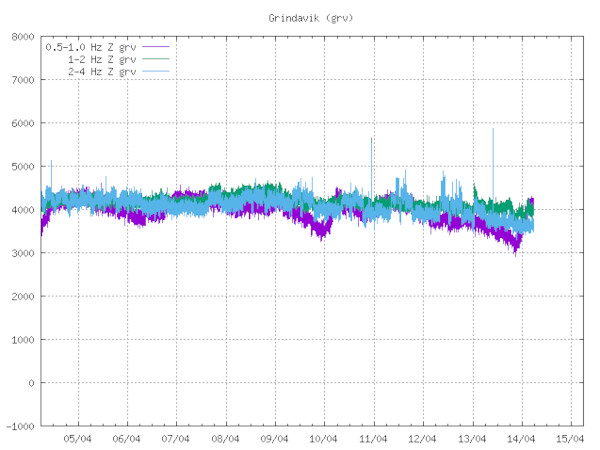
Dans une mise à jour publiée le 9 avril 2024, le Met Office indiquait que la déformation du sol dans le secteur de Svartsengi continuait d’augmenter, en même temps que l’on observait une diminution de l’intensité de l’éruption, confirmée par le tremor volcanique.
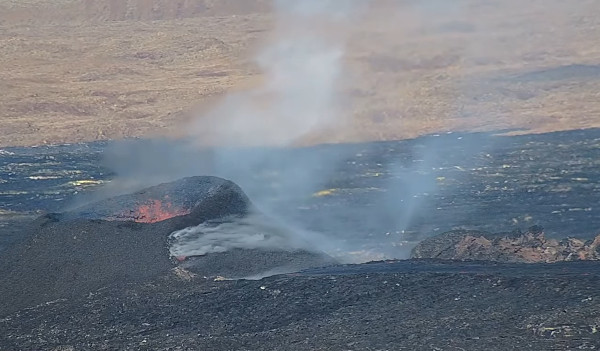
Image webcam de l’éruption le 13 avril 2024
Tremor éruptif le 14 avril 2024 (Source: Icelandic Met Office)
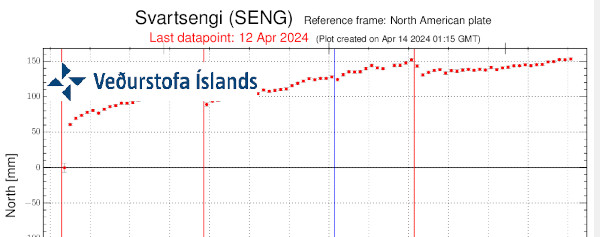
Le soulèvement du sol à Svartsengi semble assez stable et n’a augmenté que très légèrement ces derniers jours.
Source: Met Office
Selon le Met Office, cette situation montre que la plus grande partie du magma s’accumule dans le réservoir situé sous Svartsengi, avec une pression qui provoque le soulèvement du sol. L’éruption se poursuit avec une connexion ouverte entre la zone d’accumulation du magma sous Svartsengi et la chaîne de cratères de Sundhnúkur. Une partie du magma continue de s’écouler vers la surface tandis que le reste s’accumule sous Svartsengi.
L’activité sismique dans le dyke près de Grindavíkreste très faible et se concentre entre Sýlingarfell et Stóra-Skógafell, avec une légère sismicité à l’ouest de Grindavík. L’activité sismique près du Fagradalsfjall, qui persiste depuis un mois, se poursuit et reste localisée à des profondeurs d’environ 6 à 7 km.
A noter qu’un essaim sismique avec un événement de M 3,3 a été enregistré le 13 avril dans la région de Krisuvik, avec son épicentre au niveau du lac Kleifarvatn, à une profondeur de 6 km. Le séisme a été bien ressenti jusque dans la région de Reykjavik et a été suivi de plusieurs répliques.
Des niveaux élevés de SO2 continuent d’être mesurés périodiquement autour du site éruptif et dans les zones habitées de la péninsule de Reykjanes. Les émissions de gaz provenant de l’éruption continueront probablement de générer une pollution sur la péninsule de Reykjanes. Il est conseillé à la population de surveiller la qualité de l’air et de s’informer sur les symptômes liés à la pollution atmosphérique provoquée par l’éruption.
————————————————
In an update released on April 9th, 2024, the Met Office indicated that ground deformation in the Svartsengi area continued to increase, coinciding with a decrease in the intensity of the volcanic eruption, also shown by the volcanic tremor.
Inflation at Svartsengi looks quite stable and has been increasing only very slightly in the past days.
According to the Met Office, this indicates that the majority of the magma flowing into the reservoir beneath Svartsengi is accumulating there, causing an increase in pressure and ground uplift. While the eruption continues, there remains an open connection between the magma accumulation area in Svartsengi and the Sundhnúkur crater row.A portion of the magma continues to flow to the surface whereas the rest accumulates beneath Svartsengi.
Seismic activity in the dike near Grindavík has remained very low and is focused between Sýlingarfell and Stóra-Skógafell, with slight seismicity in western Grindavík. Seismic activity near Fagradalsfjall, which has been persistent for the past month, is ongoing and remains localized at depths of about 6-7 km.
It should be noted that a seismic swarm with an event reaching M 3.3 was recorded on April 13th in the Krisuvik area, with the epicenter at Kleifarvatn lake, at a depth of 6 km. The earthquake was felt well in the capital area andwas followed by several aftershocks.
Periodically high levels of SO2 continue to be measured around the volcano and in settlements on the Reykjanes Peninsula. Gas emissions from the eruption will likely cause pollution on the Reykjanes Peninsula, and residents are advised to monitor air quality and familiarize themselves with symptoms related to air pollution from the eruption.
« La baisse de pollution aggrave le réchauffement climatique ». C’est le titre d’un article publié le 13 avril 2024 sur le site web de France Info. Faut-il en conclure qu’il faut continuer à polluer pour que le réchauffement climatique ne progresse pas ?
Le titre de l’article est très maladroit et risque de faire le lit des climato-sceptiques. En effet, la pollution évoquée est seulement celle générée par les particules. On nous explique que « la disparition de la couverture d’aérosols qui réfléchit la lumière solaire vers le ciel, aggrave le réchauffement. Cela pourrait représenter jusqu’à 40% de l’augmentation de l’énergie qui réchauffe la planète entre 2001 et 2019. » L’auteur de l’article ajoute : « Lorsqu’elles sont en suspension dans l’air, les particules de pollution réfléchissent la lumière dans l’espace, et provoquent donc un refroidissement. Si on en a moins, il y a réchauffement. »
L’article ne mentionne à aucun moment le gaz carbonique ou le méthane qui sont les principaux vecteurs du réchauffement de l’atmosphère terrestre. Actuellement, les concentrations de CO2 atteignent 424,58 ppm, après avoir atteint 425 ppm au début du mois d’avril. On a affaire à ne hausse permanente. Au même moment en 2023, les concentrations étaient de 422 ppm. On se rend vite compte de la vitesse à laquelle elles augmentent. Même si la quantité de particules fines diminue, nous ne sommes pas près de voir la courbe des température diminuer sur Terre.
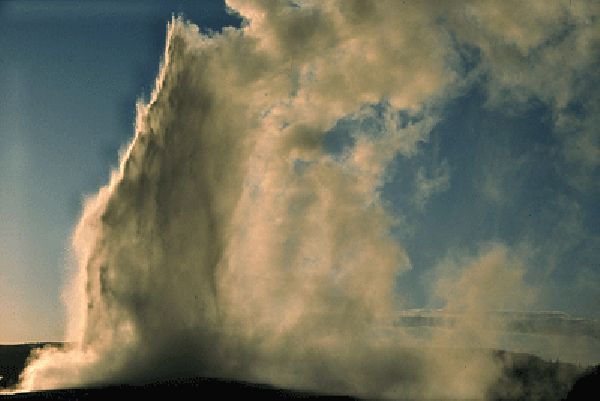
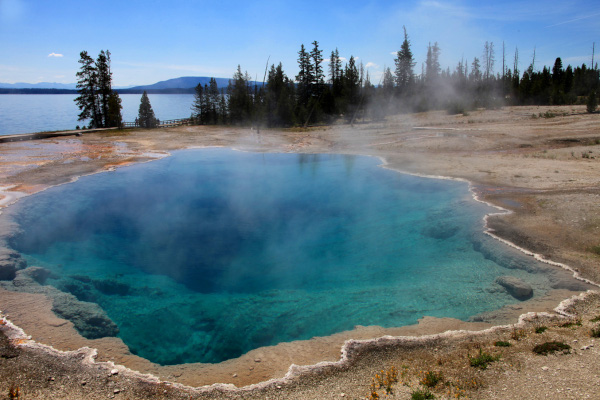
A noter que la photo illustrant l’article est censée représenter le bassin du Vieux Fidèle dans le Parc National de Yellowstone. C’est faux ; de toute évidence, l’auteur de l’article n’y a jamais mis les pieds !
 L
L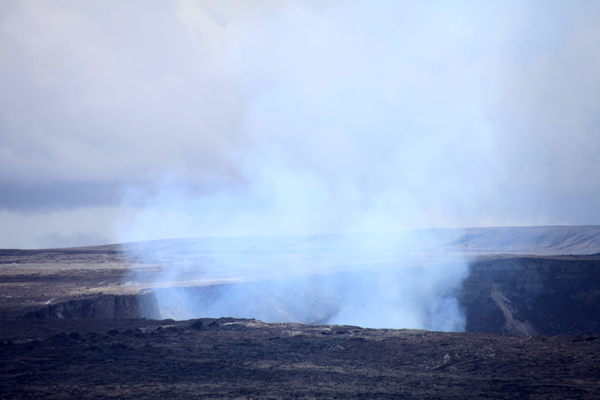
 The Hawaiian Volcano Observatory (HVO) regularly publishes articles as part of a series called “Volcano Watch” whose aim is to inform about the observations and measurements performed by scientists stationed at the Observatory . It is also popularization work which informs the public about volcanic hazards.