Islande : le Met Office patauge dans la prévision éruptive ! // Iceland: the Met Office is floundering in eruptive prediction!

Le Met Office islandais indique que bien que la vitesse de l’inflation à Svartsengi ait quelque peu diminué ces derniers jours, elle reste plus élevée qu’avant la formation du dyke qui a traversé Grindavík le 10 novembre 2023. Les volcanologues locaux pensent que la formation de nouveaux dykes ou une éruption restent possibles. Si un autre dyke devait se former, ils pensent qu’il suivrait probablement le même chemin que celui du 10 novembre. En cas d’éruption, le site le plus probable serait au nord de Grindavík, vers Hagafell et la zone autour de Sundhnúkagígar.
L’activité sismique est actuellement faible et se concentre principalement dans la zone autour de Hagafell.
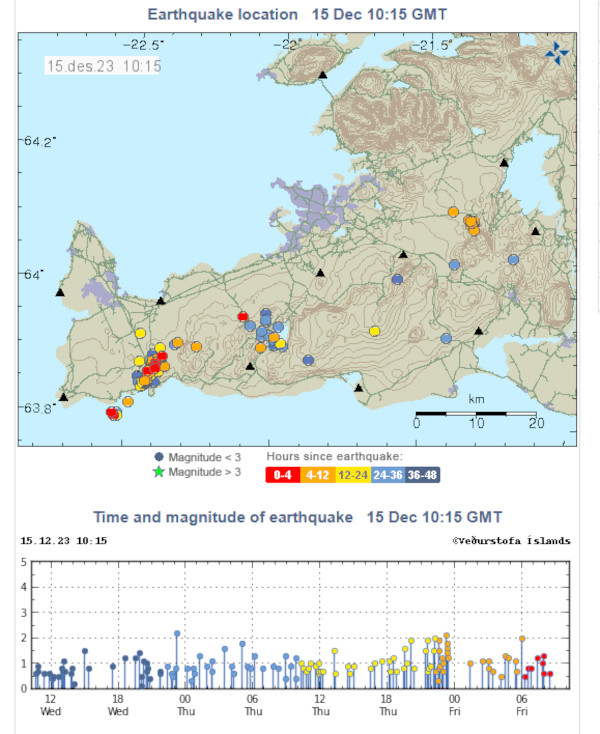
Situation sismique sur la péninsule de Reykjanes le 15 décembre 2023 (Source : IMO)

Selon le Met Office, « l’activité en cours à Svartsengi, qui a débuté en octobre, n’est pas encore terminée et un nouveau chapitre pourrait s’être ouvert avec la forte probabilité d’une nouvelle intrusion magmatique et, par la suite, un risque d’éruption élevé. […] Le dyke sous Grindavík était alimenté par le magma qui s’est accumulé sous Svartsengi. Il est probable que cette séquence d’événements se reproduise. »
Cependant, le Met Office ajoute qu’il n’est pas possible de savoir quand aura lieu la prochaine intrusion magmatique. L’incertitude est considérable et une intrusion magmatique pourrait avoir lieu dans les prochains jours, voire après plusieurs mois. En d’autres termes, NOUS NE SAVONS PAS !! Dire que la prochaine intrusion pourrait survenir dans plusieurs mois n’est pas une prévision sérieuse !!
Source  : IMO, les Watchers .

—————————————————-

The Icelandic Met Office indicates that although the rate of inflation at Svartsengi has decreased somewhat in the past days, it is still greater than it was prior to the formation of the dike that traveled under Grindavík on November 10th, 2023. Local volcanologists think that further dikes or an eruption remain possible. Should another dike form, they think it is likely it will follow the same path as the November 10 dike. Should there be an eruption, the most likely location would be north of Grindavík in the direction of Hagafell and the area around Sundhnúkagígar.

Seismic activity is currently low and mostly in the area around Hagafell.

According to the Met Office, “the ongoing activity at Svartsengi, which began in October, is not yet over and a new chapter may have begun with an increased chance of a new magma propagation and, subsequently, increased likelihood of an eruption. […] The dike beneath Grindavík was fed by magma accumulating beneath Svartsengi. It is likely that this sequence of events will repeat.”

However, the Met Office adds that it is not possible to estimate when the next magma propagation will occur. The uncertainty is considerable, and a magma propagation could happen in the next few days or possibly after several months. In other words, WE DON’T KNOW !! Saying that the next intrusion could occur in several months is not serious prediction !!

Source : IMO, the Watchers .

Péninsule de Reykjanes : éruption ou pas éruption? Personne ne le sait ! // Reykjanes Peninsula : eruption or no eruption? Nobody knows !

Aucun événement significatif n’a été signalé au cours de la journée et de la nuit écoulées. L’essaim sismique a débuté le 25 octobre 2023 sur la péninsule de Reykjanes. Cela signifie que cela fait 16 jours qu’on attend une éventuelle éruption, … et aucun événement de ce type ne s’est produit ! Le 9 novembre, un volcanologue islandais a déclaré qu’il y avait 60 % de chances qu’une éruption se produise prochainement. Il a ajouté : « Nous ne pouvons pas dire exactement ce qui se passe. » La prévision éruptive a du plomb dans l’aile ! Quand le risque éruptif se situe dans une zone désertique comme lors des précédentes éruptions, il est facile de faire des prévisions à tout va. Quand des infrastructures ou des habitations sont menacées, la prévision devient tout de suite plus compliquée!
L’activité sismique a culminé avec un événement de M4.8 aux premières heures du 9 novembre à l’ouest du Mt Þorbjörn. Il s’agit du plus puissant séisme depuis le début de l’essaim. Sept événements de M4,0 ou supérieurs ont été enregistrés dans la zone allant d’Eldvörp à l’est de Sýlingarfell. Selon le Met Office, le fait qu’il y ait des séismes plus forts qu’auparavant dans la région ne signifie pas nécessairement une accélération de la vitesse d’accumulation du magma. Cependant, comme cette accumulation se poursuit, il faut s’attendre à de nouveaux événements sismiques sur la péninsule de Reykjanes car l’intrusion magmatique génère une intensification des contraintes dans la région.
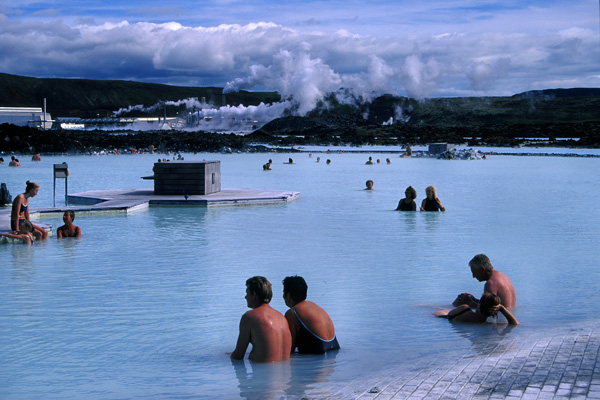
Par mesure de précaution, le Blue Lagoon est fermé pendant une semaine jusqu’au 16 novembre. Les employés recevront l’intégralité de leur salaire pendant les heures de fermeture et les clients seront remboursés intégralement.
Sources  : IMO, Iceland Monitor, Iceland Review.

Dernière minute : le Met Office islandais indique aujourd’hui (10 novembre 2023) que l’activité sismique sur la péninsule de Reykjanes a migré vers la ligne de cratères Sundhnúkar au cours de la dernière journée. Presque tous les séismes dans la région se sont produits sur cette ligne de cratères qui se trouve à l’est de Sýlingarfell et de l’autre côté de la crête par rapport à la centrale de Svartsengi.

L’activité sismique, à nouveau soutenue, a traversé la route qui conduit à Grindavik et s’éloigne donc de la centrale de Svartsengi. L’intrusion magmatique joue avec les nerfs des Islandais! (Source: Met Office)

Il semble que la sismicité soit en train de s’éloigner de la centrale électrique de Svartsengi (voir ci-dessus), mais la Protection civile a proposé le 9 novembre d’édifier un mur de protection autour du site. Selon le Ministre des Infrastructures, une autorisation de mise en œuvre venant du gouvernement sera disponible dans les prochaines heures.  » Nous sommes toujours dans un état d’incertitude (Uncertainty). Nous sommes souvent dans une telle situation en Islande et rien de grave ne se produit, donc nous allons maintenant attendre et espérer que rien de grave n’arrivera, mais nous devons aussi nous préparer au pire. »
En ce qui concerne la population, le Ministre a ajouté :  » Tout le monde fait de son mieux et on tentera de donner l’alerte le plus rapidement possible, si quelque chose arrive. Mais il est tout aussi probable que rien ne se passe, personne ne le sait. »
Source : Iceland Monitor.

—————————————————-

No significant event occurred during the past day and night. The seismic swarm started on October 25th, 2023 on the Reykjanes Peninsula. This means that an eruption has been expected for 16 days….and no such event has happened. On November 9th, an Icelandic volcanologist said there is a 60% chance of an eruption soon. He added : « We can’t say exactly what the situation is. » Eruptive prediction is in trouble! When the eruptive risk is located in a desert area as during previous eruptions, it is easy to make random predictions. When infrastructure or homes are threatened, predictions immediately become more difficult!
Seismic activity culminated with an M4.8 event in the early hours of November 9th west of Þorbjörn. It is the largest earthquake since the swarm began. Seven earthquakes M4.0 or larger in size were measured in the area from Eldvörp to the area east of Sýlingarfell. According to the Met Office, the fact that there are now larger earthquakes than before in the area does not necessarily mean an increased rate of magma accumulation. However, while the accumulation of magma continues, seismic activity can be expected on the Reykjanes Peninsula because the magma intrusion causes increased tension in the area.

As a precaution, the Blue Lagoon has been closed for one week until November 16th. Employees will be paid full wages during the closing hours and guests will receive a full refund.

Sources : IMO, Iceland Monitor, Iceland Review.

Last minute : The Icelandic Met Office indicates today (November 10th, 2023)that seismic activity on the Reykjanes peninsula has shifted to the Sundhnúkar crater line in the past day. Almost all of the earthquakes in the area have occurred in that crater line, which lies to the east of Sýlingarfell and the other side of the ridge from the power plant in Svartsengi.

It looks as if seismicity migrated away from the Svartsengi power station in the past hours, but a proposal was made for a defence wall around Svartsengi by the Civil Protection on November 9th. According to the Minister of Infrastructure, an idea of implementation from the government will be available in the next few hours.“We’re still in a state of uncertainty. We’re often in a state of uncertainty in Iceland and nothing serious happens, so we’ll now see and hope for the best, but we also need to be ready for the worst.”

As far as the population is concerned, the Minister added : « “Everyone is trying to do their best and will try to give out warning as soon  as possible, if something happens. But it’s also just as likely that nothing happens, no one knows.”

Source : Iceland Monitor.

Photo: C. Grandpey

L’Islande toujours dans l’attente d’une éruption // Iceland still waiting for an eruption

Lors d’une séance d’information organisée par la Protection civile le 6 novembre 2023, Kristín Jónsdóttir, du Met Office islandais, a indiqué que l’intrusion magmatique au niveau du mont Þorbjörn a environ un mètre d’épaisseur et met en jeu quelque six millions de mètres cubes de magma. La scientifique a ajouté que l’intrusion magmatique actuelle est différente de celle de l’éruption de Fagradalsfjall car elle se produit horizontalement et pas verticalement. De tels intrusions magmatiques peuvent s’allonger, s’épaissir progressivement et s’étirer sur les côtés. Au final, elles peuvent occuper beaucoup d’espace sans pour autant provoquer une éruption*.
En conséquence, personne ne sait si, où et quand une éruption aura lieu, même si la probabilité augmente chaque jour.
Il semble que les sites les plus exposés à une éruption se trouvent à l’ouest et au nord du mont Þorbjörn et à Sýlingarfell. Cependant, rien n’indique pour le moment.que le magma se rapproche de la surface.
Les responsables de la centrale électrique de Svartsengi indiquent que la société Orka a élaboré des plans d’intervention dont le but est d’assurer la sécurité des salariés et des sous-traitants. S’il y avait une évacuation en raison d’une éruption volcanique, le personnel quitterait les lieux, mais le fonctionnement de la centrale serait contrôlé à distance depuis la centrale électrique de Reykjanes. La société Orka a également étudié les moyens d’envoyer de l’eau dans les coulées de lave afin qu’elles puissent éventuellement ralentir leur progression avant d’atteindre la centrale électrique. Il est également possible de recouvrir les puits de forage avec du gravier et du sable, ce qui permettra de reprendre les opérations après une éruption.
En cas de panne de courant à Grindavík, des groupes électrogènes prendraient le relais si aucune alimentation n’était fournie par d’autres sources. Si nécessaire, il y a suffisamment de groupes électrogènes capables de couvrir la consommation d’électricité à Grindavík, tant pour les foyers que pour les entreprises et institutions publiques.
S’agissant de la sécurité des personnes, des plans d’évacuation ont été élaborés et mis à jour régulièrement. Voir ma note sur le plan d’évacuation de Grindavik.

A noter que les excursions au Lagon Bleu depuis Reykjavik sont suspendues pour 3 jours, par mesure de sécurité. La situation sera alors réévaluée.

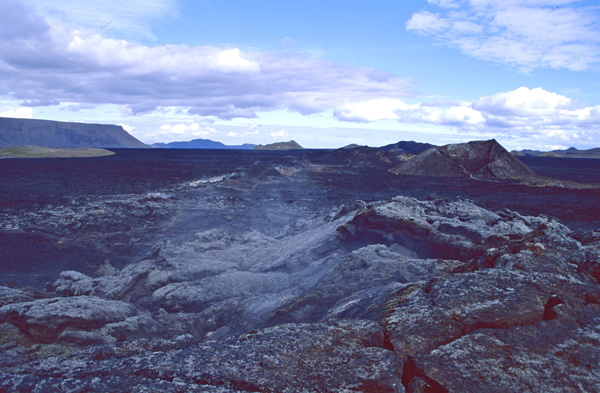
* [Ce ne serait pas la première fois qu’une éruption avorte en Islande. Je campais à Reykjalid (nord de l’Islande) en juillet 1990 alors qu’une éruption du Krafla semblait imminente. Le soulèvement du sol sous la centrale géothermique était important et la sismicité était élevée. Je pouvais ressentir les secousses à l’intérieur de mon corps sous ma tente. Un séisme a été particulièrement fort une nuit. Je me suis levé et j’ai escaladé la colline derrière le camping pour m’assurer qu’il n’y avait pas eu d’éruption. En fait, il ne s’est rien passé. Quelques jours plus tard, j’ai rencontré le regretté Maurice Krafft qui m’a dit que l’éruption avait avorté.]

——————————————

During an information briefing held by the Department of Civil Protection on November 6th, 2023, Kristín Jónsdóttir, from the Icelandic Met Office indicated that the magma accumulation at Mt. Þorbjörn is estimated to be about one metre thick and about six million cubic metres. She added, that the magma intrusions are different from those at Fagradalsfjall because they lie horizontally in ledges but not vertically. Such ledges can grow long, thicken gradually and spread to the sides. In the end, they can grow very large without an eruption*.

As a consequence, nobody knows whether, where and when an eruption will occur, although the probability increases with each day.

It looks as if the most likely places for an eruption to occur are west and north of Mt. Þorbjörn and to Sýlingarfell. However, there is no evidence of magma near the surface at hhe moment.

The managers of the Svartsengi power station indicate that the Orka company has worked on its response plans whose aim is to ensure the safety of employees and contractors. If there were an evacuation due to a volcanic eruption, shift workers would evacuate Svartsengi, but the operation would be remotely controlled from the Reykjanes power plant. The company has also looked into ways to inject water into lava flows so that they could possibly slow down before reaching the power plant. It is possible to cover drilling holes with gravel and sand filling to be able to restart operations after an eruption.

Should power outages occur in Grindavík, seserve engines would take over if no power was received from other sources. As necessary, there are enough machines that can cover the general electricity use in Grindavík, both for homes and public companies and institutions.

As far as people’s safety is concerned, plans for evacuation have been drawn up and updated regularly. See my post about the evacuation plan for Grindavik.

It should be noted that trips to the Blue Lagoon from Reykjavik have been suspended for 3 days as a safety measure. The situation will then be reevaluated.

* [It would not be the first time an eruption has aborted in Iceland. I was camping in Reykjalid (northern Iceland in 1990 when an eruption was predicted at Krafla. The ground uplift beneath the geothermal power station had been significant and seismicity was elevated. I could feel the tremors within my body while lyinging on the ground in my tent. One quake was particularly strong one night. I got up and climbed the hill behind the camping to make sure no eruption had not occurred. Actually nothing happened. A few days later, I met the late Maurice Krafft who told me that the eruption had aborted.]

Champ volcanique du Krafla (Photo: C. Grandpey)

Islande : vers la fin de l’éruption ? // Iceland : toward the end of the eruption ?

Selon les dernières observations, l’éruption de Litli-Hrútur sur la péninsule de Reykjanes marque le pas. Elle produit environ 30 à 50 % de lave de moins qu’à la mi-juillet. Si cette tendance se poursuit, la fin de l’éruption pourrait intervenir d’ici une à deux semaines.
Le débit de lave était récemment de cinq à six mètres cubes par seconde. Si ce débit devait encore baisser, la fin de l’éruption pourrait être proche. Cependant, les volcanologues islandais admettent qu’une telle prévision doit être considérée avec prudence car « nous ne savons pas ce que l’avenir nous réserve ». Une augmentation du débit ne peut pas être exclue si, par exemple, un puissant séisme avait un effet sur l’éruption.
L’éruption de Litli-Hrútur de 2023 a commencé avec plus de vigueur que les éruptions précédentes dans la Geldingadalir en 2021 et dans la Meradalir en 2022 avec un débit de lave d’environ 40 mètres cubes par seconde. Cependant, le volume a rapidement chuté, avec 16 mètres cubes le deuxième jour et 10 mètres cubes le troisième jour. Depuis lors, il a régulièrement diminué pour arriver à cinq à six mètres cubes par seconde aujourd’hui.
En supposant que l’éruption actuelle dure quatre à cinq semaines, elle dépasserait de deux semaines l’éruption de 2022, mais serait considérablement plus courte que l’éruption dans la Geldingadalir en 2021.
Source : Iceland Review.

—————————————————-

According to the latest observations, the Litli-Hrútur eruption on the Reykjanes Peninsula is declining. It is producing about 30-50% less lava than by mid-July. If this trend continues, the end of the eruption could be only one to two weeks away.

The lava flow has most recently been measured at five to six cubic metres per second, and if the rate should fall further, the end of the eruption may be in sight. However, Icelandic volcanologists admit that such predictions are to be taken with some reservation since “ we don’t know what the future holds.” An increase in the flow cannot be ruled out if for instance, a large earthquake should have an effect on the eruption.

The 2023 Litli-Hrútur eruption began with more power than the previous 2021 Geldingadalir and 2022 Meradalir eruptions with a lava flow at about 40 cubic metres per second. However, the volume quickly dropped off, measuring 16 cubic metres by the second day, and 10 cubic metres by the third day. Since then, it has steadily declined to the rate of five to six that we see today.

Supposing the current eruption lasts four to five weeks in total, it would be two weeks longer than the eruption last year but considerably shorter than the eruption in Geldingadalir 2021.

Source : Iceland Review.

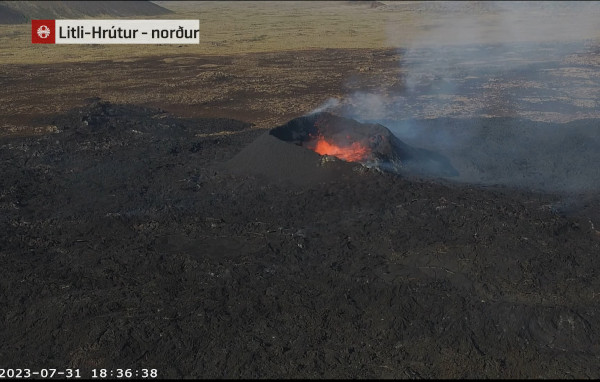
La webcam confirme la baisse d’intensité de l’éruption