Nouvelles du Poas (Costa Rica) // News of Poas Volcano (Costa Rica)

Voici quelques nouvelles du Poas dont l’accès reste interdit au public.
En décembre 2017, une pétition lancée par la population locale pour rouvrir le Parc National du Poás a été rejetée et le parc est resté fermé jusqu’à nouvel ordre.
En janvier 2018, l’absence d’indicateurs sismiques permettant de prévoir une éventuelle éruption empêcherait une évacuation rapide du Parc. Sa fermeture est donc confirmée. Le parc national du Turrialba avait été fermé pour des raisons similaires six ans auparavant et il n’a pas été rouvert depuis.
Le 3 mars 2018, le Sistema Nacional de Áreas de Conservación a annoncé les conditions d’une éventuelle réouverture du Parc National du Poas. Les estimations des dates possibles de réouverture vont du 24 mars 2018 au 1er janvier 2019.
– Mise en place d’un système de réservation obligatoire qui limite le nombre de visiteurs à 100 pour une durée de 20 minutes sur la lèvre du volcan et 45 minutes à l’intérieur du Parc
– Construction d’abris pour protéger les touristes en cas d’éruption soudaine..
– Installation de capteurs de gaz dans toutes les zones accessibles.
– Réparation des bâtiments existants et des infrastructures endommagées lors de l’éruption d’avril 2017
– Embauche et formation d’un nouveau personnel.

Source : Parc National du Poas.

Un article publié dans le Costa Rica Star le 8 mars 2018 indique que le lac qui s’est formé dans le cratère du Poas s’est à nouveau asséché. Au début de l’année 2018, les scientifiques ont annoncé la réapparition du lac à la suite des pluies dans la région et l’obstruction des conduits internes du volcan. Cependant, quelques semaines plus tard et en l’espace de 12 jours, le lac s’est asséché.
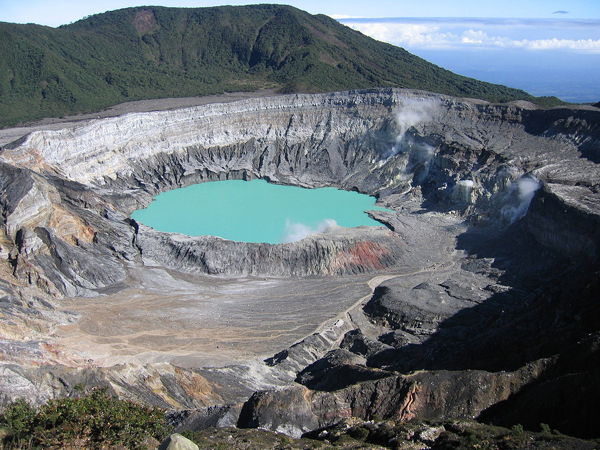
Les volcanologues ont commencé à remarquer les changements de niveau d’eau du lac à partir de la mi-février et, au 5 mars, ils ont confirmé qu’il ne restait que de petites flaques d’eau. Auparavant, le lac avait une couleur laiteuse bleu clair. Il n’était pas très profond mais atteignait jusqu’à 15 mètres de profondeur en certains points, avec des températures comprises entre 54 ° C et 97 ° C, selon les endroits.
Les scientifiques estiment que la baisse de niveau du lac s’est produite en raison de la diminution des précipitations dans la région avec le début de la saison sèche, une augmentation de la chaleur au fond du cratère et une faible alimentation en eau du système hydrothermal du volcan.

——————————————————-

Here is some news about Poas Volcano that is still closed to the public.

In December 2017, a petition launched by the local community to reopen Poás was rejected and the Park remained closed until further notice.

In January 2018, the lack of seismological indicators of a possible eruption meant the Park could not be evacuated in time and it remained closed.  Turrialba volcano national park had been closed for similar reasons six years before and had not reopened.

On March 3rd 2018, the Sistema Nacional de Áreas de Conservación announced the requirements and conditions for the possible re-opening of Poas National Park. Estimates of possible re-opening dates range from March 24th, 2018 to January 1st, 2019.

– Creation and implementation of an obligatory advanced reservation system that limits visitors numbers to 100 at a time restricted to 20 minutes at the volcano rim and 45 minutes total inside the park

– Design and construction of “volcano shelters” to protect tourists in case of an unexpected eruption.

– Installation of gas sensors in all accessible areas.

– Repair the existing buildings and infrastructure that were damaged in the April 2017 eruption

– Hire and train new staff.

Source: Poas National Park.

An article published in the Costa Rica Star on March 8th, 2018 indicated that the lake which formed at Poas Volcano has dried out again. At the beginning of 2018, scientists announced the reappearance of the lake as a result of the rainfall in the area and the closing of the internal ducts of the volcano. However, just a few weeks later and in a matter of 12 days the lake dried out.

The volcanologists started noticing the changes in the water level of the lake starting mid-February, and by March 5th they confirmed only small puddles of water were left. The lake, which had a light blue milky colour was superficial but was as much as 15 metres deep in some areas, and reached temperatures between 54°C and 97°C, depending on the areas.

Scientists consider that this phenomenon occurred due to the decreased rain in the area with the start of the dry season, an increase of the heat in the bottom of the crater and a low supply of water of the hydro-thermal system of the volcano.
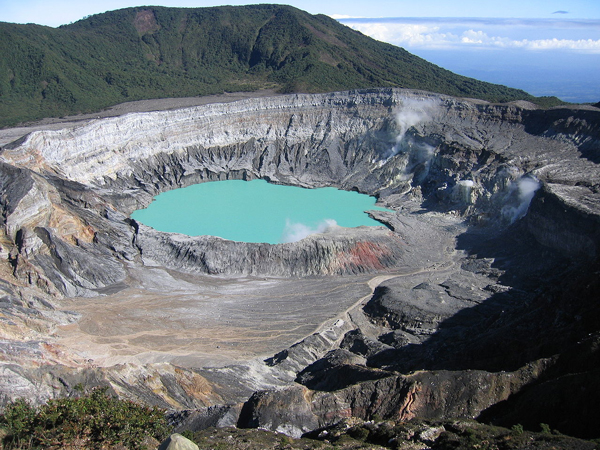
Lac de cratère du Poas en 2005 (Crédit photo: Wikipédia)

Belle vidéo du Poás (Costa Rica)

En cliquant sur le lien ci-dessous, vous aurez accès à un article publié dans le Costa Rica Star. Il est illustré par une vidéo du Poás, tournée au moyen d’un drone dans le cadre d’une mission commune réalisée par le GasLab de l’Université du Costa Rica et l’Institut de Recherche en Volcanologie et Sismologie de l’Université Nationale (OVSICORI) dans le but de mesurer les gaz émis par le volcan. La vidéo a été réalisée le 29 août et montre le dégazage avec une colonne de vapeur d’eau et de gaz magmatiques. Le panache atteint une hauteur de 300 mètres au-dessus du fond du cratère et est poussé par le vent vers l’ouest et le sud-ouest du volcan.
http://news.co.cr/video-drone-gives-us-close-look-poas-volcano-crater-costa-rica/65393/
Comme je l’ai indiqué dans des notes précédentes, le Poás a connu ces derniers temps des éruptions mineures accompagnées de panaches de cendre. Le 2 septembre, une éruption a généré un panache qui a atteint 500 mètres au-dessus du cratère. Ce panache contenait des gaz, de la vapeur, de la cendre, mais aussi des fragments de roche et une coloration rougeâtre due à des roches pulvérisées riches en fer et autres oxydes métalliques. Pendant la soirée de ce même jour, des matières incandescentes ont été observées dans le cratère actif.
Le Parc National du Poás reste fermé au public pour des raisons de sécurité; Cette situation entraîne de sérieuses pertes financières pour les entreprises touristiques locales.
Source: The Costa Rica Star.

————————————–

By clicking on the link below, you will access to an article released in the Costa Rica Star. It is illustrated by a video that was shot by means of a drone as part of a joint task carried out between GasLab of the University of Costa Rica and the National University’s Volcanology and Seismology Research Institute (OVSICORI) with the purpose of measuring the gas expelled by the Poás Volcano. The footage is from August 29th and it shows the non-stop degasification with a column of water vapour and magmatic gases. The plume reaches a height of 300 metres from the bottom of the crater and is drifting mainly to the west and southwest of the volcano.

http://news.co.cr/video-drone-gives-us-close-look-poas-volcano-crater-costa-rica/65393/

As I put it in previous posts, Poás has had sporadic and small ash eruptions. On September 2nd, the volcano went through an important eruption that reached 500 metres above the crater. The activity included gas, vapour, ash, rock fragments and a reddish coloration due to pulverized rocks rich in iron and other metallic oxides. During the evening hours of this same day, incandescent material could be seen in the active crater.

The Poás Volcano National Park remains closed to the public for security reasons; this situation has caused big financial loses to local tourism businesses.

Source: The Costa Rica Star.

Crédit photo: Wikipedia


Volcans actifs : Informations diverses // Active volcanoes : Miscellaneous news

Piton de la Fournaise (Ile de la Réunion) : Poursuite de l’éruption. Tremor stable.

Sheveluch (Kamchatka) : Forte activité explosive le 24 juillet. Niveau d’alerte élevé au Rouge, avant d’être ramené à l’Orange.

Bezymianny (Kamchatka) : Présence d’une coulée de lave sur le flanc ouest. Niveau d’alerte Orange.

Karymsky (Kamchatka) : Explosions sporadiques. Niveau d’alerte Orange.

Klyuchevskoy (Kamchatka) : Anomalie thermique et panaches de cendre. Niveau d’alerte Orange.

Bogoslof (Alaska) : Pas d’activité significative au cours de la semaine écoulée.

Cleveland (Alaska) : Présence d’un nouveau dôme de lave au fond du cratère.

Kilauea (Hawaii) : Situation stable. Voir ma dernière note sur les points chauds.

Nishinoshima (Japon) : Poursuite de l’éruption. Activité strombolienne dans le cône éruptif. Une coulée de lave avance sur le flanc ouest et atteint la mer.

Poas (Costa Rica) : Emissions gazeuses jusqu’à 300 – 500 mètres au-dessus des bouches.

Sabancaya (Pérou) : Recrudescence d’activité. Panaches de cendre jusqu’à 3 – 5 km de hauteur.

Source: Global Volcanism Network.

————————————

Piton de la Fournaise (Reunion Island): The eruption continues. The tremor is stable.
Sheveluch (Kamchatka): High explosive activity on July 24th. Alert level raised Red, before being brought back to Orange.
Bezymianny (Kamchatka): Lava flow on the western flank. Alert level is Orange.
Karymsky (Kamchatka): Sporadic explosions. Alert level at Orange.
Klyuchevskoy (Kamchatka): Thermal anomaly and ash plumes. Alert level et Orange.
Bogoslof (Alaska): No significant activity during the past week.
Cleveland (Alaska): Presence of a new lava dome on the crater floor.
Kilauea (Hawaii): Stable situation. See my last note on hotspots.
Nishinoshima (Japan): The eruption continues. Strombolian activity on the eruptive cone. A lava flow advances on the western flank and reaches the sea.
Poas (Costa Rica): Gaseous emissions up to 300 – 500 meters above the vents.
Sabancaya (Peru): Increased activity. Ash plumes up to 3 – 5 km.

Source: Global Volcanism Network.

Quelques nouvelles du Turrialba et du Poas (Costa Rica) // Some news of Turrialba and Poas (Costa Rica)

Selon les journaux costaricains, deux éruptions d’une durée de quatre heures ont secoué le Turrialba les 14 et 15 juillet dans la matinée, avec des retombées de cendre fine et une odeur de soufre perçue dans plusieurs villages de la Vallée Centrale.
La plus grande partie de la cendre est retombée sur les flancs du volcan, mais aussi sur des villages comme San Gerardo de Robert entre l’Irazú et le Turrialba.
Les sismographes ont révélé un tremor de faible intensité et des séismes basse fréquence. La colonne éruptive est montée jusqu’à 400 mètres au-dessus du cratère avant de s’étirer vers le sud-ouest et le nord-ouest.
L’OVSICORI rappelle aux personnes qui se rendront à la basilique des Anges à Carthage, à partir du week-end prochain, de surveiller l’activité des volcans actifs, car les gaz et les particules fines pourraient atteindre certains des itinéraires conduisant à l’ancienne métropole. Cependant, si l’activité se poursuit comme précédemment, avec le vent soufflant vers l’ouest et le nord-ouest, il ne devrait y avoir aucun problème. Si les conditions changent, les pèlerins devront utiliser des mouchoirs mouillés ou des masques pour se protéger.
Le Poas est également actuellement très actif et les émissions de gaz pourraient affecter les personnes qui traversent les localités de Naranjo, Zarcero, Valverde Vega et d’autres secteurs situés à proximité du Poas. Il est conseillé aux gens d’utiliser des mouchoirs, en particulier s’ils souffrent de problèmes respiratoires.

—————————————-

According to the Costa Rican newspapers, two eruptions that lasted four hours rocked Turrialba volcano on July 14th and 15th in the morning, generating ashfall and smell of sulphur in several villages in the Central Valley.

Most of the ash fell near the volcano and in villages such as San Gerardo de Robert between Irazú and Turrialba.

The instruments produced signals of low intensity tremor and low frequency earthquakes. The eruptive column reached up to 400 metres above the crater before drifting southwest and northwest.

OVSICORI reminds people who will walk to the basilica of the Angels in Carthage, from next weekend, to be attentive to the activity of the active volcanoes as the gases and fine particles could reach some of the routes towards the old metropolis. However, if the activity continues as before, with the wind blowing to the west and northwest, there should be no problem. If conditions change, pilgrims should use wet handkerchiefs or masks to protect themselves.

Poas is also currently quite active and gas emissions could affect walkers who pass through Naranjo, Zarcero, Valverde Vega and other cantons close to Poas. People are advised to use handkerchiefs, especially if they are with respiratory problems.