
Islande : le Snæfellsjökull en lice pour l’élection présidentielle // Iceland : Snæfellsjökull in the running for presidential election

La campagne présidentielle islandaise – l’élection doit avoir lieu le 1er juin 2024 – a un nouveau candidat : le glacier Snæfellsjökull. Ses supporters affirment qu’il remplit les conditions requises pour se présenter : c’est un citoyen islandais âgé de plus de 35 ans, sans casier judiciaire et avec une pétition pour le soutenir.

Lancée officiellement le 15 mars, la campagne met l’accent sur l’écologie afin de « progresser vers une prise de conscience environnementale et une unité globale. » Dans un récent communiqué de presse, on peut lire : « Nous pensons qu’il est temps de remettre en question le statu quo dans le paysage politique conventionnel, et d’élire un candidat qui symbolise l’endurance, la résilience et l’interconnectivité globale. Le Snæfellsjökull est déjà un emblème de l’Islande et un gardien de la sagesse géoculturelle ; il représente l’essence même de la stabilité et de la durabilité. Avec une présence imposante et une attitude sereine, le Snæfellsjökull incarne un équilibre entre fermeté et adaptabilité, des qualités indispensables dans notre monde en évolution rapide. »
La campagne souligne également l’importance de la gestion de l’environnement. En présentant un être non humain à la présidence de l’Islande, la campagne espère sensibiliser davantage à la durabilité et à l’éco-justice.

Le Snæfellsjökull – glacier sur une montagne enneigée – est un stratovolcan coiffé d’un glacier vieux de 700 000 ans, dans l’ouest de l’Islande, à l’extrémité de la péninsule de Snæfellsnes.

Le Snaefellsjökull vu depuis le ciel (Photo: C. Grandpey)…

…et depuis le sol (Icelandic Met Office)

La montagne est l’un des sites les plus célèbres d’Islande, principalement grâce au roman Voyage au centre de la Terre (1864) de Jules Verne, dans lequel les protagonistes trouvent sur le Snæfellsjökull l’entrée d’un passage menant au centre de la Terre. Le volcan figure également en bonne place dans le roman Kristnihald undir Jökli (1968) du prix Nobel islandais Halldór Laxness. publié en français sous le titre Úa ou Chrétiens du glacier.

« Nous descendions une sorte de vis tournante. » Gravure d’Edouard Riou pour l’édition du Voyage au Centre de la Terre de 1867 (Source: Wikipedia)

D’un point de vue géologique, le Snæfells possède de nombreux cônes pyroclastiques sur ses flancs. Les cratères sur les flancs inférieurs ont produit des coulées de lave basaltique tandis que ceux sur les flancs supérieurs ont produit les laves plus riches en silice. Les coulées de lave de l’Holocène descendent jusqu’à la mer sur toute la moitié ouest du volcan. Les roches volcaniques les plus anciennes datent d’environ 800 000 ans. Durant l’Holocène, il y a eu entre 20 et 25 éruptions.
Trois éruptions pliniennes majeures (avec un VEI 4) se sont produites il y a 8 000 à 9 000 ans, il y a 4 000 ans et il y a 1 800 ans. Cette dernière est considérée comme le plus importante de l’Holocène ; l’événement a émis jusqu’à 1 km3 de matériaux et donné naissance à un champ de lave d’environ 30 km2.
Source  : médias d’information islandais, Global Volcanism Program.

A noter que le Snaefellsjökull est, lui aussi, victime du réchauffement climatique. Dans une note publiée le 23 mai 2019, j’expliquais qu’en août 2012, pour la première fois de son histoire, le sommet du Snæfellsjökull avait perdu sa calotte de glace.

Le Snæfellsjökull (Islande) : un glacier en péril // A glacier at risk

——————————————-

Iceland’s presidential race – due to be held on June 1st, 2024 – has a new candidate : Snæfellsjökull glacier. Its defenders assert that it meets the requirements of being an Icelandic citizen, aged over 35, with no criminal record, and with a supporting petition.

Launched officially on March 15th, the campaign emphasises ecology in order to “move towards environmental consciousness and global unity.” In a recent press release, one coulsd read : “Amidst the conventional political landscape, we believe it’s time to challenge the status quo and elect a candidate that symbolizes endurance, resilience, and global interconnectedness. Snæfellsjökull is already an emblem of Iceland and a custodian of geo-cultural wisdom, representing the very essence of stability and sustainability. With a towering presence and serene demeanor, Snæfellsjökull embodies a balance of steadfastness and adaptability, qualities much needed in today’s rapidly changing world.”

The campaign also stresses the importance of environmental stewardship. By nominating a non-human being to the presidency of Iceland, the campaign hopes to bring greater awareness to sustainability and eco-justice.

Snæfellsjökull – glacier on a snow mountain – is a 700,000-year-old glacier-capped stratovolcano in western Iceland, at the end of the Snæfellsnes peninsula.

The mountain is one of the most famous sites of Iceland, primarily due to the novel Journey to the Center of the Earth (1864) by Jules Verne, in which the protagonists find the entrance to a passage leading to the center of the Earth on Snæfellsjökull. The volcano also figures prominently in the novel Under the Glacier (1968) by Icelandic Nobel laureate Halldór Laxness.

From a geological point of view, Snæfells has many pyroclastic cones on its flanks. Lower-flank craters produced basaltic lava flows and upper-flank craters intermediate-to-silicic material. Holocene lava flows extend to the sea over the entire western half of the volcano. The oldest volcanic rocks date back around 800,000 years. During the Holocene, there were between 20 and 25 eruptions.

Three major Plinian eruptions (with a VEI 4) occurred 8,000 to 9,000 years ago, 4,000 years ago and 1,800 years ago. The latter was identified as the largest of the Holocene ; the event released up to 1 km3 of volcanic material and generated a lava field that covered approximately 30 km2.

Source : Icelandic news media, Global Volcanism Program.

Snaefellsjökull is also a victim of global warming. In a post published on May 23rd, 2019, I explained that in August 2012, for the first time in its history, the summit of Snæfellsjökull had lost its ice cap. (see link above).

Islande : quelques nouvelles de l’éruption // Iceland : some news of the eruption

Le Met Office indique qu’il n’y a aucun signe indiquant que l’éruption sur la péninsule de Reykjanes touche à sa fin. Ce qui est intéressant, c’est qu’il n’y a pas de déformation ou d’inflation dans le secteur de Svartsengi, comme ce fut le cas lors des trois éruptions précédentes. Le flux de magma en provenance de la chambre profonde, probablement à 15 kilomètres de profondeur, est stable et aucun magma ne s’accumule dans la chambre superficielle. Le magma semble s’écouler directement par la fracture éruptive. Il sera intéressant d’avoir les résultats de l’analyse de la chimie de la lave pour avoir confirmation de cette situation.
Les scientifiques du Met Office affirment qu’il faut être prudent en matière de prévisions. L’éruption peut durer encore un certain temps, mais elle peut également s’arrêter avec peu ou pas de préavis.
Il s’agit de la quatrième éruption sur la chaîne de cratères de Sundhnúkagígar en moins de quatre mois. Les trois premières n’ont duré que quelques jours tandis que l’événement actuel dure beaucoup plus longtemps. Personne ne sait pourquoi cette éruption se comporte différemment. Il y a des désaccords entre les scientifiques. L’un d’eux a déclaré fort justement : « Des circonstances complexes dans la croûte régissent le déroulement de cette éruption. Nous ne disposons probablement d’aucune mesure permettant de dire exactement ce qui se passe. » Une fois de plus, on se rend compte que c’est la Nature qui commande et que l’être humain doit faire preuve d’humilité.
Source : Iceland Monitor.

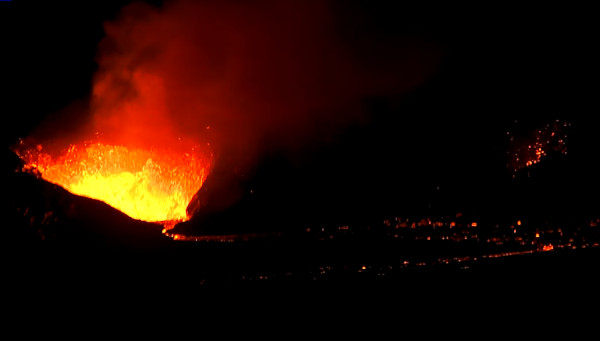
Image webcam de l’éruptionle 3 avril 2024 au soir. En ce moment, le site éruptif est dans le brouillard

———————————————————

The Met Office indicates that there are no signs that the eruption on the Reykjanes Peninsulais coming to an end. What is interesting is that there is no deformation or inflation in the Svartsengi area, as this was the case with the previous three eruptions. The flow of magma from the deep chamber, probably 15 kilometers deep, is stable and there is no magma accumulating in the shallow chamber, rather it flows directly out through the fissure. It will be interesting to have the results of the lava analysis to have a confirmation of this situation.

Scientists at the Met Office say one should be careful about making predictions. The eruption may last some time more, but it could also stop with little or no notice.

This is the fourth eruption in the Sundhnúkagígar crater row in less than four months. The first three lasted only a few days while the current one is lasting much longer. Nobody knows why this eruption is behaving differently. There are disagreements in the points of view. One scientist aptly said : « There are some complicated circumstances in the crust that govern how this eruption has panned out. We may not have any measurements that can tell us exactly what is going on. » Once again, we realize that Nature is in charge and that human beings should demonstrate humility.

Source : Iceland Monitor.

Islande : l’heure des pronostics ! // Iceland : time for predictions !

Les scientifiques islandais du Met Office et de l’Université d’Islande adorent faire des pronostics et des prévisions éruptives. Lorsque l’activité a commencé sur le Fagradalsfjall en 2021, ils ont affirmé que l’éruption était le début d’un nouveau cycle éruptif qui pourrait durer des mois, des années, voire plus. En fait, l’événement a duré six mois (19 mars – 18 septembre 2021). Une nouvelle éruption a débuté le 3 août 2022, et une autre, plus courte, a commencé le 10 juillet 2023 et s’est arrêtée le 5 août de cette même année.
Cette fois, en 2024, le Met Office est persuadé que l’éruption actuelle à Sundhnúkagígar marque probablement la fin d’une série dans la zone proche de Grindavík, même si elle est entrée dans sa troisième semaine et se poursuit au moment où j’écris ces lignes.
L’éruption a commencé le 16 mars 2024. L’activité reste confinée dans deux cratères, avec une émission de lave constante et aucun signe montrant que l’éruption est sur le point de se terminer. La majeure partie de l’activité se déroule dans le plus grand des deux cratères. Une certaine pollution par les gaz est parfois observée à Grindavík et Hafnir.
Selon un professeur de volcanologie de l’Université d’Islande, certains signes laissent supposer qu’il s’agit de la dernière éruption d’un cycle qui a débuté en décembre 2023. La chambre magmatique la moins profonde, située sous Svartsengi, n’est plus alimentée. Cela signifie que le magma en provenance de la chambre magmatique profonde monte directement vers vers la surface. L’éruption pourrait prendre fin dans les prochains jours.
Source  : Iceland Review.

Image webcam de l’éruption le 1er avril 2024

—————————————————–

Icelandic scientists at the Met office and the University of Icelad love making predictions. When activity started at Fagradalsfjall in 2021, they said the eruption was the start of a new eruptive cycle which might last for months, years or even more. Actually the event lasted six months (19 March – 18 September, 2021). A new eruption started aon August 3rd, 2022, and another short one began on July 10th, 2023 and stopped on Augsu 5th. .

This time, in 2024, the Met Office is persuaded that the current eruption in Sundhnúkagígar could mark the end of a string of eruptions in the area near Grindavík, although it is in its third week and still continuing.

The eruption began on March 16th 2024.Activity remains in two craters in the area, with steady lava flow and no immediate signs of the eruption ending. Most of the activity is ongoing in the larger of the two craters. Some gas pollution is sometimes detected in Grindavík and Hafnir.

According to a professor of volcanology at the University of Iceland, there are signs that this might be the final eruption in the cycle of volcanic activity which began in December 2023. The shallower magma chamber in the area, situated under Svartsengi, is no longer receiving magma from the eruption. Therefore, magma from the deeper magma chamber in the area is flowing to the surface and the eruption might come to an end in the next few days.

Source : Iceland Review.

KMT, un projet ambitieux en Islande // KMT, an ambitious project in Iceland

Dans deux notes publiés le 28 septembre 2021 et le 22 janvier 2024, j’expliquais qu’un nouveau projet – Krafla Magma Testbed (KMT) – est en cours de développement en Islande.

https://claudegrandpeyvolcansetglaciers.com/2021/09/28/voyage-au-centre-de-la-terre-journey-to-the-centre-of-the-earth-3/

https://claudegrandpeyvolcansetglaciers.com/2024/01/22/islande-la-geothermie-au-coeur-dun-volcan-iceland-geothermy-at-the-heart-of-a-volcano/

Un article publié le 23 mars 2024 sur le site Iceland Monitor nous informe que deux des principaux objectifs du projet sont « d’améliorer considérablement les prévisions des éruptions volcaniques dans le monde et de concevoir de nouvelles méthodes plus économiques pour la production d’énergie géothermique. »
La société KMT vise à construire dans les années à venir un centre de recherche international de recherche en matière de volcanisme et d’énergie dans la région du Krafla à Þingeyjarsveit. L’idée du projet est née du forage IDDP-1 qui, en 2009, a atteint de manière tout à fait inattendue une poche de magma dans la région du Krafla, à une profondeur de 2,1 km.
L’équipement utilisé en 2009 n’était pas capable de résister à la chaleur, à la pression et à la corrosion à proximité du magma, mais des informations importantes ont été recueillies au niveau du forage avant sa fermeture. Les scientifiques ont pu déterminer l’emplacement exact d’une chambre magmatique, une première mondiale, et le forage s’est avéré dix fois plus puissant que les forages traditionnels déjà réalisés dans la région du Krafla.
Quinze ans après le forage de 2009, l’objectif est de récidiver avec une nouvelle technologie mise au point par la société KMT.
Voici une vidéo de KMT (en anglais) expliquant le projet et ses ambitions :
https://youtu.be/Bf-yA_L8mZA

Photos: C. Grandpey

————————————————-

In two posts released on September 28th, 2021 and January 22nd, 2024, I explained that a new project – Krafla Magma Testbed (KMT) – is being developed in Iceland.

https://claudegrandpeyvolcansetglaciers.com/2021/09/28/voyage-au-centre-de-la-terre-journey-to-the-centre-of-the-earth-3/

https://claudegrandpeyvolcansetglaciers.com/2024/01/22/islande-la-geothermie-au-coeur-dun-volcan-iceland-geothermy-at-the-heart-of-a-volcano/

An article published on March 23rd, 2024 on the website Iceland Monitor informs us that two of the main goals of the project are « to greatly improve global volcanic eruption predictions and design new and more cost-effective methods for the energy production of geothermal energy. »

KMT aims to build an international research center for volcanic and energy research in the Krafla area in Þingeyjarsveit in the coming years. The idea for the project stems from the Icelandic deep-water drilling project IDDP-1, where they unexpectedly drilled into magma at Krafla at a depth of 2.1 km in 2009.

The equipment used in IDDP-1 in 2009 was not able to withstand the heat, pressure, and corrosion closer to the magma but important information was gathered from the borehole before it was closed. Scientists were now able to determine the exact location of a base magma chamber, which is considered unique worldwide, and the borehole was found to be ten times more powerful than traditional production boreholes in Krafla.

Now fifteen years after the unexpected drilling of magma in Krafla, the aim is to do so again with a new instrumentation that KMT is developing.

Here is a video from KMT explaining the project and its ambitions:

https://youtu.be/Bf-yA_L8mZA