Avec les hordes de touristes qui envahissent l’Islande, en particulier en été, les autorités sont confrontées à de plus en plus de problèmes. Ils concernent généralement la sécurité ou le non respect de la nature fragile de ce pays. Le camping sauvage arrive en première position. .
Ainsi, selon la loi islandaise, il est interdit de camper dans le Parc National de Vatnajökull, en dehors terrains de camping officiels. Cependant, chaque été, beaucoup de gens font fi de cette interdiction. Ce comportement vit probablement ses dernières heures.
Les rangers du Parc vont sillonner le Vatnajökull cet été et verbaliser ceux qui font du camping sauvage. Ils leur demanderont de quitter les lieux et de payer la somme qu’ils auraient déboursée pour passer la nuit dans l’un des campings officiels.
Parmi ceux qui pratiquent le camping en pleine nature, très peu restent sous des tentes. La plupart logent dans des camping-cars stationnés dans les parkings ou sur les bas-côtés. Le problème, c’est qu’il n’y a pas de toilettes dans ces endroits. Les gens n’ont aucun scrupule à utiliser le côté de la route ou le parking à cet effet et à laisser leurs excréments derrière eux quand ils repartent le lendemain.
La plupart des gens disent que les tarifs des campings sont trop élevés et il leur semble normal de pouvoir camper gratuitement ailleurs. Certaines personnes affirment que les limites du Parc National ne sont pas indiquées, bien qu’il y ait beaucoup de panneaux.
Les gens doivent garder à l’esprit qu’il y va de leur responsabilité de savoir où ils peuvent camper et où ils ne peuvent pas.
Source: Iceland Review. .
————————————
 With hordes of tourists invading Iceland, especially in the summer, authorities are confronted more and more problems. They usually have to do with safety or the lack of respect of the country’s fragile Nature. Wilderness camping comes first in that respect.
According to the Icelandic law it is illegal to camp in Vatnajökull National Park, outside of camping areas. However, many people do this every summer. This behaviour is about to come to an end.
Park rangers will travel around Vatnajökull this summer and charge those who camp in no-camping areas. They will be asked to move away and forced to pay as much as they would pay for staying the night in one of the camping areas.
Among those who practice wilderness camping, very few are staying in tents. Most of them are in campers, staying in parking lots or in lay-bys. The problem is that there are no toilet facilities in these places. People use the side of the road or parking lot instead, leaving their excrement behind when they leave the next day.
Most people think the fee for the camping areas is too high, so they expect to camp for free. Others affirm it is not clear enough where the National Park ends, although there are plenty of signs. People should bear in mind that it is their responsibility to find out where they can camp, and where they can’t.
Source: Iceland Review.
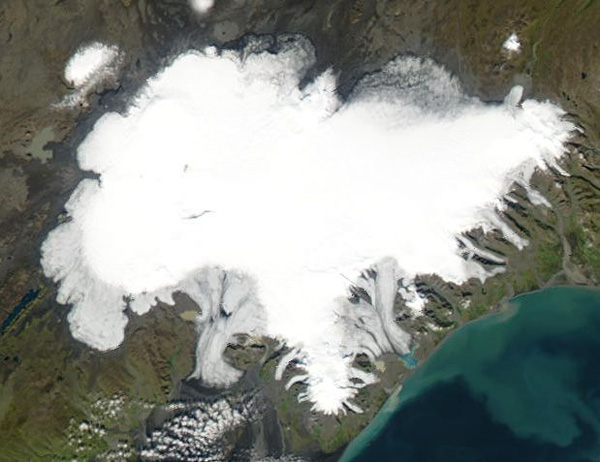
Le Vatnajökull vu depuis l’espace (Crédit photo: NASA)

 Un article paru dans le journal CostaRican Times indique que le lac de cratère du Poás a disparu suite à l’activité observée depuis le mois d’avril 2017. Il reste juste un peu d’eau dans la partie septentrionale mais le reste s’est évaporé sous l’effet de la chaleur du magma sous le cratère. Un autre changement bien visible est la présence de fumerolles dans la partie centrale du cratère. On observe toujours une activité éruptive, avec des panaches de cendre, de gaz et de vapeur d’eau pouvant atteindre 1000 mètres de hauteur.
 An article in the CostaRican Times indicates that the lake at Poás Volcano has disappeared, due to the intense activity that has been observed in the crater since April 2017. There is just a little water in the northern sector and the rest is gone because of the heat produced by the magma beneath the crater. Another change is that fumaroles have appeared in the central part of the crater. Eruptive activity is still present, with the emission of ash, gas and water vapour. The ash column may reach 1,000 metres high.