 Plusieurs événements ont été signalés depuis ma dernière note sur l’activité volcanique dans le monde.
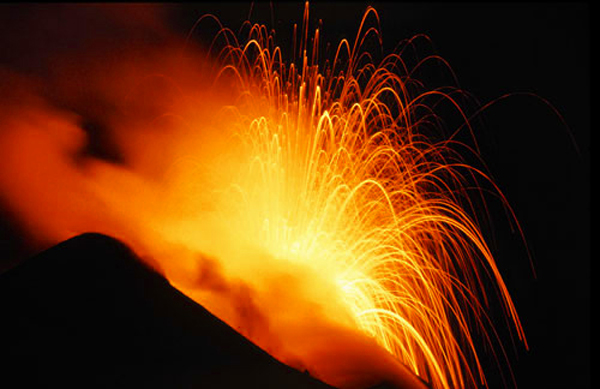
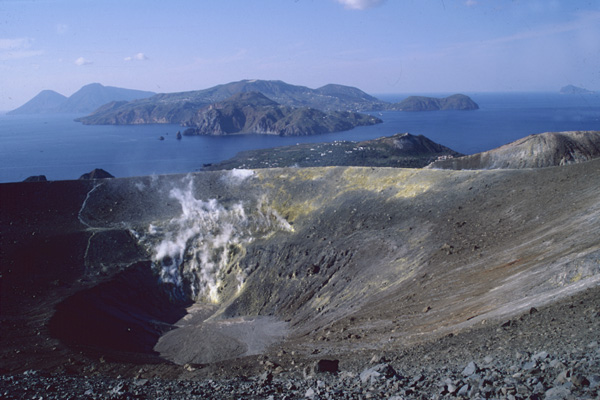
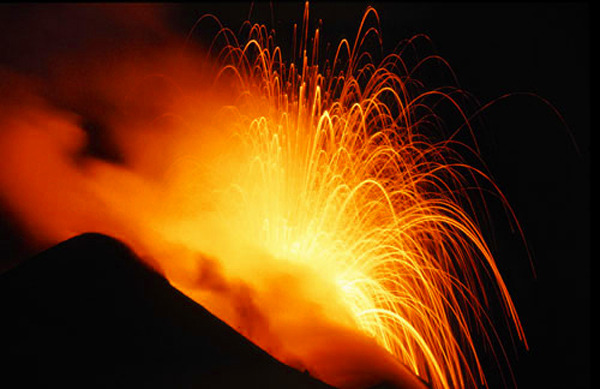
L’effondrement d’une partie de la terrasse cratèrique Nord du Stromboli (Sicile) et les événements (coulée pyroclastique, coulée de lave) qui l’ont accompagné ont maintenant pris fin .
La coulée de lave s’est arrêtée sur la Sciara del Fuoco et ll n’y a plus d’effondrements. On observe toujours une activité de spattering sur le cratère Nord 2 mais elle est est nettement moins intense que ces derniers jours.
Suite à cette baisse d’activité, les restrictions d’accès au volcan ont été levées, mais l’accès au sommet reste interdit. Au mieux, vous pourrez monter jusqu’à 400 m d’altitude avec l’accompagnement des guides.
Source: INGV, La Sicilia.

Photo: C. Grandpey
++++++++++
Une éruption explosive a commencé sur le Chikurachki (île Paramushir / Kouriles du Nord) vers 15h10 (UTC) le 15 octobre 2022. Le panache éruptif est monté jusqu’à 4,5 km d’altitude avant de dériver vers l’ESE sur 345 km. La couleur de l’alerte aérienne est passée du Vert à l’Orange car la cendre émise pendant l’éruption pourrait affecter le trafic aérien.
Des émissions de cendres ont été observées pour la dernière fois le 17 octobre. La couleur de l’alerte aérienne a alors été abaissée au Jaune le 18 octobre, puis au Vert le 19 de ce même mois.
Source : KVERT.
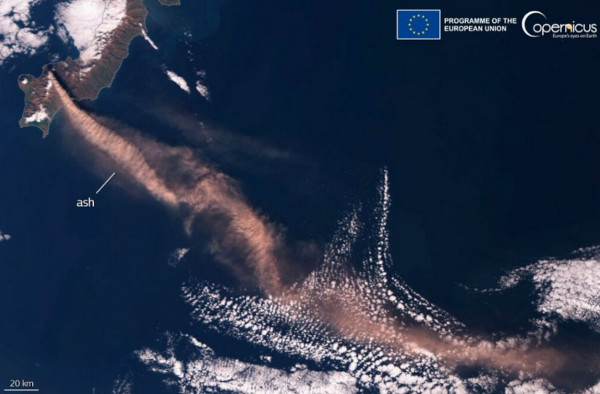
Source : Copernicus EU/Sentinel-3
++++++++++
Dès que le volcan sous-glaciaire Katla (Islande) commence à s’agiter, beaucoup de gens craignent qu’une éruption ne se prépare.
Deux séismes de magnitude supérieure à M3 ont été détectés sur le glacier Mýrdalsjökull le 16 octobre. Dans les 48 heures avant 13h20 (UTC) le 17 octobre 2022, le Met Office islandais (IMO) a enregistré 27 séismes dans la région, avec des magnitudes allant de M 1 à plus de M 3.
L’IMO indique qu’il est rare d’enregistrer trois séismes significatifs à intervalles rapprochés sur le Mýrdalsjökull. On pense qu’ils ont été causés par l’activité hydrothermale sous le Katla.
En ce qui concerne les éruptions de ce volcan, une scientifique islandaise a déclaré : « Nous n’avons pas de données fiables concernant des éruptions volcaniques du Katla. Nous ne connaissons donc pas exactement quels sont les signes avant-coureurs d’une éruption. Les descriptions en notre possession sont des chroniques de nos ancêtres. Dans ces descriptions, il est fait état de séismes que les gens ressentent dans le voisinage du volcan, et même des vibrations. Il y a des descriptions expliquant que la surface de l’eau près du Katla vibre avant une éruption. » Autrement dit, il sera très difficile de prévoir la prochaine éruption du volcan sous-glaciaire.
La dernière éruption connue du Katla a eu lieu en 1918 avec un VEI 4.

Photo: C. Grandpey
++++++++++
L’éruption de l’Alaid (îles Kouriles / Russie) se poursuit et une anomalie thermique a été identifiée sur les images satellites. L’activité explosive génère des panaches de cendres qui s’élèvent en moyenne à 3,7 km au-dessus du niveau de la mer. La couleur de l’alerte aérienne reste à Orange.
Source : KVERT.
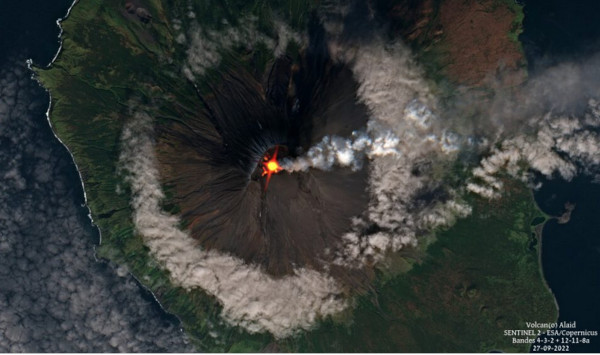
Source: Copernicus / Sentinel 3
++++++++++
Le PHIVOLCS a fait passer le niveau d’alerte du Bulusan (Philippines) à 1 (sur une échelle de 0 à 5) le 12 octobre 2022 en raison de l’augmentation de la sismicité, de l’inflation et des émissions de gaz. D’autres données montrent une hausse de l’activité hydrothermale, notamment une augmentation des températures et des émissions de dioxyde de carbone. Le PHIVOLCS demande au public de ne pas entrer dans la zone de danger permanent (PDZ) de 4 km de rayon, ni dans la zone de danger étendue (EDZ) de 2 km sur le flanc SE du volcan.
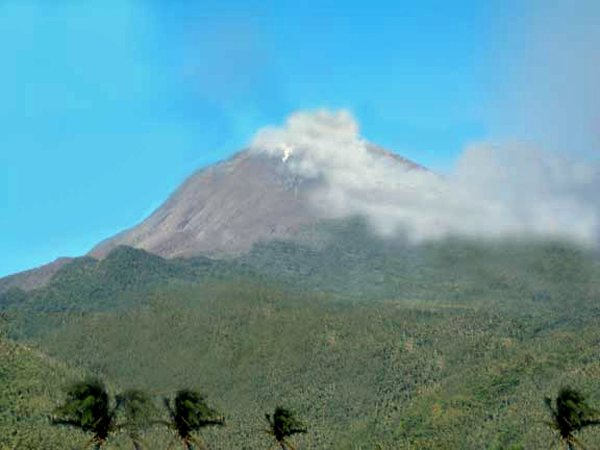
Crédit photo: Wikipedia
++++++++++
Des panaches de vapeur et de cendres s’élevant jusqu’à 350 – 500 m au-dessus du sommet sont encore émis par le Kerinci (Indonésie). Suite à une intensification de ces émissions, la couleur de l’alerte aérienne a été portée à Orange le 19 octobre. Le niveau d’alerte volcanique reste à 2 (sur une échelle de 1 à 4) et le public est invité à rester en dehors de la zone d’exclusion de 3 km.
Source : CVGHM.
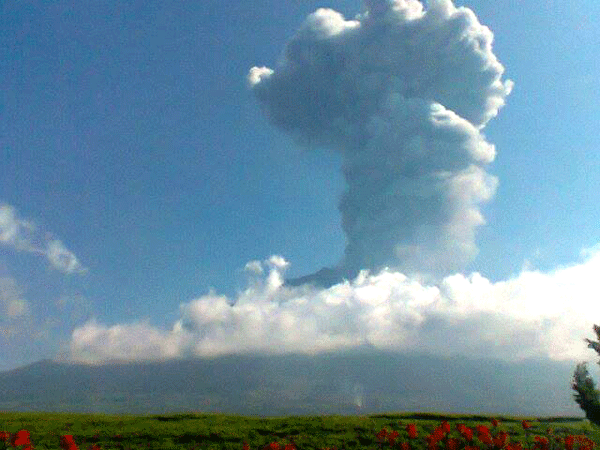
Crédit photo: Wikipedia
+++++++++++
Un niveau d’activité élevé est encore observé sur le Taal (Philippines). Des remontées de gaz et de fluides chauds dans le lac sont visibles presque quotidiennement. Les émissions de vapeur s’élèvent généralement jusqu’à 1,5 km au-dessus du lac. La sismicité est toujours importante. Les émissions de SO2 étaient en moyenne de 3 882 tonnes par jour le 13 octobre 2022. Les mesures de déformation du sol montrent toujours une légère inflation dans la moitié ouest de la caldeira et une déflation dans la moitié est. Le niveau d’alerte reste à 1 (sur une échelle de 0 à 5), et le PHIVOLCS rappelle au public que l’ensemble de Volcano Island est une zone de danger permanent (PDZ).
Source : PHIVOLCS.

Taal et Volcano Island (Crédit photo: Wikipedia)
°°°°°°°°°°
Ces informations ne sont pas exhaustives. Vous en trouverez d’autres (en anglais) en lisant le bulletin hebdomadaire de la Smithsonian Institution :
https://volcano.si.edu/reports_weekly.cfm
——————————————–
 Several events have been reported since my previous post about volcanic activity around the world.
The collapse of a part of the northern crater terrace of Stromboli (Sicily) and the events (pyroclastic flow, lava flow) that accompanied it have now come to an end.
The lava flow has stopped on the Sciara del Fuoco and there are no more collapses. There is still some spattering activity at North Crater 2 but it is much less intense than in recent days.
Following this drop in activity, access restrictions to the volcano have been cancelled but access to the summit remains prohibited. At best, you will climb up to 400 m a.s.l. with the accompaniment of the guides. .
Source: INGV, La Sicilia.
++++++++++
An explosive eruption began at Chikurachki (Paramushir Island / Northern Kuriles) at around 15:10 (UTC) on October 15th, 2022. The eruptive plume rose up to 4.5 km before drifting ESE over 345 km. The Aviation Color Code was raised from Green to Orange as the ash emission could affect air traffic.
Ash emissions were last seen on October 17th. The Aviation Color Code was lowered to Yellow on October 18th , and then to Green on October 19th.
Source: KVERT.
++++++++++
As soon as some unrest is detected at Katla subglacial volcano (Iceland), many people fear an eruption might be in the brewing.
Two earthquakes with magnitudes above M3 were detected in Mýrdalsjökull on October 16th. In 48 hours to 13:20 (UTC) on October 17th, 2022, the Icelandic Met Office (IMO) registered a total of 27 earthquakes in the area, with magnitudes ranging from M 1 to above M 3.
IMO indicates that it is unusual for three large earthquakes to occur at short intervals in Mýrdalsjökull. It is believed they were caused by hydrothermal activity beneath Katla volcano. As far as the eruptions of Katla are concerned, an Icelandic scientists has declared: » We have no measurements of volcanic eruptions in Katla, of which we are absolutely sure. So we don’t know exactly how the run-up is. Except only those descriptions we have from the chronicles of our ancestors. And in those descriptions it is quite clear that there are earthquakes that people feel in the vicinity and even vibrations, there are descriptions of how the water surface near Katla vibrates before an eruption occurs. » In other words, it will be very difficult to predict the next eruption of the subglacial volcano.
Katla’s last known eruption took place in 1918 with a VEI 4.
++++++++++
The eruption at Alaid (Kuril Islands / Russia) continues and a thermal anomaly was identified in satellite images. Explosive activity generates ash plumes that rose to 3.7 km a.s.l. The Aviation Color Code remains at Orange.
Source: KVERT.
+++++++++
PHIVOLCS raised the Alert Level for Bulusan (Philippines) to 1 (on a scale of 0-5) on October 12th, 2022 due to increased seismicity, inflation, and gas emissions. Other data suggested increased hydrothermal activity and unrest including increased temperatures and carbon dioxide emissions. PHIVOLCS reminds the public not to enter the 4-km-radius Permanent Danger Zone (PDZ), nor the 2 km Extended Danger Zone (EDZ) on the SE flank.
++++++++++
Steam and ash plumes rising as high as 350 – 500 m above the summit are still emitted by Kerinci (Indonesia). The Aviation Color Code was raised to Orange on October 19th. The Alert Level remains at 2 (on a scale of 1-4), and the public is asked to remain outside of the 3-km exclusion zone.
Source: CVGHM.
++++++++++
A high level of activity is still observed at Taal (Philippines). Upwelling gasses and hot fluids in the lake are still visible almost daily. Steam emissions generally rise as high as 1.5 km above the lake. Seismicity is still significant. SO2 emissions averaged 3,882 tonnes per day on October 13th, 2022. Ground deformation measurements continued to show slight inflation in the western half of the caldera and deflation in the eastern half. The Alert Level remains at 1 (on a scale of 0-5), and PHIVOLCS reminds the public that the entire Taal Volcano Island is a Permanent Danger Zone (PDZ).
Source: PHIVOLCS.
°°°°°°°°°°
This information is not exhaustive. You can find more by reading the Smithsonian Institution’s weekly report:
https://volcano.si.edu/reports_weekly.cfm


 Claude Grandpey : Volcans et Glaciers