Éruption islandaise : alimentation magmatique soutenue et avenir inconnu // Icelandic eruption: sustained magma supply and unknown future

Le soulèvement du sol semble avoir repris dans le secteur de Svartsengi et rien n’indique que l’éruption touche à sa fin. Les schémas montrent qu’il entre plus de magma dans la chambre magmatique qu’il n’en sort à la surface.

Source: Icelandic Mat Office

Des scientifiques de l’Université d’Islande indiquent que l’éruption qui a débuté le 16 mars 2024 est probablement la plus importante observée jusqu’à présent sur la péninsule de Reykjanes. Son intensité a rapidement diminué après le début et, ces derniers jours, on observe une grande stabilité. Deux cratères sont encore actifs au niveau de la fracture éruptive, mais l’activité se limite essentiellement à une seule bouche.

Comme je l’ai indiqué précédemment, le débit de lave est d’environ 5 à 10 mètres cubes par seconde, semblable à celui enregistré pendant l’éruption du Fagradalsfjall. Cette quatrième éruption en cours depuis le mois de décembre 2023 sur la chaîne de cratères de Sundhnúkagígar est dix fois plus longue que les précédentes, mais elle est encore beaucoup plus courte que l’éruption du Fagradalsfjall.

Source: Met Office

S’agissant de l’évolution possible de la situation, un scientifique de l’Université d’Islande estime que « la lave pourrait continuer à avancer et s’accumuler le long des digues de terre ; elle pourrait même finir dans l’océan. Un autre scénario est que la lave franchisse les digues de terre. Un troisième scénario serait que la lave s’accumule et coule vers le nord. Personne ne peut dire jusqu’où ira la coulée de lave si l’éruption dure un mois. »

Au final, ce ne sont que de belles paroles et personne ne sait comment va évoluer la situation.
Source : Iceland Monitor.

—————————————————

Inflation seems to have started in Svartsengi, although nothing indicates that the current eruption is coming to an end. More magma is flowing into the magma chamber under Svartsengi, than is flowing out of it and the inflow is not decreasing. (see chart above)

 Scientists at the University of Iceland say that the eruption that started on March 16th, 2024 is probably the most powerful eruption on the Reykjanes peninsula so far. The eruption’s intensity was rapidly reduced after the start but in the last few days, little has changed. Two craters are still active at the fissure, but activity is mostly limited to one of them.

As I put it bedore, the flow of lava is about 5-10 cubic meters per second, similar to the flow of lava in Mt Fagradalsfjall. This fourth eruption in the last four months on the Sundhnúkagígar crater row has been up to ten times longer than its predecessors, but its duration is far from the Mt Fagradalsfjall eruption.

As for the possible scenarios for the future, a scientists at the University of Iceland saus that “the lava could build up, move into a continuous flow along the defense walls and could even end up in the ocean. Another scenario is that the lava crosses the defense walls. A third scenario would be that the lava builds up a lot and flows northwards. There is no way to say how far the lava flow will go

Islande : quelques nouvelles de l’éruption // Iceland : some news of the eruption

Le Met Office indique qu’il n’y a aucun signe indiquant que l’éruption sur la péninsule de Reykjanes touche à sa fin. Ce qui est intéressant, c’est qu’il n’y a pas de déformation ou d’inflation dans le secteur de Svartsengi, comme ce fut le cas lors des trois éruptions précédentes. Le flux de magma en provenance de la chambre profonde, probablement à 15 kilomètres de profondeur, est stable et aucun magma ne s’accumule dans la chambre superficielle. Le magma semble s’écouler directement par la fracture éruptive. Il sera intéressant d’avoir les résultats de l’analyse de la chimie de la lave pour avoir confirmation de cette situation.
Les scientifiques du Met Office affirment qu’il faut être prudent en matière de prévisions. L’éruption peut durer encore un certain temps, mais elle peut également s’arrêter avec peu ou pas de préavis.
Il s’agit de la quatrième éruption sur la chaîne de cratères de Sundhnúkagígar en moins de quatre mois. Les trois premières n’ont duré que quelques jours tandis que l’événement actuel dure beaucoup plus longtemps. Personne ne sait pourquoi cette éruption se comporte différemment. Il y a des désaccords entre les scientifiques. L’un d’eux a déclaré fort justement : « Des circonstances complexes dans la croûte régissent le déroulement de cette éruption. Nous ne disposons probablement d’aucune mesure permettant de dire exactement ce qui se passe. » Une fois de plus, on se rend compte que c’est la Nature qui commande et que l’être humain doit faire preuve d’humilité.
Source : Iceland Monitor.

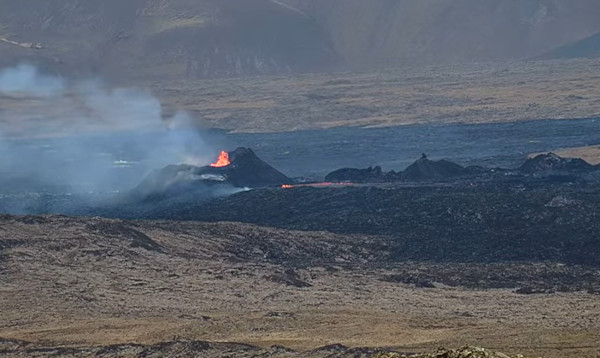
Image webcam de l’éruptionle 3 avril 2024 au soir. En ce moment, le site éruptif est dans le brouillard

———————————————————

The Met Office indicates that there are no signs that the eruption on the Reykjanes Peninsulais coming to an end. What is interesting is that there is no deformation or inflation in the Svartsengi area, as this was the case with the previous three eruptions. The flow of magma from the deep chamber, probably 15 kilometers deep, is stable and there is no magma accumulating in the shallow chamber, rather it flows directly out through the fissure. It will be interesting to have the results of the lava analysis to have a confirmation of this situation.

Scientists at the Met Office say one should be careful about making predictions. The eruption may last some time more, but it could also stop with little or no notice.

This is the fourth eruption in the Sundhnúkagígar crater row in less than four months. The first three lasted only a few days while the current one is lasting much longer. Nobody knows why this eruption is behaving differently. There are disagreements in the points of view. One scientist aptly said : « There are some complicated circumstances in the crust that govern how this eruption has panned out. We may not have any measurements that can tell us exactly what is going on. » Once again, we realize that Nature is in charge and that human beings should demonstrate humility.

Source : Iceland Monitor.

Islande : l’heure des pronostics ! // Iceland : time for predictions !

Les scientifiques islandais du Met Office et de l’Université d’Islande adorent faire des pronostics et des prévisions éruptives. Lorsque l’activité a commencé sur le Fagradalsfjall en 2021, ils ont affirmé que l’éruption était le début d’un nouveau cycle éruptif qui pourrait durer des mois, des années, voire plus. En fait, l’événement a duré six mois (19 mars – 18 septembre 2021). Une nouvelle éruption a débuté le 3 août 2022, et une autre, plus courte, a commencé le 10 juillet 2023 et s’est arrêtée le 5 août de cette même année.
Cette fois, en 2024, le Met Office est persuadé que l’éruption actuelle à Sundhnúkagígar marque probablement la fin d’une série dans la zone proche de Grindavík, même si elle est entrée dans sa troisième semaine et se poursuit au moment où j’écris ces lignes.
L’éruption a commencé le 16 mars 2024. L’activité reste confinée dans deux cratères, avec une émission de lave constante et aucun signe montrant que l’éruption est sur le point de se terminer. La majeure partie de l’activité se déroule dans le plus grand des deux cratères. Une certaine pollution par les gaz est parfois observée à Grindavík et Hafnir.
Selon un professeur de volcanologie de l’Université d’Islande, certains signes laissent supposer qu’il s’agit de la dernière éruption d’un cycle qui a débuté en décembre 2023. La chambre magmatique la moins profonde, située sous Svartsengi, n’est plus alimentée. Cela signifie que le magma en provenance de la chambre magmatique profonde monte directement vers vers la surface. L’éruption pourrait prendre fin dans les prochains jours.
Source  : Iceland Review.

Image webcam de l’éruption le 1er avril 2024

—————————————————–

Icelandic scientists at the Met office and the University of Icelad love making predictions. When activity started at Fagradalsfjall in 2021, they said the eruption was the start of a new eruptive cycle which might last for months, years or even more. Actually the event lasted six months (19 March – 18 September, 2021). A new eruption started aon August 3rd, 2022, and another short one began on July 10th, 2023 and stopped on Augsu 5th. .

This time, in 2024, the Met Office is persuaded that the current eruption in Sundhnúkagígar could mark the end of a string of eruptions in the area near Grindavík, although it is in its third week and still continuing.

The eruption began on March 16th 2024.Activity remains in two craters in the area, with steady lava flow and no immediate signs of the eruption ending. Most of the activity is ongoing in the larger of the two craters. Some gas pollution is sometimes detected in Grindavík and Hafnir.

According to a professor of volcanology at the University of Iceland, there are signs that this might be the final eruption in the cycle of volcanic activity which began in December 2023. The shallower magma chamber in the area, situated under Svartsengi, is no longer receiving magma from the eruption. Therefore, magma from the deeper magma chamber in the area is flowing to the surface and the eruption might come to an end in the next few days.

Source : Iceland Review.

Péninsule de Reykjanes (Islande) : des prévisions divergentes // Reykjanes Peninsula (Iceland) : divergent predictions

Dans une note publiée le 12 mars 2024, j’écrivais ; « le Met Office islandais affirme qu’il serait surprenant qu’il ne se passe rien cette semaine (du 11 au 17 mars). […] L’accumulation de magma sous Svartsengi continue d’augmenter régulièrement et a désormais atteint un volume plus élevé qu’au début du mois […] Si rien ne se passe cette semaine, cela signifiera que le comportement de intrusion magmatique s’est modifié. »

Finalement, l’éruption a débuté dans la soirée du 16 mars 2024. Le Met Office avait indiqué que l’accumulation de magma sous le secteur de Svartsengi continuait, et la lave a percé la surface au même endroit que le 8 février. Le Met Office avait répété qu’une éruption pourrait se déclencher très rapidement, avec un préavis de moins d’une demi-heure. Pour cette éruption, il a été d’une quarantaine de minutes.

Alors que le Met Office ne cessait de répéter que l’accumulation de magma sous Svartsengi déboucherait sur une éruption à court terme et avec un préavis très court, deux scientifiques islandais ont émis un point de vue différent. Ils estimaient qu’il faudrait une plus grande accumulation de magma sous Svartsengi pour déclencher une nouvelle intrusion. Utilisant les données du Met Office, leur analyse suggérait que l’activité observée actuellement près de Grindavík se terminerait entre le 1er juillet et le 15 août 2024.
Les données fournies par le Met Office incluaient le graphique montrant les cinq événements significatifs enregistrés depuis novembre 2023, avec trois éruptions et deux intrusions magmatiques qui n’ont pas abouti à des éruptions.

  (Source : Met Office islandais)

En utilisant ces données, les deux scientifiques ont mis au point leur propre tableau analytique permettant de prévoir la fin de l’activité actuelle. Leur graphique montre que l’afflux de magma sous Svartsengi a progressivement ralenti. En novembre, il atteignait plus de 700 000 mètres cubes par jour. Depuis cette date, l’afflux n’a cessé de diminuer. Les scientifiques pensaient que cet afflux de magma suivrait une tendance linéaire. Sur la base de cette tendance, ils prévoyaient que l’activité sur la péninsule de Reykjanes prendrait fin entre le 1er juillet et le 15 août 2024.

Graphique proposé par les deux scientifiques et montrant le ralentissement de l’afflux de magma

Finalement, c’est le Met Office qui avait raison…
Source  : Iceland Review.

Ces prévisions contradictoires ont le don d’agacer les habitants de Grindavík qui aimeraient avoir une image plus claire de l’avenir. Ils voudraient savoir si la prochaine éruption commencera à court terme ou cet automne. Une autre grande question est de savoir où elle se produira.
En fait, les différentes prévisions faites par les volcanologues ne conduisent à rien de concret. Les habitants de Grindavík disent qu’ils ont déjà dû faire face à de grands défis et que ces informations contradictoires n’arrangent rien. L’un d’eux a déclaré : « Certaines personnes disent que la prévision selon laquelle l’intrusion magmatique prendrait fin cet été est une bonne nouvelle. Je ne crois pas que ce soit fini, mais je ne suis pas un spécialiste en la matière. Nous avons connu une période extrêmement difficile mentalement et il faut rester les pieds sur terre. J’espère que tout cela se terminera le plus tôt possible, mais je ne le crois pas. »

Source : Iceland Monitor.

—————————————————

In a post published on March 12th, 2024, I wrote; “Iceland’s Met Office says it would be surprising if nothing happened this week (March 11-17). […] The magma accumulation beneath Svartsengi continues to increase steadily and has now reached a higher volume than at the beginning of the month […] If nothing happens this week, it will mean that the behaviour of magma intrusion has changed. »
Finally, an eruption started on the evening of March 16th, 2024. The Met Office had indicated that the accumulation of magma under the Svartsengi area continued, and it breached the surface at the same location as on February 8th. The Met Office had reiterated that an eruption could occur very quickly, with less than half an hour’s notice. For this eruption, the notice was around forty minutes.

While the Met Office repeatedly said the buildup of magma beneath Svartsengi wiould lead to an eruption in the short term and with very little notice, two Icelandic scientists offered a different view. They estimated that it would take a greater accumulation of magma beneath Svartsengi to trigger a new intrusion. Using Met Office data, their analysis suggested that the activity currently observed near Grindavík would end between July 1 and August 15, 2024.
Data provided by the Met Office included the graph showing the five significant events recorded since November 2023, with three eruptions and two magmatic intrusions that did not result in eruptions (see graph above).

Using this data, the two scientists developed their own analytical table to predict the end of the current activity. Their graph shows that the influx of magma beneath Svartsengi has gradually slowed down. (see graph above). In November, it reached more than 700,000 cubic meters per day. Since then, the influx has continued to decline. Scientists thought this magma influx would follow a linear trend. Based on this trend, they predicted that activity on the Reykjanes Peninsula would end between July 1 and August 15, 2024.

In the end, it was the Met Office that was right…
Source: Iceland Review.

These contradictory forecasts had the gift of annoying the residents of Grindavík who would like to have a clearer picture of the future. They wanted to know if the new eruption would start in the short term or in the autumn. Another big question was where the next eruption would occur.
In fact, the various predictions made by volcanologists do not lead to anything concrete. Grindavík residents say they have already faced big challenges and this conflicting information doesn’t help matters. One resident said: “Some people say the prediction that magma intrusion will end this summer is good news. I don’t think it’s over, but I’m not an expert on the subject. We have experienced an extremely difficult period mentally and we have to stay with our feet on the ground. I hope this all ends as soon as possible, but I don’t think so. »
Source: Iceland Monitor.