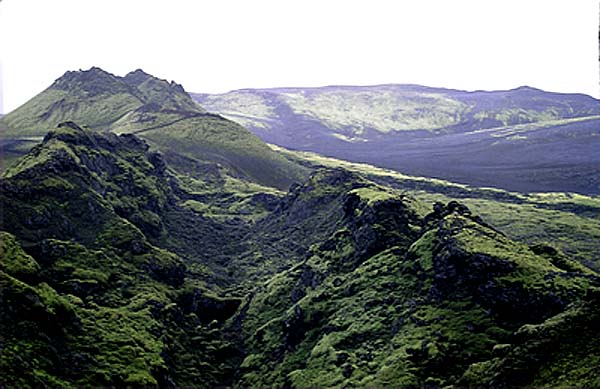
L’éruption se poursuit dans l’Holuhraun sans changement significatif. L’affaissement de la caldeira du Bárðarbunga continue et la sismicité reste élevée sur le volcan. La zone couverte par la lave mesure maintenant 70 kilomètres carrés, soit 7 km carrés de plus qu’il y a deux semaines et demi. A titre de comparaison, la calotte glaciaire de l’Eyjafjallajökull mesure 78 kilomètres carrés et le Þingvallavatn, le deuxième plus grand lac du pays a une superficie de 82 kilomètres carrés.
La lave récemment émise a été baptisée Nornahraun ou «lave des sorcières» à cause de l’abondance de filaments semblables à ceux que l’on trouve sur le Kilauea à Hawaii où ils sont appelés « cheveux de Pélé ». En Islande, ces fibres sont connues sous le nom de nornahár ou « cheveux des sorcières. »
L’un des principaux problèmes causés par l’éruption de l’Holuhraun est la pollution de l’air qui peut affecter différentes régions de l’Islande, selon la direction du vent. Par exemple, les enseignants ont récemment gardé à l’intérieur de l’établissement les enfants de l’école maternelle de Graenuvellir près d’Husavik pour les mettre à l’abri du SO2 que le vent avait poussé vers le nord. Comme l’a dit le maire de Norðurþing: «Il n’y a absolument rien que l’on puisse faire, à part rester à l’intérieur. Les personnes les plus sensibles doivent éviter l’effort physique à l’extérieur, essayer de rester chez elles et chauffer leurs maisons pour empêcher le gaz d’y pénétrer. »
D’une manière générale, le gouvernement a émis des alertes sur les risques pour la santé. L’exposition au dioxyde de soufre peut provoquer une irritation des yeux, de la gorge et des poumons. Des niveaux élevés peuvent conduire à des difficultés respiratoires. Les enfants sont les plus vulnérables. La plupart des Islandais espèrent seulement que le vent souffle dans le bon sens et aussi qu’il pleuve pour réduire les effets des nuages de gaz.
Source : Iceland Review.
——————————————–
 The Holuhraun eruption continues with no significant changes. The subsidence of the Barðarbunga caldera is going on as well and seismicity is still high on the volcano. The area covered in new lava from the Holuhraun eruption now measures 70 square kilometres, a 7-square-km larger than two and a half weeks ago.
For comparison, the Eyjafjallajökull icecap, is 78 square kilometres and Þingvallavatn, the country’s second largest lake, 82 square kilometres.
The new lava has been dubbed Nornahraun or ‘Witches’ Lava’ after the abundance hair-like similar to the ones to be found on Hawaii’s kilauea where they are called Pele’s hair. In Icelandic the fibers are known as nornahár or ‘witches’ hair.’
One of the main problems caused by the Holuhraun eruption is the air pollution that may affect different regions of Iceland according to the wind direction. For instance, the kids at the Graenuvellir kindergarten in Husavik were recently kept inside to protect them from the SO2 that had been blown to the north. Said the mayor of Nordurthing: “There’s exactly nothing you can do, aside from going inside. People that are more sensitive than others need to avoid physical exertion outside and try to stay inside and warm up their houses to prevent the gas from getting inside.”
Globally, the government has issued warnings on the health risks. Exposure to sulfur dioxide can cause irritation in the eyes, throat and lungs. High levels can lead to breathing difficulties. Children are the most vulnerable. So most Icelanders are just hoping the wind blows the right way and also for rain to damp the gas clouds.
Source : Iceland Review.

Le champ de lave de l’Holuhraun vu par l’ Institut des Sciences de la Terre.