
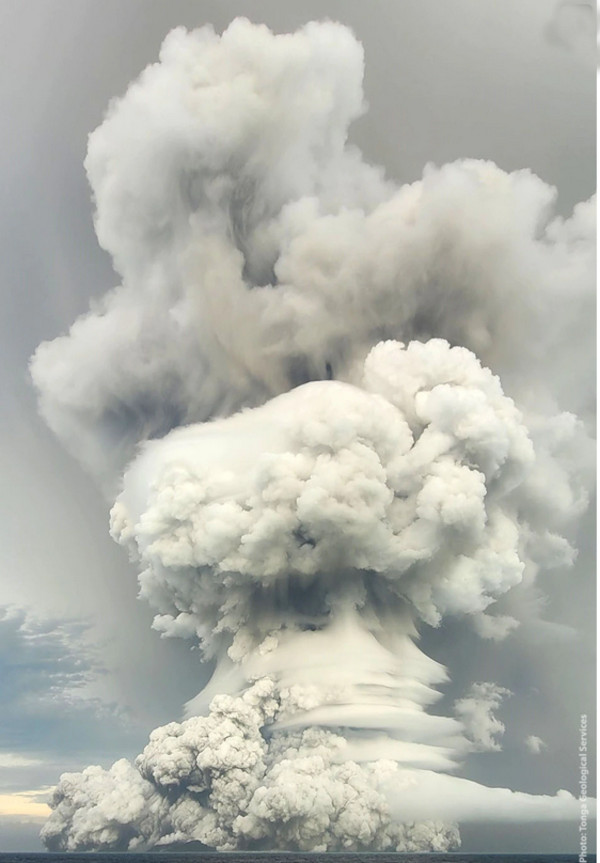
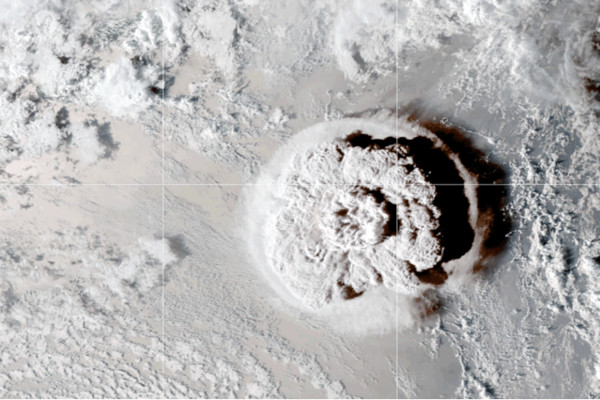
 L’éruption du Hunga Tonga Hunga-Ha’apai, le 15 janvier 2022, a été l’une des plus puissantes de l’histoire de l’humanité. Elle a déclenché la foudre la plus intense jamais enregistrée et le premier méga-tsunami documenté depuis l’Antiquité. Aujourd’hui, les scientifiques découvrent encore fréquemment de nouveaux éléments sur cet événement et sa source.
Dans une étude récente publiée dans la revue Science Advances, des scientifiques expliquent avoir enfin cartographié l’immense système d’alimentation magmatique qui a donné naissance à cette méga éruption. Elle a été ressentie dans le monde entier, mais le contexte sous-marin du volcan a toujours déconcerté les scientifiques qui tentent de comprendre comment une explosion aussi violente a pu se produire.
Dans la nouvelle étude, les chercheurs ont cartographié de légères variations de l’attraction gravitationnelle dans les eaux autour de l’île avant et après l’éruption et ils ont découvert que l’explosion était probablement alimentée par deux chambres magmatiques qui ont fusionné.
Les réservoirs magmatiques se trouvent à différentes profondeurs, entre 2 et 10 kilomètres sous le volcan et avaient probablement stocké une forte proportion de magma liquide avant l’éruption de 2022. Les chercheurs ont découvert que l’explosion a éjecté environ 30 % du magma – soit plus de 9 kilomètres cubes – stocké dans une chambre centrale peu profonde, ce qui a provoqué l’effondrement du plancher du volcan et la formation d’une caldeira de 850 mètres de diamètre. Lorsque la pression dans le réservoir central a chuté suite à l’explosion, le magma stocké dans un réservoir plus profond, au nord, a probablement traversé la croûte et reconstitué le réservoir central, ouvrant ainsi un chenal entre les deux chambres. On peut lire dans l’étude qu’il est également possible que du magma provenant d’une source riche en gaz, plus profonde dans la croûte terrestre, soit monté jusqu’à la chambre centrale, ce qui « pourrait aussi expliquer la violence de l’éruption de 2022 ».
Une troisième poche de magma, située au nord-ouest de la chambre centrale, semble déconnectée du système et ne pas avoir participé à l’éruption.
Il se pourrait que 26 kilomètres cubes de magma susceptibles d’alimenter une éruption soient encore stockés dans les deux principaux réservoirs situés sous le Hunga Tonga. Le magma susceptible d’être émis pendant une éruption est un magma en fusion à plus de 50 % et pauvre en solides cristallins.
Bien que l’étude donne un aperçu du système d’alimentation du volcan, elle ne montre pas ce qui a déclenché l’éruption du 15 janvier 2022. Les résultats gravimétriques ne permettent pas directement de déterminer le déclencheur de l’éruption, mais ils donnent « une idée de l’endroit et de la quantité de magma pouvant être encore stockée sous le volcan ».
Source : Live Science.
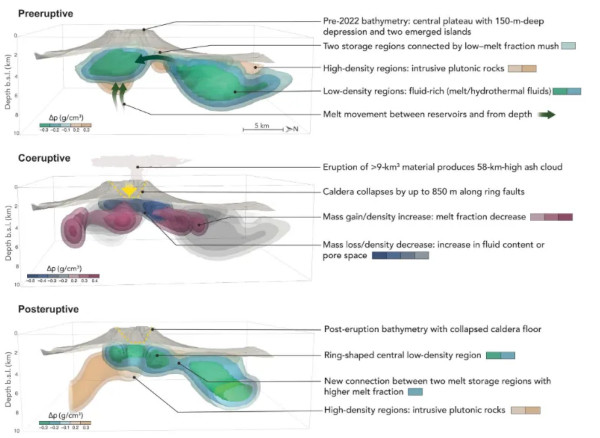
Diagramme montrant la réorganisation du système de stockage magmatique sous le Hunga Tonga Hunga-Ha’apai lors de l’éruption de 2022.
 A diagram showing the reorganization of the magma storage system beneath Tonga’s Hunga volcano during the 2022 eruption.
Diagramme en taille réelle / Real size diagram :
https://cdn.mos.cms.futurecdn.net/piayUQXUt8knRWzaAoUbf5.png
————————————————–
The eruption of Hunga Tonga Hunga-Ha’apai volcano on January 15th, 2022 was one of thr most powerful in human history. It triggered the most intense lightning storm ever recorded and the first documented mega tsunami since antiquity. Today, scientists frequently discover new elements about this event and its source.
In a recent study published in the journal Science Advances, scientists explain they have finally mapped the huge magma plumbing system that gave birth to the record-breaking blast. It was felt worldwide, but the volcano’s underwater setting posed a challenge for scientists trying to understand how such a violent blast occurred.
In the new study, researchers have mapped slight variations in the pull of gravity in waters around the island before and after the eruption and found that the explosion was likely fed by two magma chambers that merged.
The magma reservoirs sit at different depths between 2 and 10 kilometers under the volcano and likely stored a high proportion of liquid magma before the 2022 eruption. The researchers found that the blast ejected roughly 30% of the magma – more 9 cubic kilometers – from a shallow central chamber, which caused the roof of the volcano to cave in and form an 850-meter caldera. As the pressure in the central reservoir dropped following the explosion, magma stored in a deeper reservoir to the north may have burst through the crust and replenished the central reservoir, opening up a channel between the two chambers. One can read in the study that it is also possible that magma from a gas-rich source deeper within Earth’s crust rose to the central chamber, which « may also explain the violence of the 2022 eruption. »
A third pocket of magma, located to the northwest of the central chamber, seems disconnected from the system.
Up to 26 cubic kilometers of eruptible magma could still be stored in the two main reservoirs beneath the Hunga Tonga volcano. Eruptible magma is defined as magma that is over 50% melt and low in crystal solids.
While the study revealed what fueled the volcano, it could not show what triggered the massive eruption. The gravity results do not directly allow to conclude on the eruption trigger, but they give »an idea of where and how much magma could be stored under the volcano. »
Source : Live Science.

 Claude Grandpey : Volcans et Glaciers
