L’éruption du Hunga Tonga-Hunga Ha’apai : un record d’éclairs // A record of lightning strikes

L’éruption du volcan sous-marin Hunga Tonga-Hunga Ha’apai en 2022 appartient au monde des superlatifs et des records. Elle a généré la plus puissante explosion atmosphérique jamais enregistrée. Elle a également produit un nombre record d’éclairs au cours d’un orage électrique qui a duré 11 heures et s’est étendu sur 240 kilomètres.
Dans une note publiée le 26 janvier 2023, j’écrivais que pour étudier les éclairs qui ont accompagné l’éruption, les scientifiques ont utilisé les données de GLD360, un réseau de détection de la foudre au sol. Ces données ont révélé que, sur les quelque 590 000 éclairs détectés pendant l’éruption, environ 400 000 se sont produits dans les six heures qui ont suivi la puissante explosion du 15 janvier.
Avant l’éruption du Hunga Tonga-Hunga Ha’apai, le plus grand événement de foudre volcanique s’est produit en Indonésie en 2018, lorsque l’Anak Krakatau est entré en éruption et a généré environ 340 000 éclairs en une semaine. Environ 56 % des éclairs produits par l’éruption des Tonga ont frappé la terre ou la surface de l’océan, et plus de 1 300 impacts ont été enregistrés sur Tongatapu, l’île principale des Tonga.
Une nouvelle étude publiée le 19 juin 2023 dans la revue Geophysical Research Letters nous donne plus de détails sur cet aspect de l’éruption. Nous apprenons que l’orage électrique a eu lieu à une altitude sans précédent de 20 à 30 kilomètres.
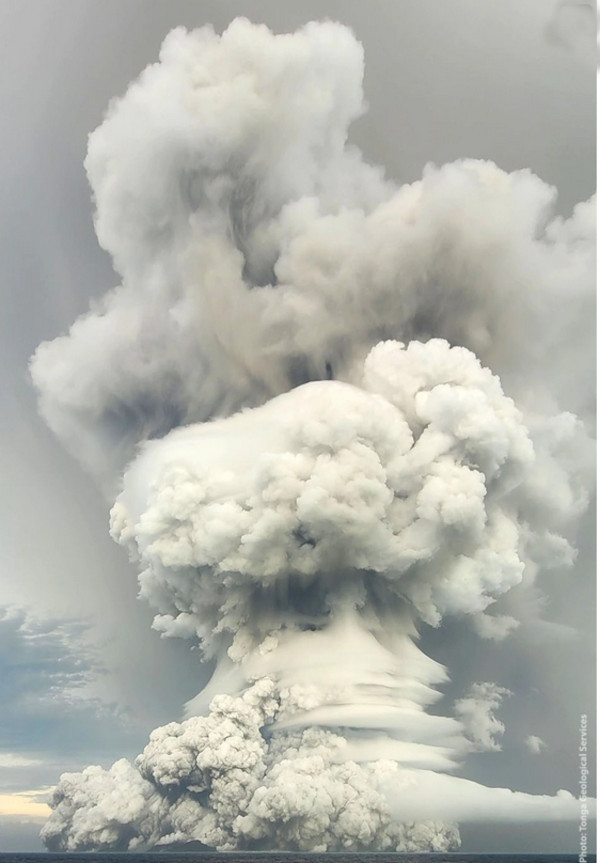
L’imagerie satellite montre que les éclairs n’étaient pas répartis au hasard dans le panache éruptif, mais qu’ils se produisaient en plusieurs anneaux concentriques qui semblaient liés à chaque phase explosive du volcan. En s’élevant, le panache a pris la forme d’un pin parasol. Ce phénomène a imprimé au nuage un mouvement vertical si important que l’onde a couvert 10 kilomètres en verticalité. Cette onde de pression oscillante, également connue sous le nom d’onde de gravité, est à l’origine de la foudre.
Les éclairs ont pu se former de deux manières différentes au sein de cette onde de gravité en forme d’anneau. L’éruption du Hunga Tonga s’étant déroulée sous l’eau, elle a injecté beaucoup d’eau dans l’atmosphère terrestre et les cristaux de glace qui en ont résulté ont adopté des charges positives et négatives. En outre, une partie des cendres volcaniques, formées de roches fragmentées et de magma projetées dans l’air par l’éruption, ont également été ionisées, ce qui a donné naissance à de nouvelles zones de charge positive et négative.
Si des anneaux de foudre ont déjà été observés dans des panaches volcaniques, l’éruption du Hunga Tonga a été la première à montrer des anneaux multiples (on en a compté quatre) et la foudre a glissé sur les ondulations des anneaux, comme un surfeur sur les vagues de l’océan.

Les anneaux de foudre sont également appelés « trous de foudre », car à l’intérieur de l’anneau, il n’y a généralement pas d’éclairs. L’éruption du Hunga Tonga est toutefois différente : les trous ont commencé à se remplir d’éclairs dans les minutes qui ont suivi le passage de l’onde de gravité. Le mécanisme à l’origine de ce remplissage n’a pas encore été élucidé par les chercheurs.
Outre le fait de battre des records, l’éruption du Hunga Tonga est susceptible de nous renseigner sur le volcanisme sur la Terre primitive, voire sur d’autres corps célestes. L’éruption est de type phréatoplinien, autrement dit elle se produit lorsqu’une énorme quantité de roche en fusion jaillit à travers une épaisse couche d’eau.
L’éruption pourrait aider à comprendre comment la foudre se déclenche sur d’autres planètes, telles que Vénus, ou d’autres corps planétaires qui ne sont pas le cadre de la foudre traditionnelle.
Source : Space.com.

——————————————–

The 2022 Hunga Tonga-Hunga Ha’apai volcanic eruption belongs to the world of superlatives. It produced the most powerful atmospheric explosion ever recorded. It also generated a record number of lightning strikes in a thunderstorm that lasted 11 hours and spread across 240 kilometers.

In a post released on January 26th, 2023, I wrote that to study the lightning that accompanied the eruption, the scientists used data from GLD360, a ground-based lightning detection network. This data revealed that, of the approximately 590,000 lightning strikes detected during the eruption, around 400,000 occurred within six hours that followed the powerful January 15th explosion.
Prior to the Hunga Tonga-Hunga Ha’apai eruption, the largest volcanic lightning event occurred in Indonesia in 2018, when Anak Krakatau erupted and generated around 340,000 lightning strikes in a week. About 56% of the lightning produced by the Tonga eruption struck the land or ocean surface, and more than 1,300 strikes were recorded on Tongatapu, the main island of Tonga.

A new research published on June 19th, 2023 in the journal Geophysical Research Letters gives us more details about tat aspect of the eruption. We learn that the lightning storm took place at an unprecedented altitude of between 20 and 30 kilometers.

The satellite imagery shows that the lightning was not randomly spread across the plume but rather occurred in several concentric rings that seemed to be linked to each explosive outburst from the volcano. As the plume rose upward, it formed an « umbrella cloud. » This imparted a vertical motion into the cloud so huge that the wave, moving outward from the center of the plume, was 10 vertical kilometers from crest to trough. This oscillating pressure wave, also known as a gravity wave, was the source of the lightning.

There are two ways the lightning may have formed within this ring-shaped gravity wave. Since the Hunga Tonga eruption took place underwater, it injected lots of water into Earth’s atmosphere, the resulting ice crystals adopting positive and negative charges. In addition, some of the volcanic ash that was formed of fragmented rock and magma blown into the air by the eruption also become ionized, leading to more areas of positive and negative charge. It is the gradient in electrical charge that sets off sudden sparks of lightning.

While lightning rings have been seen in volcanic plumes before, the Hunga Tonga eruption was the first time multiple rings (four of them) had been seen and the lightning rode the rippling rings like a surfer on ocean waves.

Lightning rings are also termed « lightning holes, » because inside the ring there usually is no lightning. However, the Hunga Tonga eruption was different: because the holes started filling with lightning within minutes of the gravity wave rippling by. The mechanism that prompted this infilling remains unclear.

Besides breaking records in the present day, the Hunga Tonga eruption could also teach us about volcanism on the early Earth, and even potentially on other celestial bodies. The eruption is a type referred to as phreatoplinian. It occurs when a huge amount of molten rock erupts through a thick layer of water.

The eruption could also have implications for the way that lightning gets going on other planets, such as Venus, or other planetary bodies that do not support traditional lightning.

Source : Space.com.
Source: NASA

L’éruption du Hunga-Tonga Hunga-Ha’apai ne cesse de surprendre // The Hunga-Tonga Hunga-Ha’apai eruption was really amazing

Des mois après qu’elle se soit produite (15 janvier 2022), l’éruption du volcan sous-marin Hunga-Tonga Hunga-Ha’apai intrigue toujours la communauté scientifique car sa puissance n’avait jamais été observée à l’occasion d’autres éruptions sur Terre.
Une analyse des ondes sismiques a révélé quatre événements qui ont été interprétés comme de puissantes poussées de roche en fusion sous le volcan. En l’espace de cinq minutes, chacun de ces coups de boutoir a probablement développé une force d’un milliard de tonnes.
Comme je l’ai écrit précédemment, le Hunga-Tonga Hunga-Ha’apai a généré la plus grande explosion atmosphérique jamais enregistrée par l’instrumentation moderne. Elle a déplacé environ 10 kilomètres cubes de roche, de cendres et de sédiments. Une grande partie a été évacuée par la caldeira du volcan et a été propulsée directement dans le ciel.
Des scientifiques se sont réunis à Chicago lors de la réunion d’automne de l’American Geophysical Union (AGU) pour comparer les derniers résultats de leurs études à propos de cette éruption hors du commun.
Un scientifique de l’Université de Houston (Texas) a détaillé l’analyse, par son équipe, des ondes sismiques qui ont accompagné l’événement de magnitude M 5,8 et qui se sont propagées pendant un peu plus de 10 minutes après le début de l’éruption. Ces signaux ont été captés par plus de 400 stations à travers le monde. Le chercheur les attribue à une poussée magmatique qui a percuté la base de la caldeira. Il semble qu’une nouvelle arrivée de magma ait tout à coup atteint la chambre magmatique et l’ait mise en surpression. Il ajoute : « Le magma a surgi à grande vitesse, comme un train qui aurait percuté un mur. Le phénomène s’est produit à quatre reprises en 300 secondes. »
Les satellites ont montré que les cendres du Hunga-Tonga ont atteint une altitude de 57 km; c’est le panache volcanique le plus élevé jamais enregistré. De nouvelles données présentées lors de la réunion de l’AGU ont indiqué que les cendres sont montées jusque dans l’espace. En effet, les capteurs des satellites de l’agence spatiale américaine et de l’US Air Force qui mesurent le rayonnement ultraviolet lointain du Soleil ont détecté dans leurs données un fort coefficient d’absorption à une altitude supérieure à 100 km, ce qui correspond à la ligne Karman, la frontière avec l’espace.
Les analyses de l’éruption ont également révélé que le volcan avait envoyé dans l’espace une masse de vapeur d’eau estimée entre 20 000 à 200 000 tonnes. Les scientifiques expliquent qu’il n’est pas surprenant qu’un volcan sous-marin envoie de l’eau dans le ciel lors d’une éruption, mais la hauteur atteinte par cette eau défie l’entendement.

Cette eau a de toute évidence contribué à créer les conditions nécessaires à la plus grande concentration de foudre jamais détectée. Le panache de l’éruption du Hunga-Tonga a produit 400 000 éclairs le 15 janvier, avec jusqu’à 5 000 à 5 200 événements par minute. C’est un ordre de grandeur supérieur à celui observé pendant les orages supercellulaires qui sont parmi les plus puissants sur Terre. La concentration d’éclairs était si élevée qu’elle a saturé les capteurs. Le nombre de 400 000 est donc très probablement en dessous de la vérité.
Une conséquence remarquable de tous ces éclairs est qu’ils ont produit un flash de rayons gamma détecté par un satellite de la NASA qui recherche dans l’Univers ces émissions à haute énergie. Elles sont censées provenir de trous noirs lointains ou d’explosions d’étoiles. C’était la première fois que le vaisseau spatial Fermi captait un tel flzsh en provenance d’un volcan sur Terre. Cela confirme le caractère extrême et exceptionnel de l’éruption Hunga-Tonga.
Source : la BBC.

——————————————–

Months after it happened on January 15th 2022, the eruption of Hunga-Tonga Hunga-Ha’apai summarine volcano still puzzles scientists around the word as its power had never been observed on other eruptiond on Earth.

An analysis of seismic waves has revealed four individual events that are interpreted to be thrusts of molten rock beneath the underwater mountain. Occurring within a five-minute period, each of these blows is calculated to have had a force of a billion tonnes.

As I put it previously, the seamount produced the biggest atmospheric explosion ever recorded by modern instrumentation. It displaced some 10 cubic kilometers of rock, ash and sediment, much of it exiting through the volcano’s caldera, to shoot straight up into the sky.

Scientists have gathered in Chicago at the American Geophysical Union (AGU) Fall Meeting to compare the latest results of their investigations into what happened.

A scientist from the University of Houston (Texas) detailed his team’s analysis of the Magnitude 5.8 seismic waves generated just over 10 minutes into the climactic eruption. These signals were picked up at more than 400 monitoring stations around the globe. The researcher attributes them to a pulse of magma moving up from below the mountain and hitting the base of the caldera. It looked as if a new batch of magma had suddenly just reached into the magma chamber and over-pressured the chamber. He adds : « The pulse of the magma was travelling up at high speed and it was like a train hitting the base of the wall. It hammered four times within 300 seconds. »

Ash from Hunga-Tonga was measured by weather satellites to have travelled 57 km above the Earth’s surface, the highest ever recorded volcanic plume. But new data presented at the AGU meeting indicated the disturbance went higher still, all the way to space. Sensors on US space agency and US Air Force satellites that measure far-ultraviolet radiation from the Sun noticed a strong absorption feature in their data correlated to an altitude above 100 km, which corresponds to the Karman Line, the recognised boundary to space.

Analyses of the eruption aloso revealed that the volcano sent into space a mass o water vapour estimated between 20,000 to 200,000 tonnes. Scientists say that a submarine volcano throwing so much water into the sky during an eruption is not a surprise, but the height to which that water travelled is. This water also clearly played a role in creating the conditions necessary to generate the greatest concentration of lightning ever detected. The Hunga-Tonga eruption plume produced 400,000 lightning events on January 15th, with rates of up to 5,000 to 5,200 events per minute. This is an order of magnitude higher than the one observed in super-cell thunderstorms, some of the strongest thunderstorms that exist on Earth. The rates were so high that they saturated the sensors. The 400,000 number is most probably below the truth.

One remarkable consequence of all this lightning is that it produced a gamma-ray flash detected by a Nasa satellite that normally looks out into the Universe for such high-energy emissions. These are expected to come from far-off black holes or exploding stars. This was the first time the Fermi spacecraft had caught a flash coming from a volcano on Earth. This confirms the extreme and exceptional nature of the Hunga-Tonga eruption.

Source: The BBC.

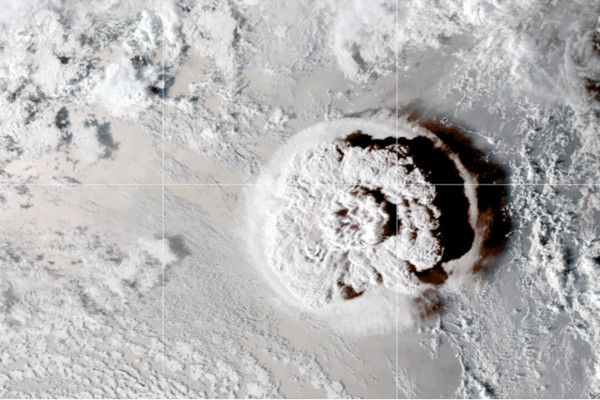
Images montrant l’étendue du nuage de cendres au moment de l’éruption du Hunga-Tonga Hunga-Ha’apai (Source: USGS)

L’éruption du Hunga Tonga-Hunga Ha’apai (Tonga) a battu des records // The Hunga Tonga-Hunga Ha’apai eruption (Tonga) broke records

L’éruption sous-marine du Hunga Tonga-Hunga Ha’apai (archipel des Tonga) le 15 janvier 2022 a battu simultanément deux records : le panache volcanique a atteint des hauteurs encore jamais observées par les satellites, et l’éruption a généré un nombre encore jamais observé d’éclairs, avec près de 590 000 impacts de foudre en trois jours.
Deux satellites météorologiques – le Geostationary Operational Environmental Satellite 17 (GOES-17) de la NOAA et le Himawari-8 de l’Agence japonaise d’exploration aérospatiale – ont observé cette éruption exceptionnelle depuis l’espace, ce qui a permis aux scientifiques de calculer jusqu’où le panache avait pénétré dans l’atmosphère.Ils ont déterminé que, à son point culminant, le panache s’est élevé à une hauteur de 58 km, ce qui signifie qu’il a percé la mésosphère, la troisième couche de l’atmosphère. Après qu’une première explosion ait généré ce panache très volumineux, une nouvelle explosion a propulsé des cendres, du gaz et de la vapeur à plus de 50 km dans le ciel. A titre de comparaison, en 1991, le mont Pinatubo (Philippines) avait généré un panache qui s’étendait sur 35 km au-dessus du volcan. Dans la stratosphère (donc sous la mésosphère), le gaz et les cendres du volcan se sont accumulés et se sont étalés pour couvrir une superficie de 157 000 kilomètres carrés.
Pour étudier la foudre, l’équipe scientifique a utilisé les données de GLD360, un réseau de détection de foudre au sol. Ces données ont révélé que, sur les quelque 590 000 coups de foudre détectés lors de l’éruption, environ 400 000 se sont produits dans les six heures qui ont suivi la puissante explosion du 15 janvier.
Avant l’éruption du Hunga Tonga-Hunga Ha’apai, le plus grand événement de foudre volcanique s’était produit en Indonésie en 2018, lorsque l’Anak Krakatau est entré en éruption et a généré environ 340 000 éclairs en une semaine. Environ 56% de la foudre produite par l’éruption des Tonga a frappé la surface de la terre ou de l’océan, et plus de 1 300 impacts ont été recensés sur l’île principale des Tonga, Tongatapu.
La foudre peut se diviser en deux catégories. Un type de foudre a été causé par une « charge sèche », dans laquelle des cendres, des roches et des particules de lave entrent en collision dans l’air et échangent des électrons chargés négativement. Le deuxième type de foudre a été causé par la « charge de glace », qui se produit lorsque le panache volcanique atteint des hauteurs où l’eau peut geler et former des particules de glace qui s’entrechoquent.
Ces deux processus conduisent à des coups de foudre en provoquant l’accumulation d’électrons sur la partie inférieure des nuages; ces particules chargées négativement jaillissent ensuite vers des régions de nuages plus élevées et chargées positivement ou vers des régions chargées positivement du sol ou de la mer en dessous.
Source : space.com.

—————————————–

The submarine eruption that occurred in the Tonga archipelago on January 15th, 2022 shattered two records simultaneously: The volcanic plume reached greater heights than any eruption ever captured in the satellite record, and the eruption generated an unparalleled number of lightning strikes, with almost 590,000 bolts over the course of three days.

Two weather satellites – NOAA’s Geostationary Operational Environmental Satellite 17 (GOES-17) and the Japan Aerospace Exploration Agency’s Himawari-8 – captured the unusual eruption from above, allowing scientists to calculate just how far the plume penetrated the atmosphere.They determined that, at its highest point, the plume rose 58 km into the air, meaning it pierced the mesosphere, the third layer of the atmosphere. After an initial blast generated this towering plume, a secondary blast sent ash, gas and steam more than 50 km into the air. As a comparison,.in 1991, Mount Pinatubo (Philippines) unleashed a plume that extended 35 km above the volcano. In the stratosphere (beneath the mesosphere), gas and ash from the volcano accumulated and spread to cover an area of 157,000 square kilometers.

To study the lightning, the scientific team used data from GLD360, a ground-based lightning detection network. These data revealed that, of the nearly 590,000 lightning strikes that took place during the eruption, about 400,000 occurred within six hours after the big blast on January 15th.

Prior to the Tonga eruption, the largest volcanic lightning event happened in Indonesia in 2018, when Anak Krakatau erupted and generated about 340,000 lightning strikes over the course of a week. About 56% of the lightning during the Tonga eruption struck the surface of the land or ocean, and more than 1,300 strikes landed on Tonga’s main island of Tongatapu.

The lightning came in two categories. One type of lightning was caused by « dry charging, » in which ash, rocks and lava particles repeatedly collide in the air and swap negatively charged electrons. The second type of lightning was caused by « ice charging, » which occurs when the volcanic plume reaches heights where water can freeze and form ice particles that slam into each other.

Both of these processes lead to lightning strikes by causing electrons to build up on the undersides of the clouds; these negatively charged particles then leap to higher, positively charged regions of the clouds or to positively charged regions of the ground or sea below.

Source : space.com.

Panache émis par l’éruption du 15 janvier 2022 (Source: Tonga Services

Etna (Sicile) : éclairs et glissement de terrain // Lightning and landslide

Lors de l’intense éruption du 10 février 2022, de superbes fontaines de lave accompagnées de panaches de cendre ont jailli du Cratère Sud-Est de l4etna. Comme souvent dans de telles circonstances, on aperçoit des éclairs dans le panache éruptif. Ils sont le résultat de l’électricité statique provoquée par le frottement des particules de cendre. Les éclairs volcaniques sont un flux d’électricité très intense entre deux zones dans lesquelles il y a des charges électriques de signe opposé. Deux conditions doivent exister pour que le phénomène se produise : la présence d’un mécanisme qui génère la séparation des charges entre deux masses considérables de matière et un processus qui relie les deux masses afin de permettre la circulation de l’électricité. Dans le cadre de la foudre volcanique, il y a une différence dans le potentiel des lapilli à l’intérieur du nuage éruptif.

En cliquant sur ce lien, vous verrez les belles fontaines de lave émises par le Cratère SE ainsi que, très brièvement – vers 50 secondes – un éclair volcanique:

++++++++++

Le 11 février 2022 au matin, quelques heures après la fin de l’épisode éruptif sus-mentionné, un impressionnant glissement de terrain a affecté le cratère Sud-Est de l’Etna. Dans la vidéo ci-dessous, on peut voir le moment où la masse de matériaux se détache du volcan. L’épisode éruptif s’était terminé vers 23h00 la veille.

Source: La Sicilia.

—————————————-

During the intense eruption of February 10th, 2022, nice lava fountains accompanied by ash plumes erupted from Mt Etna’s Southeast Crater. As often in such circumstances, we could see flashes of lightning in the eruptive plume. They are the result of static electricity caused by the friction of ash particles. Volcanic lightning is a very intense flow of electricity between two areas in which there are electric charges of opposite signs. Two conditions should exist for the phenomenon to occur: the presence of a mechanism that generates the separation of charges between two considerable masses of matter and a process that connects the two masses in order to allow the flow of electricity. As part of volcanic lightning, there is a difference in the lapilli potential inside the eruptive plume.
In the video above, you will see the nice lava fountains emitted by the SE Crater as well as, very briefly – around 50 seconds – a volcanic flash of lightning.

++++++++++

On February 11th, 2022 in the morning, a few hours after the end of the above-mentioned eruptive episode, an impressive landslide affected tMT Etna’s SE Crater. In the video above, one can see the moment when the mass of material broke away from the volcano. The eruptive episode had ended around 11:00 p.m. the day before.

Source : La Sicilia.