Islande : la poisse ! // Iceland is really unlucky !

Après l’évacuation de Grindavik (3 500 habitants), c’est au tour des îles Vestmann d’être menacées d’évacuation. En effet, la conduite qui transporte l’eau potable vers l’archipel a été endommagée et n’est pas réparable. Bien que le tuyau soit encore pleinement opérationnel, il pourrait se briser à tout moment, privant d’eau l’île d’Heimaey (4 523 habitants). La canalisation a été endommagée il y a dix jours lorsqu’un chalutier y a malencontreusement jeté l’ancre et accroché la conduite au passage.
Les dégâts concernent une section de 300 mètres. Des images sous-marines montrent que le tuyau s’est considérablement déplacé. La possibilité d’une réparation temporaire semble difficile, voire impossible. La seule solution est d’installer un nouveau tuyau.
Une « phase de danger » est en vigueur aux îles Vestmann en raison de la situation. Un plan d’intervention prévoit la mise en place d’une nouvelle canalisation, travail qu’il faudra effectuer au plus tard l’été prochain.
Pour l’instant, la population n’a pas besoin de rationner ou de stocker l’eau. Les réservoirs de la ville disposent de 5 000 tonnes d’eau potable, ce qui pourrait suffire pour plusieurs jours ou plus d’une semaine en cas de rupture complète de la conduite. Le chauffage d’Heimaey dépend également de l’approvisionnement en eau. Les autorités locales indiquent que si la conduite d’eau endommagée se brise, la ville pourra continuer à chauffer les maisons et les bâtiments pendant deux semaines avec son stock d’eau. Si de l’eau supplémentaire est nécessaire, il est, pour le moment, prévu de la transporter depuis la grande île vers les Vestmann, plutôt que d’évacuer la population. Malgré tout, les autorités locales examinent les plans d’évacuation, au cas où…
Source  : médias d’information islandais.

Carte topographique des îles Vestmann (Source : Wikipedia)

————————————————

After the evacuation of Grindavik (pop. 3,500), it is up to the Vestmann Islands to be under the threat of an evacuation. Indeed, the pipe that transports drinking water to the archipelago has been damaged beyond repair. While the pipe is still fully functional, it could break at any moment, leaving Heimaey island pop. 4,523) without water. The pipe was damaged ten days ago when a trawler unintentionally dropped an anchor on it, which then got stuck on the pipe.

The damage to the pipe stretches across a 300-metre section. Underwater pictures show that the pipe has shifted significantly from its former location. The possibility of a temporary repair would be difficult. The only permanent solution is a new pipe.

A “danger phase” is in effect for the Westman Islands due to the situation. A response plan is in the works to lay down new piping, which will need to be done by next summer at the latest.

For the time being, there is no need for Westman Islands residents to save or store water. The town’s water tanks store 5,000 tonnes of drinking water, which could be sufficient from several days to over a week if the water pipe does break fully. The local heating is also dependent on the water supply. Local authorities indicate that if the damaged water pipe does break, the town will be able to continue heating homes and buildings for up to two weeks with its stored water. If additional water is necessary, the current plan is to transport it to the Westman islands rather than evacuate residents. The town authorities are, however, reviewing evacuation plans.

Source : Icelandic news media.
Islande : pourquoi je ne crois pas à une éruption // Iceland : why I don’t believe an eruption will occur

Comme je l’ai indiqué précédemment, je pense – mais je peux me tromper – qu’il n’y aura pas d’éruption sur la péninsule de Reykjanes. Selon moi, on est face à une éruption avortée. Que s’est-il passé ?

L’intrusion magmatique ne fait aucun doute. Tous les instruments ont démontré sa présence. Elle est même considérable, couvrant un distance d’une quinzaine de kilomètres du nord au sud, sur une bonne largeur.

L’intrusion a probablement débuté vers le 24 – 27 octobre 2023 quand les sismographes se sont agités et quand les inclimomètres au sol et les satellites ont détecté un gonflement du sol.

Avec sa source probable dans le secteur de Svarstsengi, le magma en provenance des profondeurs a emprunté les fractures qui déchirent l’Islande du nord-est au sud-ouest. Elles sont le fruit de l’accrétion que connaît l’Islande depuis des lustres. L’une de ces fractures,, légèrement orientée NE – SO, a conduit l’intrusion magmatique vers la bourgade de Grindavik où la pression du magma a fait se soulever et se fracturer le sol, avec la sismicité qui va de pair.

En s’étalent dans les fractures, cette intrusion à grande échelle n’a pas eu une pression suffisante pour que la lave perce la surface. Deux paramètres (sismicité et inflation) semblaient annoncer une éruption, mais les émissions de gaz et leur température étaient absentes. Certes, on a détecté la présence de SO2 en profondeur dans un puits de forage, mais ce n’est pas suffisant pour annoncer un éruption en surface.

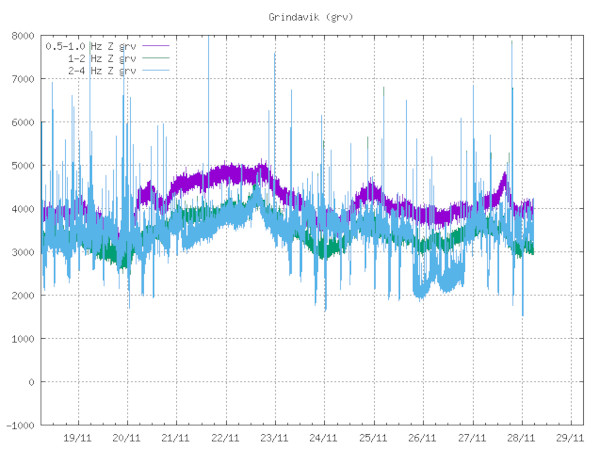
Aujourd’hui, si la sismicité persiste, de même que le soulèvement du sol dans le secteur de Svartsengi, ces phénomènes n’ont plus rien à voir avec leur ampleur initiale. De plus, le tremor  montre des valeurs basses.

Source: IMO

On peut raisonnablement penser, comme l’indique le Met Office, qu’il subsiste une alimentation du dike magmatique en profondeur, sous le magma en cours de solidification de l’intrusion, ce qui justifie la sismicité et la déformation enregistrées actuellement. Toutefois, cette arrivée de magma n’a plus la force d’atteindre le surface. D’ailleurs les hypocentres des séismes restent, pour la plupart, à 3 – 5 km de profondeur.

Il faut néanmoins rester vigilant. Comme je l’écrivais le 27 novembre, un nouvel afflux de magma pourrait changer la donne, mais les instruments le signaleront.

En attendant, le Blue Lagoon reste fermé au moins jusqu’au 7 décembre.

———————————————-

As I put it previously, I think – but I could be wrong – that there will be no eruption on the Reykjanes Peninsula. In my opinion, we are facing an aborted eruption. What happened ?
The magma intrusion is beyond doubt. All instruments demonstrated its presence. It is even considerable, covering a distance of about fifteen kilometers from north to south, over a significant width.
The intrusion probably began around October 24 – 27, 2023, as shown by the seismographs and ground inclimometers, as weel as by satellites which detected an uplift of the ground.
With its likely source in the Svarstsengi area, the magma coming from the depths travelled along the fractures which tear Iceland from the northeast to the southwest. They are the fruit of the accretion that Iceland has been experiencing for ages. One of these fractures, slightly oriented NE – SW, led the magma intrusion towards the town of Grindavik where the pressure of magma caused the ground to rise and fracture, with the seismicity that goes parallel.
While spreading out in the fractures, this large-scale intrusion did not have sufficient pressure for lava to break through the surface. Two parameters seemed to indicate an eruption, but gas emissions and their temperature were absent. Sure, SO2 has been detected at depth in a borehole, but this is not sufficient to herald a surface eruption.
Today, seismicity persists, as well as ground uplift in the Svartsengi area, but these phenomena no longer have anything to do with their initial magnitude. What’s more, the tremor is showing low values.
We can reasonably think, as indicated by the Met Office, that there remains a supply of the magma dike at depth, beneath the now solidified magma of the intrusion, which accounts for the seismicity and deformation currently recorded. However, this influx of magma no longer has the strength to reach the surface. Moreover, the hypocenters of the earthquakes remain, for the most part, at 3 – 5 km depth.
However, one should remain vigilant. As I wrote on November 27th, a new influx of magma could change the situation, but the instruments will react and signal it.

Meantime, the Blue Lagoon will remain closed at least until December 7th.

Islande : le Met Office croit toujours à une éruption // Iceland : the Met Office still believes an eruption might occur

Dans sa mise à jour du 27 novembre 2023, le Met Office islandais estime toujours qu’une éruption pourrait se produire le long de l’intrusion magmatique sur la péninsule de Reykjanes.

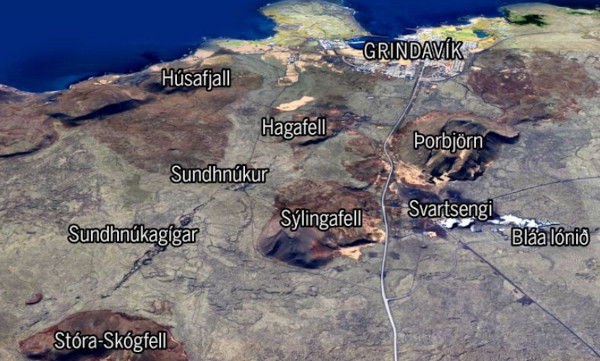
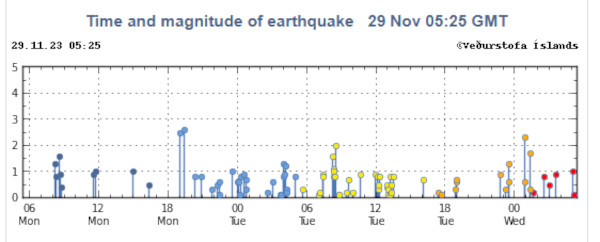
L’activité sismique a diminué ces derniers jours et est désormais relativement stable. La plupart des événements ont lieu près de Sýlingarfell et Hagafell.

Les données des stations GPS et les images satellite montrent que le soulèvement du sol se poursuit dans la région de Svartsengi et que la déformation est toujours en cours le long et autour du dyke magmatique
Selon le Met Office, les données sismiques et de déformation montrent que le magma continue de s’accumuler sous le secteur de Svartsengi et de s’écouler dans la partie médiane du dyke détecté le 10 novembre. En conséquence, une éruption le long de l’intrusion magmatique est toujours considérée comme probable tant que l’afflux de magma se poursuit. La zone où le risque d’une éruption est le plus élevé se situe au milieu du dyke entre Hagafell et Sýlingarfell.
[NDLR : Il est à noter que le tremor continue de montrer des valeurs basses. Pour l’instant, il ne semble pas que l’afflux de magma mentionné par le Met Office soit suffisamment fort pour que la lave puisse percer la surface.]

Le tremor le 28 novembre 2023 (Source: IMO)

—————————————————-

In its update of November 27th, 2023, the Icelandic Met Office still believes that an eruption might occur somewhere along the magma intrusion on the Reykjanes Peninsula.

Seismic activity has declned in the past days and is now relatively stable. Most of the events are located near Sýlingarfell and Hagafell.

Data from GPS stations and satellite images show that uplift continues in the area of Svartsengi and deformation is still ongoing along and around the dike.

According to the Met Office, both seismic and deformation data suggest that magma continues to accumulate beneath Svartsengi and to flow into the middle portion of the dike which formed on November 10th. As a consequence, an eruption along the dike is still considered likely as long as the magma inflow continues. The area with the highest likelihood for an eruption is in the middle part of the dike between Hagafell and Sýlingarfell.

[Editor’s note : It should be noted that the tremor is keeping low values. For the time being, it does not look as if the magma influx mentioned by the Met Office is strong enought for lava to pierce the surface].

Islande : pas d’éruption en vue…mais on ne sait jamais ! // Iceland : no eruption in sight…but you never know!

Selon un professeur de géophysique de l’Université d’Islande, la majeure partie de l’intrusion magmatique dans le secteur de Svartsengi s’est solidifiée et la probabilité d’une éruption diminue, d’autant plus que l’inflation du sol dans la région a ralenti. Le géophysicien explique que le dyke a une épaisseur d’environ deux mètres dans la plupart des endroits, mais avec un peu plus de largeur ailleurs. Maintenant que deux semaines se sont écoulées depuis la formation du dyke, 90 % se sont solidifiés. La probabilité d’une éruption s’éloigne donc considérablement.
Cependant, selon le scientifique, « on ne peut exclure le risque d’une éruption. La zone la plus sensible se trouve au milieu de l’intrusion magmatique, à l’est de la montagne Sýlingarfell. Il pense qu’un nouveau processus pourrait démarrer dans un avenir proche, car le magma afflue toujours à une profondeur de 5 à 6 km sous Svartsengi. Toutefois, il n’y a actuellement aucune contrainte et très peu d’activité sismique.
Le professeur affirme que rien n’indique aujourd’hui qu’une éruption va débuter au niveau de la fracture qui traverse Grindavik, car il n’y a aucun signe d’accumulation de magma dans le secteur.
Source :Iceland Monitor.

————————————————

According to a professor of geophysics at the University of Iceland, the majority of the magma channel at Svartsengi has solidified. The likelihood of a volcanic eruption is decreasing and the land rising at Svartsengi has slowed down. The geophysicist explains that the dike is about two metres thick in most places, but somewhat wider elsewhere. Now that two weeks have passed since the dike was formed, 90% of it is solidified. Thus, the likelihood of an eruption has become considerably lower.

However, in his opinion, “there is no way to exclude that there will be an eruption. The most likely area is in the middle of the tunnel, east of Sýlingarfell mountain.”. He thinks a new process can start in the near future because magma is still inflowing into a storage chamber at a depth of 5-6 km below Svartsengi, but there is currently no tension and very little earthquake activity.

The professor says that there are no longer any indications that an eruption will begin in the Grindavik fissure as there are no signs of any magma accumulating there.

Source : Iceland Monitor.