Les volcans du Guatemala en images // Images of Guatemala volcanoes

drapeau francaisUne mission scientifique a récemment eu lieu au Guatemala. Son but était d’obtenir des images radar des volcans afin de détecter des déformations qui seraient le signe d’une activité imminente, avec les risques que cela suppose pour les zones boisées ou cultivées. A bord d’un avion C20 de la NASA, un radar à synthèse d’ouverture (RSO) a, entre autres,  rassemblé sur une même photo quatre volcans parmi les plus actifs du pays. On remarquera que tous les volcans se dressent le long d’une ligne née de la subduction de la plaque des Cocos sous celle des Caraïbes.

guatemala-volcanoes-01

(Crédit photo:  NASA)

Vous verrez une image plus grande en cliquant sur ce lien :

http://i.livescience.com/images/i/000/065/328/original/guatemala-volcanoes-140424.jpeg?1398378062

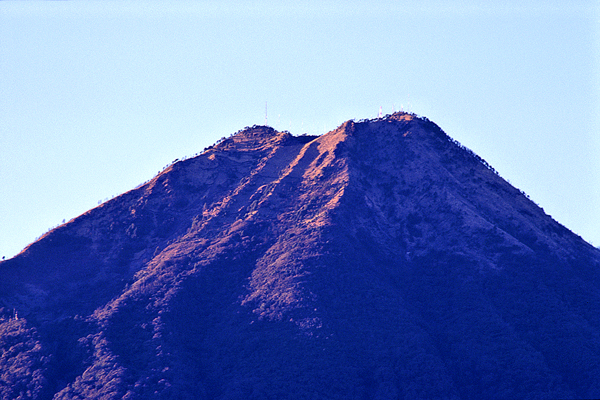
Le volcan à la forme conique au centre de l’image est l’Agua (3500 mètres) qui se dresse tout près de la ville d’Antigua (35 000 habitants), inscrite au Patrimoine Mondial de l’UNESCO. Le volcan tire son nom de la masse d’eau qui a accompagné un lahar en 1541. Quand j’ai visité Antigua, j’ai été impressionné par les traces laissées par le lahar sur le flanc du volcan et je me suis dit que ce n’était pas forcément une bonne idée de construire une ville à cet endroit.

 guatemala-volcanoes-02

Sommet de l’Agua et trace du lahar  (Photo:  C. Grandpey)

Derrière l’Agua, on distingue parfaitement deux autres volcans. Celui de gauche est le Fuego – le volcan de feu – qui a montré une belle activité au cours des derniers mois. L’éruption la plus significative a eu lieu en septembre 2012, avec l’évacuation de plus de 30 000 personnes dans les villages au pied du volcan.

A côté du Fuego se dresse l’Acatenango dont les dernières éruptions (sans caractère particulièrement explosif) remontent aux années 1920 et à 1972. La dernière éruption digne de ce nom s’est produite il y a environ 1900 ans.

 guatemala-volcanoes-03

Le Fuego et l’Acatenangovus depuis Antigua  (Photo:  C. Grandpey)

Le volcan au premier plan est le Pacaya dont la dernière éruption a eu lieu le 2 mars 2014 avec une activité strombolienne dans le cratère Mackenney et des coulées de lave.

 guatemala-volcanoes-04

Le Pacaya  (Photo: C.  Grandpey)

La liste des volcans actifs du Guatemala serait incomplète si l’on ne mentionnait pas le Santa Maria dont les éruptions ont tué plusieurs milliers de personnes en 1902 et 1929 (voir mon livre Killer Volcanoes). En 1922 est né le Santiaguito dont l’activité est quasi permanente.

guatemala-volcanoes-05

Vue du Santa Maria (3772 m.)  [Photo:  C.  Grandpey]

guatemala-volcanoes-06

Le Santiaguito vu depuis le sommet du Santa Maria  (Photo:  C. Grandpey)

 ———————————————

drapeau anglaisA four-week radar-imaging mission was recently performed in Guatemala. Its aim was to provide data on land deformation near volcanoes, which can indicate imminent activity and danger to vegetation data in forested areas. NASA’s C20-A aircraft, carrying a Synthetic Aperture Radar (SAR), could take a picture showing four volcanoes among the most active in the country. One can notice that all the volcanoes are located along a line due to the subduction of the Cocos plate beneath the Caribbean plate.

A larger image can be seen by clicking on this link:

http://i.livescience.com/images/i/000/065/328/original/guatemala-volcanoes-140424.jpeg?1398378062

The conical volcano in the middle of the image is Agua (3,500 metres), the mountain close to Antigua (pop. 35,000) and a UNESCO World Heritage site. The volcano gets its name from a 1541 lahar, because of the watery flood associated with this event. When I visited Antigua, I was impressed by the traces left by the lahar and I told myself that building a city so close to the volcano was not the best idea.

 Behind Agua, one can see two peaks. The one on the right is Fuego – the Volcano of Fire – which has been quite active during the past months. The most significant eruption occurred in September 2012 and led to the evacuation of more than 30,000 people from nearby villages.

Next to Fuego is Acatenango, which erupted in the 1920s and again in 1972, though those eruptions did not involve explosive ejections of ash and lava. The last explosive eruption of the volcano was about 1,900 years ago.

Finally, the volcano in the foreground is Pacaya whose most recent eruption was on March 2nd 2014 with strombolian activity in the Mackenney Crater and lava flows.

However, the list of Guatemala active volcanoes should also include Santa Maria whose eruptions killed several thousand people in 1902 and 1929. Santiaguito was born in 1922 at the foot of Santa Maria and has been quite active since then.


Cinq volcans du Kamchatka! // Five Kamchatka volcanoes!

drapeau francaisLa NASA a mis en ligne les photos de cinq volcans du Kamtchatka prises le 14 Avril par Landsat 8 lors d’un passage du satellite au-dessus de la péninsule: Shiveluch, Klyuchevskoy, Bezymianny, Kizimen et Karymsky.
http://earthobservatory.nasa.gov/IOTD/view.php?id=83502

En ce qui concerne l’activité, le niveau d’alerte du Shiveluch est Orange. Le dôme continue à croître. Des explosions modérées avec émissions de cendre, activité fumerollienne, incandescence au niveau du dôme et avalanches pyroclastiques accompagnent ce processus.
Le niveau d’alerte est également Orange pour le Karymsky où on enregistre une activité sismique modérée. L’activité strombolienne et vulcanienne modérée continue. Les données satellitaires montrent une faible anomalie thermique sur le volcan.
Source: KVERT.

 —————————————————-

drapeau anglaisNASA has released the photos of five Kamchatka volcanoes taken on April 14th by Landsat 8 during a single satellite pass: Shiveluch, Klyuchevskoy, Bezymianny, Kizimen and Karymsky.

http://earthobservatory.nasa.gov/IOTD/view.php?id=83502

As far as activity is concerned, the alert level for Shiveluch is Orange. A growth of the lava dome continues. Moderate ash explosions, fumarolic activity, incandescence of the dome and hot avalanches accompany this process.

The alert level is Orange for Karymsky as well. Moderate seismic activity is recorded. Strombolian and moderate vulcanian activity continues. Satellite data show a weak thermal anomaly over the volcano.

Source: KVERT.

Shiveluch-blog

Crédit photo:  NASA.

Photos du Kelud (Indonésie)

drapeau francaisEn cliquant sur le lien ci-dessous, vous verrez une galerie de photos montrant les transformations subies par le cratère du Kelud et les effets de la cendre sur la région.

http://www.oysteinlundandersen.com/Volcanoes/Kelud/Kelud-Volcano-Indonesia-February-2014.html

 ———————————————–

drapeau anglaisBy clicking on the link below, you will see a great gallery of photos showing the changes undergone by the crater of Mount Kelud, as well as the effects of the ash on the region.

http://www.oysteinlundandersen.com/Volcanoes/Kelud/Kelud-Volcano-Indonesia-February-2014.html

Le Mont St Helens, 33 ans après ! // Mount St Helens, 33 years later !

drapeau francaisUne pellicule photo vieille de 33 ans et non encore développée a été découverte par hasard dans les locaux du journal The Columbian. Elle contient des images encore jamais vues du Mont St Helens quelques jours avant son éruption.

Les photos ont été prises par Reid Blackburn, photographe pour le journal, avant qu’il soit lui-même victime de l’éruption. Il se trouvait à bord d’un avion quand il a pris les photos du sommet encore conique du Mont St Helens. Une semaine plus tard, il perdit la vie à bord de son véhicule en voulant couvrir l’événement. La pellicule est restée trois décennies dans sa boîte, perdue parmi les archives du journal. Son développement n’a pas été une mince affaire car avec le numérique, les laboratoires susceptibles de développer des films argentiques se font rares. C’est finalement un photographe privé qui a pris en, charge la pellicule.

Une petite vidéo donne une idée des photos en noir et blanc réalisées par Reid Blackburn.

http://www.king5.com/news/local/237402741.html

drapeau anglaisAn undeveloped roll of film from 33 years ago with never-before-seen photos of Mount Saint Helens days before it erupted just resurfaced at The Columbian newspaper.

The pictures were taken before Columbian photographer Reid Blackburn died in the May 1980 eruption. He went up in a plane to capture the images of the conical summit of the volcano. A week later, Blackburn was killed in his vehicle while covering the eruption.

The roll of film got lost in the newspaper’s archives before it was ever developed. Those unprocessed black-and-white images spent the next three decades coiled inside the film canister. The Columbian’s photo assistant recently discovered the roll in a studio storage box, and it was finally developed. The processing was not an easy task. Today, with digital technology, there are very few labs able to process conventional films. Finally, it was a private photographer who could perform this task.

A short video gives an idea of the black and white photos taken by Reid Balckburn :

http://www.king5.com/news/local/237402741.html