Nouvelle éruption à court terme en Islande ? // New eruption in the short term in Iceland ?

Alors que l’éruption qui a débuté le 16 mars 2024 se poursuit à Sundhnúksgígaröð, le Met Office islandais prévient qu’une nouvelle éruption pourrait commencer très prochainement dans la même zone. C’était l’un des scénarios imaginés par les volcanologues islandais il y a quelques jours.
L’activité sismique sur la péninsule de Reykjanes montre qu’une éruption pourrait se produire à tout moment. Les scientifiques pensent qu’elle interviendra plus ou moins dans le même secteur que les éruptions précédentes.
Un soulèvement du sol est de nouveau observé à Svartsengi depuis début avril, signe évident d’une accumulation de magma sous la surface. Le Met Office explique que la hausse a atteint un niveau tel qu’une éruption est désormais possible à tout moment. Cependant, il est peu probable qu’elle se produise ailleurs sur la péninsule. L’éruption pourrait avoir lieu près de Grindavík ou de Svartsengi.

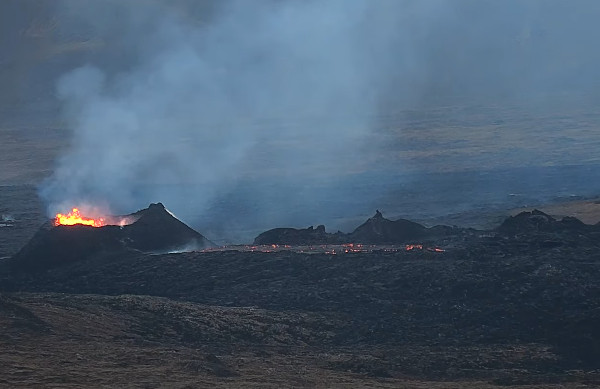
Image webcam de l’éruption le 21 avril 2024 au matin. Les projections sont moins intenses depuis quelques jours dans la bouche active. Pas sûr que le projet d’ouverture du site aux touristes tienne la route si une nouvelle éruption se déclenche…!

——————————————

While the eruption that started on March 16th, 2024 is still going on at Sundhnúksgígaröð, the Icelandic Met Office warns that another eruption might start very soon in the same area. It was one of the scenarios imagned by the Met Office a few days ago.

Seismic activity in Reykjanes is giving every indication that an eruption could occur at any moment. Scientists believe it will go off at roughly the same location as before.

Ground uplift has been again observed at Svartsengi since early April, a typical sign of magma gathering beneath the surface. The Met Office explains that the rising has reached a level where now an eruption is predicted to occur at any moment. However, it is unlikely that it will occur anywhere else but where it already is. As such, it may erupt near Grindavík or Svartsengi.

Islande : soulèvement du sol à Svartsengi et évolution possible de la situation // Iceland : ground uplift at Svartsengi and possible evolution of the situation

L’éruption qui a débuté le 16 mars 2024 au niveau du cratère Sundhnúkur sur la péninsule de Reykjanes, se poursuit à un rythme constant avec un débit de lave d’un peu plus de 3 mètres cubes par seconde. Depuis le 5 avril, un seul cratère est actif sur la fracture éruptive.
Lorsque l’éruption a commencé en mars, le soulèvement du sol à Svartsengi a considérablement ralenti et s’est presque arrêté. Cela indiquait qu’il existait un équilibre entre l’arrivée de magma dans le réservoir magmatique sous Svartsengi et le débit éruptif au niveau de la chaîne de cratères de Sundhnúkur.
Début avril, le soulèvement du sol a recommencé à augmenter à Svartsengi, et le volume de magma qui s’évacue maintenant à Sundhnúkur est identique à celui qui s’accumule dans le réservoir sous Svartsengi. Cela provoque une augmentation de la pression magmatique et donc un soulèvement du sol.

Soulèvement du sol à Svartsengi (Source: Met Office)

L’évolution actuelle est différente de celle des éruptions passées. Avec l’éruption actuelle, on a un débit de lave relativement stable au niveau du cratère Sundhnúkur et, en même temps, un soulèvement du sol à Svartsengi. On ne sait donc pas comment va évoluer la situation. Aujourd’hui, on ne peut exclure une montée du magma vers la surface avec une activité éruptive qui s’ajouterait à l’éruption en cours.
Si l’accumulation de magma se poursuit au même rythme, la probabilité d’une autre propagation du magma vers la surface augmentera dans les jours ou semaines à venir, même si l’éruption actuelle continue. Une telle situation n’a jusqu’à présent jamais été observée sur la péninsule de Reykjanes.
Dans son dernier rapport, le Met Office envisage plusieurs scénarios si la propagation du magma vers la surface coïncide avec l’éruption actuelle :
1) Le magma pourrait quitter le réservoir magmatique sous Svartsengi et atteindre la chaîne de cratères de Sundhnúkur, comme cela s’est produit au cours des six dernières éruptions.
2) Suite à l’arrivée d’un nouveau magma, de nouvelles fractures éruptives pourraient s’ouvrir dans la zone située entre Stóra-Skógfell et Hagafell et le cratère éruptif actuel pourrait s’agrandir en raison d’une augmentation soudaine du débit de lave.
3) Il est également possible que la propagation du magma vers la surface ne se produise pas, mais que le débit de l’éruption actuelle commence à augmenter régulièrement jusqu’à ce qu’un nouvel équilibre soit atteint entre l’arrivée de magma et le débit éruptif en surface. Cependant, si l’arrivée de magma en surface entraîne l’ouverture d’une nouvelle fracture éruptive ailleurs que dans la zone située entre Stóra-Skógfell et Hagafell, un tel scénario s’accompagnera très probablement d’une sismicité intense et d’une déformation beaucoup plus visible que lors des éruptions précédentes.
Source : Met Office.

Jusqu’à présent, l’accès au site de l’éruption sur la péninsule de Reykjanes était interdit, mais la situation pourrait bientôt changer. L’Office islandais du tourisme a mis en place un groupe de travail chargé de faire le nécessaire pour ceux qui souhaiteraient assister à l’éruption.
L’idée est d’ouvrir une zone près de Svartsengi avec accès par la Grindavíkurvegur du côté est. Des discussions sont en cours avec les propriétaires fonciers et, si elles aboutissent, le groupe de travail prévoit de créer un parking payant pour les visiteurs. C’est une bonne idée, mais l’éruption est beaucoup moins intense qu’il y a quelques semaines.

Source : Iceland Review.
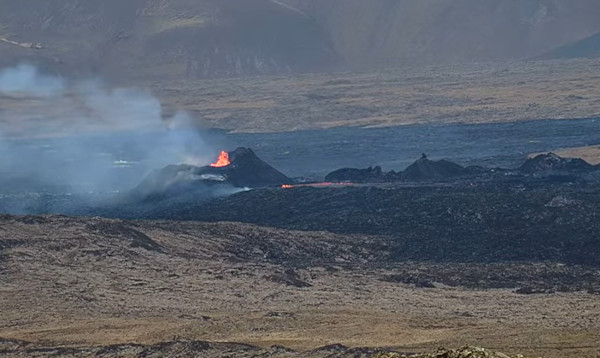
Vue de l’éruption le 19 avril 2024 (image webcam)

———————————————–

The eruption that started on March 16th, 2024 at the Sundhnúkur crater row on the Reykjanes Peninsula is going on at a steady rate with a lava flow just over 3 cubic meters per second. Since April 5th, only one crater has erupted.

When the eruption started in March, ground uplift at Svartsengi slowed down considerably and almost stopped. This indicated an equilibrium between magma inflow into the magma reservoir beneath Svartsengi, and to the surface at the Sundhnúkur crater row.

At the beginning of April, ground uplift began to increase again at Svartsengi, and a similar volume of magma is now being erupted at Sundhnúkur as is accumulated in the reservoir beneath Svartsengi, causing increased magma pressure, and thus ground uplift.

The current development is different from the past eruptions. With the current one, there is a relatively stable lava flow at Sundhnúkur crater row and, at the same time,ground uplift in Svartsengi. Therefore, there is more uncertainty now than before about the possible development of the event. Today, one cannot exclude a magma propagation to the surface during the ongoing eruption.

If magma accumulation continues at a similar rate, the likelihood of another magma propagation increases in the coming days or weeks, even though an eruption is still ongoing. This kind of situation has thus far not been seen before in the area.

In its latest report, the Met Office predicts deveral robable scenarios if magma propagation coincides with the current eruption:

  1. Magma might propagate from the magma reservoir beneath Svartsengi to the Sundhnúkur crater row, as has happened in the last six times.
  2. Following the magma propagation, new eruptive fissures could open in the area between Stóra-Skógfell and Hagafell and the current eruptive crater could be enlarged due to a sudden increase of lava flow.
  3. It is also possible that magma propagation will not occur, but that the flow of the current eruption will begin to increase steadily until a new equilibrium between the inflow of magma from below and flow to the surface from the crater is reached. However, if magma propagation results in a new eruptive fissure opening elsewhere than in the area between Stóra-Skógfell and Hagafell, such a scenario would very likely be accompanied by intense seismicity and deformation with considerably more notice than previous eruptions.

Source : Met Office.

Up to now, access to the eruption site on the Reykjanes Peninsula was prohibited, but the situation might change soon. The Icelandic Tourist Board leads a workgroup that has the task of preparing facilities for those who want to view the volcanic eruption.

The idea is to open an area near Svartsengi with access through Grindavíkurvegur road on the eastern side. Contracts are underway with land owners and if they are completed, the workgroup plans to make a parking space for those who want to witness the eruption. Visitors will be charged for access to the parking space. This is a good idea, but the eruption is far less intense than a few weekks ago.

Source : Iceland Review.
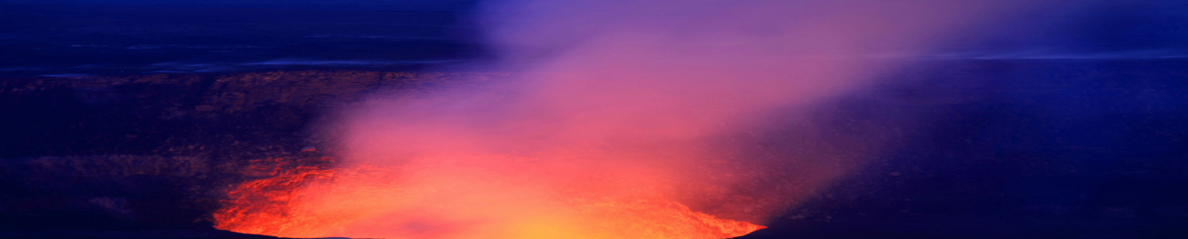
Islande : Source des éruptions de Fagradalsfjall et de Sundhnúkagígar // Iceland : Source of the Fagradalsfjall and Sundhnúkagígar eruptions

Depuis l’éruption de Fagradalsfall de 2021 à 2023 jusqu’à la dernière éruption sur la chaîne de cratères de Sundhnúkagígar, il y a eu, à un moment ou à un autre, des désaccords entre scientifiques sur ces événements. Cette fois, c’est le groupe de sismologues de l’Université d’Uppsala en Suède qui contredit la théorie islandaise sur l’emplacement de la chambre magmatique sous le mont Fagradalsfjall.
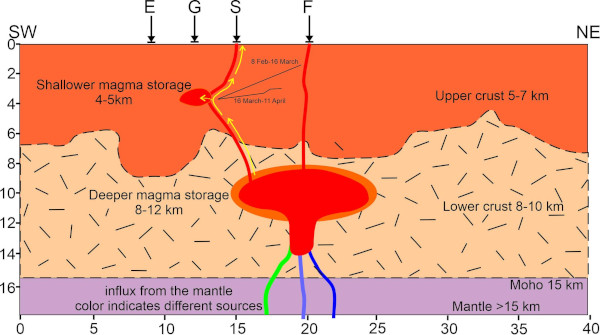
Jusqu’à présent, les scientifiques islandais pensaient que la chambre magmatique était située à la lisière supérieure du manteau, à plus de 15 km de profondeur. Cependant, selon les résultats des sismologues suédois, elle se trouve directement sous le mont Fagradalsfjall, à une profondeur de seulement 8 à 12 km, c’est-à-dire dans la partie supérieure de la croûte inférieure. La chambre magmatique en question mesure une dizaine de kilomètres de large et contient un magma plutôt primaire.

Le réservoir magmatique peu profond, qui est à l’origine de l’éruption actuelle, est situé à environ 4 ou 5 km sous le secteur de Svartsengi et contient un magma plus élaboré. Le magma s’écoule du réservoir magmatique profond vers le réservoir supérieur, ce qui explique l’inflation au niveau du secteur de Svartsengi. Lorsque le réservoir peu profond est plein et qu’il a accumulé environ 10 à 15 millions de mètres cubes de magma, son toit se brise et une éruption commence.

Le magma qui s’est écoulé lors des éruptions sur le système éruptif du mont Fagradalsfjall de 2021 à 2023 provenait directement du réservoir magmatique profond.
Le magma de l’éruption actuelle au niveau de la chaîne de cratères Sundhnúkagígar a également été observé dans le réservoir magmatique profond, mais il a fait une halte dans le réservoir le moins profond. Le magma semble y avoir séjourné pendant environ 3 à 5 semaines où il s’est modifié au cours du processus de différenciation, devenant plus léger avant de remonter à la surface lors de l’éruption. [NDLR : Une fois encore, cette différenciation subie par le magma au cours de son séjour dans une chambre magmatique me rappelle la théorie des ‘magmas TGV ‘ et des ‘magmas omnibus’ ru regretté Alain De Goër de Herve].
Source : Université d’Islande.

Source : Université d’Uppsala

—————————————————————

From the Fagradalsfall eruption from 2021 to 2023 to the latest eruption on the Sundhnúkagígar crater row, there have been, some time or other, disagreements among scientists about these events. This time, it is the findings of the Uppsala University of Sweden’s seismic group that contradict the previous notion of the location of the magma chamber under Mt Fagradalsfjall.

It was previously thought that the magma chamber was located at the top of the mantle at a depth of more than 15 km. However, according to the results of the Swedish seismologists, it is located directly under Mt Fagradalsfjall at a depth of 8 to 12 km, i.e. in the upper part of the lower crust.

The magma chamber in question is about 10 km wide and contains rather primitive magma.

The shallow magma reservoir, which is the source of the current eruption, is located about 4 to 5 km below Svartsengi, and it holds more advanced magma. The magma flows from the deeper magma reservoir to the upper reservoir, which is the cause of the inflation in Svartsengi. When the shallow reservoir is full, and has axccumulated about 10 to 15 million cubic meters of magma, the roof breaks and an eruption starts.

The magma that flowed in the eruptions in the Mt Fagradalsfjall system from 2021 to 2023 came directly from the deeper magma reservoir.

The magma in the current eruption at the Sundhnúkagígar crater row was detected from the deeper magma reservoir too, but with a stop in the shallower reservoir. The magma appeared to have been in the shallow reservoir for about 3 to 5 weeks where it developed, becoming lighter before it came to the surface during the the eruption.

Source : University of Iceland.

Péninsule de Reykjanes (Islande) : l’éruption continue // Reykjanes Peninsula (Iceland) : the eruption continues

20 mars 2024.

17 heures : L’éruption se poursuit aujourd’hui. Voici une capture d’écran de la webcam installée le long de la fissure éruptive ce matin à 7h00.

Il semble que l’émission de lave soit assez stable ou en légère baisse. Cependant, une inflation du sol est toujours enregistrée dans la région de Svartsengi, ce qui montre que le magma alimente toujours le réservoir superficiel.

Une image InSAR obtenue le 19 mars 2024 a montré des signes évidents d’inflation du sol dans le secteur de Svartsengi du 17 au 18 mars. Les données GPS du 18 mars laissent supposer que l’inflation pourrait diminuer dans les prochains jours. Cela pourrait être dû au fait que le magma s’écoule désormais facilement vers la surface le long de la fracture éruptive et ne s’accumule pas sous Svartsengi. L’évolution des données concernant l’éruption et la déformation du sol au cours des prochains jours permettra de savoir si un équilibre est atteint entre l’afflux de magma sous Svartsengi et l’émission de lave à la surface.

Il ne semble pas que l’éruption soit sur le point de se terminer ; elle a déjà duré plus longtemps que les trois autres éruptions survenues près de la chaîne de cratères Sundhnúkagígar. Cependant, l’expérience montre qu’une éruption dans la région peut s’arrêter brusquement.
Les éruptions précédentes ont commencé soudainement et l’activité a rapidement décliné, comme ce fut le cas avec cette éruption. Elles se sont ensuite arrêtées, alors que celle-ci se poursuit.
Le front des coulées semble avoir cessé de progresser et la nouvelle lave s’accumule maintenant sur l’ancienne. Le front de la coulée de lave la plus au sud se trouve à environ 300 mètres de la Suðurstrandarvegur qui ne semble donc pas menacée pour le moment.

Source : Met Office via Iceland Monitor.

—————————————————

March 20th, 2024.

5:00 pm : The eruption is continuing today. Here is a screenshot of the webcam along the eruptive fissure this morning at 7:00 am.

Il looks as if the lava output is fairly stable or slightly declining. However, ground inflation is still recorded in the Svartsengi area, showing that magma is still feeding the shallow reservoir.

An InSAR image published on March 19th, 2024 showed clear signs of land inflation in Svartsengi from 17 to 18 March. GPS data from 18 March suggest that the inflation rate is possibly decreasing. This could be due to magma now flowing towards the surface and therefore not accumulating beneath Svartsengi. The development of the eruption and deformation signals over the next few days will reveal whether an equilibrium will be reached between the magma inflow beneath Svartsengi and the lava flow on the surface.

It does not look as if the eruption is about to end, and it has already been longer than all the other three eruptions that have occurred near the Sundhnúkagígar crater row. However, experience also shows that an eruption in the region can stop suddenly.

The previous eruptions started with a bang and rapidly subsided, as has been the case with this eruption. They then stopped, which this one did not. .

The front of the lava flows seem to have stopped moving and the new lava seems to flow on top of the existing lava. The front of the south flow is about 300 metres from the Suðurstrandarvegur road.

Source : Met Office via Iceland Monitor.