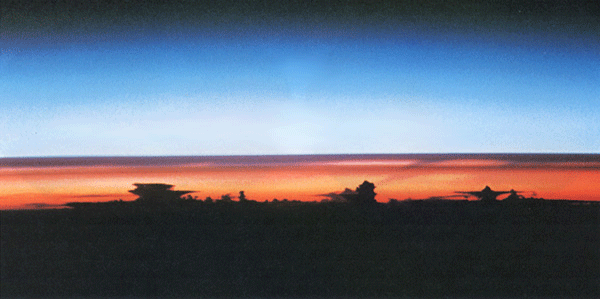
Nouvelles informations sur l’éruption du Hunga-Tonga Hunga-Ha’apai // More information on the Hunga-Tonga Hunga-Ha’apai eruption

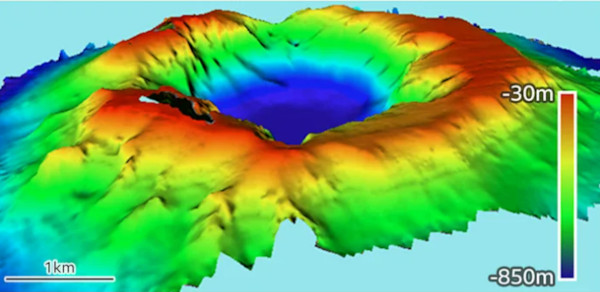
Des chercheurs viennent de terminer la cartographie du cratère du Hunga-Tonga Hunga-Ha’apai, le volcan sous-marin de l’archipel des Tonga qui, le 15 janvier 2022, a produit l’une des plus grandes explosions atmosphériques jamais observées sur Terre. La caldeira mesure maintenant 4 km de large et descend à 850 m sous le niveau de la mer. Avant l’éruption, la base du volcan était à une profondeur d’environ 150m. Le volume de matière émis est estimé à au moins 6,5 km3.
Des scientifiques de l’Université d’Auckland (Nouvelle-Zélande) ont publié un rapport qui analyse le processus éruptif et formule des recommandations pour la résilience future. Là encore, on remarquera que les scientifiques sont capables de décrire l’éruption, mais que personne n’a jamais été en mesure de la prévoir.
Bien qu’il soit peu probable que le Hunga-Tonga Hunga-Ha’apai (HTHH) produise une éruption semblable avant plusieurs siècles, il ne faudrait pas oublier qu’il existe au moins 10 volcans sous-marins dans cette région du Pacifique sud-ouest. Eux aussi pourraient entrer violemment en éruption sur une échelle de temps plus brève.
L’Institut national de recherche sur l’eau et l’atmosphère (NIWA) de Nouvelle-Zélande a publié une carte bathymétrique de la zone autour du volcan. Une comparaison avec les cartes de la caldeira, réalisées en 2015 et 2016, donc avant l’éruption, montre des changements majeurs.
En plus d’un approfondissement général de la caldeira, de grosses parties des parois intérieures de la falaise ont disparu, en particulier à l’extrémité sud du cratère. Cependant, le cône du volcan tel qu’il se présente aujourd’hui semble structurellement solide. La caldeira est un peu plus grande en diamètre et un peu moins profonde à cause des effondrements des côtés vers l’intérieur. Le côté nord-est semble un peu mince et fragile; s’il lâchait prise, un tsunami mettrait en danger les îles Ha’apai, mais la structure du volcan semble globalement assez robuste.
Les scientifiques commencent à avoir une bonne idée du processus éruptif. Les très nombreuses données d’observation obtenues le15 janvier montrent que l’événement a connu une surcharge dans la demi-heure après 17h00 (heure locale).
Au fur et à mesure que la caldeira s’est fracturée, l’eau de mer a commencé à interagir avec le magma à haute température qui se décompressait en remontant des profondeurs. Il y a eu des explosions assourdissantes causées par des interactions entre le magma et l’eau à grande échelle.
Les scientifiques néo-zélandais insistent sur l’importance des coulées pyroclastiques au cours de l’éruption. Les nuages de cendres et de roches très denses projetés dans le ciel sont retombés et ont roulé sur les flancs du volcan et sur le fond de l’océan. Ils sont en grande partie à l’origine des vagues de tsunami qui ont déferlé sur les côtes de l’archipel des Tonga. Ces vagues de tsunami atteignaient 18 m de hauteur à Kanokupolu, à l’ouest de Tongatapu (65 km au sud du HTHH) ; 20m de haut sur l’île Nomukeiki (une distance similaire mais au nord-est); 10m de haut sur les îles à des distances supérieures à 85 km du volcan.
Source : Université d’Auckland, NIWA.

—————————————–

Researchers have just finished mapping the crater of Hunga-Tonga Hunga-Ha’apai, the underwater Tongan volcano that, on January 15th, 2022, produced one of Earth’s biggest atmospheric explosions. The caldera of the volcano is now 4km wide and drops to a base 850m below sea level. Before the eruption, the base was at a depth of about 150m. The volume of material ejected by the volcano can thus be estimated at least 6.5 cubic km.

Scientists from the University of Auckland (New Zealand) have issued a report which assesses the eruption and makes recommendations for future resilience. Here again, we can notice that we are able to describe the eruption but nobody was ever able to predict it.

Although Hunga-Tonga Hunga-Ha’apai (HTHH) is unlikely to give a repeat performance for many hundreds of years, there are at least 10 volcanic seamounts in the wider region of the south-west Pacific that could produce something similar on a shorter timescale.

New Zealand’s National Institute for Water and Atmospheric (NIWA) Research has released a bathymetry map for the area immediately around the volcano. A comparison with pre-eruption maps of the caldera, made in 2016 and 2015, shows the major changes.

In addition to a general deepening, big chunks have been lost from the interior cliff walls, particularly at the southern end of the crater. However, the volcano cone as it stands today looks structurally sound. The caldera is a little bigger in diameter and a little shallower as the sides collapse inwards. The north-eastern side looks a bit thin and if that failed, a tsunami would endanger the Ha’apai islands. But the volcano’s structure looks quite robust.

Scientists are beginning to get a good idea of how the eruption progressed. The wealth of observational data from January 15th suggests the event became supercharged in the half-hour after 17:00 (local time).

As the caldera cracked, seawater was able to interact with decompressing hot magma being drawn up rapidly from depth. There were sonic booms caused by large-scale magma-water interactions.

NZ scientists insist on the significance of pyroclastic flows in the eruption. These thick dense clouds of ash and rock thrown into the sky fell back to roll down the sides of the volcano and along the ocean floor. They caused much of the tsunami wave activity that inundated coastlines across the Tongan archipelago. The tsunami waves were 18m high at Kanokupolu, on western Tongatapu (65km south of HTHH); 20m high on Nomukeiki Island (a similar distance but to the north-east); 10m high on islands at distances greater than 85 km from the volcano.

Source: University of Auckland, NIWA.
Source: Université d’Auckland
Source: Tonga Services
Autre conséquence de l’éruption du Hunga Tonga-Hunga Ha’apai // Another consequence of the Hunga Tonga-Hunga Ha’apai eruption

Lorsque le volcan Hunga Tonga-Hunga Ha’apai (archipel des Tonga) est entré en éruption le 15 janvier 2022, il a envoyé des ondes de choc dans l’atmosphère ainsi que des vagues de tsunami à travers notre planète. Aujourd’hui, une nouvelle étude publiée dans les Geophysical Research Letters montre que les effets de l’éruption ont également atteint l’espace, avec un événement météorologique spatial majeur.
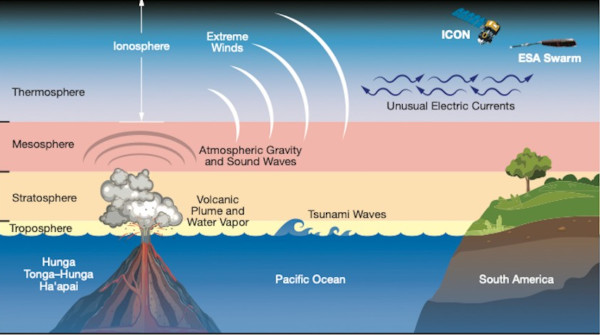
En analysant les données fournies par la mission Ionospheric Connection Explorer (ICON) de la NASA et des satellites Swarm de l’ESA, les scientifiques ont découvert que, dans les heures qui ont suivi l’éruption, des vents atteignant la vitesse d’un ouragan et des courants électriques inhabituels se sont formés dans l’ionosphère. Le rôle de la mission d’ICON est d’identifier comment la météo sur Terre interagit avec celle de l’espace, une idée relativement nouvelle qui annule les hypothèses précédentes selon lesquelles seules les forces du Soleil et de l’espace pouvaient influencer la météo en bordure de l’ionosphère.
L’éruption du Hunga Tonga a généré l’une des plus grandes perturbations spatiales jamais observées au cours de l’ère moderne. Elle permet aux scientifiques d’analyser le lien encore mal compris entre la basse atmosphère et l’espace. L’événement permet également d’étudier comment les événements sur Terre peuvent affecter la météo dans l’espace, à côté de l’influence de la météo spatiale sur la météo terrestre.
Lorsque le volcan est entré en éruption, il a envoyé un énorme panache de gaz, de vapeur d’eau et de poussière dans le ciel. L’explosion a également créé d’importantes perturbations de pression dans l’atmosphère, ce qui a provoqué des vents violents. Au fur et à mesure que ces vents se sont dirigés vers les couches atmosphériques plus minces, ils ont commencé à s’accélérer. Lorsqu’ils ont atteint l’ionosphère et les confins de l’espace, ICON a enregistré des vitesses de vent allant jusqu’à 725 km/h, ce qui en fait les vents les plus violents – en dessous de 195 km d’altitude – jamais mesurés par la mission depuis son lancement en 2019.
Dans l’ionosphère, ces vents très puissants ont également affecté les courants électriques. Les particules ionosphériques génèrent régulièrement un courant électrique qui se dirige vers l’est – l’électrojet équatorial – alimenté par les vents de la basse atmosphère. Après l’éruption, l’électrojet équatorial a atteint cinq fois sa puissance de crête normale et a radicalement changé de direction; il s’est dirigé vers l’ouest pendant une courte période. C’est quelque chose qui n’avait été observé auparavant que pendant de fortes tempêtes géomagnétiques.
On estime maintenant que l’indice d’explosivité volcanique (VEI) de l’éruption du Hunga Tonga a atteint 6 sur une échelle de 8 niveaux, ce qui la place parmi les plus grandes éruptions volcaniques jamais enregistrées avec des instruments géophysiques modernes.
Source, NASA, ESA, Geophysical Researcher Letters, The Watchers.

—————————————

When the Hunga Tonga-Hunga Ha‘apai volcano (Tonga archipelag) erupted on January 15th, 2022, it sent atmospheric shock waves and tsunami waves around the world. Now, a new research published in Geophysical Research Letters shows the effects of the eruption also reached space, causing a major space weather event.

Analyzing data from NASA’s Ionospheric Connection Explorer (ICON) mission and ESA’s Swarm satellites, scientists found that in the hours after the eruption, hurricane-speed winds and unusual electric currents formed in the ionosphere. In particular, ICON’s mission is to identify how Earth’s weather interacts with weather from space, a relatively new idea supplanting previous assumptions that only forces from the Sun and space could create weather at the edge of the ionosphere.

The Hunga Tongo eruption created one of the largest disturbances in space ever seen in the modern era. It is allowing scientists to test the poorly understood connection between the lower atmosphere and space. It also allows them to look at how events on Earth can affect weather in space, in addition to space weather affecting Earth.

When the volcano erupted, it sent a giant plume of gases, water vapour, and dust into the sky. The explosion also created large pressure disturbances in the atmosphere, leading to strong winds.

As the winds expanded upwards into thinner atmospheric layers, they began moving faster. Upon reaching the ionosphere and the edge of space, ICON clocked the windspeeds at up to 725 km/h, making them the strongest winds below 195 km altitude measured by the mission since its launch in 2019.

In the ionosphere, extreme winds also affected electric currents. Particles in the ionosphere regularly form an east-flowing electric current – the equatorial electrojet – powered by winds in the lower atmosphere. After the eruption, the equatorial electrojet surged to five times its normal peak power and dramatically flipped direction, flowing westward for a short period. This is something that was only previously seen with strong geomagnetic storms.

It is now estimated the Hunga Tonga’s volcanic explosivity index (VEI) reached 6 on a scale of 8 levels, placing it among the largest volcanic eruptions ever recorded with modern geophysical instrumentation.

Source, NASA, ESA, Geophysical Researcher Letters, The Watchers.

Source: Tonga Services

Source: NASA

Eruption du Hunga Tonga-Hunga-Ha’apai : pas d’effet sur la température terrestre // No impact on Earth’s temperature

Les scientifiques viennent de confirmer que l’éruption sous-marine du Hunga Tonga-Hunga Ha’apai en janvier 2022 n’affectera pas le climat de la Terre malgré la présence de nuages de cendres de dizaines de kilomètres de hauteur dans l’atmosphère (voir ma note précédente à ce sujet),
De puissantes éruptions volcaniques provoquent parfois un refroidissement à court terme de la planète, mais ce ne sera pas le cas avec le récent événement dans l’archipel des Tonga.
Une nouvelle étude confirme en effet les estimations précédentes. Elle indique que l’effet de refroidissement du Hunga Tonga ne dépasserait pas 0,004 ° C dans l’hémisphère nord et 0,01 ° C dans l’hémisphère sud, ce qui est encore moins que certaines estimations précédentes.
La clé de l’impact d’une éruption volcanique sur la température de la Terre est la quantité de dioxyde de soufre (SO2) qui a été émise par le volcan. En effet, dans l’atmosphère, le gaz forme des particules d’aérosol qui font obstacle à la lumière du soleil, avec diminution de la quantité d’énergie qui entre dans le système terrestre. Par exemple, l’éruption du Pinatubo en 1991 a entraîné un refroidissement d’environ 0,6°C qui a duré près de deux ans. La différence avec l’éruption aux Tonga, c’est que les cendres rejetées dans l’air par le Pinatubo contenaient environ 50 fois plus de dioxyde de soufre.
Source : space.com.

——————————————

Scientists have just confirmed that the Hunga Tonga submarine eruption in January 2022 will not affect Earth’s climate despite sending clouds of ash dozens of kilometers high into the atmosphere (see my previous post about this topic),

Powerful volcanic eruptions sometimes cause short-term cooling of the planet, but this won’t be the case of the recent Tonga event.

A new study confirms previous estimates, stating that the cooling effect of Hunga Tonga could range from just 0.004°C in the northern hemisphere to 0.01°C in the southern hemisphere, which is even less than some of the previous estimates expected.

The key to the impact of a volcanic eruption on the Earth’s temperature is the amounrt of sulfur dioxide (SO2) that has been emitted by the volcano. Indeed, in the atmosphere the gas forms aerosol particles, which deflect sunlight, thus decreasing the amount of energy that enters the Earth’s system. For example, the 1991 explosive eruption of Mount Pinatubo produced a cooling of about 0.6°C that lasted for nearly two years. The difference with the Tonga eruption is that the ash spewed into the air by Mount Pinatubo contained about 50 times as much sulfur dioxide.

Source: space.com.

Effet de l’éruption du Pinatubo sur l’atmosphère (Source : Wikipedia)

L’éruption du Hunga Tonga-Hunga Ha’apai (Tonga) a battu des records // The Hunga Tonga-Hunga Ha’apai eruption (Tonga) broke records

L’éruption sous-marine du Hunga Tonga-Hunga Ha’apai (archipel des Tonga) le 15 janvier 2022 a battu simultanément deux records : le panache volcanique a atteint des hauteurs encore jamais observées par les satellites, et l’éruption a généré un nombre encore jamais observé d’éclairs, avec près de 590 000 impacts de foudre en trois jours.
Deux satellites météorologiques – le Geostationary Operational Environmental Satellite 17 (GOES-17) de la NOAA et le Himawari-8 de l’Agence japonaise d’exploration aérospatiale – ont observé cette éruption exceptionnelle depuis l’espace, ce qui a permis aux scientifiques de calculer jusqu’où le panache avait pénétré dans l’atmosphère.Ils ont déterminé que, à son point culminant, le panache s’est élevé à une hauteur de 58 km, ce qui signifie qu’il a percé la mésosphère, la troisième couche de l’atmosphère. Après qu’une première explosion ait généré ce panache très volumineux, une nouvelle explosion a propulsé des cendres, du gaz et de la vapeur à plus de 50 km dans le ciel. A titre de comparaison, en 1991, le mont Pinatubo (Philippines) avait généré un panache qui s’étendait sur 35 km au-dessus du volcan. Dans la stratosphère (donc sous la mésosphère), le gaz et les cendres du volcan se sont accumulés et se sont étalés pour couvrir une superficie de 157 000 kilomètres carrés.
Pour étudier la foudre, l’équipe scientifique a utilisé les données de GLD360, un réseau de détection de foudre au sol. Ces données ont révélé que, sur les quelque 590 000 coups de foudre détectés lors de l’éruption, environ 400 000 se sont produits dans les six heures qui ont suivi la puissante explosion du 15 janvier.
Avant l’éruption du Hunga Tonga-Hunga Ha’apai, le plus grand événement de foudre volcanique s’était produit en Indonésie en 2018, lorsque l’Anak Krakatau est entré en éruption et a généré environ 340 000 éclairs en une semaine. Environ 56% de la foudre produite par l’éruption des Tonga a frappé la surface de la terre ou de l’océan, et plus de 1 300 impacts ont été recensés sur l’île principale des Tonga, Tongatapu.
La foudre peut se diviser en deux catégories. Un type de foudre a été causé par une « charge sèche », dans laquelle des cendres, des roches et des particules de lave entrent en collision dans l’air et échangent des électrons chargés négativement. Le deuxième type de foudre a été causé par la « charge de glace », qui se produit lorsque le panache volcanique atteint des hauteurs où l’eau peut geler et former des particules de glace qui s’entrechoquent.
Ces deux processus conduisent à des coups de foudre en provoquant l’accumulation d’électrons sur la partie inférieure des nuages; ces particules chargées négativement jaillissent ensuite vers des régions de nuages plus élevées et chargées positivement ou vers des régions chargées positivement du sol ou de la mer en dessous.
Source : space.com.

—————————————–

The submarine eruption that occurred in the Tonga archipelago on January 15th, 2022 shattered two records simultaneously: The volcanic plume reached greater heights than any eruption ever captured in the satellite record, and the eruption generated an unparalleled number of lightning strikes, with almost 590,000 bolts over the course of three days.

Two weather satellites – NOAA’s Geostationary Operational Environmental Satellite 17 (GOES-17) and the Japan Aerospace Exploration Agency’s Himawari-8 – captured the unusual eruption from above, allowing scientists to calculate just how far the plume penetrated the atmosphere.They determined that, at its highest point, the plume rose 58 km into the air, meaning it pierced the mesosphere, the third layer of the atmosphere. After an initial blast generated this towering plume, a secondary blast sent ash, gas and steam more than 50 km into the air. As a comparison,.in 1991, Mount Pinatubo (Philippines) unleashed a plume that extended 35 km above the volcano. In the stratosphere (beneath the mesosphere), gas and ash from the volcano accumulated and spread to cover an area of 157,000 square kilometers.

To study the lightning, the scientific team used data from GLD360, a ground-based lightning detection network. These data revealed that, of the nearly 590,000 lightning strikes that took place during the eruption, about 400,000 occurred within six hours after the big blast on January 15th.

Prior to the Tonga eruption, the largest volcanic lightning event happened in Indonesia in 2018, when Anak Krakatau erupted and generated about 340,000 lightning strikes over the course of a week. About 56% of the lightning during the Tonga eruption struck the surface of the land or ocean, and more than 1,300 strikes landed on Tonga’s main island of Tongatapu.

The lightning came in two categories. One type of lightning was caused by « dry charging, » in which ash, rocks and lava particles repeatedly collide in the air and swap negatively charged electrons. The second type of lightning was caused by « ice charging, » which occurs when the volcanic plume reaches heights where water can freeze and form ice particles that slam into each other.

Both of these processes lead to lightning strikes by causing electrons to build up on the undersides of the clouds; these negatively charged particles then leap to higher, positively charged regions of the clouds or to positively charged regions of the ground or sea below.

Source : space.com.

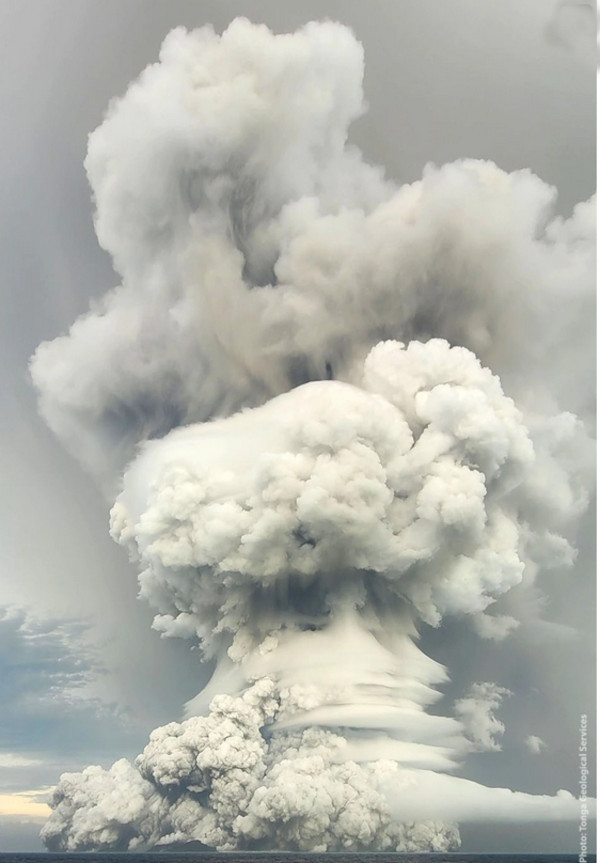
Panache émis par l’éruption du 15 janvier 2022 (Source: Tonga Services