 Selon une équipe scientifique du World Weather Attribution (WWA), le réchauffement climatique a largement contribué à l’effondrement catastrophique d’un glacier fin août, avec des inondations catastrophiques dans certaines régions du Népal et du Tibet. Environ 1 400 personnes ont perdu la vie et et des milliers d’autres sont portées disparues.
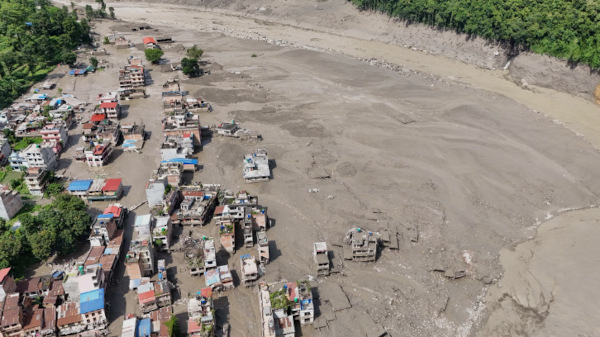
Le rapport du WWA indique que, bien qu’il soit difficile de déterminer avec précision le rôle joué par le réchauffement climatique dans l’effondrement d’une masse de roche et de glace couvrant environ deux kilomètres carrés sur le mont Langtang Lirung, la hausse des températures a créé les conditions propices à cet événement.
Selon les chercheurs, « il ne fait aucun doute que le changement climatique d’origine anthropique a joué un rôle dans la préparation du terrain pour cette catastrophe, avec la dégel du pergélisol, l’amincissement des glaciers et de la prédominance des précipitations pluvieuses sur les chutes de neige ».
Le rapport explique qu’en août, la température moyenne dans la région de l’Himalaya était supérieure d’environ 5 degrés Celsius à la normale, dont 1,5 °C imputable au réchauffement climatique.
Des chutes de neige inhabituellement abondantes en octobre et novembre 2025 ont également accru le volume d’eau de fonte lorsque les températures ont commencé à grimper, ce qui a probablement contribué à déclencher l’effondrement du glacier.
Les glaciers de la région s’amincissent d’environ 50 centimètres par an depuis l’an 2000, modifiant ainsi les contraintes exercées sur la roche. Le dégel du pergélisol a également pu fragiliser les parois rocheuses de l’encaissant du glacier.
Il convient de noter qu’un séisme de magnitude 7,8 a frappé la même montagne en 2015. Il a pu jouer un rôle en affaiblissant le substrat rocheux, bien que son impact exact reste indéterminé.
En conclusion, le rapport du WWA indique que la zone de l’effondrement glaciaire était géologiquement vulnérable et avait été potentiellement fragilisée par le séisme de 2015. Toutefois, elle a été davantage déstabilisée par le recul du glacier et le dégel du pergélisol, ainsi que par l’excès d’eau de fonte et la chaleur exceptionnelle enregistrés juste avant l’effondrement.
Source : WWA.
—————————————-
 According to the World Weather Attribution (WWA) group of researchers, global warming largely contributed to the catastrophic glacier collapse that flooded parts of Nepal and Tibet in late August, killing around 1,400 people and leaving thousands still missing.
The WWA report says that while it is difficult to ascertain the precise role played by global warming in the collapse of around 2 square kilometers of rock wall and glacier ice on the Langtang Lirung mountain last month, soaring temperatures created the preconditions that made it more likely.
According to the researchers, « there’s absolutely no doubt that human induced climate change played a role here in the preconditioning of the disaster through permafrost thawing, through thinning of the glaciers, through having more rainfall instead of snow.«
The report explains that mean temperatures were around 5 degrees Celsius higher than normal in the Himalayan region in August, with 1.5° C of the increase coming from global warming.
Unusually high levels of snowfall in October and November 2025 also added to the volume of meltwater once temperatures began to rise, which probably helped trigger the glacier collapse.
Glaciers in the region have been thinning by about half a metre per year since the year 2000, changing stresses on the rock. Melting permafrost is also likely to have weakened the rock wall.
It should also be remembered that an M 7.8 earthquake that hit the same mountain in 2015 could have played a role by weakening the underlying bedrock, but its precise impact is unclear.
In its conclusion, the WWA report says that the area of the glacier collase was geologically vulnerable, potentially weakened by the 2015 earthquake, but it was destabilised further by glacier and permafrost retreat and by the excessive meltwater and exceptional warmth in the final period before the collapse.
Source : WWA.

