
 Ce n’est pas une surprise: chaque fois que la sismicité augmente dans le Parc National de Yellowstone, certains craignent que le volcan entre en éruption et les tabloïds britanniques, que ce soit le Daily Star ou The Express, contribuent à faire souffler un vent de panique.
Comme je le mentionnais précédemment, un essaim sismique significatif a effectivement débuté le 12 juin 2017 sur la marge occidentale du Parc National de Yellowstone. Cependant, rien ne prouve que cet événement est annonciateur d’une éruption catastrophique dans un avenir prévisible et il n’est donc pas nécessaire de paniquer. Les essaims sismiques sont fréquents à Yellowstone et ils représentent environ 50% de la sismicité dans cette région des Etats-Unis.
Au cours de l’essaim sismique actuel, on a enregistré 464 événements d’une magnitude maximale de M 4,4 ; 5 autres secousses se situaient autour de M 3 ; 57 séismes avoisinaient M 2 ; 238 montraient une magnitude d’environ M 1. Ces différents séismes ont été localisés à des profondeurs de 0 à 14,5 km par rapport au niveau de la mer.
On remarquera qu’il s’agit du plus grand nombre de séismes enregistrés à Yellowstone en une seule semaine au cours des cinq dernières années. Malgré tout, ce nombre est inférieur aux recensements hebdomadaires lors d’essaims sismiques semblables en 2002, 2004, 2008 et 2010.
L’Observatoire n’a pas modifié les niveaux d’alerte. Le niveau d’alerte volcanique est Normal; La couleur de l’alerte aérienne est Verte.
Une nouvelle webcam orientée vers le sud-sud-est sur le lac Yellowstone a été installée sur le le relais de téléphonie mobile près de Fishing Bridge. Pour accéder à cette caméra et à d’autres caméras de Yellowstone, il suffit de cliquer sur ce lien:
https://volcanoes.usgs.gov/volcanoes/yellowstone/multimedia_webcams.html
—————————————–
 It does not come as a surprise: Each time seismicity increases at Yellowstone National Park, there are fears that the volcano might erupt and the British tabloids, whether the Daily Star or The Express – contribute to spreading a wave of panic.
As I put it before, it is true that an energetic earthquake swarm started on June 12th, 2017 on the western edge of Yellowstone National Park. However, there is no indication that this is heralding a catastrophic eruption in the foreseeable future and there is no need to panic. Earthquake swarms are common in Yellowstone and, on average, comprise about 50% of the total seismicity in the Yellowstone region.
The current seismic swarm is composed of 464 events with a maximum magnitude of M 4.4. 5 more earthquakes were in the M 3 range, 57 earthquakes in the M 2 range, 238 in the M 1 range. These events have depths from ~0.0 km to ~14.5 km, relative to sea level.
This is the highest number of earthquakes at Yellowstone within a single week in the past five years. However, this number is inferior to weekly counts during similar earthquakes swarms in 2002, 2004, 2008 and 2010.
The Yellowstone Volcano Observatory has not changed the alert levels. The current volcano alert level is Normal; the aviation colour code is Green.
It should be noted that a new webcam looking south-southeast over Yellowstone Lake has been installed on the cell phone tower near Fishing Bridge. To access this and other Yellowstone webcams, you just need to click on this link:
https://volcanoes.usgs.gov/volcanoes/yellowstone/multimedia_webcams.html
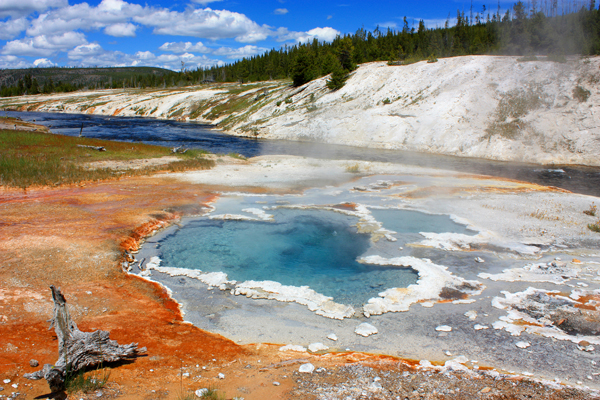
Photo: C. Grandpey

 Claude Grandpey : Volcans et Glaciers