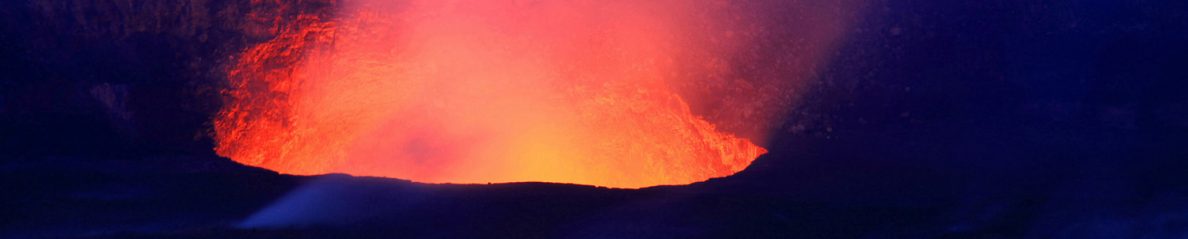
 Un article de la revue scientifique Elsevier nous apprend qu’une équipe de chercheurs italiens sous la houlette du Professeur Giuseppe Patanè a probablement découvert dans la Mer Ionienne, dans un secteur compris entre Riposto et Aci Castello, un volcan sous-marin couvrant une superficie d’environ 400 km2, donc encore plus grande que l’Etna. Bien qu’étant distant de quelques dizaines de kilomètres seulement du géant sicilien, le volcan sous-marin semble être totalement indépendant.
L’étude italienne renferme des révélations surprenantes, avec la démonstration de la théorie selon laquelle les violents séismes qui ont frappé la région de la Sicile ionienne au cours des siècles sont étroitement liés à l’activité du volcan sous-marin. Selon le Professeur Patanè, sa taille est impressionnante. « Nous l’avons toujours eu sous votre nez, mais personne n’a jamais remarqué son existence ! » Sa structure globale rappelle celle de l’Etna, avec une énorme dépression sur le versant oriental qui part de 500 mètres en dessous du niveau de la mer pour se terminer à 2500 mètres de profondeur. A titre de comparaison, le diamètre maximal de la Valle del Bove de l’Etna est de 7 km, celui de la caldeira submergée est de 20 kilomètres, donc trois fois plus grand.
La découverte du volcan sous-marin s’est faite par hasard, lorsque les chercheurs ont examiné une carte des fonds marins le long de la côte ionio-etnéenne. Ils ont vite repéré l’étrange morphologie en «fer à cheval» en face de Riposto et Acireale. L’équipe scientifique a décidé de poursuivre les recherches en utilisant les cartes de la Marine et avec l’aide des plongeurs du service incendie de Catane. Finalement, le traitement de toutes les données recueillies ne laisse aucun doute: Au large de Riposto et en descendant plus au sud jusqu’à Capo Mulini, il y a bien un ancien volcan!
La structure du volcan sous-marin remonte à une époque plus ancienne que l’Etna. Aucun signe d’activité n’a été décelé mais la présence de «fluides chauds » ne saurait être exclue.
Source : InMeteo.
 An article in the scientific journal Elsevier tells us that a team of Italian researchers led by Professor Giuseppe Patanè probably discovered in the Ionian Sea, in an area between Riposto and Aci Castello, a submarine volcano covering an area of about 400 km2, so even larger than Mount Etna. Although a few tens of kilometers away from the Sicilian giant, the underwater volcano seems to be totally independent.
The Italian study contains startling revelations, with the demonstration of the theory that earthquakes that struck the region of the Ionian Sicily over the centuries are closely linked to the activity of the underwater volcano. According to Professor Patanè, its size is impressive. « It’s always been under our nose, but nobody ever noticed its existence! » Its overall structure resembles that of Etna, with a huge depression on the eastern side which starts 500 meters below sea level and ends at a depth of 2500 meters. For comparison, the maximum diameter of Mount Etna’s Valle del Bove is 7 km while the width of the submerged caldera is 20 km, so three times larger.
The discovery of the underwater volcano was made by chance, when the researchers examined a map of the seabed along the Ionio-Etnean coast. They soon spotted the strange “horseshoe”morphology in front of Riposto and Acireale. The scientific team decided to continue the research using maps of the Navy and with the help of divers from Catania fire brigade. Finally, the processing of all the data leaves no doubt: Off Riposto and down further south to Capo Mulini there is an ancient volcano!
The structure of the underwater volcano dates back to an earlier period than Mount Etna. No sign of activity was detected but the presence of « hot fluids » should not be excluded.
Source: InMeteo.

Aci Castello est surtout connu pour les pillow lavas au pied du château (Photo: C. Grandpey)
 Claude Grandpey : Volcans et Glaciers
Il Professore Giuseppe Patanè, che da anni conosco e che mi onora della sua amicizia, è un eccellente docente presso l’ Università degli Studi di Catania ( ….per una volta onore anche all’Ateneo catanese per meriti nel campo della ricerca vulcanologica).
Pur esssendo uno scienziato acuto e di geniali intuizioni, il Professore Patanè non è mai, dico mai, rimasto sulla sommità di quella torre di avorio che troppo spesso sembra essere la dimora di tanti uomini di scienza.
Durante le crisi sismiche o sotto il pericolo di eruzioni, agli abitanti di Mascalucia o di Nicolosi capita di incontrare il loro »professore di vulcanologia » che riesce ragionevolmente a rassicurali con un non so che
di bonomia e di prudente ottimismo.
Egli si è anche occupato del rischio sismico nella Sicilia orientale, ed ha fatto studi sull’evoluzione morfologica dell’Etna.
Io non posseggo sufficienti competenze scientifiche per capire a fondo le sue geniali intuizioni nel campo della geologia applicata, ma una sua opera, scritta in collaborazione con J.C. Tanguy, quella sì l’ho capita, letta e riletta. L’ETNA ET LE MONDE DES VOLCANS (Diderot Editore, Parigi 1996) è una eccellente monografia scritta in uno stile rigorosamente scientifico ma comprensibile a tutte le intelligenze. Nessuna polemica scientifica, politica o sociale inquina una lucida esposizione dei fatti. Ciò ha reso l’opera di Patanè e Tanguy certamente apprezzata dagli autoctoni etnei, non troppo contenti negli anni passati di leggere un’opera omonima di H. Tazieff piena zeppa di di veleni e di inesattezze quando questi si immetteva disinvoltamente nel terreno incerto di una controversia scientifica e sociale che ignorava in quanto non siciliano.
Esprimo al caro amico Giuseppe Patanè stima profonda e sincera ammirazione.
Pippo Scarpinati
J’aimeJ’aime