Ours polaire abattu en Islande // Polar bear killed in Iceland

L’arrivée d’un ours en Islande, en provenance du Groenland, est un événement exceptionnel, mais il arrive que des plantigrades débarquent dans le nord-ouest de l’île, transportés par de petits icebergs qui se sont détachés de la banquise.

Un ours, probablement un jeune animal, a été observé sur une plage dans le Jökulfjörður et les autorités islandaises ont immédiatement décidé de l’abattre pour assurer la sécurité de la population de Höfðaströnd, où un homme vit actuellement dans une maison d’été.
La police a déclaré que c’était le seul moyen d’assurer la sécurité de la zone. « Les ours polaires sont dangereux. Personne ne va transporter de tels animaux vivants dans un hélicoptère ou un bateau. De plus, l’Agence de l’Environnement ne dispose pas du matériel nécessaire pour capturer des animaux vivants, il n’y avait donc pas d’autre solution que de tuer l’ours. »
Interrogée sur le sort de la carcasse de l’animal, la police a déclaré qu’elle sera transportée à Reykjavik où un laboratoire spécialisé l’examinera et prélèvera des échantillons. Il faudra être vigilant car les ours sont connus pour véhiculer des bactéries qui peuvent être dangereuses pour l ‘homme. L’ours peut aussi être porteur de la rage et de la grippe aviaire. Un échantillon d’ADN permettra de savoir à quelle population du Groenland il appartient.
Beaucoup d’Islandais sont très mécontents quand des ours polaires sont abattus. Un policier a déclaré qu’il doit débrancher son téléphone la nuit car les gens appellent pour demander de ne pas tuer les ours et les laisser partir.
Les autorités islandaises ont contacté un vétérinaire du Groenland lorsque l’ours a été vu pour la première fois sur la plage, mais le vétérinaire a dit que les Groenlandais n’en voulaient pas parce qu’ils ont assez d’animaux.
Une tentative a déjà été effectuée pour sauver un ours polaire qui avait débarqué en Islande en 2008, mais elle n’a pas abouti. Un chercheur de l’Institut d’histoire naturelle a expliqué que « tout avait été fait pour l’éloigner, un navire avait même été prévu, mais les Groenlandais ont simplement dit « Non, nous ne l’acceptons pas. Il peut s’agir d’un animal malade ».
Source : Iceland Monitor.
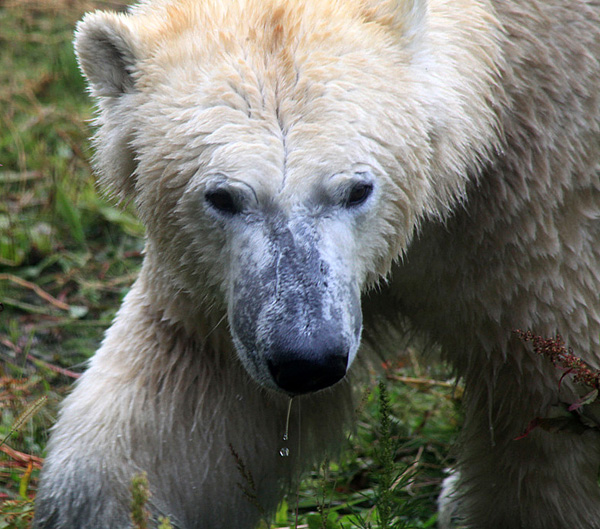
Photo: C. Grandpey

———————————————

The arrival of a polar bear in Iceland is an exceptional event, but animals from Greenland may land in northwest Iceland, carried by small icebergs that detached from Greenland’s sea ice. One of them, probably a young animal, was observed on a beach in Iceland’s Jökulfjörður in the Westfjords, and Icelandic authorities decided to kill it to ensure the safety of people at Höfðaströnd where one adult lives in a summer house.

The police said this was the only way to do ensure the safety of the area. « Polar bears are dangerous. No one is going to take such animals alive in a helicopter or boat. Moreover, the Environment Agency does not have the equipment needed to capture animals alive, so there was no other resources than to kill the bear. »

Asked what will happen to the carcass of the animal, the police said it will be transported to Reykjavík where a natural science laboratory will examine it and take samples. Various things will be checked because the bears are known for being exposed to bacteria that can be dangerous to humans. The bear can carry rabies and bird flu. A DNA sample will also allow to know which of the Greenland population it is.

Many people in Iceland get very angry when polar bears are shot. A policeman said he usually has to unplug the phone at night because people call to ask not to shoot the bears but to let them go.

Icelandic authorities talked to a vet in Greenland when the bear was first seen on the beach, but the vet said that they didn’t want him at all because they have enough animals.

An attempt was already made to save a polar bear that landed in Iceland in 2008, but that it was unsuccessful. A researcher at the Natural History Institute of Iceland explained that « everything was supposed to be done to get it away, a guard ship was waiting outside and everything, but the Greenlanders just said « No, we do not accept this. It can be a sick animal’. »

Source : Iceland Monitor.

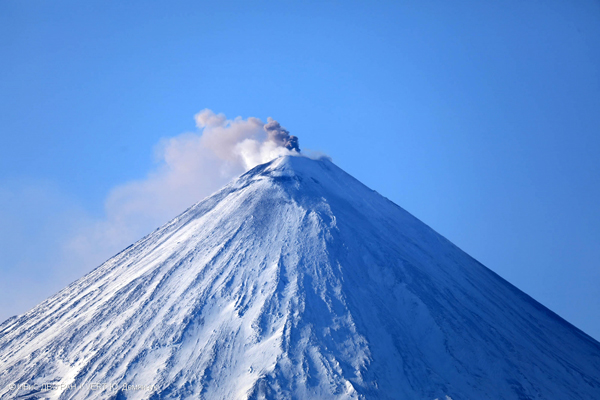
Mort sur le Klyuchevskoy (Kamchatka) // Death on Klyuchevskoy (Kamchatka)

Au moins six alpinistes russes sont morts en escaladant le Klyuchevskoy (Kamtchatka). Les sauveteurs n’ont pas pu atteindre six autres personnes en raison du mauvais temps. On pense que deux des alpinistes en détresse s’abritent dans un camp à 3 300 m d’altitude et quatre autres dans une tente à 4 000 m.
Le groupe de 12 personnes, dont deux guides, a commencé son ascension vers le sommet de 4 754 m le 30 août. Quatre jours plus tard, quatre alpinistes se seraient tués lors d’une chute à environ 4 000 m. Deux autres sont morts peu de temps après. L’un des guides se serait cassé la jambe et l’état des autres alpinistes n’est pas connu pour le moment.
À l’heure actuelle, la couleur de l’alerte aérienne est Jaune pour le Klyuchevskoy, tout comme pour le Bezymianny. Elle est Orange pour l’Ebeko, le Karymsky et le Sheveluch.

Les volczns peuvent tuer sans être en éruption…
Source : médias d’information internationaux, KVERT.

—————————————–

At least six Russian climbers have died while climbing Klyuchevskoy (Kamchatka). Rescuers were unable to reach another six climbers because of bad weather. Two of the climbers are believed to be sheltering in a camp at 3,300m above sea level, and another four in a tent at 4,000m.
The 12-strong group, which included two guides, began their ascend to the 4,754m summit on August 30th. Four days later, four climbers are believed to have been killed instantly after a fall at about 4,000m. Another two died shortly afterwards. One of the guides is reported to have broken his leg and the condition of the remaining climbers was not immediately known.

At the moment, the aviation colour code fo Klyuchevskoy is Yellow, as vell as for Bezymianny. It is Orange for Ebeko, Karymsky and Sheveluch.

Volcanoes can kill without erupting…

Source: International news media, KVERT

Crédit photo : KVERT

Parc National des Virunga (RDC) = Danger ! // Virunga National Park (DRC) = Danger !

Situé à la frontière avec le Rwanda et l’Ouganda, le Parc National des Virunga en République Démocratique du Congo s’étend sur 7800 km² dans la province du Nord-Kivu. Des bords du lac Kivu au volcan Nyiragongo, à la sortie de Goma, jusqu’aux monts Rwenzori à la frontière avec l’Ouganda vers le nord, le plus ancien parc naturel d’Afrique sert de refuge à des espèces menacées comme le gorille des montagnes,  passion de la célèbre primatologue Dian Fossey, assassinée en 1985.

Dans un article publié le 18 février 2019 France Info nous apprenait que le parc national des Virunga était de nouveau accessible aux touristes après plus de neuf mois de fermeture imposée par plusieurs incidents meurtriers. Le 11 mai 2018, une ranger avait été tuée et trois personnes, dont deux touristes britanniques, avaient été enlevées puis libérées. Entre le 9 avril et le 21 mai de la même année, deux militaires, un civil, cinq gardes et un chauffeur avaient également été abattus dans le parc par des hommes armés non identifiés.

En 2019, la sécurité du parc a été soumise à un audit et les rapports ont révélé que tous les indicateurs sécuritaires étaient bons. C’est qui a justifié la réouverture aux touristes le 15 février 2019 des deux premiers sites du parc, le volcan Nyiragongo, et le site de Kibumba où vivent les gorilles de montagne.

L’embellie aura été de courte durée. Le 10 janvier 2021, au moins six éco-gardes ont été tués dans le parc national des Virunga au cours d’une attaque perpétrée par des hommes armés, probablement des Maï-Maï, un groupe de miliciens aux activités criminelles. L’attaque a eu lieu dans l’espace situé entre Nyamitwitwi et Nyamilima, dans le centre du parc. Le parc a bien sûr été de nouveau fermé aux visiteurs.

Créé en 1925, le parc national des Virunga est inscrit au patrimoine mondial de l’Unesco. Joyau naturel, les Virunga sont aussi le théâtre des confits de la région troublée du Nord-Kivu, où des groupes armés se disputent le contrôle des richesses du sol et du sous-sol. Le parc est surveillé par 689 rangers armés, dont au moins 200 ont été tués dans l’exercice de leurs fonctions, dans l’histoire récente du parc.

——————————————-

Located on the border with Rwanda and Uganda, the Virunga National Park in the Democratic Republic of the Congo covers an area of  7,800 km² in the province of North Kivu. From the shores of Lake Kivu to the Nyiragongo volcano, on the outskirts of Goma, to the Rwenzori mountains on the border with Uganda to the north, Africa’s oldest natural park serves as a refuge for endangered species such as the mountain gorillas, the passion of the famous primatologist Dian Fossey, murdered in 1985.

In an article published on February 18th, 2019, France Info informed us that the Virunga National Park was again accessible to tourists after more than nine months of closure imposed by several deadly incidents. On May 11th, 2018, a ranger was killed and three people, including two British tourists, were kidnapped and then released. Between April 9th and May 21st of the same year, two soldiers, a civilian, five guards and a driver were also shot dead in the park by unidentified gunmen.

In 2019, the park’s safety was audited and reports found that all safety indicators were good. This is what justified the reopening to tourists on February 15th, 2019 of the first two sites of the park, the Nyiragongo volcano, and the Kibumba site where mountain gorillas live.

The upturn was short-lived. On January 10th, 2021, at least six eco-guards were killed in Virunga National Park in an attack by armed men, possibly Mai-Mai, a militia group with criminal activities. The attack took place in the space between Nyamitwitwi and Nyamilima, in the center of the park. The park was of course closed to visitors again.

Created in 1925, Virunga National Park is a UNESCO World Heritage Site. A natural jewel, the Virunga are also the scene of conflicts in the troubled region of North Kivu, where armed groups are vying for control of the riches of the soil and the subsoil. The park is guarded by 689 armed rangers, of whom at least 200 have been killed in the line of duty, in the park’s recent history.

Lac de lave du Nyiragongo (Crédit photo : Wikipedia)

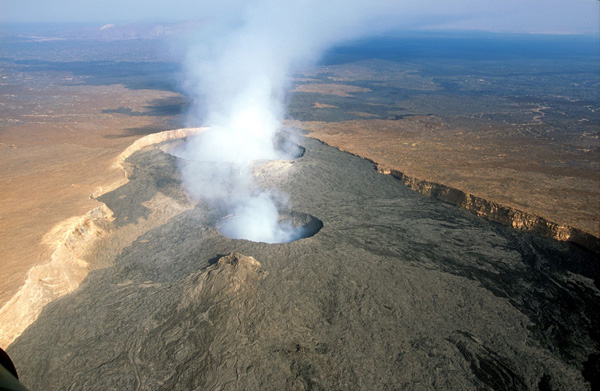
Sécurité sur l’Erta Ale ? Pas si sûr ! // Safety on Erta Ale Volcano ? Not so sure !

Selon plusieurs agences de presse, parmi lesquelles le très sérieux site BBC News, un touriste allemand a été tué et un guide blessé dimanche dernier lors d’une visite del’Erta Ale, dans le nord-est de l’Ethiopie. Ils faisaient partie d’un groupe qui visitait le volcan. On ne sait pas qui a mené l’attaque, mais le gouvernement éthiopien a lancé une enquête.
La région de l’Afar, à cheval sur la frontière entre l’Érythrée et l’Éthiopie, est fréquentée par plusieurs groupes séparatistes. Il y a cinq ans, le Front Démocratique Révolutionnaire Afar – le plus important de ces groupes – a revendiqué la mort de cinq touristes et l’enlèvement de quatre autres dans la région d’Afar. Le groupe prône la création d’une terre Afar indépendante, qui comprendrait des régions d’Éthiopie, d’Érythrée et de Djibouti.
J’ai toujours été fasciné par cette région et tenté de visiter l’Erta Ale et la dépression du Danakil avec ses couleurs fantastiques. Cependant, je n’ai jamais effectué le voyage pour des raisons de sécurité. Je ne veux plus être accompagné par des gardes armés comme ce fut le cas lors de ma visite au volcan Pacaya au Guatemala dans les années 1990. Les agences de voyages affirment régulièrement que la sécurité n’est pas un problème dans la région de l’Erta Ale mais le dernier événement tragique prouve que ce n’est pas vrai.

—————————————

According to several press agencies, among which the very serious website BBC News, a German tourist was shot dead and a guide injured last Sunday during a visit to Erta Ale in north-eastern Ethiopia. They were part of a group which had travelled to the volcano. It is not known who carried out the attack, but the Ethiopian government has launched an investigation.

The Afar region, which straddles the border between Eritrea and Ethiopia, is known as an operating ground for several separatist groups. Five years ago, the Afar Revolutionary Democratic Front – the most prominent of the groups – claimed responsibility for the deaths of five tourists and the abduction of four others in the Afar region. The group seeks the creation of an independent Afar homeland, which would include areas of Ethiopia, Eritrea and Djibouti.

I have always been fascinated and tempted to visit Erta Ale and the Danakil depression with its fantastic colours. However, I have never performed the trip for safety reasons. I no longer want to be accompanied by armed guards as was the case when I visited Pacaya volcano in Guatemala in the 1990s. Travel agencies regularly affirm that security is not a problem in the Erta Ale region but the last tragic event proves this is not true.

Crédit photo: Wikipedia