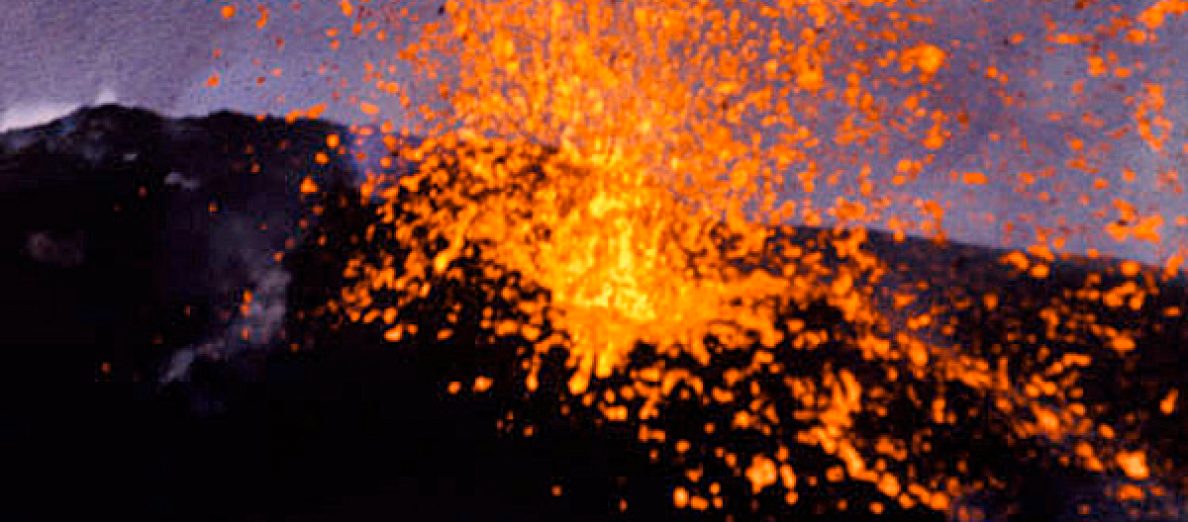
 En mai 2006 un torrent de boue se déversait près de la ville de Sidoarjo, dans l’est de l’île de Java. Baptisé Lusi, il a recouvert une douzaine de villages, des usines, une autoroute et une voie ferrée. Il a aussi entraîné l’évacuation de plus de 40 000 personnes, avec un bilan humain de douze morts. De nombreux scientifiques estiment que la catastrophe a été provoquée par un forage exploratoire de gaz effectué par la société Lapindo Brantas, qui appartient à l’un des hommes les plus riches du pays, Aburizal Bakrie. De son côté, la compagnie affirme qu’elle est liée à un séisme survenu deux jours plus tôt dans le centre de Java. Lapindo Brantas a cependant accepté de verser 380 millions de dollars de compensation à quelque 10 000 familles.
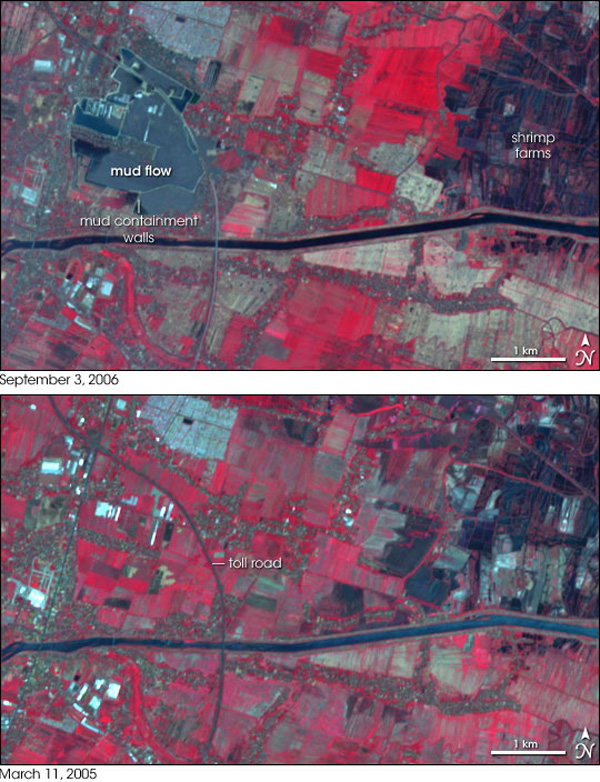
Sidoarjo avant et après la catastrophe du 28 mai 2006 (Source: NASA)
Aujourd’hui, les habitants d’un village du nord de Sumatra craignent d’être confrontés à une catastrophe semblable à celle de Sidoarjo. Des coulées de boue à haute température ont été observées dans le village de Roburan Dolok le 25 avril 2025. L’Agence nationale de gestion des catastrophes (BNPB) parle de 21 éruptions réparties sur cinq sites le 30 avril.
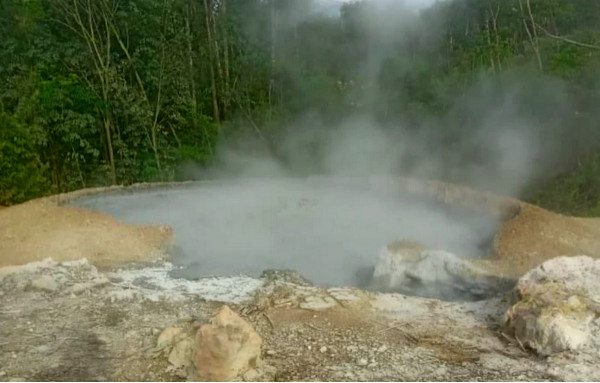
La boue à Roburan Dolok (Crédit photo: BNPB)
Selon la BNPB, la boue a détruit ou endommagé quelque 5 hectares de plantations d’hévéas. D’autres rapports locaux indiquent que les dégâts concernent une zone beaucoup plus vaste et affectent également les rizières, rendant certaines terres infertiles.
D’après les habitants, ce n’est pas la première fois que des coulées de boue affectent le village, mais leur fréquence augmente depuis 2018 et s’est intensifiée ces derniers mois.
La boue a contaminé l’approvisionnement en eau de quatre villages, tandis que les émissions de gaz ont pollué Roburan Dolok. Cependant, la BNPB a assuré aux habitants que ces émissions ne contiennent pas de sulfure d’hydrogène (H2S).
La plupart des coulées de boue se situent à seulement 10 à 15 mètres d’un site de forage exploité par la société PT Sorik Marapi Geothermal Power (SMGP). L’entreprise a nié tout lien entre ses activités et les coulées de boue du village de Roburan Dolok, affirmant qu’il s’agissait d’un phénomène naturel qui se produit dans la région depuis quatre ans. La société explique également qu’elle a foré le site en 2017, mais a interrompu ses activités faute de ressources géothermiques. On craint malgré tout que la propagation de la coulée de boue soit liée aux activités de PT SMGP qui aurait été impliquée dans plusieurs catastrophes dans la région depuis le début de ses activités en 2017. Ainsi, en février 2024, des habitants de Sibanggor Julu et Sibanggor Tonga, situés à environ 9 km du village de Roburan Dolok, sont tombés malades peu après le début de l’exploitation par SMGP d’un puits géothermique foré à environ 700 mètres de là. Au moins 123 personnes ont été hospitalisées pour suspicion d’intoxication au gaz toxique. Des incidents similaires se sont produits en 2022 et 2021 ; ils ont touché des dizaines de personnes et causé cinq décès
Il a été demandé au gouvernement indonésien d’agir immédiatement car les habitants craignent une répétition de la catastrophe dévastatrice du volcan de boue de Sidoarjo où la boue continue de s’écouler…
Source : Asia News Network.
——————————————-
 In May 2006 a mudflow flooded the area near the town of Sidoarjo in eastern Java. Called Lusi, it buried a dozen villages, factories, a highway and a railway. It also forced the evacuation of over 40,000 people, with a death toll of twelve. Many scientists believe that the disaster was caused by an exploratory drilling carried out by the gas company Lapindo which belongs to one of the richest men in the country, Aburizal Bakrie. For its part, the company says it is linked to an earthquake that had occurred two days before in central Java. Lapindo has however agreed to pay $ 380 million compensation to some 10,000 families.
Today, residents of a village in North Sumatra fear another Sidiarjo disaster. Hot mudflows struck the Roburan Dolok village on April 25 2025, with the National Disaster Management Agency (BNPB) confirming 21 eruptions spread across five locations on April 30.
According to the BNPB, the eruptions have destroyed or damaged about 5 hectares of rubber plantations. Meanwhile, some local reports indicate that the damage has extended to a much greater area, affecting rice crops as well, and leaving some lands infertile.
According to the locals, the village is no stranger to hot mudflows, but their frequency has been increasing since 2018, and it has intensified in the last few months.
The mud has contaminated the water supply of 4 villages, while the gas emissions have polluted Roburan Dolok. However, the BNPB assured the residents that the emissions are free from hydrogen sulfide (H2S).
Most of the mudflow eruptions are located just 10 to 15 meters from a drilling site operated by PT Sorik Marapi Geothermal Power (SMGP). The company has denied any link between their operations and the mudflow eruptions in Roburan Dolok village, claiming that the incidents are a natural phenomenon that has been occurring in the area for the past four years. The company claims they drilled the site in 2017 but halted their activities because of a lack of geothermal resources. It is suspected that the spreading mudflow is linked to the company’s operations. It is said that PT SMGP has been linked to several disasters in the region since the company began operations in 2017. In February 2024, residents of Sibanggor Julu and Sibanggor Tonga, about 9 km from Roburan Dolok Village, fell ill shortly after SMGP began operating a recently drilled geothermal well about 700 meters away. At least 123 people were hospitalized for suspected toxic gas poisoning. Similar incidents occurred in 2022 and 2021, affecting dozens of people and resulting in five fatalities.
The Indonesian government has been asked to take immediate action, warning that local residents are terrified of a repeat of the devastating Sidoarjo mud volcano which continues to erupt to this day.
Source : Asia News Network.
 Claude Grandpey : Volcans et Glaciers