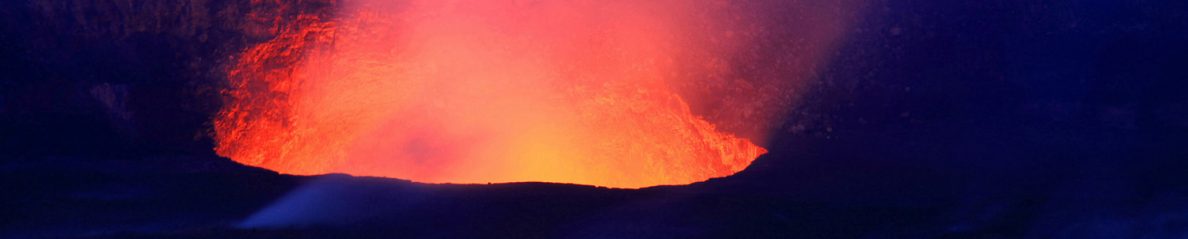
Photos du Kelud (Indonésie)

drapeau francaisEn cliquant sur le lien ci-dessous, vous verrez une galerie de photos montrant les transformations subies par le cratère du Kelud et les effets de la cendre sur la région.

http://www.oysteinlundandersen.com/Volcanoes/Kelud/Kelud-Volcano-Indonesia-February-2014.html

 ———————————————–

drapeau anglaisBy clicking on the link below, you will see a great gallery of photos showing the changes undergone by the crater of Mount Kelud, as well as the effects of the ash on the region.

http://www.oysteinlundandersen.com/Volcanoes/Kelud/Kelud-Volcano-Indonesia-February-2014.html

Les tornades du Sinabung (suite) // Mount Sinabung’s tornadoes (continued)

drapeau francaisJ’aimerais revenir sur ma note intitulée « Les tornades du Sinabung » mise en ligne le 5 février dernier. Comme je l’indiquais, ces tornades n’en sont pas vraiment. En cliquant sur le lien ci-dessous, vous trouverez un article (en anglais) expliquant comment se forme ce phénomène.

On peut lire que les vraies tornades se présentent sous la forme d’un nuage en entonnoir relié au sol à sa base et à la partie inférieure d’un cumulonimbus à son sommet. Ces tornades se forment du haut vers le bas, à partir de la base du nuage.

Dans le cas des tourbillons du Sinabung, c’est l’inverse ; ils partent du sol. Les coulées pyroclastiques réchauffent l’air au-dessus du sol et le font donc s’élever. L’air qui se trouve sur les côtés vient s’engouffrer dans le vide partiel qui s’est créé. C’est ce qui génère ces tourbillons qui peuvent prendre de l’ampleur et donner naissance aux vortex que l’on voit dans la vidéo. Des tourbillons semblables apparaissent également pendant les incendies de forêts à grande échelle. Comme je l’indiquais dans ma note, les Américains ont baptisés ces tourbillons « dust devils » et les Australiens les appellent « willy-willies ».

L’article inclut une formidable photo d’un nuage de cendre du Sinabung, prise le 7 janvier 2014.

http://www.slate.com/blogs/bad_astronomy/2014/0/07/volcano_twisters_ash_devils_spawned_from_sinabung.html?wpisrc=burger_bar

———————————————-

drapeau anglaisI’d like to come back to my note entitled « Mount Sinabung’s tornadoes « released on February 5th . As I put it, these tornadoes are not really tornadoes. By clicking on the link below, you will find an article (in English) explaining how this phenomenon develops.
One can read the real tornadoes are when a funnel cloud is connected to the ground at its bottom and the base of a cumulonimbus cloud at its top. They form from the top down, dropping from the cloud base.

In the case of Mount Sinabung’s swirls, the phenomena are built from the ground up. The pyroclastic flow heats the air over the ground, causing it to rise. Air from the sides then rushes in to fill the partial vacuum. This creates swirls which can get amplified into the vortices seen in the video. Similar vortices also appear during large-scale forest fires. As I wrote in my note, Americans have called these vortices « dust devils » and the Australians « willy – willies ».
The article includes a great photo of an ash cloud from Sinabung, taken on January 7th, 2014 .

http://www.slate.com/blogs/bad_astronomy/2014/0/07/volcano_twisters_ash_devils_spawned_from_sinabung.html?wpisrc=burger_bar

Image satellite du Vanuatu

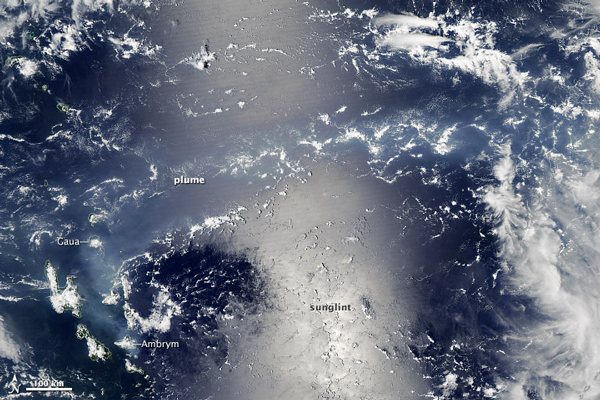
drapeau francaisLa NASA a mis en ligne une image (les couleurs sont réelles) de l’archipel du Vanuatu prise le 7 janvier 2014 par le satellite Aqua. Un vaste panache de brouillard volcanique (baptisé « smog » par les Américains) s’élève d’Ambrym et s’étire à travers le Pacifique Sud, avec une branche vers le NO et une autre vers le NE.

Actuellement, les volcans les plus actifs du Vanuatu sont le Yasur et son activité strombolienne sur l’île de Tanna, tandis que l’on observe le Benbow et le Marum sur l’île d’Ambrym. Un spectaculaire chaudron de lave s’agite au fond du cratère du Benbow.

La dernière éruption d’Ambrym a eu lieu en 1913 et a entraîné la mort de 21 personnes. Elle est décrite en détail dans mon livre Killer Volcanoes (voir colonne de gauche de ce blog).

drapeau anglaisNASA has released a true-colour image of the Vanuatu archipelago taken on January 7th 2014 by the Aqua satellite. A broad plume of volcanic vog (a combination of “volcanic” and “smog”) and ash rises from Ambrym and spreads across the South Pacific, arching from the volcanic island both to the northwest and to the northeast.

Currently, the most active volcanoes at Vanuatu are Yasur which shows strombolian activity on Tanna Island while Marum and Benbow are to be seen at Ambrym, with a nice lava caldron deep inside Benbow’s crater.

The last eruption at Ambrym occurred in 1913 and caused the death of 21 people. It is described in my book Killer Volcanoes (see left-hand column of this blog).

Vanuatu-blog

Crédit photo:  NASA

Le Mont St Helens, 33 ans après ! // Mount St Helens, 33 years later !

drapeau francaisUne pellicule photo vieille de 33 ans et non encore développée a été découverte par hasard dans les locaux du journal The Columbian. Elle contient des images encore jamais vues du Mont St Helens quelques jours avant son éruption.

Les photos ont été prises par Reid Blackburn, photographe pour le journal, avant qu’il soit lui-même victime de l’éruption. Il se trouvait à bord d’un avion quand il a pris les photos du sommet encore conique du Mont St Helens. Une semaine plus tard, il perdit la vie à bord de son véhicule en voulant couvrir l’événement. La pellicule est restée trois décennies dans sa boîte, perdue parmi les archives du journal. Son développement n’a pas été une mince affaire car avec le numérique, les laboratoires susceptibles de développer des films argentiques se font rares. C’est finalement un photographe privé qui a pris en, charge la pellicule.

Une petite vidéo donne une idée des photos en noir et blanc réalisées par Reid Blackburn.

http://www.king5.com/news/local/237402741.html

drapeau anglaisAn undeveloped roll of film from 33 years ago with never-before-seen photos of Mount Saint Helens days before it erupted just resurfaced at The Columbian newspaper.

The pictures were taken before Columbian photographer Reid Blackburn died in the May 1980 eruption. He went up in a plane to capture the images of the conical summit of the volcano. A week later, Blackburn was killed in his vehicle while covering the eruption.

The roll of film got lost in the newspaper’s archives before it was ever developed. Those unprocessed black-and-white images spent the next three decades coiled inside the film canister. The Columbian’s photo assistant recently discovered the roll in a studio storage box, and it was finally developed. The processing was not an easy task. Today, with digital technology, there are very few labs able to process conventional films. Finally, it was a private photographer who could perform this task.

A short video gives an idea of the black and white photos taken by Reid Balckburn :

http://www.king5.com/news/local/237402741.html