Éruption en Islande : le Met Office dans le brouillard // The eruptive situation in Iceland puzzles the Met Office

La situation éruptive sur la péninsule islandaise de Reykjanes fai se poser beaucoup de questions aux scientifiques du Met Office islandais et de l’Université d’Islande. Faisant référence au soulèvement du sol dans la région de Svarsengi, qui est désormais plus important qu’avant les éruptions précédentes, ils ont d’abord déclaré qu’une éruption était imminente. Aujourd’hui, l’un des volcanologues vient de déclarer que si une éruption se produit sur la péninsule de Reykjanes, elle se déclenchera probablement vers le 20 mars 2025. Cependant, il souligne que « la prévision d’une éruption reste incertaine, et il est également possible que du magma s’accumule à l’ouest du lac Kleifarvatn ».
Le scientifique ajoute que si une éruption se produit, elle suivra probablement le schéma familier des événements passés ; elle commencera au mont Stóra-Skógfell avant que des fissures progressent dans une ou les deux directions. « L’éruption pourrait durer plusieurs jours, voire plusieurs semaines. »

Le volcanologue pense également que les éruptions le long de la chaîne de cratères Sundhnúkagígar sont sur le point de se terminer. « L’activité éruptive du mont Fagradalsfjall a duré pendant environ deux ans avant de se déplacer vers Sundhnúkagígar il y a un peu plus d’un an. Ces deux éruptions ont montré des différences ; par exemple, il y a eu moins d’inflation au mont Fagradalsfjall. Aujourd’hui, le cycle éruptif actuel semble se terminer, et je suis persuadé que les volcans de Sundhnúkar vont terminer leur activité cette année. »
Bien que le prochain essaim sismique puisse commencer à tout moment, son emplacement exact reste inconnu. Deux essaims dans les secteur de Krysuvik, à l’ouest du lac Kleifarvatn, les 7 et 9 mars 2025 indiquent que du magma s’accumule peut-être dans la région. Le volcanologue du Met Office déclare : « Le fait que ces événements se produisent à cinq kilomètres de profondeur laissent supposer que du magma s’accumule sous la région. Cela pourrait éventuellement conduire à une éruption dans le secteur, bien qu’il soit impossible de dire si cela se produira cette année, dans dix ans ou dans vingt ans. »
Il convient de noter qu’un autre scientifique du Met Office a interprété différemment l’activité sismique dans la région de Krysuvik. « L’activité sismique à Krýsuvík n’est pas liée aux événements sur la chaîne de cratères de Sundhnúkagígar. Les essaims sismiques sont un phénomène naturel dans la région ; ils se produisent environ toutes les une à deux semaines. La péninsule de Reykjanes est connue pour son activité sismique périodique due au mouvement de la dorsale médio-atlantique, où les plaques tectoniques eurasienne et nord-américaine se rencontrent. » On peut aussi lire dans l’Iceland Monitor : « Les scientifiques continuent d’observer ces schémas pour évaluer tout changement potentiel de l’activité volcanique ou hydrothermale, d’autant plus qu’une nouvelle éruption à Reykjanes pourrait survenir à tout moment. »
Comme le disait le regretté François Le Guern au début de ses conférences :  »Je ne sais pas, nous ne savons pas prévoir les éruptions volcaniques ».
Source : Met Office, Iceland Review, Iceland Monitor.

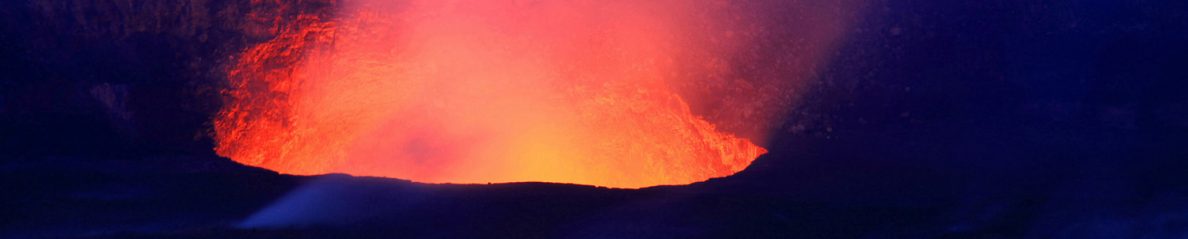
Krysuvik site d’une  prochaine éruption? (Photo: C. Grandpey)

————————————————–

The eruptive situation on the Reykjanes Peninsula in Iceland is puzzling scientists at the Icelandic Met Office and at the University of Iceland. Referring to the ground uplift in the Svarsengi area which is now more significant than before the previous eruptions, they first said that an eruption was imminent. Today, one of the volcanologists says that if an eruption occurs on the Reykjanes Peninsula, it is most likely to happen around March 20th, 2025. However, he emphasizes that  »predicting an eruption remains uncertain, and it is still possible that magma is accumulating west of Kleifarvatn Lake. »

The sacientist suggests that if an eruption does occur, it will likely follow the familiar pattern of past events, beginning at Mt. Stóra-Skógfell before cracks extend in one or both directions.  »The eruption could last for several days or even weeks. » The scientist also believes that eruptions in the Sundhnúkagígar crater row are nearing their conclusion.  »The Mt. Fagradalsfjall volcanoes were active for about two years before activity shifted to Sundhnúkagígar just over a year ago. These two eruptions have shown differences ; for instance, we saw less inflation at Mt. Fagradalsfjall. Now, the current eruption cycle appears to be winding down, and I firmly expect that the Sundhnúkar volcanoes will finish their activity this year. »

While the next seismic swarm could begin at any time, its exact location remains unknown. Two earthquake swarms west of Kleifarvatn Lake on March 7th and 9th suggest that magma may be accumulating in the area. The Met Office’s volcanologist says :  »The fact that these quakes are occurring five kilometers deep suggests magma is accumulating beneath. This could eventually lead to an eruption there, though whether that happens this year, in ten years, or in twenty is impossible to say. »

It should be noted that another scientist at th Met Office interpreted the seismic activity in the Krysuvik area differently.  »The earthquakes in Krýsuvík are not related to the events in the Sundhnúkagígar series. Seismic swarms are a natural occurrence in the area, happening roughly every one to two weeks. The Reykjanes Peninsula is known for its periodic earthquake activity due to the movement of the Mid-Atlantic Ridge, where the Eurasian and North American tectonic plates meet.  » One can also read in the Iceland Monitor :  »Scientists continue to observe these patterns to assess any potential changes in volcanic or geothermal activity, especially in light of the fact that a new eruption in Reykjanes could occur at any time. »

As the late François Le Guern used to say at the beginning of his conferences :  »I don’t know, we don’t know how to predict volcanic eruptions ».

Source : Met Office, Iceland Review, Iceland Monitor.

Islande : des éruptions plus difficiles à prévoir ? // Iceland : eruptions more difficult to predict ?

Depuis le mois de décembre 2023, la prévision éruptive le long de la chaîne de cratères Sundhnúkagígar sur la péninsule de Reykjanes est relativement bonne. En s’appuyant sur les données de soulèvement du sol dans le secteur de Svatseengi, qui correspondent à l’accumulation de magma sous la surface, les scientifiques du Met Office ont pu dire, avec une marge d’erreur relativement faible, à quel moment une éruption était susceptible de se produire.
Cependant, selon une étude récente effectuée par des scientifiques de l’Institut des sciences de la Terre de l’Université d’Islande en collaboration avec le Met Office islandais, la prévision des prochaines éruptions pourrait devenir plus difficile.
La composition chimique du magma émis lors des quatre premières éruptions de Sundhnúkagígar révèle qu’il provient de plusieurs chambres ou sources magmatiques proches les unes des autres, à une profondeur d’environ cinq kilomètres. L’étude se base sur les données des quatre premières éruptions, en décembre 2023 et en janvier, février et mars 2024.
L’objectif de l’étude était de mieux comprendre l’accumulation de magma pour chaque éruption en examinant la composition chimique du magma émis. Si cette composition change à chaque éruption, cela montre que le magma provient de plusieurs chambres magmatiques.
La méthodologie de l’étude comprenait le prélèvement d’un certain nombre d’échantillons de lave à différents endroits au cours des quatre éruptions, ainsi que l’étude des différentes compositions chimiques du magma. Au total, 161 échantillons ont été collectés ; leur analyse a été réalisée à l’Institut des sciences de ta Terre de l’Université d’Islande et au Laboratoire Magmas et Volcans de Clermont-Ferrand.
Le résultat des analyses révèle que la composition chimique du magma est très variable, ce qui laisse supposer qu’il provient de chambres magmatiques différentes à une profondeur d’environ cinq kilomètres sous la chaîne de cratères. De plus, la composition chimique varie également d’une éruption à l’autre, ce qui indique des changements dans les chambres magmatiques à mesure que l’activité volcanique progresse sur la péninsule de Reykjanes.
Selon la conclusion de l’étude, comme il existe probablement plus d’une chambre magmatique sous Svartsengi, il peut être difficile de prévoir quand les prochaines éruptions auront lieu. Le comportement des éruptions peut également changer. Il peut être difficile de prévoir la quantité de magma émise par chaque éruption et la durée de l’éruption, en fonction de la chambre d’où provient ce magma.
On savait déjà que le magma est susceptible de s’accumuler dans plusieurs chambres magmatiques proches les unes des autres, mais c’est la première fois que cela est confirmé, grâce à l’analyse détaillée du magma émis sur la chaîne de cratères Sundhnúkagígar.

L’étude souligne également que l’analyse de la composition chimique du magma fournit des informations permettant l’interprétation des données géophysiques ; cela pourrait conduire à une meilleure compréhension du comportement des volcans.
Source ; Icelandic Met Office, Iceland Monitor.

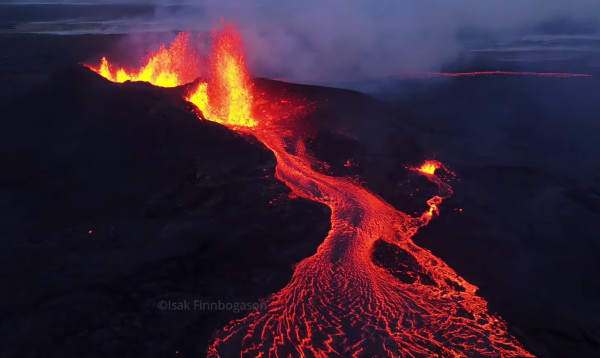
Image webcam de la dernière éruption

————————————————-

Since December 2023, the prediction of eruptions along the Sundhnúkagígar crater row on the Reykjanes Peninsula has been quite good. Relying on ground uplift in the Svatseengi area that corresponded with magma accumulation beneath the surface, scientists at the Met Office were able to say, with a relatively small margin of error, when the next eruption would occur.
However, according to a recent study by scientists at the Earth Sciences Institute of the University of Iceland in collaboration with the Icelandic Meteorological Office, eruptive prediction might become more difficult in the future.

The chemical composition of the magma in the first four eruptions in the Sundhnúkagígar crater row suggests that the magma comes from several magma chambers or vents that are close to each other at a depth of about five kilometers.The study is based on data from the first four eruptions, in December 2023 and January, February and March 2024.

The goal of the study was to gain a better understanding of magma accumulation for each eruption by examining the chemical composition of the magma that emerged. If it turned out to change in each eruption, it would be an indication that the magma came from more than one magma chamber.

The methodology of the study included that the researchers collected a number of lava samples in many places in the eruption areas during the four eruptions and investigated the different chemical composition of the magma. They took a total of 161 samples whose analysis was carried out at the Institute of Geosciences of the University of Iceland and the Laboratoire Magmas et Volcans in Clermont-Ferrand.

The result of the analysis was that the chemical composition of the magma is very variable, which suggests that it comes from several different magma chambers at a depth of about five kilometers below the series of craters. In addition, the chemical composition also varies from one eruption to another, which indicates changes in the magma chambers as the volcanic activity progresses on the Reykjanes Peninsula.

The conclusion of the study is that since there is possibly more than one magma chamber under Svartsengi, it may be difficult to predict when the next eruptions will occur. Then the behaviour of the volcanic eruptions can also change. It may be difficult to predict how much magma will be produced by each eruption and how long the eruption will last, depending on which chamber the magma comes from.

We know that it is probably common for magma to accumulate in more than one magma chamber that are close to each other in volcanoes, but this is the first time it has been confirmed, thanks to the detailed analysis of the magma from the Sundhnúkagígar crater row. The study also emphasizes that the analysis of the chemical composition of magma provides more accurate information that helps in the interpretation of geophysical data and will lead to a better understanding of the behaviour of volcanoes.

Source ; Icelandic Met Office, Iceland Monitor.

Islande : l’éruption est probablement imminente // Iceland : an eruption likely in the very short term

Au cours des derniers jours, le nombre de séismes a augmenté de jour en jour le long de la chaîne de cratères Sundhnúkagígar. Environ 110 événements ont été enregistrés le 18 août 2024, alors qu’il y en avait environ 60 à 90 par jour la semaine dernière.
Selon le National Weather Service, « la chaîne de cratères Sundhnúkagígar sera probablement affectée par une intrusion magmatique, voire une éruption ». L’activité sismique actuelle est très semblable à celle des jours qui ont précédé l’éruption qui a commencé le 29 mai.
La plupart des séismes sont inférieurs à M1,0, mais pendant le week-end, deux d’entre eux avaient des magnitudes supérieures à M2,0. L’un s’est produit un peu à l’est du mont Sýlingarfell et l’autre entre le mont Hagafell et le mont Sýlingarfell. Ce dernier avait une magnitude de M2,5. Il s’agit du plus fort séisme enregistré dans la région depuis la dernière éruption.
Source : Iceland Monitor.

Image webcam de l’éruption du 29 mai 2024

———————————————-

Over the past few days, the number of earthquakes has increased day by day around the Sundhnúkagígar crater row. About 110 earthquakes were recorded on August 18th, 2024, while there were about 60 to 90 per day last week.

According to the National Weather Service, « the Sundhnúkagígar crater row will likely be affected by a magma run and even an eruption. » The current seismic activity is very similar to the seismic activity in the days before the eruption that began on May 29th.

Most of the earthquakes are below M1.0, but during the weekend two earthquakes were measured above M2.0. One of them was a short distance east of Mt Sýlingarfell and the other between Mt Hagafell and Mt Sýlingarfell. The other had a magnitude M2.5.This is the largest earthquake recorded in the region since the last eruption.

Dsource : Iceland Monitor.

Islande : Source des éruptions de Fagradalsfjall et de Sundhnúkagígar // Iceland : Source of the Fagradalsfjall and Sundhnúkagígar eruptions

Depuis l’éruption de Fagradalsfall de 2021 à 2023 jusqu’à la dernière éruption sur la chaîne de cratères de Sundhnúkagígar, il y a eu, à un moment ou à un autre, des désaccords entre scientifiques sur ces événements. Cette fois, c’est le groupe de sismologues de l’Université d’Uppsala en Suède qui contredit la théorie islandaise sur l’emplacement de la chambre magmatique sous le mont Fagradalsfjall.
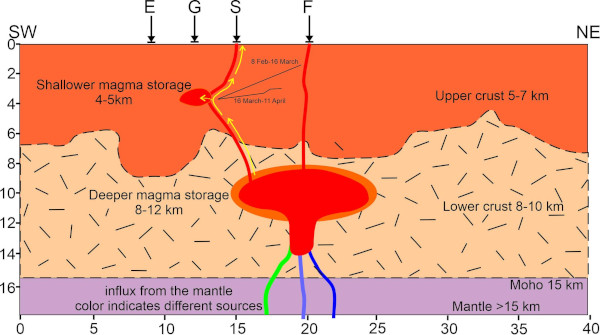
Jusqu’à présent, les scientifiques islandais pensaient que la chambre magmatique était située à la lisière supérieure du manteau, à plus de 15 km de profondeur. Cependant, selon les résultats des sismologues suédois, elle se trouve directement sous le mont Fagradalsfjall, à une profondeur de seulement 8 à 12 km, c’est-à-dire dans la partie supérieure de la croûte inférieure. La chambre magmatique en question mesure une dizaine de kilomètres de large et contient un magma plutôt primaire.

Le réservoir magmatique peu profond, qui est à l’origine de l’éruption actuelle, est situé à environ 4 ou 5 km sous le secteur de Svartsengi et contient un magma plus élaboré. Le magma s’écoule du réservoir magmatique profond vers le réservoir supérieur, ce qui explique l’inflation au niveau du secteur de Svartsengi. Lorsque le réservoir peu profond est plein et qu’il a accumulé environ 10 à 15 millions de mètres cubes de magma, son toit se brise et une éruption commence.

Le magma qui s’est écoulé lors des éruptions sur le système éruptif du mont Fagradalsfjall de 2021 à 2023 provenait directement du réservoir magmatique profond.
Le magma de l’éruption actuelle au niveau de la chaîne de cratères Sundhnúkagígar a également été observé dans le réservoir magmatique profond, mais il a fait une halte dans le réservoir le moins profond. Le magma semble y avoir séjourné pendant environ 3 à 5 semaines où il s’est modifié au cours du processus de différenciation, devenant plus léger avant de remonter à la surface lors de l’éruption. [NDLR : Une fois encore, cette différenciation subie par le magma au cours de son séjour dans une chambre magmatique me rappelle la théorie des ‘magmas TGV ‘ et des ‘magmas omnibus’ ru regretté Alain De Goër de Herve].
Source : Université d’Islande.

Source : Université d’Uppsala

—————————————————————

From the Fagradalsfall eruption from 2021 to 2023 to the latest eruption on the Sundhnúkagígar crater row, there have been, some time or other, disagreements among scientists about these events. This time, it is the findings of the Uppsala University of Sweden’s seismic group that contradict the previous notion of the location of the magma chamber under Mt Fagradalsfjall.

It was previously thought that the magma chamber was located at the top of the mantle at a depth of more than 15 km. However, according to the results of the Swedish seismologists, it is located directly under Mt Fagradalsfjall at a depth of 8 to 12 km, i.e. in the upper part of the lower crust.

The magma chamber in question is about 10 km wide and contains rather primitive magma.

The shallow magma reservoir, which is the source of the current eruption, is located about 4 to 5 km below Svartsengi, and it holds more advanced magma. The magma flows from the deeper magma reservoir to the upper reservoir, which is the cause of the inflation in Svartsengi. When the shallow reservoir is full, and has axccumulated about 10 to 15 million cubic meters of magma, the roof breaks and an eruption starts.

The magma that flowed in the eruptions in the Mt Fagradalsfjall system from 2021 to 2023 came directly from the deeper magma reservoir.

The magma in the current eruption at the Sundhnúkagígar crater row was detected from the deeper magma reservoir too, but with a stop in the shallower reservoir. The magma appeared to have been in the shallow reservoir for about 3 to 5 weeks where it developed, becoming lighter before it came to the surface during the the eruption.

Source : University of Iceland.