Puyehue (Chili) : Hausse du niveau d’alerte // Puyehue (Chile) : The alert level has been raised

Dans un bulletin spécial publié le 20 juin, le SERNAGEOMIN indique que le niveau d’alerte du Puyehue-Cordón Caulle a été a été élevé à la couleur Jaune (2 sur une échelle de 4) le 20 juin 2018 en raison d’une augmentation de la sismicité depuis le début du mois. Entre le 1er et le 15 juin 2018, 272 séismes ont été enregistrés sous le volcan. 48 étaient des événements longue période (LP) associés à la dynamique des fluides à l’intérieur du volcan. 215 autres événements étaient d’origine volcano-tectonique, associés à des mouvements du magma. Ils ont été localisés à 0,6 km à l’ouest du site de l’éruption de 2011, à une profondeur de 2,8 km. Les instruments ont également enregistré 9 séismes hybrides associés à des signes de déformation.
La dernière éruption du Puyehue-Cordón Caulle a débuté le 4 juin 2011 et s’est terminée en avril 2012. On lui a attribute un VEI de 5
Source: SERNAGEOMIN.

———————————————

In a special bulletin released on June 20th, SERNAGEOMIN indicates that the alert level for Puyehue-Cordón Caulle volcano was raised to Yellow (2 on a scale of 4) on June 20th, 2018 due to increased seismicity since the beginning of the month. Between June 1st and 15th, 2018, 272 earthquakes were recorded under the volcano. 48 were long-period (LP) earthquakes associated with dynamics of fluids inside the volcano. 215 events were volcano-tectonic, associated with the movement of magma. These were located 0.6 km west of the 2011 eruption, at a depth of 2.8 km. Instruments also registered 9 hybrid earthquakes associated with evidence of deformation.

The last eruption of Puyehue-Cordón Caulle volcano started on June 4th, 2011 and ended in April 2012. It was given a VEI of 5

Source: SERNAGEOMIN.
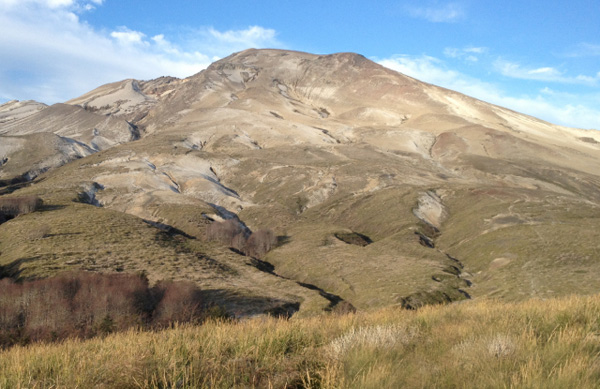
Crédit photo: SERNAGEOMIN
Bárðarbunga (Islande / Iceland)

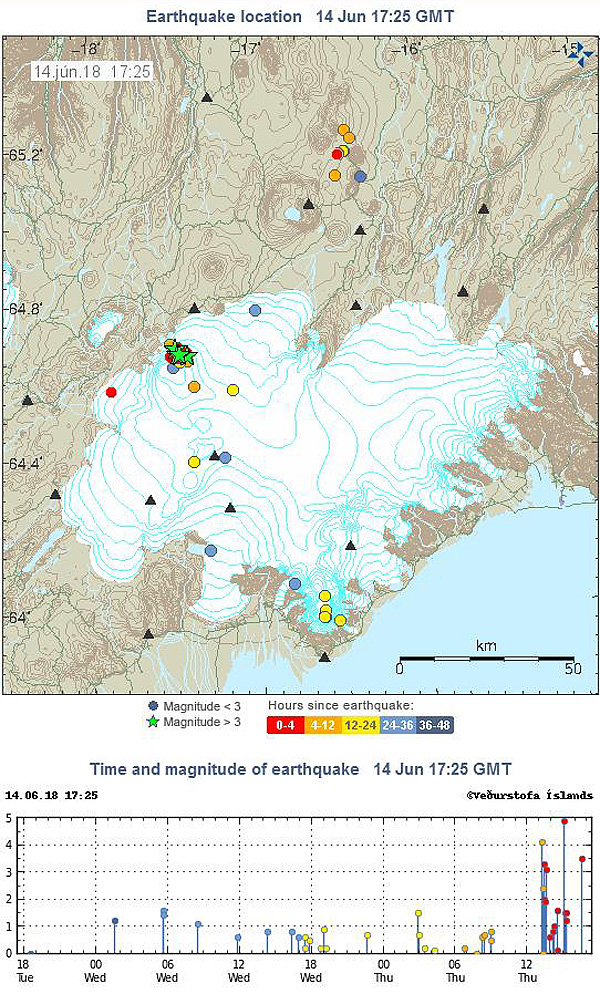
Un essaim sismique a été enregistré dans la partie septentrionale du Bárðarbunga. Il a commencé avec un événement de M 4,1 à 13h14 le 14 juin 2018. D’autres secousses ont suivi et un événement de M 4,9 a par la suite été enregistré à 15h05. C’est le séisme le plus puissant enregistré sur le Bárðarbunga depuis la fin de l’éruption au début de l’année 2015. C’est aussi la même magnitude qu’un autre séisme enregistré le 30 janvier de cette année.  A noter que ces différents séismes ont des hypocentres relativement superficiels et ne semble pas indiquer une ascension du magma.

L’Iceland Met Office précise qu’il n’y a pas de signes qu’une éruption va se produire, mais la situation est contrôlée attentivement.

————————————-

An earthquake swarm has been registered in the northern part of Bárðarbunga. It began with an M 4.1 event at 13.14 on June 14th, 2018. Several quakes followed and then a larger one occurred at 15.05 with a magnitude of M 4.9. This is the largest earthquake measured in Bárðarbunga since the eruption stopped at Bárðarbunga in early 2015 and is the same magnitude as an earthquake that occurred on January 30th this year.

The Iceland Met Office however says that there are no signs of an eruption but is monitoring the area closely.

Source: Iceland Met Office

Sierra Negra (Iles Galapagos) [suite / continued]

Voici quelques informations supplémentaires fournies par l’Instituto Geofisico sur son site web le 8 juin 2018 sur la situation du volcan Sierra Negra dans les Iles Galapagos. Vous trouverez des graphiques illustrant les informations à cette adresse:

http://www.igepn.edu.ec/islas-galapagos-informes/gal-sierra-negra/gal-sn-especiales/gal-sn-e-2018/20867-informe-especial-sierra-negra-n-4/file

Comme je l’ai écrit dans une note précédente sur la Sierra Negra, le nombre et la magnitude des séismes augmentent régulièrement depuis la moitié de l’année 2016. Cette augmentation de la sismicité s’accompagne d’une déformation très significative de l’édifice volcanique qui laisse supposer qu’une nouvelle éruption est possible dans quelques semaines ou quelques mois.
La sismicité est principalement volcano-tectonique, liée à la fracturation interne des roches. Cependant, un nombre important d’événements reflète des mouvements de fluides à l’intérieur du volcan. Depuis janvier 2018, il y a eu 11 séismes de magnitude supérieure ou égale à M 4.0. Les événements se situent principalement sur les bords de la caldeira, à l’exception de la lèvre NE, source des éruptions de 1979 et 2005.
Une importante déformation a été détectée par la station GV04 au centre de la caldeira tandis que la station GV01, située sur le bord extérieur de la caldeira, montre moins de déformation. Les données globales indiquent que la déformation continue sous la caldeira à faible profondeur.
Source: Instituto Geofisico, The Watchers. .

———————————————-

Here is some more information provided by the Instituto Geofisico on its website on June 8th, 2018 about the situation at Sierra Negra Volcano in the Galapagos Islands. You will find graphs illustrating the information at this address:

http://www.igepn.edu.ec/islas-galapagos-informes/gal-sierra-negra/gal-sn-especiales/gal-sn-e-2018/20867-informe-especial-sierra-negra-n-4/file

As I put it in a previous post about Sierra Negra, the number and magnitudes of earthquakes have been steadily increasing since mid-2016. This is happening together with very significant deformation suggesting a new eruption is possible in a matter of weeks or months.

Seismicity is mainly volcano-tectonic, related to internal rock fracturing. However, a significant number of events reflect fluid oscillations and movements inside the volcano. Since January 2018, there have been 11 earthquakes with magnitudes greater than or equal to M 4.0. The events are located mainly on the edges of the caldera, except its NE edge, the source of eruptions in 1979 and 2005.

Very large deformation has been detected at the GV04 station in the centre of the caldera while Station GV01, located on the outer edge of the caldera shows less deformation. The data suggest that deformation continues under the caldera at a shallow depth.

Source : Instituto Geofisico, The Watchers.

Evolution de la sismicité sur le Sierra Negra au cours des derniers mois

(Source: Instituto Geofisico)

Great Sitkin (Iles Aléoutiennes / Alaska)

L’activité sismique est en hausse depuis 5 jours sur le Great Sitkin dans les Iles Aléoutiennes. Le 10 juin 2018 les instruments ont détecté un signal pouvant correspondre à une brève explosion phréatique. En conséquence, l’AVO a élevé l’alerte aérienne à la couleur Jaune.

Source : AVO.

—————————————–

Earthquake activity at Great Sitkin Volcano in the Aleutians has been elevated over the past five days, and on June 10th, 2018 a signal that may represent a short-lived steam explosion was detected by seismic data. AVO has raised the Aviation Color Code to Yellow.

Source: AVO.

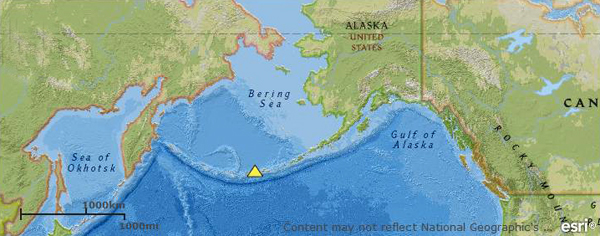
Le triangle jaune marque la position du Great Sitkin

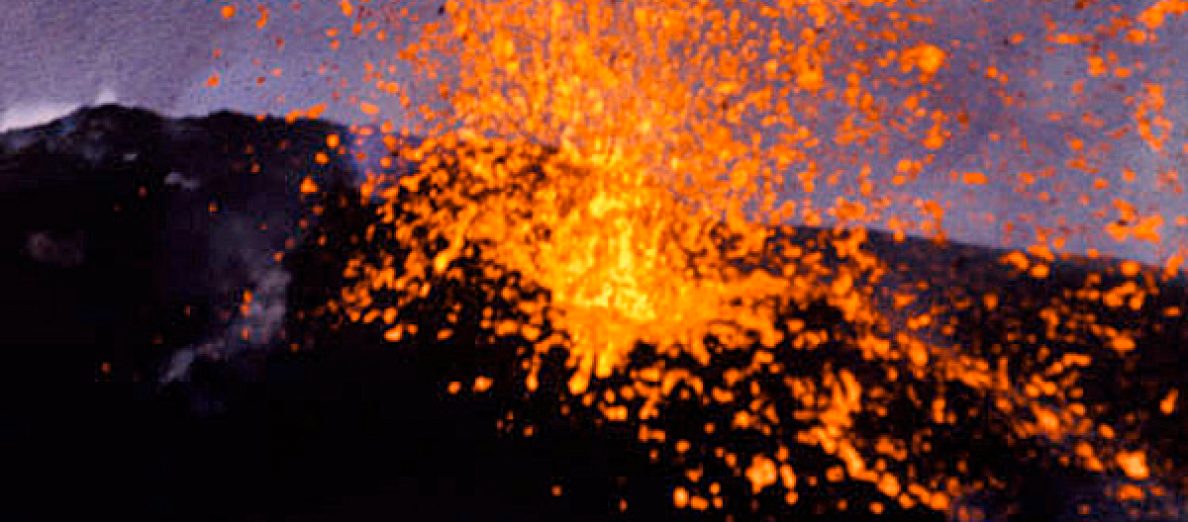
Le Great Sitkin en septembre 2015 (Source: AVO)