Sierra Negra (Iles Galapagos) [suite / continued]

Voici quelques informations supplémentaires fournies par l’Instituto Geofisico sur son site web le 8 juin 2018 sur la situation du volcan Sierra Negra dans les Iles Galapagos. Vous trouverez des graphiques illustrant les informations à cette adresse:

http://www.igepn.edu.ec/islas-galapagos-informes/gal-sierra-negra/gal-sn-especiales/gal-sn-e-2018/20867-informe-especial-sierra-negra-n-4/file

Comme je l’ai écrit dans une note précédente sur la Sierra Negra, le nombre et la magnitude des séismes augmentent régulièrement depuis la moitié de l’année 2016. Cette augmentation de la sismicité s’accompagne d’une déformation très significative de l’édifice volcanique qui laisse supposer qu’une nouvelle éruption est possible dans quelques semaines ou quelques mois.
La sismicité est principalement volcano-tectonique, liée à la fracturation interne des roches. Cependant, un nombre important d’événements reflète des mouvements de fluides à l’intérieur du volcan. Depuis janvier 2018, il y a eu 11 séismes de magnitude supérieure ou égale à M 4.0. Les événements se situent principalement sur les bords de la caldeira, à l’exception de la lèvre NE, source des éruptions de 1979 et 2005.
Une importante déformation a été détectée par la station GV04 au centre de la caldeira tandis que la station GV01, située sur le bord extérieur de la caldeira, montre moins de déformation. Les données globales indiquent que la déformation continue sous la caldeira à faible profondeur.
Source: Instituto Geofisico, The Watchers. .

———————————————-

Here is some more information provided by the Instituto Geofisico on its website on June 8th, 2018 about the situation at Sierra Negra Volcano in the Galapagos Islands. You will find graphs illustrating the information at this address:

http://www.igepn.edu.ec/islas-galapagos-informes/gal-sierra-negra/gal-sn-especiales/gal-sn-e-2018/20867-informe-especial-sierra-negra-n-4/file

As I put it in a previous post about Sierra Negra, the number and magnitudes of earthquakes have been steadily increasing since mid-2016. This is happening together with very significant deformation suggesting a new eruption is possible in a matter of weeks or months.

Seismicity is mainly volcano-tectonic, related to internal rock fracturing. However, a significant number of events reflect fluid oscillations and movements inside the volcano. Since January 2018, there have been 11 earthquakes with magnitudes greater than or equal to M 4.0. The events are located mainly on the edges of the caldera, except its NE edge, the source of eruptions in 1979 and 2005.

Very large deformation has been detected at the GV04 station in the centre of the caldera while Station GV01, located on the outer edge of the caldera shows less deformation. The data suggest that deformation continues under the caldera at a shallow depth.

Source : Instituto Geofisico, The Watchers.

Evolution de la sismicité sur le Sierra Negra au cours des derniers mois

(Source: Instituto Geofisico)

Vers un réveil du Galeras (Colombie) ? // Eruptive activity soon on Galeras Volcano (Colombia) ?

Dans des bulletins spéciaux publiés le 12 juin 2018, le Servicio Geologico Colombiano (SGC) indique qu’une augmentation significative de l’activité sismique est observée sur le Galeras. Des hausses semblables ont été enregistrées le 29 mai et le 2 juin 2018. La dernière éruption du Galeras s’est produite en 2014.
Un essaim comprenant 310 événements a été signalé entre le 11 juin (avec un événement M 4,5) et le 12 juin. Certains ont été ressentis par les habitants à proximité du volcan. Les autres paramètres géophysiques et géochimiques restent inchangés
Le niveau d’alerte est maintenu à 3 (Jaune, changements dans l’activité volcanique) depuis 2011.
Après 10 années de calme, le Galeras a connu un regain d’activité en 1988. Une éruption soudaine a tué 6 volcanologues et 3 touristes qui se trouvaient dans le cratère quand il a explosé le 4 janvier 1993. Stanley Williams était l’un des scientifiques. Il a décrit cet événement tragique dans un livre poignant intitulé Surviving Galeras («Les cris du volcan» dans la version française).
Le groupe faisait partie d’une excursion dans le cadre d’une conférence scientifique. Ses membres avaient décidé d’entrer dans le cratère malgré l’observation d’un nombre important de tornillos qui avaient été enregistrés lors des éruptions précédentes et avaient également été enregistrés dans les jours précédant l’explosion.
Source: Servicio Geologico Colombiano.

————————————————–

In special bulletins released on June 12th, 2018, the Servicio Geologico Colombiano (SGC) indicates that a significant increase in seismic activity is observed at Galeras volcano. Previous increases were recorded on May 29th and June 2nd, 2018. The last eruption of Galeras occurred in 2014.

A swarm including 310 earthquakes has been reported between June 11th (with an M 4.5 event) and June 12th. Some of the quakes were felt by nearby residents. Other geophysical and geochemical parameters remain unchanged

The alert level has been kept at 3(Yellow; changes in the behaviour of volcanic activity) since 2011.

After 10 years of quiescence, Galeras became active again in 1988. A sudden eruption killed 6 volcanologists and 3 tourists who were inside the crater when it exploded on January 4th, 1993. One of the scientists was Stanley Williams who described this tragic event in a gripping book entitled Surviving Galeras (“Les cris du volcan” in the French version).

The group was part of a scientific conference excursion. Its members had decided to enter the crater despite the observation of a significant number of tornillos which had preceded previous eruptions and were also recorded in the days before the eruption.

Source: Servicio Geologico Colombiano.

Vue aérienne du Galeras en janvier 2006 (Crédit photo: Wikipedia)

Profil sismique des tornillos, connus et redoutés sur le Galeras (Source: USGS)

Great Sitkin (Iles Aléoutiennes / Alaska)

L’activité sismique est en hausse depuis 5 jours sur le Great Sitkin dans les Iles Aléoutiennes. Le 10 juin 2018 les instruments ont détecté un signal pouvant correspondre à une brève explosion phréatique. En conséquence, l’AVO a élevé l’alerte aérienne à la couleur Jaune.

Source : AVO.

—————————————–

Earthquake activity at Great Sitkin Volcano in the Aleutians has been elevated over the past five days, and on June 10th, 2018 a signal that may represent a short-lived steam explosion was detected by seismic data. AVO has raised the Aviation Color Code to Yellow.

Source: AVO.

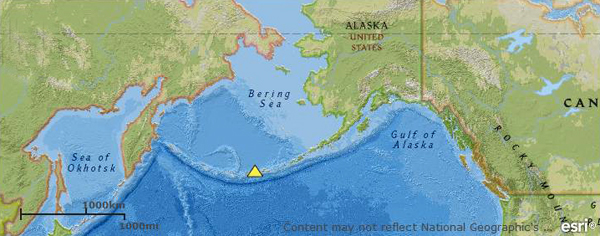
Le triangle jaune marque la position du Great Sitkin

Le Great Sitkin en septembre 2015 (Source: AVO)


Sierra Negra (Iles Galapagos / Galapagos Islands)

Selon le site web d’El Universo, le volcan Sierra Negra dans les îles Galapagos montre une hausse d’activité. La sismicité est en augmentation depuis janvier 2018 avec des événements allant jusqu’à M 4,8. La couleur du niveau d’alerte a été élevée à Jaune, ce qui signifie que l’accès à l’île Isabela est restreint. La persistance d’une sismicité élevée laisse supposer que le magma s’agite à l’intérieur du volcan, ce qui pourrait se solder par une éruption.
Les scientifiques ont installé un réseau sismique temporaire et deux inclinomètres numériques à proximité et à l’intérieur de la caldeira du Sierra Negra.
Le Sierra Negra est l’un des plus grands volcans des Iles Galapagos. Il possède une caldeira de forme ovale qui mesure 9 km d’est en ouest et 7 km du nord au sud. Il a produit au moins 10 éruptions dans l’époque historique, avec une période de repos moyenne de 15 ans entre chaque période éruptive. Ses deux dernières éruptions ont eu lieu en 1979 et 2005.
Source: El Universo.

———————————————–

According to the El Universo website, the Sierra Negra volcano in the Galapagos Islands is showing increased signs of activity. Seismicity has been increasing since January 2018 with events up to M 4.8 and the colour of the alert level has been raised to Yellow, which means that access to areas of Isabela Island is restricted. The persistence of high levels of seismicity suggests that magma is moving inside the Sierra Negra volcano, which could produce an eruption.

Scientists have installed a temporary seismic network and  two digital inclinometers in the surroundings and in the interior of the Sierra Negra volcano caldera.

Sierra Negra is one of the largest volcanoes in the Galapagos Islands and has an oval caldera, which measures 9 km east-west and 7 km north-south. It has produced at least 10 eruptions in the historical epoch, with an average resting period of 15 years between each eruptive period. Its last two eruptions occurred in the years 1979 and 2005.

Source : El Universo.

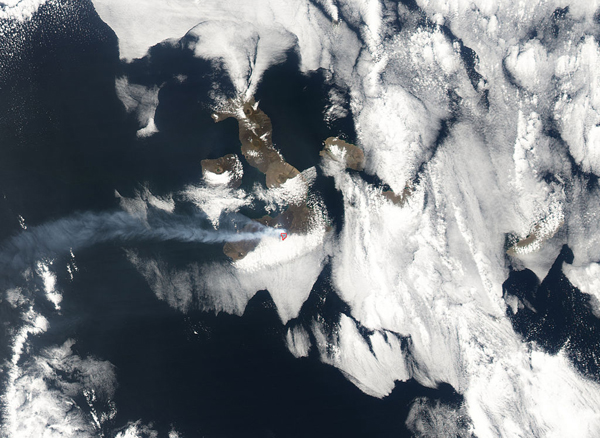
Image satellite des îles Galápagos en octobre 2005 lors de la dernière éruption du volcan Sierra Negra dont on aperçoit le panache. (Crédit photo : NASA)