Etna (Sicile / Italie): Situation stable?

drapeau francais8 heures: L’Etna est resté invisible cette nuit à cause de la couverture nuageuse. Toutefois, le tremor se maintient quasiment au même niveau qu’hier. Cela signifie que l’activité strombolienne et effusive se poursuit probablement au niveau de la bouche située sur le versant SE du Nouveau Cratère SE.

12 heures: On observe en ce moment une forte hausse du tremor. Malheureusement, la visibilité n’est pas excellente. Attendons pour voir ce que nous réserve l’Etna!

Normal
0
21

MicrosoftInternetExplorer4

/* Style Definitions */
table.MsoNormalTable
{mso-style-name: »Tableau Normal »;
mso-tstyle-rowband-size:0;
mso-tstyle-colband-size:0;
mso-style-noshow:yes;
mso-style-parent: » »;
mso-padding-alt:0cm 5.4pt 0cm 5.4pt;
mso-para-margin:0cm;
mso-para-margin-bottom:.0001pt;
mso-pagination:widow-orphan;
font-size:10.0pt;
font-family: »Times New Roman »;}

20 heures : Le tremor a joué au yo-yo au cours de la journée. Ce soir, la webcam L.A.V.E. montre que l’activité n’a guère varié sur le Nouveau Cratère SE, avec une belle effusion de lave.

drapeau anglais8:00: Mount Etna has remained invisible during the night because of the cloud cover. However, the tremor has kept the same level as yesterday. This means that strombolian and effusive activity is probably going on at the vent on the SE flank of the New SE Crater.

12:00: One can see right now a strong increase in the tremor. Unfortunately, visibility is not very good. Let’s see how the situation will develop in the coming hours.

Normal
0
21

MicrosoftInternetExplorer4

st1:*{behavior:url(#ieooui) }

/* Style Definitions */
table.MsoNormalTable
{mso-style-name: »Tableau Normal »;
mso-tstyle-rowband-size:0;
mso-tstyle-colband-size:0;
mso-style-noshow:yes;
mso-style-parent: » »;
mso-padding-alt:0cm 5.4pt 0cm 5.4pt;
mso-para-margin:0cm;
mso-para-margin-bottom:.0001pt;
mso-pagination:widow-orphan;
font-size:10.0pt;
font-family: »Times New Roman »;}

20:00: The tremor has been quite irregular today. Tonight, the LAVE webcam shows us that activity has not much changed on the NSEC, with a nice effusion of lava.
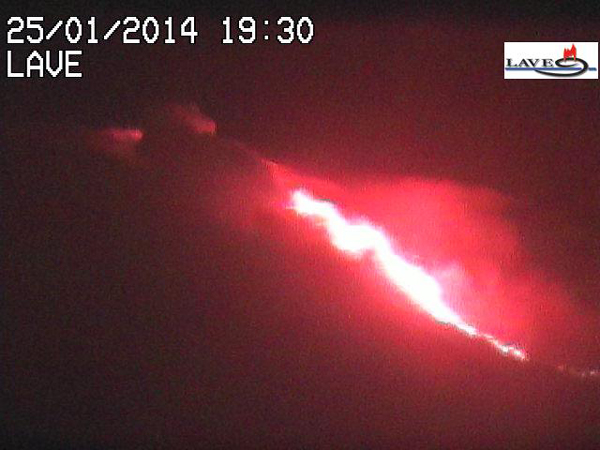
Etna-22-janvier

L’Etna ce soir…

Etna (Sicile / Italie)

drapeau francais6 heures: L’activité strombolienne et l’émission de lave sur le versant SE du NCSE continuent et semblent même s’intensifier si l’on en juge par le tracé du tremor qui est à la hausse depuis le 22 janvier. La coulée atteignait hier soir une longueur d’environ 500 mètres.

Etna-22-janvier

Le tremor ce matin

Voici une petite vidéo montrant l’activité actuelle:

http://www.cataniatoday.it/cronaca/l-etna-da-spettacolo-con-i-suoi-colori-accesi-nella-prima-eruzione-del-nuovo-anno.html

18h30: Le tremor s’est stabilisé au niveau qui était le sien ce matin. Les images de la webcam L.A.V.E. montrent ce soir la persistance de l’activité strombolienne et de l’effusion de lave sur le flanc SE du NCSE.

Etna-22-janvier

La situation ce soir.

drapeau anglais6:00: The strombolian activity and the emission of lava on the SE flank of the NSEC continue and even seem to intensify, judging from the tremor that has been rising since January 22nd. Last night, the lava flow had travelled about 500 metres.

Here is a short video showing the current activity:

http://www.cataniatoday.it/cronaca/l-etna-da-spettacolo-con-i-suoi-colori-accesi-nella-prima-eruzione-del-nuovo-anno.html

18:30: The tremor has kept the same level as this morning. The images of the L.A.V.E. webcam show that strombolian activity and lava effusion continue on the SE flank of the NSEC.

Pacaya (Guatemala): Dernières nouvelles // Latest news

drapeau francaisDans un bulletin spécial en date du 21 janvier, l’INSIVUMEH indique qu’après l’épisode éruptif des 9, 10 et 11 janvier derniers, une activité effusive persiste sur le Pacaya, comme le montre le tremor qui maintient un niveau assez élevé (voir ci-dessous). La lave avance lentement sur le versant sud où elle a parcouru environ 3,6 km en brûlant la végétation sur son passage.

L’activité effusive a cessé sur le flanc ouest samedi à 11 heures.

S’agissant du cratère Mackenney, le cône intracratérique a été complètement détruit, laissant un gouffre où l’on observe uniquement une activité fumerollienne.

drapeau anglaisIn a special bulletin released on January 21st, INSIVUMEH indicates that after the eruptive episode of January 9th, 10th and 11th, effusive activity is still observed on Pacaya. The level of the tremor is still elevated (see below). Lava is moving slowly down the southern flank of the volcano where it travelled over 3.6 km, burning the vegetation on its way.

Effusive activity stopped on Saturday at 11 a.m. on the western flank.

As far as the Mackenney crater is concerned, the cone inside the crater has been completely destroyed and has been replaced by a deep hole where fumarolian activity and nothing else can be observed.

 Pacaya-janvier

Kilauea (Hawaii / Etats Unis): la forêt brûle toujours // The forest is still burning

drapeau francaisLa coulée Kahauale’a 2 continue à progresser en mettant le feu à la forêt au nord du Pu’uO’o, comme on peut le voir sur les images (réelles et thermiques) mises en ligne par le HVO.

http://hvo.wr.usgs.gov/multimedia/?display=default

La coulée est alimentée par un spatter cone situé dans la partie NE du Pu’uO’o. Elle parcourt ensuite environ 7 km en direction du nord. D’après le HVO, la coulée a progressé d’environ 300 mètres entre le 27 novembre et le 6 décembre.

S’agissant de l’activité sur l’East Rift Zone au cours des derniers mois, il est utile de rappeler qu’une éruption fissurale a débuté le 21 septembre 2011 dans la partie supérieure du versant E du Pu’uO’o. Elle a donné naissance à une coulée baptisée Peace Day qui a avancé en direction du SE et traversé les anciens Jardins Royaux au début du mois de décembre 2011. La coulée a ensuite marqué une pause avant de redevenir active et d’atteindre l’océan le 24 novembre 2012. Son activité a ensuite commencé à décliner et la lave n’entrait plus dans l’océan le 20 août 2013. La coulée a été déclarée officiellement inactive début novembre.

La coulée Kahauale’a 1 qui est née sur le rebord nord du plancher du Pu’uO’o à la mi-janvier 2013 a cessé d’avancer fin avril, mais une nouvelle coulée baptisée Kahauale’a 2 a pris de relais dans le même secteur au début du mois de mai. C’est elle qui avance aujourd’hui dans la forêt.

drapeau anglaisThe Kahauale’a 2 lava flow continues to burn through forest north of Pu’uO’o, as can be seen on the images (both real and thermal) released by the Hawaiian Volcano Observatory (HVO).

http://hvo.wr.usgs.gov/multimedia/?display=default

The flow is fed by a spatter cone located in the north-eastern part of the Pu’u O’o vent. It then travels 7 km to the north. According to HVO, the flow advanced about 300 metres between November 27th and December 6th.

If we refer to activity on the East Rift Zone during the past months, we can remember that a fissure eruption started on the upper east flank of Pu’u O’o on September 21st 2011. It fed what became known as the Peace Day flow, which advanced southeast through the abandoned Royal Gardens subdivision in early December 2011. The flow then stalled and re-entered the ocean on November 24th 2012, until activity started to decline and the ocean entry stopped on August 20th 2013. The Peace Day flow was pronounced dead by early November.

The Kahauale’a 1 lava flow, which started at the northeast edge of the Pu’u O’o crater floor in mid-January 2013, was dead by late April, but a new flow, Kahauale’a 2, became active in the same area in early May and is today moving slowly across the forest…

Fougere-Hawaii

(Photo:  C. Grandpey)