Un immense parc national en Islande // Huge national park in Iceland

Ceux qui aiment l’Islande – j’en fais partie – seront heureux d’apprendre qu’ils pourront bientôt visiter un nouveau parc national dans le pays.

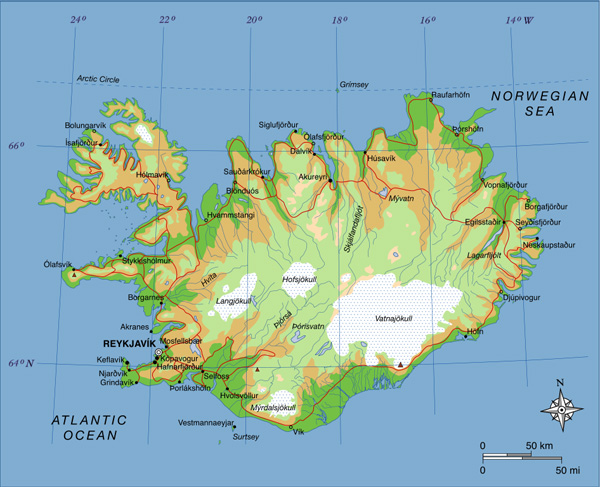
La région des hautes terres du centre de l’île – Central Highland region – est appelée à devenir le plus grand parc national d’Europe. Il aura une superficie de 40 000 km² sur les 103 000 km² de l’Islande, soit environ 30% de la superficie du pays.

Le projet de loi présentant la création du parc a été introduit au Parlement par le ministre islandais de l’Environnement le 30 novembre 2020. Ne soyons pas dupes ; les autorités islandaises ont bien compris les avantages économiques et financiers du projet ! Il est clair que la création du parc national dans les Highlands stimulera le tourisme et, par voie de conséquence, l’économie nationale dans son ensemble.

La région des hautes terres du centre de l’Islande est l’une des plus grandes régions non habitées d’Europe et un important lieu de reproduction pour les oiseaux. Environ la moitié de la superficie envisagée pour le parc national est déjà protégée, avec notamment le parc national du Vatnajökull, le glacier Hofsjökull et le Landmannalaugar. Le parc renfermera les zones déjà protégées et les élargira pour créer un unique parc national.

Il est prévu que le parc soit divisé en six régions administratives qui seront gérées conjointement par les autorités municipales et étatiques. Une entité spéciale sera créée pour superviser la gestion du parc, avec des représentants locaux et étatiques ainsi que d’autres parties intéressées.

Contrairement à ce qui se passe aux États-Unis par exemple, l’accès aux parcs nationaux en Islande est actuellement gratuit. Cependant, des droits de stationnement sont exigés dans le parc national de Þingvellir et le parc national de Skaftafell, une partie du parc national de Vatnajökulsþjóðgarður. Dans ces deux parcs, il y a des panneaux avec les informations de paiement. La redevance pour chaque parc (750 ISK pour une voiture familiale jusqu’à 5 places, par exemple) dépend de la durée de stationnement d’un véhicule déterminée par la reconnaissance de la plaque d’immatriculation. Vous trouverez toutes les informations nécessaires en cliquant sur ce lien:

https://www.bluecarrental.is/useful-information/road-tolls/

 Il est fort probable que la même politique sera appliquée dans le nouveau parc national. Avec le très grand nombre de touristes prévu,  il sera une belle source de revenus pour l’économie islandaise!

Source: Revue d’Islande.

———————————————-

Those who love Iceland – I am one of them – will be pleased to learn that they will soon visit a new National Park in the country.

The Central Highland region is set to become the largest national park in Europe, covering around 30% of Iceland. This would also make it the national park that represents the highest percentage of the total area of a country, with over 40,000 km² of the total 103,000 km² surface area of Iceland. A bill outlining the park’s establishment was introduced in Parliament by Iceland’s Minister for the Environment on November 30th, 2020.

Let’s not be mistaken; Icelandic authorities see advantages in the project. It is clear that the establishment of the Highland National Park would boost tourism and, as a result, the national economy as a whole.

Iceland’s Central Highland region is one of the largest unpopulated regions in Europe and an important breeding ground for birds. Around half of the proposed area of the park is already protected, including under Vatnajökull National Park, Hofsjökull glacier, and Landmannalaugar.

The proposed park would unite already protected areas and expand them to create a single, unified Highland National Park. The park is to be separated into six administrative regions to be jointly managed by municipal and state authorities. A special board will be established to oversee the park’s management, consisting of local and state representatives as well as other interested parties.

Contrary to what happens in the United States for instance, access to the national parks in Iceland is currently free. However, drivers need to pay Entrance Fee / Parking Fee in Þingvellir National Park and Skaftafell National Park, a part of Vatnajökulsþjóðgarður National Park. In both parks there are signs and payment information which nobody should miss. The charge at each park (750 ISK for a family car with up to 5 seats, for example) is based on length of stay of a vehicle determined by license plate recognition. You will find all the necessary information by clicking on this link :

https://www.bluecarrental.is/useful-information/road-tolls/

It is highly likely that the same policy will be used in the new national park, which will be geed news for Iceland’s national economy!

Source: Iceland Review.

La région de Skaftafell est déjà un parc national (Photo: C. Grandpey)

Injecter le CO2 dans le sous-sol de la Mer du Nord, une bonne idée ? // Is it a good idea to inject CO2 in the North Sea’s subsoil ?

Le gaz carbonique (CO2) est l’un des principaux gaz à effet de serre d’origine anthropique. Afin de s’approcher le plus possible des objectifs de la COP 21 et de l’Accord de Paris sur le climat, des projets sont mis en oeuvre pour essayer de se débarrasser de ce gaz polluant. .

Dans une note publiée le 17 juin 2016, j’abordais le projet CarbFix lancé en Islande à côté d’une centrale géothermique dans la périphérie de Reykjavik. Cette centrale exploite une source de vapeur produite par le magma à faible profondeur, en sachant que du CO2 et des gaz soufrés d’origine volcanique sont émis en même temps que la vapeur. Le but est de capter le gaz et de le réinjecter dans le sous-sol. Vous pourrez lire cette note en cliquant sur ce lien :

https://claudegrandpeyvolcansetglaciers.com/2016/06/17/islande-de-la-geothermie-au-stockage-du-co2-iceland-from-geothermal-energy-to-the-storage-of-co2/

La Suisse s’intéresse elle aussi au stockage du gaz carbonique. C’est ainsi que les usines de retraitement des déchets appellent la Confédération à créer un vaste réseau de gazoducs pour exporter leur CO2 vers la Norvège, où il serait stocké dans d’anciens gisements de gaz naturel sous la mer du Nord. Les 30 usines suisses de retraitement des déchets produisent chacune plus de 100 000 tonnes de CO2 par an.

Comme la Suisse ne dispose pas de capacité de stockage suffisante, les incinérateurs veulent relier leurs usines à un réseau de gazoducs qui permettrait d’exporter ce gaz carbonique vers le nord de l’Europe et plus particulièrement la Norvège. Le pays stocke déjà avec succès du CO2 dans d’anciens gisements de gaz naturel sous la mer du Nord depuis 1996 et il s’apprête d’ici 2024 à ouvrir de nouveaux réservoirs pour y enfouir du CO2 européen.

Plusieurs géants pétroliers comme BP, Royal Dutch Shell et Total ont annoncé le 26 octobre 2020 un partenariat pour mettre en place des infrastructures de transport et de stockage de CO2 en mer du Nord britannique, afin de réduire la pollution du secteur industriel.

Cette initiative, menée par BP, est portée également par le norvégien Equinor, l’italien Eni et le gestionnaire du réseau électrique britannique National Grid. Leur objectif est de participer à deux projets déjà lancés et visant à décarboner des régions industrielles dans le nord de l’Angleterre avec pour objectif d’atteindre la neutralité carbone en 2030.

Ces projets doivent voir le jour en 2026 et misent sur le captage de CO2 émis par les industries ainsi que sur l’utilisation de carburant à partir d’hydrogène. Le captage vise à récupérer le CO2 dans les fumées, à le transporter puis le stocker dans le sous-sol, mais cette technique est coûteuse et encore peu développée.

L’enfouissement du CO2 dans des couches géologiques profondes ne fait pas l’unanimité. Selon Greenpeace, il n’est pas encore prouvé que le CO2 qu’on envoie dans ces couches géologiques y reste; on n’est pas sûr qu’il n’y ait pas de fuites, ne serait-ce que par le biais de failles ou de fractures géologiques, sans parler d’anciens puits dont le colmatage n’est pas forcément parfaitement hermétique. Il est bien évident que du CO2 qui s’échapperait dans la mer mettrait en danger l’écosystème marin et entraîner à fortiori des risques pour la santé humaine.

———————————————

Carbon dioxide (CO2) is one of the main greenhouse gases of anthropogenic origin. In order to try and reach the objectives of COP 21 and the Paris Climate Agreement, projects are being implemented to try to get rid of this polluting gas. .

In a note published on June 17, 2016, I referred to the CarbFix project launched in Iceland alongside a geothermal power plant on the outskirts of Reykjavik. This plant uses a source of steam above Iceland’s shallow magma chambers , but some CO2 and sulfur gases of volcanic origin are emitted at the same time as the steam. The goal is to capture the gas and re-inject it underground. You can read this post by clicking on this link:
https://claudegrandpeyvolcansetglaciers.com/2016/06/17/islande-de-la-geothermie-au-stockage-du-co2-iceland-from-geothermal-energy-to-the-storage-of-co2/

Switzerland is also interested in storing carbon dioxide. The waste reprocessing factories are calling on the Confederation to create a vast network of pipelines to export their CO2 to Norway, where it would be stored in former natural gas fields under the North Sea. The 30 Swiss waste reprocessing plants each produce more than 100,000 tonnes of CO2 per year.
As Switzerland does not have sufficient storage capacity, the incinerators want to connect their factories to a network of pipelines that would allow this carbon dioxide to be exported to northern Europe and more particularly to Norway. The country has already successfully stored CO2 in old natural gas fields under the North Sea since 1996 and is preparing by 2024 to open new reservoirs to bury European CO2 in them.

Several oil giants such as BP, Royal Dutch Shell and Total announced on October 26th, 2020 a partnership to set up CO2 transport and storage infrastructure in the British North Sea, in order to reduce pollution in the industrial sector.
This initiative, led by BP, is also supported by the Norwegian Equinor, the Italian Eni and the operator of the British electricity network National Grid. Their objective is to participate in two projects already launched and aiming at decarbonizing industrial regions in the north of England with the aim of achieving carbon neutrality by 2030.
These projects are due to be achieved in 2026 and rely on the capture of CO2 emitted by industries as well as the use of fuel from hydrogen. Capture aims to recover the CO2 in the fumes, to transport it and then store it underground, but this technique is expensive and still underdeveloped.

There is no unanimous support for burying CO2 in deep geological layers. According to Greenpeace, it is not yet proven that the CO2 that is sent into these geological layers stays there; we are not sure that there are no leaks, if only through faults or geological fractures, not to mention old wells whose plugging is not necessarily perfectly hermetic. It is obvious that CO2 escaping into the sea would endanger the marine ecosystem and lead to risks for human health

Schéma illustrant le projet Northern Lights d’enfouissage du CO2 en Norvège (Source : Northern Lights).

Islande: Les Fjords de l’Ouest bientôt Parc National // Iceland : The Westfjords soon a National Park

Les sites inclus dans ce nouveau Parc National seraient Vatnsfjörður, Surtarbrandsgil, Geirþjófsfjörður, le secteur de la cascade de Dynjandi ainsi que la ferme Hrafnseyri dans le fjord d’Arnarfjörður, lieu de naissance de Jón Sigurðsson, héros de l’indépendance de l’Islande. Le Parc comprendrait à la fois des sites naturels et des sites d’importance historique pour l’Islande. L’Agence de l’Environnement demande au public de suggérer des noms pour le nouveau parc national. Les suggestions peuvent être faites sur le site Internet de l’Agence :

https://ust.is/nattura/fridlysingar/fridlysingar-i-vinnslu/thjodgardur-a-vestfjordum/sendu-hugmynd-ad-nafni/

Source: Iceland Review. .

————————————–

Sites included within the planned park are Vatnsfjörður, Surtarbrandsgil, Geirþjófsfjörður, and the land under Dynjandi waterfall as well as the farmstead Hrafnseyri in Arnarfjörður fjord, the birthplace of Iceland’s independence hero Jón Sigurðsson. The park would this include both natural sites and sites of historic importance to Iceland.

The Environment Agency is asking the public to suggest names for the national park. Submissions can be entered via their website:

https://ust.is/nattura/fridlysingar/fridlysingar-i-vinnslu/thjodgardur-a-vestfjordum/sendu-hugmynd-ad-nafni/

Source: Iceland Review.

Cascade de Dynjandi (Photo : C. Grandpey)

Les Etats-Unis font le forcing dans l’Arctique et se retirent de l’Accord de Paris // The U.S. puts pressure on the Arctic and withdraws from the Paris Agreement

Après le Groenland, c’est au tour de l’Islande d’être convoitée par les Etats-Unis. Katrín Jakobsdóttir, la Première Ministre islandaise, a déclaré qu’il n’était pas question pour l’armée américaine d’établir une présence permanente en Islande ou de construire une nouvelle base militaire dans les fjords de l’Est. C’était une idée émise par l’amiral Robert Burke de la Marine américaine lors d’une conférence de presse à l’ambassade américaine de Reykjavik. Il a suggéré la possibilité pour les avions anti-sous-marins et les forces de soutien d’avoir une présence permanente à l’aéroport de Keflavík. Il a également proposé d’établir des installations portuaires pour la marine américaine dans l’est de l’Islande.

En réponse à ces déclarations, la Première Ministre islandaise a rappelé que l’accord de défense avec les États-Unis et l’adhésion à l’OTAN faisaient partie de la politique de sécurité nationale islandaise. Sur cette base, l’armée américaine dispose de certaines installations à l’aéroport de Keflavík, notamment pour accueillir des avions anti-sous-marins. C’est également sur cette base que des exercices aériens sont régulièrement menés par l’OTAN dans l’espace aérien islandais. Mais tout changement majeur à l’intérieur de cet accord de défense est hors de question.

Source: Iceland Review.

°°°°°°°°°°

Le 4 novembre 2020, les Etats-Unis sont officiellement sortis de l’Accord de Paris de 2015 sur le climat. De son côté, Joe Biden a promis de revenir sur cette décision s’il est élu à la tête du pays.

Ratifié par Barack Obama, l’accord avait été rapidement rejeté par Donald Trump, dès 2017. Le président américain avait été contraint d’attendre novembre 2019 pour signifier le retrait américain, puis encore un an pour l’officialisation de cette décision.

Source : Presse internationale.

—————————————

After Greenland, it is up to Iceland to be coveted by the U.S. Iceland’s Prime Minister Katrín Jakobsdóttir has stated she considers it out of the question for the US Army to have a permanent presence in Iceland or build a new army base in the East Fjords. I twas a suggestion made by Admiral Robert Burke of the US Navy at a press conference at the US Embassy in Reykjavík. He suggested the possibility of anti-submarine aircraft and support forces having a permanent presence at Keflavík Airport. He also suggested port facilities for the US Navy in East Iceland.

Responding to his statements, Iceland’s Prime Minister said that the defence agreement with the US and membership in NATO are part of Iceland’s national security policy. On that basis, the US military has certain facilities at Keflavík Airport, including to accommodate anti-submarine aircraft. It is also on that basis that exercises in air patrol are carried out by NATO in Icelandic air space on a regular basis. But any substantial change is out of the question.

Source : Iceland Review.

°°°°°°°°°°

On November 4th, 2020, the United States officially withdrew from the 2015 Paris Climate Agreement. Joe Biden has promised to reverse this decision if he is elected.

Ratified by Barack Obama, the agreement was quickly rejected by Donald Trump in 2017. The American president was forced to wait until November 2019 to signify the American withdrawal, then another year for the formalization of this decision.

Source: International press.

Aéroport de Keflavk (Source: OTAN)