Impact de l’éruption du Hunga Tonga-Hunga Ha’apai sur le réseau électrique // Impact of the 2022 Hunga Tonga-Hunga Ha’apai eruption on the electrical network

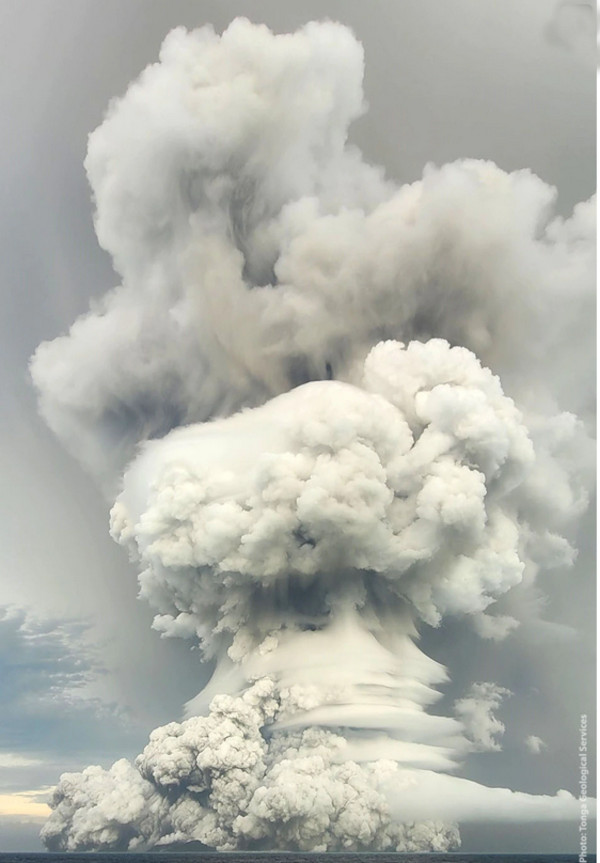
L’éruption du Hunga Tonga-Hunga Ha’apai le 14 janvier 2022 a été l’une des plus puissantes de l’histoire moderne et a eu un impact significatif à la fois sur la terre ferme et sur l’atmosphère terrestre. Le volcan a propulsé des nuages de cendres jusqu’à 58 km dans la mésosphère, la plus haute colonne éruptive de l’histoire et la plus grande éruption jamais observée par l’instrumentation moderne.
L’éruption sur l’île principale des Tonga, Tongatapu, a pour conséquence une série de coupures de courant causées par des retombées de cendres corrosives. Le problème a commencé en septembre 2022. Tonga Power, le fournisseur d’électricité de l’île, a qualifié la situation de « crise » en raison des dégâts sans précédent causés au réseau aérien haute tension à travers l’île. Les habitants ont été confrontés à des pannes de courant à partir de septembre 2022. Les cendres corrosives ont très sérieusement endommagé les câbles haute tension. Conçu pour résister aux forts vents cycloniques, le réseau a été corrodé par les dépôts de cendres qui se sont solidifiées avant d’attaquer l’intérieur des câbles électriques.
Selon Tonga Power, cette corrosion a provoqué quatre pannes de courant notables. La région la plus touchée est le district de Nuku’alofa, où de nombreuses coupures de courant se sont produites, impactant non seulement le district, mais également les villages voisins qui dépendent de la même desserte. Le problème de corrosion est exacerbé par la chaleur du soleil et celle des câbles proprement dits, ce qui entraîne des courts-circuits sur le réseau de Tongatapu.
Lors d’une récente conférence de presse, les responsables de Tonga Power ont dressé un bilan de l’étendue des dégâts. Ils ont montré des échantillons de câbles endommagés, expliquant comment la cendre abrasive adhère aux fils et les pénètre, jusqu’à ce que l’isolation soit rongée, conduisant à un court-circuit. Les responsables de Tonga Power ont insisté sur le fait que c’est l’une des premières fois que le réseau rencontre un tel problème, notamment dû à l’impact des cendres volcaniques.
Les équipes de Tonga Power évaluent actuellement les dégâts et il faut s’attendre à d’autres pannes dans un avenir proche. Les câbles endommagés devront être remplacés. Un nettoyage méticuleux de tout le réseau électrique est indispensable pour éviter une corrosion supplémentaire et garantir une alimentation électrique fiable.
Source : The Watchers.

——————————————

The eruption of Hunga Tonga-Hunga Ha’apai volcano on January 14th, 2022 was one of the most powerful of modern history and had a significant impact both on land and in the Earth’satmosphere. It sent ash clouds as high as 58 km into the mesosphere, marking the highest-known eruption column in history and the largest ever observed eruption with modern instrumentation.

A consequence of the eruption on Tonga’s main island, Tongatapu, was a series of power outages caused by corrosive ash fallout. The problem began in September 2022. Tonga Power, the island’s electricity provider, termed the situation a “crisis” due to the unprecedented damage to the high voltage aerial network across the island. Residents have been grappling with power outages since September 2022, The corrosive ash has wreaked havoc on the high voltage electrical cabling. Designed to withstand strong cyclone winds, it has been corroded by the solidified ash, causing significant damage to the internal wiring.

According to Tonga Power, this corrosion has thus far caused four notable power outages. The most affected region is the Nuku’alofa district, where many faults have occurred, impacting not only the district but also neighboring villages connected to the same feeder. The corrosion problem is exacerbated by the heat from sunlight and the cable itself, resulting in short circuits across Tongatapu’s network.

At a recent press conference, officials from Tonga Power shed light on the extent of the damage. They exhibited damaged wires, explaining how the abrasive ash sticks to the wires, grazing them until the insulation is eaten away, leading to a short circuit. Tonga Power officiels insisted that this is one of the first times the network has experienced such a problem, especially from volcanic ash impact.

Tonga Power teams are currently surveying the damage, and more outages are anticipated in the near future. The damaged wires will need replacement, and meticulous cleaning of all power line cables is crucial to prevent further erosion and ensure a reliable power supply.

Source : The Watchers.

Source: Tonga Services

L’éruption du Hunga Tonga-Hunga Ha’apai a totalement remodelé le plancher océanique // The Hunga Tonga-Hunga Ha’apai eruption totally reshaped the seafloor

Le 15 janvier 2022, l’éruption du Hunga Tonga-Hunga Ha’apai dans l’archipel des Tonga a été l’explosion la plus puissante observée sur Terre dans l’histoire moderne. Elle a battu toutes sortes de records. Ainsi, elle a propulsé un panache de gaz et de cendres à 57 kilomètres dans la mésosphère ; c’est le plus haut panache jamais enregistré. Elle a également déclenché un tsunami qui a atteint le Pérou et un bang supersonique qui a été perçu jusqu’en Alaska.
Selon un article publié dans la revue Science le 8 septembre 2023, lorsque l’énorme panache de cendres et de poussières est retombé dans l’océan, il a remodelé les fonds marins de manière spectaculaire. Pour la première fois, des scientifiques ont reconstitué ce qui a pu se passer sous la surface du Pacifique. Selon les chercheurs, en retombant, tous ces matériaux se sont répandus sous l’eau sur des dizaines de kilomètres. De tels processus n’avaient jamais été observés auparavant. Les données recueillies indiquent qu’au moins 9,5 kilomètres cubes de matériaux – voire 10 km3 – ont été déplacés lors de l’événement cataclysmique. Il s’agit d’un volume équivalent à près de 4 000 pyramides égyptiennes.
À environ 70 kilomètres du volcan, l’éruption a coupé un câble à fibre optique au fond de la mer. Pour les Tongiens et les équipes de secours, la rupture de ce câble a constitué un problème majeur car elle a gravement perturbé le réseau Internet dans l’archipel. Pour les scientifiques, l’interruption brutale d’Internet a permis de dater le moment exact où le câble a été sectionné: l’événement s’est produit environ une heure et demie après l’éruption. La coupure a également fait comprendre aux scientifiques que l’éruption avait perturbé le plancher océanique.
Un propriétaire de bateau tongien a filmé le début de l’éruption avec la caméra d’un téléphone portable, ce qui a indiqué l’heure exacte à laquelle les matériaux volcaniques ont commencé à retomber dans l’océan. Plusieurs mois plus tard, une mission scientifique a quitté la Nouvelle-Zélande pour étudier les fonds marins et collecter des échantillons dans les dépôts laissés par les coulées de débris. Contrairement à une grande partie de l’océan, les fonds marins autour des Tonga avaient déjà été cartographiés, ce qui a permis aux scientifiques de se rendre compte des changements subis par la topographie.
Les chercheurs ont réalisé que le volcan a déplacé en quelques heures autant de matériaux qu’en déversent toutes les rivières de la planète en une année. Ces coulées gigantesques ont parcouru plus de 90 kilomètres depuis leur origine, en creusant des fossés où l’on pourrait loger des gratte-ciel.
Lorsque le volcan a explosé, il a expulsé d’énormes quantités de roches, de cendres et de gaz. Lorsque cela se produit sur Terre, on observe des coulées pyroclastiques qui détruisent tout sur leur passage. S’agissant du Hunga Tonga-Hunga Ha’apai, cette masse en chute libre n’avait aucun support terrestre ; elle a donc fini sa course dans la mer. Les scientifiques ont estimé que les matériaux se sont propagés à 120 km/heure depuis la source de l’éruption. Si c’est exact, c’est 50 % plus rapide que les autres coulées sous-marines étudiées ailleurs sur la planète. Les chercheurs affirment que de telles coulées sous-marines n’avaient jamais été observées auparavant.

Vous verrez sur cette page une modélisation des coulées de matériaux émises par le Hunga Tonga-Hunga Ha’apai :

https://www.bbc.com/news/science-environment-63678177
Source  : Popular Science, Yahoo Actualités, la BBC.

————————————————

On January 15th, 2022, the eruption of of Hunga Tonga-Hunga Haʻapai in the Tonga archipelago was the most powerful explosion observed on Earth in modern history and it broke all kinds of records. It shot gas and ash 57 kilometers up into Earth’s mesosphere, higher than the plume from any other volcano on record. It also unleashed a tsunami that reached Peru and a sonic boom heard as far as Alaska.

According to a paper published in Science on September 8th, 2023, when the huge volume of volcanic ash and dust fell back into the water, it reshaped the seafloor in a dramatic fashion. For the first time, scientists have reconstructed what might have happened beneath the Pacific’s violently strewn waves. According to the research, all that material flowed underwater for dozens of kilometers. Such processes had never been observed before. The gathered data indicates that at least 9.5 cubic km of material was displaced during the cataclysmic event. This is a volume equivalent to something approaching 4,000 Egyptian pyramids.

About 70 kilometers from the volcano, the eruption cut off a seafloor fiber-optic cable. For Tongans and rescuers, the broken cable was a major inconvenience that severely disrupted the islands’ internet. For scientists, the abrupt severance of internet traffic provided a timestamp of when something touched the cable: around an hour and a half after the eruption. The cut also alerted scientists to the fact that the eruption had disrupted the seafloor.

A Tongan charter boat owner had caught the initial eruption with a mobile phone camera, giving an exact time when volcanic ejecta began to fall into the water. Several months later, a mission sailed from New Zealand to survey the seafloor and collect volcanic flow samples. Unlike in much of the ocean, the seafloor around Tonga had already been mapped, allowing scientists to corroborate changes to the topography.

The researchers realised that the volcano moved as much matter in a few hours as the world’s rivers delivered into the oceans in a whole year. These truly immense flows traveled more than 90 kilomrters from their origin, carving out gullies as tall as skyscrapers.

When the volcano exploded, it spewed out immense quantities of rock, ash and gas. When this happens on earth, it triggers fast-moving pyroclastic flows that menace anything in their path. But over Hunga Tonga–Hunga Haʻapai, that falling mass had nowhere to go but out to sea. Scientists estimated the material fanned out from Hunga Tonga–Hunga Haʻapai at 120 kilometers per hour. If correct, that’s 50 percent faster than any other underwater flow recorded on the planet. The researchers say that these underwater flows had never been observed before.

You will see on this page a model of the flows of materials emitted by Hunga Tonga-Hunga Ha’apai :

https://www.bbc.com/news/science-environment-63678177

Source : Popular Science, Yahoo News, the BBC.

Source: NASA

Réchauffement climatique : records de température en série // Global warming : series of temperature records

Le record mondial de température (56,7°C le 10 juillet 1913) n’a pas été battu le dimanche 16 juillet 2023 à Furnace Creek, dans la Vallée de la Mort, mais on a tout de même relevé 53,3°C.

Comme je l’ai écrit précédemment, c’est tout l’ouest des Etats Unis qui est confronté à un dôme de chaleur. L’Arizona est l’un des Etats les plus sévèrement touchés. A Phoenix, la capitale, les températures ont atteint 43°C pendant 16 jours consécutifs, et même 47°C au cours du dernier week-end. Les hôpitaux connaissent des records d’affluence. Des gens souffrent de brûlures au second degré après être entrés en contact avec les trottoirs où la température atteint 71°C. Certains patients ont été placés dans des espèces de caissons en plastique remplis de glace. Des « lieux de fraîcheur » ont été mis en place, avec distribution de bouteilles d’eau fraîche, en particulier dans les bibliothèques, les églises et les locaux disposant de climatisation.

Le sud de l’Europe n’est pas épargné, avec des records de température en Grèce, en Espagne , ou encore en Italie

J’entendais ce matin sur la radio France Info que l’éruption du volcan Hunga Tonga Hunga-Ha’apai (janvier 2022) serait l’une des causes des vagues de chaleur actuelles. Affirmer cela est aller un peu vite en besogne ! En effet, la hausse des températures a débuté bien avant l’éruption aux Tonga. Une très forte sécheresse sévissait déjà depuis de très longs mois dans l’ouest des Etats Unis. Même en France, le manque d’eau dû au réchauffement climatique n’a pas attendu l’éruption du Hunga Tonga pour se manifester. A la limite, on pourrait penser que l’éruption du Hunga Tonga a quelque peu intensifié la hausse des températures au cours de l’été 2022, mais pour le reste, c’est bien le réchauffement climatique d’origine anthropique qui est la véritable cause du problème.

———————————————-

The world temperature record (56.7°C on July 10th, 1913) was not broken on Sunday July 16th, 2023 at Furnace Creek, in Death Valley, but 53.3°C was still recorded .
As I put it previously, the entire western United States is facing a heat dome. Arizona is one of the hardest hit states. In Phoenix, the capital, temperatures reached 43°C for 16 consecutive days, and even 47°C over the last weekend. Hospitals are experiencing record crowds. People suffer second degree burns after coming into contact with pavements where the temperature reaches 71°C. Some patients were placed in plastic containers filled with ice. « Cool places » have been set up, with distribution of cold water bottles, in particular in libraries, churches and premises with air conditioning.
Southern Europe is not spared, with temperature records in Greece, Spain and Italy.
I heard this morning on France Info radio that the eruption of the Hunga Tonga Hunga-Ha’apai volcano (January 2022) would be one of the causes of the current heat waves. Saying this is a bit far-fetched ! Indeed, the rise in temperatures began long before the eruption in Tonga. A very severe drought had already been raging for very long months in the western United States. Even in France, the lack of water due to global warming did not wait for the eruption of Hunga Tonga. One might think that the Hunga Tonga eruption has somewhat intensified the rise in temperatures during the summer of 2022, but for the rest, anthropogenic global warming is the real cause of the problem.


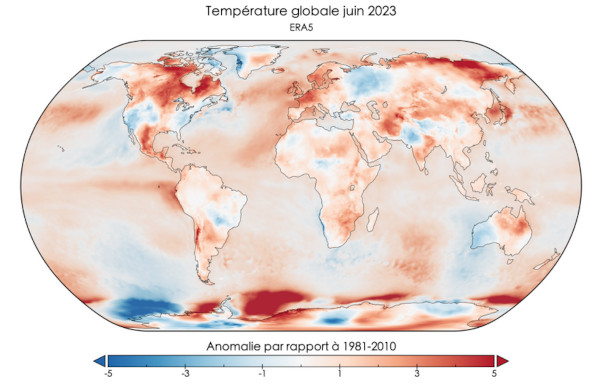
Carte des anomalies ERA5 en juin 2023 par rapport à 1981-2010

L’éruption du Hunga Tonga-Hunga Ha’apai : un record d’éclairs // A record of lightning strikes

L’éruption du volcan sous-marin Hunga Tonga-Hunga Ha’apai en 2022 appartient au monde des superlatifs et des records. Elle a généré la plus puissante explosion atmosphérique jamais enregistrée. Elle a également produit un nombre record d’éclairs au cours d’un orage électrique qui a duré 11 heures et s’est étendu sur 240 kilomètres.
Dans une note publiée le 26 janvier 2023, j’écrivais que pour étudier les éclairs qui ont accompagné l’éruption, les scientifiques ont utilisé les données de GLD360, un réseau de détection de la foudre au sol. Ces données ont révélé que, sur les quelque 590 000 éclairs détectés pendant l’éruption, environ 400 000 se sont produits dans les six heures qui ont suivi la puissante explosion du 15 janvier.
Avant l’éruption du Hunga Tonga-Hunga Ha’apai, le plus grand événement de foudre volcanique s’est produit en Indonésie en 2018, lorsque l’Anak Krakatau est entré en éruption et a généré environ 340 000 éclairs en une semaine. Environ 56 % des éclairs produits par l’éruption des Tonga ont frappé la terre ou la surface de l’océan, et plus de 1 300 impacts ont été enregistrés sur Tongatapu, l’île principale des Tonga.
Une nouvelle étude publiée le 19 juin 2023 dans la revue Geophysical Research Letters nous donne plus de détails sur cet aspect de l’éruption. Nous apprenons que l’orage électrique a eu lieu à une altitude sans précédent de 20 à 30 kilomètres.
L’imagerie satellite montre que les éclairs n’étaient pas répartis au hasard dans le panache éruptif, mais qu’ils se produisaient en plusieurs anneaux concentriques qui semblaient liés à chaque phase explosive du volcan. En s’élevant, le panache a pris la forme d’un pin parasol. Ce phénomène a imprimé au nuage un mouvement vertical si important que l’onde a couvert 10 kilomètres en verticalité. Cette onde de pression oscillante, également connue sous le nom d’onde de gravité, est à l’origine de la foudre.
Les éclairs ont pu se former de deux manières différentes au sein de cette onde de gravité en forme d’anneau. L’éruption du Hunga Tonga s’étant déroulée sous l’eau, elle a injecté beaucoup d’eau dans l’atmosphère terrestre et les cristaux de glace qui en ont résulté ont adopté des charges positives et négatives. En outre, une partie des cendres volcaniques, formées de roches fragmentées et de magma projetées dans l’air par l’éruption, ont également été ionisées, ce qui a donné naissance à de nouvelles zones de charge positive et négative.
Si des anneaux de foudre ont déjà été observés dans des panaches volcaniques, l’éruption du Hunga Tonga a été la première à montrer des anneaux multiples (on en a compté quatre) et la foudre a glissé sur les ondulations des anneaux, comme un surfeur sur les vagues de l’océan.

Les anneaux de foudre sont également appelés « trous de foudre », car à l’intérieur de l’anneau, il n’y a généralement pas d’éclairs. L’éruption du Hunga Tonga est toutefois différente : les trous ont commencé à se remplir d’éclairs dans les minutes qui ont suivi le passage de l’onde de gravité. Le mécanisme à l’origine de ce remplissage n’a pas encore été élucidé par les chercheurs.
Outre le fait de battre des records, l’éruption du Hunga Tonga est susceptible de nous renseigner sur le volcanisme sur la Terre primitive, voire sur d’autres corps célestes. L’éruption est de type phréatoplinien, autrement dit elle se produit lorsqu’une énorme quantité de roche en fusion jaillit à travers une épaisse couche d’eau.
L’éruption pourrait aider à comprendre comment la foudre se déclenche sur d’autres planètes, telles que Vénus, ou d’autres corps planétaires qui ne sont pas le cadre de la foudre traditionnelle.
Source : Space.com.

——————————————–

The 2022 Hunga Tonga-Hunga Ha’apai volcanic eruption belongs to the world of superlatives. It produced the most powerful atmospheric explosion ever recorded. It also generated a record number of lightning strikes in a thunderstorm that lasted 11 hours and spread across 240 kilometers.

In a post released on January 26th, 2023, I wrote that to study the lightning that accompanied the eruption, the scientists used data from GLD360, a ground-based lightning detection network. This data revealed that, of the approximately 590,000 lightning strikes detected during the eruption, around 400,000 occurred within six hours that followed the powerful January 15th explosion.
Prior to the Hunga Tonga-Hunga Ha’apai eruption, the largest volcanic lightning event occurred in Indonesia in 2018, when Anak Krakatau erupted and generated around 340,000 lightning strikes in a week. About 56% of the lightning produced by the Tonga eruption struck the land or ocean surface, and more than 1,300 strikes were recorded on Tongatapu, the main island of Tonga.

A new research published on June 19th, 2023 in the journal Geophysical Research Letters gives us more details about tat aspect of the eruption. We learn that the lightning storm took place at an unprecedented altitude of between 20 and 30 kilometers.

The satellite imagery shows that the lightning was not randomly spread across the plume but rather occurred in several concentric rings that seemed to be linked to each explosive outburst from the volcano. As the plume rose upward, it formed an « umbrella cloud. » This imparted a vertical motion into the cloud so huge that the wave, moving outward from the center of the plume, was 10 vertical kilometers from crest to trough. This oscillating pressure wave, also known as a gravity wave, was the source of the lightning.

There are two ways the lightning may have formed within this ring-shaped gravity wave. Since the Hunga Tonga eruption took place underwater, it injected lots of water into Earth’s atmosphere, the resulting ice crystals adopting positive and negative charges. In addition, some of the volcanic ash that was formed of fragmented rock and magma blown into the air by the eruption also become ionized, leading to more areas of positive and negative charge. It is the gradient in electrical charge that sets off sudden sparks of lightning.

While lightning rings have been seen in volcanic plumes before, the Hunga Tonga eruption was the first time multiple rings (four of them) had been seen and the lightning rode the rippling rings like a surfer on ocean waves.

Lightning rings are also termed « lightning holes, » because inside the ring there usually is no lightning. However, the Hunga Tonga eruption was different: because the holes started filling with lightning within minutes of the gravity wave rippling by. The mechanism that prompted this infilling remains unclear.

Besides breaking records in the present day, the Hunga Tonga eruption could also teach us about volcanism on the early Earth, and even potentially on other celestial bodies. The eruption is a type referred to as phreatoplinian. It occurs when a huge amount of molten rock erupts through a thick layer of water.

The eruption could also have implications for the way that lightning gets going on other planets, such as Venus, or other planetary bodies that do not support traditional lightning.

Source : Space.com.

Source: NASA