
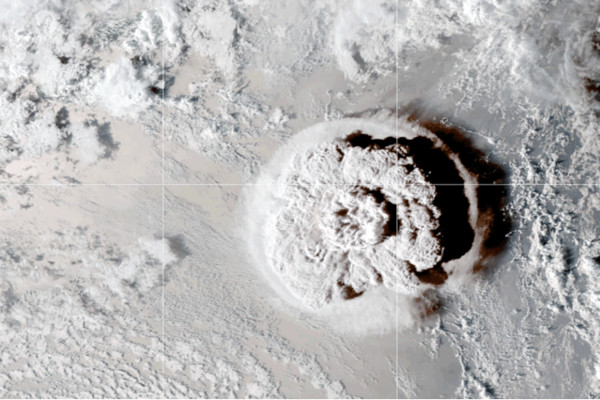
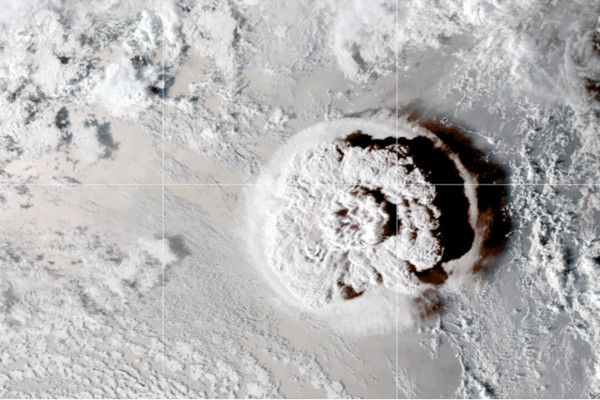
 Le 15 janvier 2022, l’éruption du Hunga Tonga-Hunga Ha’apai dans l’archipel des Tonga a été l’explosion la plus puissante observée sur Terre dans l’histoire moderne. Elle a battu toutes sortes de records. Ainsi, elle a propulsé un panache de gaz et de cendres à 57 kilomètres dans la mésosphère ; c’est le plus haut panache jamais enregistré. Elle a également déclenché un tsunami qui a atteint le Pérou et un bang supersonique qui a été perçu jusqu’en Alaska.
Selon un article publié dans la revue Science le 8 septembre 2023, lorsque l’énorme panache de cendres et de poussières est retombé dans l’océan, il a remodelé les fonds marins de manière spectaculaire. Pour la première fois, des scientifiques ont reconstitué ce qui a pu se passer sous la surface du Pacifique. Selon les chercheurs, en retombant, tous ces matériaux se sont répandus sous l’eau sur des dizaines de kilomètres. De tels processus n’avaient jamais été observés auparavant. Les données recueillies indiquent qu’au moins 9,5 kilomètres cubes de matériaux – voire 10 km3 – ont été déplacés lors de l’événement cataclysmique. Il s’agit d’un volume équivalent à près de 4 000 pyramides égyptiennes.
À environ 70 kilomètres du volcan, l’éruption a coupé un câble à fibre optique au fond de la mer. Pour les Tongiens et les équipes de secours, la rupture de ce câble a constitué un problème majeur car elle a gravement perturbé le réseau Internet dans l’archipel. Pour les scientifiques, l’interruption brutale d’Internet a permis de dater le moment exact où le câble a été sectionné: l’événement s’est produit environ une heure et demie après l’éruption. La coupure a également fait comprendre aux scientifiques que l’éruption avait perturbé le plancher océanique.
Un propriétaire de bateau tongien a filmé le début de l’éruption avec la caméra d’un téléphone portable, ce qui a indiqué l’heure exacte à laquelle les matériaux volcaniques ont commencé à retomber dans l’océan. Plusieurs mois plus tard, une mission scientifique a quitté la Nouvelle-Zélande pour étudier les fonds marins et collecter des échantillons dans les dépôts laissés par les coulées de débris. Contrairement à une grande partie de l’océan, les fonds marins autour des Tonga avaient déjà été cartographiés, ce qui a permis aux scientifiques de se rendre compte des changements subis par la topographie.
Les chercheurs ont réalisé que le volcan a déplacé en quelques heures autant de matériaux qu’en déversent toutes les rivières de la planète en une année. Ces coulées gigantesques ont parcouru plus de 90 kilomètres depuis leur origine, en creusant des fossés où l’on pourrait loger des gratte-ciel.
Lorsque le volcan a explosé, il a expulsé d’énormes quantités de roches, de cendres et de gaz. Lorsque cela se produit sur Terre, on observe des coulées pyroclastiques qui détruisent tout sur leur passage. S’agissant du Hunga Tonga-Hunga Ha’apai, cette masse en chute libre n’avait aucun support terrestre ; elle a donc fini sa course dans la mer. Les scientifiques ont estimé que les matériaux se sont propagés à 120 km/heure depuis la source de l’éruption. Si c’est exact, c’est 50 % plus rapide que les autres coulées sous-marines étudiées ailleurs sur la planète. Les chercheurs affirment que de telles coulées sous-marines n’avaient jamais été observées auparavant.
Vous verrez sur cette page une modélisation des coulées de matériaux émises par le Hunga Tonga-Hunga Ha’apai :
https://www.bbc.com/news/science-environment-63678177
Source : Popular Science, Yahoo Actualités, la BBC.
————————————————
 On January 15th, 2022, the eruption of of Hunga Tonga-Hunga Haʻapai in the Tonga archipelago was the most powerful explosion observed on Earth in modern history and it broke all kinds of records. It shot gas and ash 57 kilometers up into Earth’s mesosphere, higher than the plume from any other volcano on record. It also unleashed a tsunami that reached Peru and a sonic boom heard as far as Alaska.
According to a paper published in Science on September 8th, 2023, when the huge volume of volcanic ash and dust fell back into the water, it reshaped the seafloor in a dramatic fashion. For the first time, scientists have reconstructed what might have happened beneath the Pacific’s violently strewn waves. According to the research, all that material flowed underwater for dozens of kilometers. Such processes had never been observed before. The gathered data indicates that at least 9.5 cubic km of material was displaced during the cataclysmic event. This is a volume equivalent to something approaching 4,000 Egyptian pyramids.
About 70 kilometers from the volcano, the eruption cut off a seafloor fiber-optic cable. For Tongans and rescuers, the broken cable was a major inconvenience that severely disrupted the islands’ internet. For scientists, the abrupt severance of internet traffic provided a timestamp of when something touched the cable: around an hour and a half after the eruption. The cut also alerted scientists to the fact that the eruption had disrupted the seafloor.
A Tongan charter boat owner had caught the initial eruption with a mobile phone camera, giving an exact time when volcanic ejecta began to fall into the water. Several months later, a mission sailed from New Zealand to survey the seafloor and collect volcanic flow samples. Unlike in much of the ocean, the seafloor around Tonga had already been mapped, allowing scientists to corroborate changes to the topography.
The researchers realised that the volcano moved as much matter in a few hours as the world’s rivers delivered into the oceans in a whole year. These truly immense flows traveled more than 90 kilomrters from their origin, carving out gullies as tall as skyscrapers.
When the volcano exploded, it spewed out immense quantities of rock, ash and gas. When this happens on earth, it triggers fast-moving pyroclastic flows that menace anything in their path. But over Hunga Tonga–Hunga Haʻapai, that falling mass had nowhere to go but out to sea. Scientists estimated the material fanned out from Hunga Tonga–Hunga Haʻapai at 120 kilometers per hour. If correct, that’s 50 percent faster than any other underwater flow recorded on the planet. The researchers say that these underwater flows had never been observed before.
You will see on this page a model of the flows of materials emitted by Hunga Tonga-Hunga Ha’apai :
https://www.bbc.com/news/science-environment-63678177
Source : Popular Science, Yahoo News, the BBC.
Source: NASA
 Claude Grandpey : Volcans et Glaciers