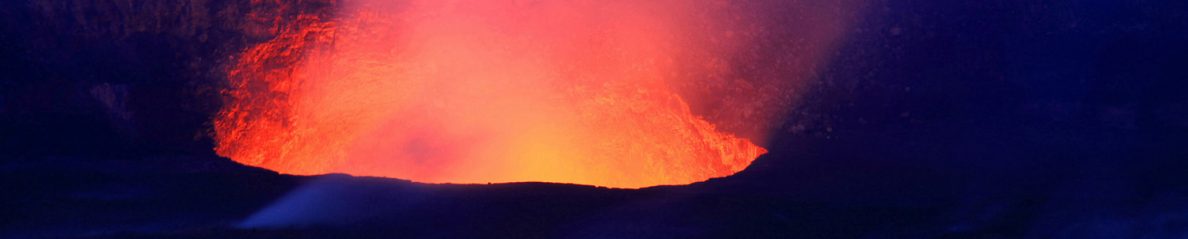
 Depuis quelques semaines, l’Etna montre des signes de réveil. Le Nouveau Cratère SE (NCSE) émet de temps en temps de petites quantités de cendre, mais les faits nouveaux se déroulent dans le Cratère Nord-Est (CNE). Le fond du cratère s’est effondré soudainement en laissant apparaître une bouche semi-circulaire qui émet désormais un panache de gaz relativement dense.
Le Cratère Nord-Est est aujourd’hui le point le plus haut sommet du volcan (3324 m au-dessus du niveau de la mer) et son activité la plus récente remonte à mai 2016 lorsque le fond de ce cratère a été complètement bloqué par des matériaux éruptifs. Depuis environ un an et demi, le CNE est resté «fermé» et a cessé d’expulser le panache de gaz qui l’avait caractérisé ces dernières années. Aujourd’hui, la reprise d’activité de l’Etna coïncide avec la «réouverture» du Cratère Nord-Est. C’est une nouveauté importante pour l’histoire récente du volcan qui indique un changement significatif dans l’équilibre précaire qui régit le sommet de l’Etna et ses cratères sommitaux.
Les chercheurs de l’INGV suivent de près l’évolution de la situation. Le 23 novembre 2017, le sommet de l’Etna a été analysé depuis le ciel grâce aux images captées par un drone Phantom 4 Pro qui a également survolé la nouvelle bouche de dégazage. Les images obtenues ont été retravaillées afin de reconstruire en 3D les surfaces topographiques détectées par le drone, en faisant ressortir les moindres différences grâce aux capacités de haute résolution de la caméra utilisée. Les images du drone révèlent, entre autres, la stabilité précaire des parois intérieures du CNE qui sont rapidement soumises à des effondrements soudains et imprévisibles. C’est une raison de plus de se montrer particulièrement prudent lorsque l’on s’approche de la lèvre de ce cratère et de ses abords.
Source : La Gazzetta Siracusana
——————————————
 In recent weeks, Mt Etna has shown signs of reawakening. The New SE Crater SE (NSEC) emits small amounts of ash from time to time, but the new facts take place in the North-East Crater (NEC). The bottom of the crater collapsed suddenly, revealing a semi-circular vent that now emits a relatively dense plume of gas.
The Northeast Crater is today the highest point of the volcano (3324 m above sea level) and its most recent activity dates back to May 2016 when the bottom of this crater was completely blocked by eruptive materials. For about a year and a half, the NEC has remained « closed » and has stopped expelling the gas plume that had characterized it in recent years. Today, the resumption of activity of Mt Etna coincides with the « reopening » of the NEC. This is an important novelty for the recent history of the volcano which indicates a significant change in the precarious balance that governs the summit of Mount Etna and its summit craters.
INGV researchers are closely observing the evolution of the situation. On November 23rd, 2017, the summit of Etna was analyzed from the sky thanks to the images captured by a Phantom 4 Pro drone that also flew over the new degassing vent. The images obtained have been reworked in order to reconstruct in 3D the topographic surfaces detected by the drone, highlighting the slightest differences thanks to the high resolution capabilities of the camera. The images of the drone reveal, among other things, the precarious stability of the inner walls of the NCE which are rapidly subject to sudden and unpredictable collapses. This is another reason to be particularly careful when approaching the rim of this crater and its surroundings Source: The Gazzetta Siracusana

Vue du fond du Cratère Nord-Est. Image obtenue grâce au drone Phantom 4 Pro le 23 novembre 2017. La flèche montre la fumerolle dans le cratère. (Source : INGV)






 Claude Grandpey : Volcans et Glaciers