 Le Mayon reste très actif, même si l’intensité de l’éruption semble avoir légèrement diminué. Dans ses derniers bulletins, le PHILVOCS indique que de petites fontaines de lave sporadiques sont toujours observées au sommet, ainsi que des coulées de lave sur les flancs du volcan. La cendre s’évacue en général sous forme de panaches blancs à gris clair de faible hauteur, à l’exception de certains événements qui génèrent des panaches gris foncé qui montent plus haut au-dessus du cratère. L’activité s’accompagne de forts grondements audibles dans un rayon de 10 kilomètres. On observe toujours des coulées pyroclastiques et des coulées de lave. Ces coulées descendent les ravines Miisi, Basud et Bonga. Les coulées de lave dans les ravines Miisi et Bonga-Buyuan ont avancé respectivement sur 3,2 kilomètres et 4 kilomètres depuis le sommet. Des effondrements de blocs se produisent régulièrement sur les fronts et les marges des coulées au cours de leur progression. Les émissions de SO2 atteignaient en moyenne 3 066 tonnes par jour le 1er février 2018. Les mesures GPS indiquent une inflation de l’édifice volcanique depuis les mois d’octobre et novembre 2017. Cela montre que le magma continue à exercer une pression au cours de son ascension.
Le niveau d’alerte 4 reste en vigueur sur le Mayon.
Le PHILVOCS demande constamment au public de ne pas entrer dans la zone de danger de huit kilomètres de rayon et de se méfier des coulées pyroclastiques et des lahars susceptibles d’emprunter les ravines qui entaillent les flancs du volcan. Il est conseillé aux pilotes d’éviter de voler près du sommet du Mayon car la cendre émise par de soudaines éruptions peut être dangereuse pour les avions.
Source: PHILVOCS.
Les autorités locales ont ordonné à toutes les personnes vivant en dehors de la zone de danger de huit kilomètres de quitter les hébergements provisoires afin de résoudre le problème de surpeuplement dans les centres d’évacuation. L’occupation idéale des écoles est une salle de classe pour huit à dix familles mais actuellement, le taux d’occupation est d’une salle de classe pour 20, voire 30 familles. Le PHILVOCS a indiqué aux autorités locales que les personnes qui vivent à moins de neuf où dix kilomètres du cratère sont en sécurité. En effet, en prenant en compte l’histoire éruptive du Mayon, la distance maximale atteinte par les coulées pyroclastiques est de sept kilomètres. Le kilomètre supplémentaire ajouté à la zone de danger est une simple précaution en cas de scénario catastrophe.
Suite à la décision de déloger les personnes à l’extérieur de la zone de danger de 8 km, les camions de la police, de l’armée et des unités gouvernementales vont récupérer les personnes évacuées et les conduire à leur domicile. On s’attend à ce que certains habitants ne soient pas d’accord pour partir, par crainte de ne plus bénéficier des produits de première nécessité et d’autres avantages. Cependant, les autorités ont assuré à toutes les familles qu’il y aurait une distribution continue et qu’elles pourraient également bénéficier du programme «argent contre travail».
Une fois l’opération de transfert terminée, certaines personnes hébergées dans des centres d’évacuation surpeuplés seront conduites dans les écoles et les salles de classe qui vont se trouver libérées. Toutefois, des véhicules militaires et de police restent prêts à intervenir si une évacuation rapide s’avérait nécessaire.
Source: Manila Bulletin.
——————————————-
 Mt Mayon is still very active, even though the intensity of the eruption seems to have slightly decreased. In its latest updates, PHILVOCS indicates that the volcano continues to exhibit sporadic and weak lava fountaining, continuous lava effusion and degassing from the summit crater. Much of the activity produces low white to light-gray plumes, with the exception of some events that produce higher gray ash plumes. The activity is accompanied by loud, booming sounds audible within 10 kilometres away. Episodes of pyroclastic and lava flows are still observed. They travel down the Miisi, Basud and Bonga gullies.The Miisi and Bonga-Buyuan lava flows have advanced to 3.2 kilometres and 4 kilometres, respectively, from the summit crater. Rockfall events are generated by the collapsing lava front and margins of the advancing lava flows. SO2 emissions reached an average of 3,066 tons per day on February 1st 2018. GPS measurements still indicate a sustained inflation of the edifice since November and October last year, which is consistent with pressurization by magma intrusion.
The alert level 4 remains in effect over Mayon Volcano.
PHILVOCS reminds the public to refrain from entering the eight kilometre-radius danger zone and to be additionally vigilant against pyroclastic flows and lahars along channels draining the edifice. Pilots are advised to avoid flying close to the volcano’s summit as ash from any sudden eruption can be hazardous to aircraft.
Source: PHILVOCS.
Authorities have ordered a decamp of all persons living outside the eight-kilometre danger zone to solve the problem of heavy congestion in the evacuation centres. The ideal ratio of classroom to evacuees is one room per eight to 10 families but currently, the ratio is at one classroom per 20 and even 30 families. PHILVOCS has said to local authorities that those living within nine and 10 kilometres away from the crater are already safe. Volcanologists also explained that, based on the history of Mayon’s eruption, the farthest distance of pyroclastic flows is seven kilometres away from the crater.The additional one kilometre serves as a precaution for a worst-case scenario.
As a consequence of the decision to decamp the persons outside the 8-km danger zone, trucks from the police, military and local government units will fetch the evacuees and transport them back to their houses. Some of the residents are expected to resist the decamp for fear that they will no longer avail of the relief goods and other benefits. However, authorities assured those economically-displaced families living outside the 8-km danger zone that there will be a continuous distribution of relief goods and they can also avail of the cash-for-work program.
Once the decamp is performed, some of the evacuees in congested evacuation centres will be transferred to schools and classrooms vacated as a result of the decamp. Military and police vehicles will be placed on standby if in case there is a need for quick evacuation.
Source: Manila Bulletin.
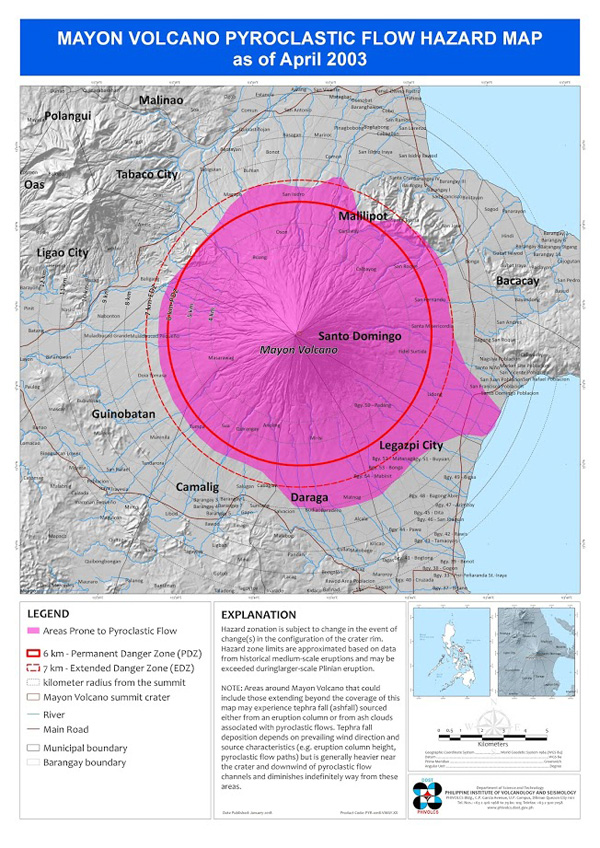
Carte des zones menacées par les coulées pyroclastiques (Source : PHILVOCS)
 Dans sa dernière mise à jour, le PHILVOCS indique qu’une troisième coulée de lave est apparue sur le Mayon. Elle descend la ravine Basud sur 3 kilomètres. Les coulées de lave dans les ravines Miisi et Bonga-Buyuan ont atteint respectivement 3,2 km et 4,5 km.
 In its latest update, PHILVOCS indicates that a third lava flow is coming from Mount Mayon. It is travelling down from the Basud Channel over 3 kilometres. Lava flows in the Miisi and Bonga-Buyuan channels reached 3.2 km and 4.5 km, respectively.


