Le Japon a commencé à exploiter avec succès un gisement de ressources minérales en eaux profondes au large de la côte d’Okinawa. C’est, à ce jour, la plus grande extraction de ce type sur des monts hydrothermaux. Elle soulève des inquiétudes dans le monde scientifique car cette nouvelle ruée vers l’or pourrait affecter les créatures uniques qui vivent sur ces gisements.
Les gisements d’Okinawa, situés à plus de 1 500 mètres sous la surface de la mer, sont dus à la présence de bouches hydrothermales. Ces cheminées, connues sous le nom de «fumeurs noirs», émettent des panaches à haute température riches en zinc, nickel, cuivre et autres éléments rares. Lorsque les panaches entrent en contact avec l’eau de mer froide, les métaux retombent et s’accumulent sur le fond marin.
Depuis des années, les compagnies d’extraction minière à travers le monde entier sont impatientes d’exploiter ces trésors sous-marins qui détiennent de nombreux éléments essentiels à la fabrication des smartphones et des ordinateurs. Le gisement exploité par le Japon est censé contenir une quantité de zinc équivalente à la consommation annuelle du pays. Il produit également de l’or, du cuivre et du plomb.
Le Japon exploite le gisement au large d’Okinawa depuis un mois. Il s’agit en fait davantage de tester des robots miniers sous-marins plutôt qu’une opération commerciale. Malgré tout, c’est un pas en avant vers une exploitation minière des fonds marins à grande échelle.
Les sources hydrothermales sur les fonds océaniques ont été découvertes dans les années 1970 et fascinent les scientifiques depuis cette époque. Chaque source est unique et peuplée par des créatures différentes qui se nourrissent à partir des fluides hydrothermaux toxiques qui jaillissent dans l’océan.
L’un des problèmes auxquels les scientifiques sont confrontés est que ces systèmes hydrothermaux sont très dynamiques. Ils peuvent apparaître et disparaître au cours des décennies, voire des siècles. On sait que certains systèmes ont été affectés par une éruption volcanique, recouverts de lave, mais sont redevenus actifs au bout d’une dizaine d’années.
Les « fumeurs noirs » recèlent également des substances chimiques toxiques comme le plomb et l’arsenic et on ne sait pas trop ce qui se passerait si une exploitation minière rencontrait des problèmes entraînant leur épanchement dans la mer. Les animaux qui vivent sur les fonds marins ou sur la source hydrothermale seraient-ils blessés? Que se passerait-il si un épanchement de fluides toxiques se produisait dans les eaux proches du rivage, dans une région où vivent les gens?
L’International Seabed Authority (ISA), organisme dépendant des Nations Unies pour la gestion des fonds marins, a accordé plus de 25 contrats à certains pays, parmi lesquels le Japon, pour explorer des gisements. Toutefois, aucune opération minière à des fins commerciales n’a encore lieu. L’ISA veut s’assurer que l’exploitation minière en profondeur se fera en toute sécurité. L’agence s’est engagée à élaborer des réglementations environnementales d’ici 2020, ce qui signifie que les robots sous-marins destinés à l’exploitation des gisements hydrothermaux seront commercialement opérationnels vers 2025. Si un État membre de l’ISA devait exploiter les gisements à des fins commerciales, sans attendre la diffusion des conditions environnementales de l’ISA, il y aurait des répercussions diplomatiques.
Pour le moment, le Japon se contente d’explorer les sources hydrothermales dans ses eaux côtières. Le Ministère de l’Économie, du Commerce et de l’Industrie envisage l’exploitation commerciale des gisements hydrothermaux au large d’Okinawa vers le milieu de l’année 2020.
Indépendamment de ce que le Japon fait dans ses propres eaux, les sources hydrothermales et les autres gisements minéraux sous-marins en haute mer seront bientôt ouverts à l’exploitation minière. L’enjeu concerne l’un des écosystèmes les plus rares et les plus méconnus de notre planète. À l’échelle mondiale, on pense que les sources hydrothermales dans les profondeurs des océans couvrent environ 30 kilomètres carrés, soit moins d’un pour cent de la superficie du Parc National de Yellowstone. Il ne faudrait pas oublier que les êtres vivant qui peuplent ces sources ont déjà permis de grandes découvertes. Par exemple, l’un de ces petits organismes contient un composé qui pourrait aider à traiter la maladie d’Alzheimer. Il n’est pas impossible que les « fumeurs noirs » hébergent des communautés d’organismes susceptibles de donner naissance au prochain grand médicament.
Source: Presse japonaise, en particulier The Japan Times.
————————————–
 Japan has successfully tapped into a deposit of mineral resources from a deep-water seabed off the coast of Okinawa, the largest such extraction of its type. It is sparking renewed concerns among scientists about how this new gold rush will affect the unique creatures living off these ore deposits.
The Okinawa deposits, located over 1,500 metres below the sea surface, are formed by hydrothermal vents. These chimneys, known as “black smokers”, on the seafloor spew out hot plumes rife with zinc, nickel, copper, and other rare elements; when the plumes collide against the cold seawater, the metals fall out and accumulate on the seafloor.
Mineral extraction companies all over the world have been gearing up for years to tap into these underwater treasure troves which hold many of the rare elements key to power smartphones and computers. The deposit mined by Japan is believed to contain an amount of zinc equivalent to the country’s annual consumption. The ore also includes gold, copper, and lead.
Japan has been working on the deposit off Okinawa for a month. It is still part of an effort to test underwater mining robots rather than a full-blown commercial operation. Still, it’s a step forward in making large-scale seabed mining a reality.
Hydrothermal vents were discovered in the 1970s and have fascinated scientists ever since. Each vent system is unique, with different creatures inhabiting its slopes and feeding off the toxic hydrothermal fluids spewing out into the ocean.
One of the problems scientists are confronted with is that hydrothermal are very dynamic, turning on and off over the span of decades or even centuries. Some hydrothermal vent systems are known to have been completely wiped out by a volcanic eruption, buried by lava, but began spewing out fluids again after about a decade.
Hydrothermal vents also contain toxic chemicals like lead and arsenic and it is unclear what would happen if mining equipment failed, leading to a spill. Will animals on the seafloor or water column be harmed? What if there is a spill in waters close to the shore, where people live?
The International Seabed Authority (ISA), the United Nations’ independent treaty organization, has granted over 25 contracts to countries, including Japan, to explore for minerals. But no large-scale commercial mining operations are taking place just yet. The ISA is still figuring out how to make sure deep-sea mining is done safely. The agency has committed to develop environmental regulations by 2020, which means that big underwater robots mining hydrothermal vents will be commercially operational around 2025. If any ISA member state were to conduct large-scale commercial seabed mining within its own coastal waters without waiting for the production of the ISA environmental code, that would have diplomatic repercussions.
For now, Japan is mining vents in its own coastal water. The country’s Economy, Trade and Industry Ministry then plans to commercialize mining at the sites off Okinawa around the middle of 2020.
Regardless of what Japan is doing in its own waters, hydrothermal vents and other underwater mineral deposits in the high seas will be opened to mining soon. At stake is one of the most unique ecosystems on our planet. Globally, active vents are estimated to cover about 30 square kilometres, less than one percent of the area of Yellowstone National Park. It should not be forgotten that deep-sea animals have yielded big discoveries before, including one small organism that contains a compound that could help treat Alzheimer’s. Maybe hydrothermal vents host communities of organisms that may yield the next big drug. Source: Presse japonaise, en particulier The Japan Times.
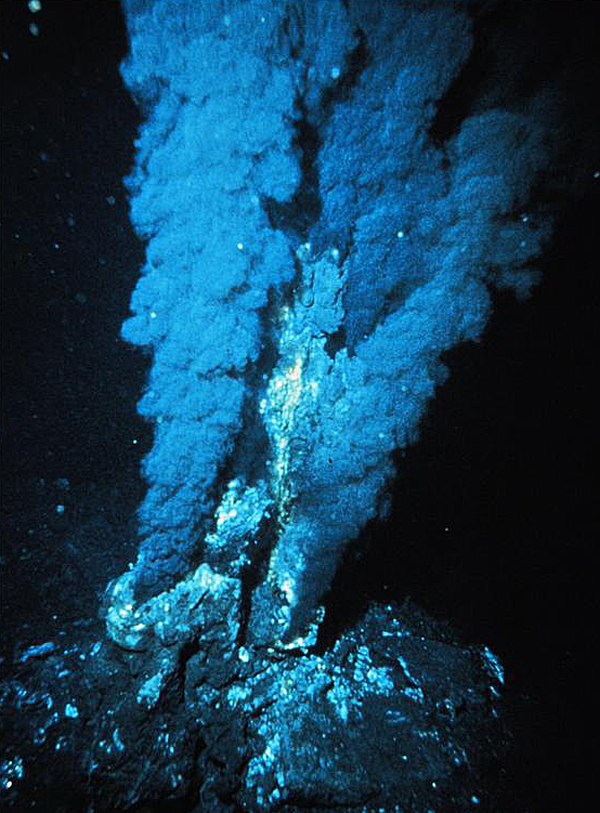
« Fumeur noir » dans l’Atlantique (Source : Wikipedia)