Webcams siciliennes

L’Association Volcanologique Européenne (L.A.V.E.) vient de mettre en ligne une nouvelle webcam sur le Stromboli. Elle est accessible en cliquant sur ce lien :

http://www.lave-volcans.eu/webcams_stromboli.php?numero=1

Cette webcam s’ajoute à celle déjà présente sur l’Etna :

 http://www.lave-volcans.eu/webcams_etna.php?numero=2

Bonus intéressant : La webcam de l’Etna s’accompagne d’archives permettant de voir l’activité volcanique au cours des dernières 24 heures. Très utile quand les éruptions ont lieu pendant notre sommeil !

D’autres webcams sont orientées vers les cratères de l’Etna et le Stromboli, comme celles proposées par Radio Studio 7 dont certaines sont en streaming et permettent donc d’observer l’activité volcanique en direct :

http://www.radiostudio7.it/webcam.asp

Des vues en streaming sont également proposées par l’Osservatorio Meteorologico di Nunziata di Mascali. On peut choisir le versant sud de l’Etna :

http://www.osservatoriometeorologiconunziata.it/joomla30/index.php/web-cam/etna-sud-live

ou le versant nord :

http://www.osservatoriometeorologiconunziata.it/joomla30/index.php/web-cam/etna-nord-live

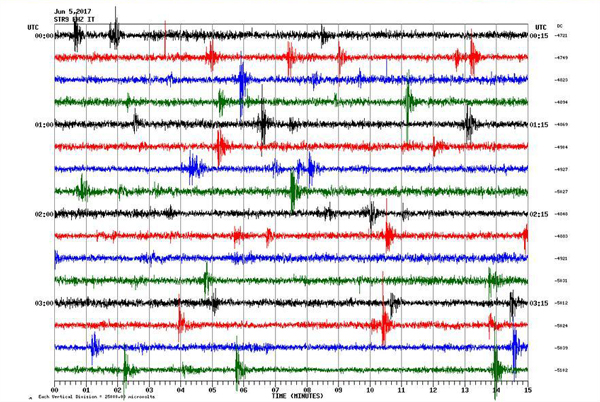
Les webcams de l’INGV ne manquent pas d’intérêt. Elles permettent de voir la Fossa di Vulcano, le Stromboli et l’Etna. Pour ce dernier, viennent s’ajouter les images des caméras thermiques. Le site propose également de suivre l’activité sismique :

http://www.ct.ingv.it/it/?option=com_wrapper&view=wrapper&Itemid=100&lang=it

D’autres webcams sont orientées vers l’Etna. En voici quelques exemples; la liste n’est pas exhaustive :

https://www.meteoindiretta.it/wcdet/8691/giarre__ct_/panoramica_sul_vulcano_etna/

http://www.telegrafovecchio.com/wcam/cam1.jpg

http://www.guide-etna.com/

http://www.etnanatura.it/foto/storicowebcam1.php

Des abeilles du Masaya aux coccinelles du Stromboli // From the bees of Masaya to the ladybirds of Stromboli

drapeau-francaisAu cours de la visite des volcans, on peut faire des découvertes surprenantes. Un chercheur britannique ne s’attendait pas à voir les abeilles à proximité du cratère actif du Masaya au Nicaragua. De la même façon, je fus très surpris de découvrir des grappes de coccinelles sur le Stromboli et sur l’Etna.

Un scientifique qui effectuait des observations sur le Masaya, à proximité de Managua, la capitale du Nicaragua, a découvert une petite abeille, Anthophora squammulosa, qui essayait de se frayer un chemin à travers les amoncellements de cendre, à la recherche de nectar. Cette petite abeille et ses congénères ont élu domicile dans un seul secteur du Masaya. C’est un endroit où les températures peuvent monter jusqu’à 42°C et où des pluies acides tombent de temps en temps sur les pentes supérieures de la montagne. Aucune végétation n’est visible dans cette partie du volcan. Le scientifique s’est demandé pourquoi des abeilles se trouvaient là et une étude a été lancée avec la collaboration d’autres chercheurs du monde entier.

Ils ont voulu tout d’abord savoir combien d’abeilles étaient présentes et ils sont arrivés à une estimation de 1000 à 2000 insectes.
Un autre mystère était la nourriture des abeilles. Les femelles creusent des nids composés d’alvéoles à une trentaine de centimètres de profondeur sur le flanc du volcan, où elles pondent leurs œufs. Elles recueillent ensuite le pollen et le nectar qu’elles déposent dans le nid pour nourrir les larves après l’éclosion des oeufs. La majeure partie du pollen provient d’une seule plante, Melanthera nivea, une fleur sauvage robuste qui peut résister aux précipitations acides sur le volcan.
Les chercheurs pensent que les abeilles peuvent vivre dans l’environnement hostile du volcan car il y a peu de prédateurs et de parasites qui pourraient menacer leur survie. De plus, leurs nids ne sont pas brisés par des racines souterraines vu qu’il n’y a guère de végétation sur le Masaya. Cependant, il existe une double menace bien réelle pour cette population d’abeilles: Une éruption pourrait les anéantir, et comme elles dépendent d’un seul type de plante, si cette plante venait à disparaître, il ne leur resterait plus rien pour se nourrir et pour vivre. Quelle drôle de vie !
Source: Science Mag.

Tout comme les abeilles sont inattendues sur le Masaya, une rencontre avec des coccinelles constitue une réelle surprise sur l’Etna ou le Stromboli en Sicile. La population de coccinelles est spectaculaire entre juin et février de l’année suivante. Les espèces Cocinella septempunctata et Adalia bipunctata se concentrent sur ou sous les pierres et à l’intérieur des fractures dans la lave. Les deux espèces se différencient par le nombre de points noirs sur leurs élytres rouges.
Les coccinelles sont très utiles pour la nature car elles se nourrissent de pucerons et ce sont de remarquables prédateurs qui peuvent parfois manger leur propre progéniture. Quand leur nombre est très élevé dans certaines régions du monde, on les recueille pour les utiliser dans la protection des arbres fruitiers.
Lorsque l’on regarde les coccinelles qui se cachent à l’intérieur des fractures volcaniques, on pourrait penser qu’elles y ont été apportées par le vent et qu’elles attendent une mort certaine en raison du manque de nourriture. Cependant, la réalité est très différente. Dirigées par une sorte d’instinct, les coccinelles effectuent un vol migratoire vers les zones élevées de leur habitat lorsque l’air chaud des plaines provoque un manque de pucerons qui représentent leur principale source de nourriture. Après avoir pondu leurs œufs dans les vergers d’agrumes de la Sicile, les coccinelles, repues, migrent vers les pentes supérieures de l’Etna qui sont dépourvues de prédateurs tels que les araignées, les oiseaux ou les rongeurs. Au début du printemps suivant, lorsque la population de pucerons réapparaît, les coccinelles sortent de leurs cachettes et migrent dans l’autre sens ; elles envahissent alors les lieux où elles peuvent trouver une nourriture abondante.
On peut se demander pourquoi les coccinelles se rassemblent en grappes si fournies. Aucune réponse définitive n’a été proposée. C’est peut-être parce qu’elles réagissent de la même manière à des facteurs microclimatiques (humidité, chaleur et lumière), ou parce qu’elles sont attirées par les odeurs laissées par les premiers insectes qui sont arrivés sur place.
Source: Revue de L’Association Volcanologique Européenne.

—————————————

drapeau-anglaisWhen visiting volcanoes, you can make surprising discoveries. A British researcher did not expect to see bees close to the active crater of Masaya volcano in Nicaragua. In the same way, I was very surprised to find swarms of ladybirds on Stromboli and Mount Etna.

A scientist who was visiting Masaya volcano, just outside the Nicaraguan capital city of Managua, discovered a little bee, Anthophora squammulosa, which was zipping through the ash heaps looking for nectar and burrowing in a pile of volcanic debris. These bees nest almost exclusively in one patch of Masaya. There, temperatures may climb as high as 42°C, and acid rain occasionally falls on the upper slopes of the mountain. Nothing visible grows. The scientist wondered why the bees were there and a study was launched with other researchers from around the globe.

First, they wanted to figure out just how many bees were present and came to an estimation of 1000 to 2000 insects.

Another mystery was what the bees were eating. The females dig cell-like nests nearly 30 centimetres into the side of the volcano, where they lay their eggs. They then collect pollen and nectar to deposit in the nest for the developing larva to eat after they hatch. 99% of the pollen comes from only one plant, Melanthera nivea, a tough wildflower that can survive the volcano’s acid rainfall.

The researchers think that the bees may thrive in the volcano’s adverse environment because it hosts few predators and parasites that would threaten their survival. It could also be that their nests aren’t broken up by underground roots as there is hardly any vegetation on Masaya. However, the bee population living on the volcano may be under a real threat: Not only could an errant eruption kill them, but because they are specialized to only one type of plant, if that plant died out, they would be left with nothing. The little bees are living life literally on the edge!

Source : Science Mag.

Just like the bees are quite unexpected on Masaya volcano, ladybirds come as a real surprise on Mt Etna or Stromboli volcano in Sicily. The ladybird population is at its highest between June and February of the next year.  Cocinella septempunctata and Adalia bipunctata concentrate on or under the stones and within the fissures of the lava. Both species are differentiated by the number of black dots on their red wings.
Ladybirds are very precious to nature as there are remarkable predators that can sometimes eat their own offspring.  As their numbers is sometimes very high in some regions of the world, they are collected to be used in the protection of fruit trees.

When looking at the ladybirds hiding inside the fissures, one might think they have been carried on the volcano by the wind where they are waiting for a certain death because of the lack of food. However, reality is quite different. Led by some sort of instinct, they perform a migratory flight towards the elevated areas of their habitat when the warmer air of the plains induces a drastic lack of aphids which represent their main food source. After having laid their eggs in the citrus fruit orchards of Sicily, the ladybirds migrate to the higher slopes of Mt Etna which are devoid of predators such as spiders, birds or rodents. Early during the next spring, when the aphid population reappears, the ladybirds come out of their hiding places and migrate the other way round and invade the places with plentiful food.

Another question needs to be answered: why are the ladybirds gathering in such great numbers? The reason may be that they react in the same way to microclimatic factors (humidity, heat and light), or because they are drawn by the odours left by the first insects that arrived on the spot.

Source: Review of L’Association Volcanologique Européenne.

Coccinelles

Les coccinelles du Stromboli (Photo: C. Grandpey)

Images de Stromboli (Sicile / Italie)

drapeau-francaisEn cliquant sur le lien ci-dessous, vous pourrez voir une petite vidéo réalisée par l’ami Jean-Paul Céceille (adhérent de L’Association Volcanologique Européenne). Elle montre l’activité du Stromboli le 30 avril 2016. Elle était essentiellement concentrée dans la bouche située au sud-ouest (côté Ginostra). Le document propose également quelques images de Lipari et Vulcano.

https://www.youtube.com/watch?v=azgRu07uD4E

————————————–

drapeau-anglaisBy clicking on the link below, you will see a short video shot by my friend Jean-Paul Céceille (Member of L’Association Volcanologique Européenne). It shows activity at Stromboli volcano on April 30th 2016. It was mainly concentrated in the vent located to the SW of the crater. The document also invites you to a few minutes in Lipari and Vulcano.

https://www.youtube.com/watch?v=azgRu07uD4E

Strombo-blog

Photo: C. Grandpey


The volcano and the barometer: Strombolian activity and atmospheric pressure

drapeau-anglaisSince the dawn of science, man has always tried to account for his activities or his behaviour through external phenomena among which lunar attraction, barometric pressure and the amplitude of ocean tides were given priority. Even today, a gardener will tell you that he sows during « the rising moon period » and that he plants during « the waning moon period » ; those who suffer from asthma find it more difficult to breathe when air pressure is high ; many a fisherman associates the quality of his catch with the coefficient of the tide ; and many other similar examples could undoubtedly be found round the world…
The world of volcanoes itself does not lie beyond this tradition. However, the subject of this study will be confined to the possible correlation between atmospheric pressure and eruptive activity on strombolian-type volcanoes. At one time, I was going to associate atmospheric pressure and fumarolian intensity ; actually, in the course of my frequent visits to Vulcano (Aeolian Islands – Italy), I realised that the density of the gas clouds was related more to the degree of hygrometry of the air than to its pressure, though there may occasionally exist a relationship between both phenomena. Nevertheless, at Vulcano, the density of the fumarolian clouds, essentially observed in the morning, very rarely corresponds with a fluctuation in atmospheric pressure.

1. Personal approach.

At Stromboli, the correlation between weather conditions and eruptive activity has existed for a very long time. In 1862, in a book entitled Volcanoes, G. P. Scrope wrote that « the inhabitants of Stromboli positively make use of their volcano as a weather-glass ». Even today, most inhabitants do observe ‘their’ volcano to forecast the weather, relying on the perception or non-perception of the explosions from the villages. Yet, we may believe that, more than barometric pressure, it is the direction of the wind that leads the Strombolians’ forecasts. Indeed, the explosions in the craters are mainly audible when the wind blows from the west, where most disturbances come from, not forgetting however that they are accompanied by a fall in barometric pressure.
Among the people at Stromboli, those who know the volcano best are the guides. One evening, I was chatting with one of them – Antonio Aquilone – on the Cima, while the activity at the craters was quite normal and sustained. Suddenly, a fog shrouded the top of the mountain and the eruptive explosions stopped at the same time. I won’t forget Tonio’s remark : « See, he (meaning the volcano) has understood the weather was changing ». During the (cold) hours that followed, the eruptive activity remained remarkably low. When the fog eventually cleared up around 5 a .m., the explosions started anew. My personal barometer had recorded a fall in pressure that coincided with these observations.
One day of April 1995, I witnessed a similar phenomenon, with a sudden fall in barometric pressure (10 mBars or so) late in the afternoon, together with a coming of clouds from the north and a strong decrease of explosive activity. I then obtained the following diagrams :

Baro 1

Baro 2

Such observations are confirming others performed at Stromboli over 12- to 18-hour periods, in relation with studies of explosive frequency.

2. Scientific approach.

As far as I know, scientific reports on the possibility of a relationship between eruptive activity and atmospheric pressure are very few and apart from some excerpts from Acta Vulcanologica, there is little scientific literature on the subject. Professor S. Falsaperla (Volcanological Institute of Catania) and Professor E. Schick (Geophysical Institute of Stuttgart) are apparently the only people in Europe to have published noteworthy articles.
In a letter, Prof. Falsaperla told me that her « personal opinion was that both on Stromboli and on whatever volcano a relationship exists, although it can be more or less important with reference to the internal state of the volcanic system. As many physical and chemical parameters may play a role in the rate of explosive activity, the influence of pressure is not easy to model even in a relatively ‘simple’ volcano as Stromboli ».
Between January and April 1983, Prof. Falsaperla took part in a workshop about barometric pressure and the frequency of seismic events at Stromboli. The complete results have been collected in Volume 3 of IAVCEI Proceedings in Volcanology edited in 1992 and been summed up in the following diagrams :

Baro 4_modifié-1

The positive side of these diagrams is to clearly show the whole situation over a given period (January-April) ; however, the compactness of the graphs does not allow us to see certain punctual occasions when a sudden and brutal fall (10 mBars or more) in atmospheric pressure seems to cause a change in eruptive activity [ see 1st part of this study]. Such a phenomenon would more clearly appear in a daily or even a weekly diagram.
Nevertheless, studying Prof. Falsaperla’s diagrams, we may reasonably assert that if common points do exist, they are not numerous enough to let us conclude with certainty that there exists a systematic coincidence at Stromboli between seismic (namely eruptive) activity and barometric pressure.
Besides, Pr. Falsaperla remarks that, in order to study the relationship between atmospheric pressure and the hourly occurrence of eruptive shocks, another variable – the dynamic behaviour of magma – should be taken into account. Indeed, some vulcanologists (for instance B. Martinelli in 1991) admit that the mixture of magma and gases is an unstable thermodynamic equilibrium that may undergo a transformation (explosive degassing or overpressure) following disturbances – should they be slight – in the magmatic conduits ; such disturbances might be caused by variations in tides or barometric pressure. Prof. Falsaperla seems to approve this theory since she concludes her study by writing that other external phenomena such as tidal forces, wind, rainfall loading, sea-wave surges etc… are likely to act as a complement to atmospheric pressure.
As far as tides are concerned, again very few studies have been published. The most interesting was performed in 1983 by a team led by Prof. Emter ; after 5,000 hours of observations corresponding with 30,000 explosions, these scientists did not find any tangible sign of the influence of tides on the triggering process of eruptions.

Among scientists themselves, opinions may diverge. French vulcanologist Haroun Tazieff wrote me that after 30 years of visits to Sicilian volcanoes he « could neither establish a correlation between eruptive activity and atmospheric pressure, nor with tides, nor with lunar attraction ». Moreover, he was « extremely sceptical about Prof. Falsaperla’s suggestions », leaning on the fact that « his own observations about that hypothetical correlation had not only been made at Stromboli, but on many prolonged activities ranging from Kituro or Nyiragongo to Erta’Ale or Capelinhos ».

3. Hygrometry.

During the latest observations, an additional parameter – hygrometry – has been taken into account. Indeed, in most cases, a drop in atmospheric pressure is paralleled by an increase in humidity.
It should be noted (not only about Stromboli) that such a change in hygrometry may lead to considerable changes in the morphology of the plumes escaping from active vents or fumarolic fields. Therefore, one has to be very careful before making a link between density of the plume and eruptive activity.
This remark has been confirmed during observations on various sites such as La Fossa di Vulcano, Mount Etna and Stromboli.

4. Conclusion.

On comparing scientific opinion with my own observations, I have arrived at the following conclusions :
As far as large-scale volcanic systems are concerned (I mean those that have very powerful feeding conduits, such as Kilauea or Nyiragongo, and involve huge magmatic and degassing forces), if barometric pressure has any influence over the eruptive process, it is negligible compared to the forces coming from the inner of the earth and so is not detected.
On the other hand, when eruptive activity is more reduced, or even sporadic – as is often the case at Stromboli – it is easier to apprehend that phenomenon, to observe it and to measure it, above all when it is occasional or punctual. This remark confirms B Martinelli’s (see above) about external factors liable to cause a disequilibrium in the mixture of magma and gases.
Anyway, even though this parameter may seem interesting, it does not look as if the correlation between eruptive activity and barometric pressure is an essential factor to volcanic approach. Other more prolonged observations ought to be performed to shed light on this phenomenon.

++++++++++++++

I would like to thank J. M. Bardintzeff, S. Falsaperla, H. Tazieff and the Stromboli guides who, through their collaboration, allowed me to achieve this study.

++++++++++++++

R E F E R E N C E S

Acta Vulcanologica. Vol 3. (1993.)

IAVCEI Proceedings in Volcanology, vol 3. (1992).

Emter D., Zuern W., Schick R.., Lombardo G. : Search for tidal effects on volcanic activities at Mt Etna & Stromboli. (1986).

Falsaperla S., Neri G. : Seismic monitoring of volcaoes : Stromboli (Southern Italy).(1986).

Martinelli B. : Fluidinduzierte Mechanismen für die Entstehung von vulkanischen Tremor-Signalen. (1991).

Schick R., Mueller W. : Volcanic activity and eruption sequences at Stromboli during 1983-1984. (1988)

Scrope G. P. : Volcanoes (1862) Ed.. Longmans & Roberts, London.

Str blog 01

Str blog 05

Str blog 07

Str blog 08

Photos: C. Grandpey