La fonte ultra-rapide du glacier Petermann (Groenland) // The ultra-rapid melting of the Petermann Glacier (Greenland)

J’ai écrit plusieurs articles ces dernières années (18 avril 2017, 14 février 2019, 14 mai 2023) sur la fonte du glacier Petermann, l’une des plus grandes rivières de glace du Groenland. Il est situé dans le Haut-Arctique, à 80 degrés de latitude nord. C’est l’un des grands glaciers émissaires (il vient vêler dans l’océan) par lesquels la calotte glaciaire du Groenland termine sa course dans la mer. Les scientifiques ont averti que le glacier Petermann retient à lui seul une trentaine de centimètres d’élévation potentielle du niveau de la mer au niveau de la calotte glaciaire du Groenland.
Des études récentes de la fonte rapide du glacier indiquent qu’elle est due à l’intrusion d’eau de mer sous la glace. L’une d’elles, publiée dans les Geophysical Research Letters explique que l’élévation du niveau de la mer pourrait s’avérer bien pire que ce qui a été estimé précédemment. D’autres travaux sont parvenus à des conclusions similaires sur les glaciers émissaires de l’Antarctique.
À l’aide de données satellitaires, un groupe de chercheurs a découvert que la vitesse de fonte des glaces était passée d’environ 3 mètres par an dans les années 1990 à près de 10 mètres par an dans les années 2020. La fonte rapide est provoquée par l’intrusion d’eau de mer sous la glace dans la « zone d’ancrage » du glacier, autrement dit la limite entre l’endroit où la glace s’accroche au substrat rocheux et l’endroit où elle flotte à la surface de l’océan. À cet endroit, l’eau de l’océan monte et descend au gré des marées, faisant fondre rapidement la glace terrestre par le bas. Auparavant, les scientifiques pensaient que cette zone était beaucoup plus petite.
Les dernières études indiquent que les glaciers fondent beaucoup plus rapidement qu’on ne le pensait jusqu’à présent et que l’élévation du niveau de la mer a été sous-estimée par les scientifiques. La montée du niveau de la mer continue de menacer les zones côtières, sujettes aux inondations et à l’érosion. Tant que des mesures efficaces ne seront pas prises – notamment lors des COP – pour freiner le réchauffement climatique, les glaciers continueront de fondre et le niveau des océans ne cessera de monter, sans oublier les événements extrêmes déclenchés par la hausse des températures à travers le monde.
Source : Médias d’information internationaux.
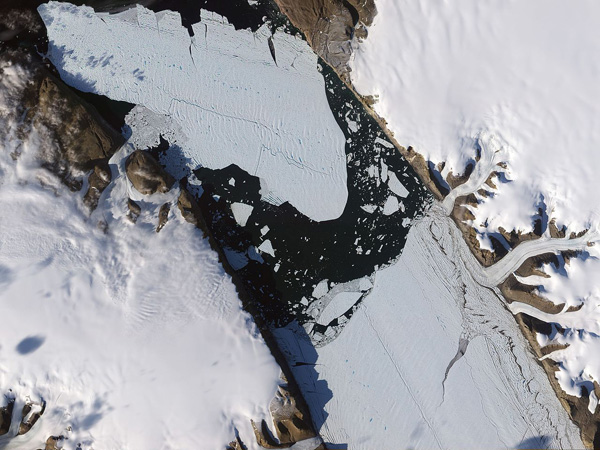
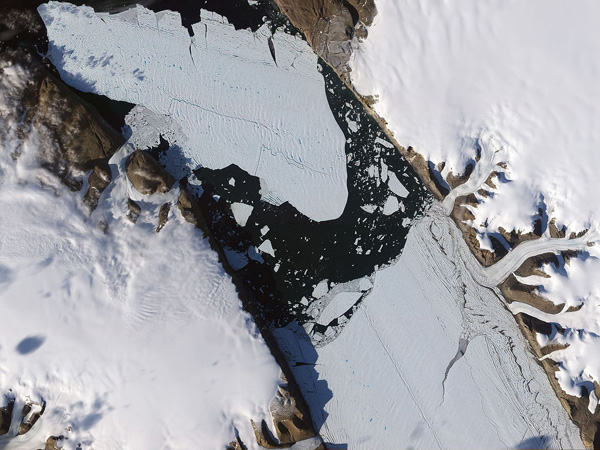
Image d’un vêlage du Petermann en 2012 (Source : NASA)

Vue du Petermann en octobre 2022 (Source : Copernicus)

————————————————

I have written several posts in the past years (18 April 2017, 14 February 2019, 14 May 2023) about the melting of the Petermann Glacier, one of the largest ice rivers in Greenland. It is located in the high Arctic at 80 degrees North latitude. It is one of the most important outlets by which the Greenland ice sheet extends and flows into the sea. Scientists have warned that Petermann glacier holds back about a foot of potential sea level rise from the Greenland ice sheet.

Recent research exploring the rapid melting of the glacier points to seawater intrusion beneath the ice as a culprit. The study published in Geophysical Research Letters also suggests that sea level rise could end up being much worse than previously estimated. Other studies have come to similar conclusions about outlet glaciers in Antarctica.

Using satellite data, a group of researchers found that the ice melt rate increased from about about 3 meters per year in the 1990s to nearly 10 meters per year in the 2020s. The rapid melting was caused by seawater intrusion beneath the ice in the « grounding zone » which is the the boundary between where the ice is grounded on the bedrock and where it is floating. Here, ocean water rises and falls with changes in tides, quickly melting grounded ice from below. Previously, scientists believed this zone to be much smaller.

The new research indicates that glaciers melt much faster in the ocean than previously thought and that sea level rise has been thus far underestimated by scientists. Rising sea levels continue to threaten coastal communities, which are prone to flooding and erosion. As long as no efficient measures are taken – especially during the COPs – to curb global warming, glaciers will keep melting and oceans will never stop rising, without forgetting the extreme events triggered by rising temperatures around the world.

Source : International news media.

La fonte inquiétante du glacier Petermann au Groenland // The worrying melting of the Petermann Glacier in Greenland

Une nouvelle étude confirme la fonte rapide et inquiétant de l’Arctique. Elle s’appuie sur des observations du glacier Petermann, un glacier côtier situé dans le nord-ouest du Groenland à l’est du détroit de Nares. Le glacier possède la plus grande langue glaciaire de l’hémisphère nord. D’importants vêlages se produisent et, le 5 août 2010, une observation du satellite Aqua a montré le détachement du plus gros morceau de glace jamais répertorié depuis 1962, avec un iceberg de 251 km2.

Le glacier Petermann est l’un des seuls de l’Arctique à posséder une plate-forme glaciaire. Elle présente une longueur de plus de 60 km. Comme on l’a vu en Antarctique, ces plates-formes sont des éléments essentiels car elles stabilisent la glace qui ne flotte pas. Elles jouent le rôle de rempart pour les glaciers situés en amont. Mesurer les changements affectant ces plates-formes est donc crucial car leur disparition peut entraîner une augmentation du déversement d’icebergs dans l’océan et donc une augmentation du niveau de la mer.

Le glacier Petermann était considéré comme stable car il avait très peu réagi au réchauffement de l’océan et de l’atmosphère, qui a largement affecté les autres glaciers groenlandais. À l’aide de plusieurs centaines de données d’imagerie satellitaire fournies par l’Agence spatiale européenne (ESA), la NASA et l’Agence spatiale italienne (ASI), une équipe scientifique internationale a pu observer les changements qui ont affecté la plate-forme glaciaire du Petermann au cours des 30 dernières années. Grâce à des méthodes interférométriques de pointe, les chercheurs ont pu mesurer très précisément la position de la ligne d’échouage du glacier, autrement dit la limite où le glacier commence à flotter pour devenir une plate-forme glaciaire. La mesure de la localisation de cette frontière est importante car elle exerce un contrôle important sur la stabilité du glacier. C’est aussi un très bon indicateur de la réaction du glacier au réchauffement climatique.

Si le glacier est resté relativement stable depuis les années 1990, les chercheurs ont récemment observé un changement spectaculaire dans son comportement. En particulier, au cours des sept dernières années, ils ont assisté à une série d’événements qui montrent tous les signes d’une déstabilisation de ce secteur du Groenland. Entre 2014 et 2015, le flux du glacier a commencé à s’accélérer de manière significative. Après cet événement, deux grandes fissures se sont ouvertes ; elles ont divisé la plate-forme glaciaire en trois parties différentes. Depuis 2017, le glacier est à nouveau actif et sa ligne d’échouage a reculé de façon spectaculaire : Entre 2017 et 2021, elle a reculé de 5 km, ce qui dépasse de loin la variabilité naturelle observée habituellement avec ce glacier.

Selon les scientifiques, ces événements laissent entrevoir une déstabilisation imminente du glacier Petermann qui n’avait pas connu cette menace jusqu’à présent. Depuis les années 1970, les scientifiques ont mesuré une augmentation significative des températures océaniques dans cette zone de l’Arctique. La hausse de température de l’océan peut accroître la fonte des plates-formes glaciaires qui sont sapées par en dessous. Les auteurs de l’étude pensent que « les événements dramatiques qui se produisent actuellement sont les conséquences d’un affaiblissement à long terme de la plate-forme de Petermann, dû en partie au réchauffement des eaux océaniques. »

L’affaiblissement des plates-formes est une question importante, notamment en Antarctique, où la plupart des glaciers se terminent par des extensions flottantes, comme le glacier Petermann dans l’Arctique. Le Groenland est soumis à un plus large éventail de forçages climatiques ; l’observation de ce qui s’y passe pourrait donc permettre de mieux comprendre ce qui pourrait arriver dans l’Antarctique dans le futur.

Après la rupture meurtrière du glacier Marmolada dans les Alpes et au Tadjikistan, les effondrements rapides de glaciers s’accumulent sous toutes les latitudes, comme des signes toujours plus criants des changements qui affectent notre planète, ce qui appelle à une action immédiate pour agir contre la crise climatique.

Source : Institut des Géosciences de l’Environnement (IGE) de Grenoble.

———————————————-

A new study confirms the rapid and worrying melting of the Arctic. It is based on observations of the Petermann Glacier, a coastal glacier located in northwest Greenland, east of Nares Strait. The glacier has the largest glacier tongue in the northern hemisphere. Massive calvings occur, and on August 5th, 2010, an observation from the Aqua satellite showed the detachment of the largest chunk of ice ever recorded since 1962, with an iceberg measuring 251 km2.
The Petermann Glacier is one of the few in the Arctic to have an ice-shelf. It has a length of more than 60 km. As seen in Antarctica, these shelves are essential because they stabilize ice that does not float. They act as a rampart for the glaciers located upstream. Measuring the changes affecting the ice-shelves is therefore crucial because their disappearance can lead to an increase in the discharge of icebergs into the ocean and therefore a rise in sea level.
Petermann Glacier was considered stable because it had reacted very little to ocean and atmospheric warming, which has largely affected other glaciers in Greenland. Using several hundred satellite imagery data provided by the European Space Agency (ESA), NASA and the Italian Space Agency (ASI), an international scientific team was able to observe the changes that have affected the Petermann ice-shelf over the last 30 years. Using state-of-the-art interferometric methods, the researchers were able to measure very precisely the position of the glacier’s grounding line, in other words the limit where the glacier begins to float to become an ice-shelf. The measurement of the location of this boundary is important because it exerts an important control on the stability of the glacier. It is also a very good indicator of the reaction of the glacier to global warming.
While the glacier had remained relatively stable since the 1990s, researchers have recently observed a dramatic change in its behavior. In particular, over the past seven years, they have witnessed a series of events that show all the signs of a destabilization of this area of Greenland. Between 2014 and 2015, the flow of the glacier began to accelerate significantly. After this event, two large cracks opened; they divided the ice-shelf into three different parts. Since 2017, the glacier has been active again and its grounding line has receded dramatically: Between 2017 and 2021, it has receded by 5 km, which far exceeds the natural variability usually observed with this glacier.
According to the scientists, these events point to an imminent destabilization of the Petermann glacier, which had not known this threat until now. Since the 1970s, scientists have measured a significant increase in ocean temperatures in this area of the Arctic. Rising ocean temperatures may increase the melting of ice shelves that are being undermined from below. The study authors believe that « the dramatic events now occurring are the consequences of a long-term weakening of the Petermann ice-shelf, due in part to warming ocean waters. »
The weakening of shelves is an important issue, especially in Antarctica, where most glaciers end in floating extensions, in the same way as the Petermann Glacier in the Arctic. Greenland is subject to a wider range of climate forcings; observing what is happening there could therefore provide a better understanding of what could happen in Antarctica in the future.
After the deadly rupture of the Marmolada glacier in the Alps and in Tajikistan, rapid glacier collapses are accumulating at all latitudes, as ever more glaring signs of the changes affecting our planet. This situation calls for immediate action to act against the climate crisis.

Source : Institut des Géosciences de l’Environnement (IGE) de Grenoble.

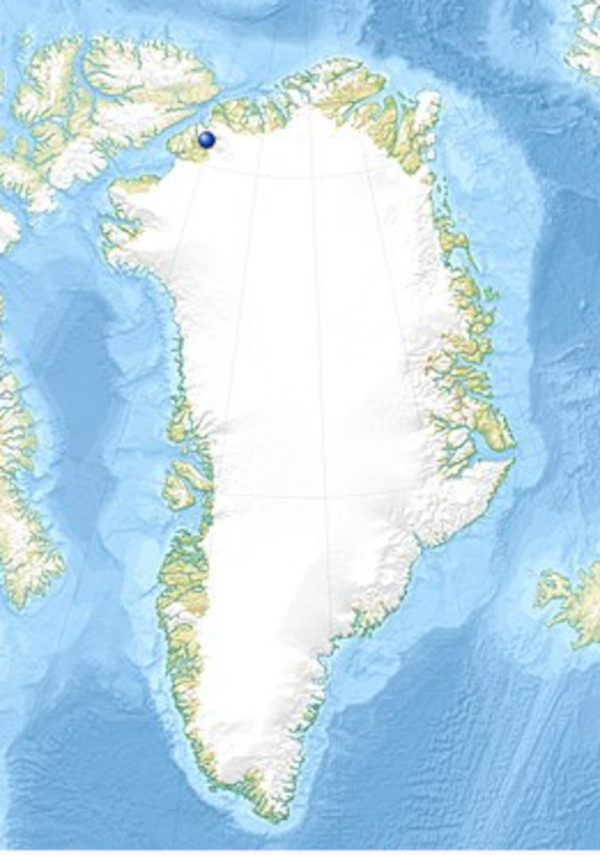
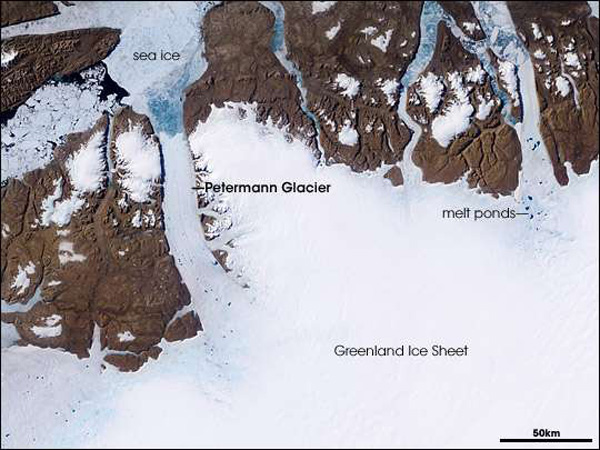
Localisation géographique et images satellites du glacier Petermann (Source: Wikipedia)

Groenland : Nouvelle accélération du glacier Petermann // Greenland : The Permann Glacier is again accelerating

Dans une note mise en ligne le 18 avril 2017, j’attirais l’attention sur le comportement du glacier Petermann au Groenland. A cette époque, les scientifiques avaient décelé sur les images satellitaires une nouvelle fracture dans la plateforme glaciaire, avec le risque d’une une rupture spectaculaire dans les années à venir.

Le glacier Petermann, situé à 80 degrés de latitude nord, constitue l’une des principales portes par lesquelles la calotte glaciaire du Groenland s’écoule dans la mer. En 2010 et 2012, la plateforme flottante du glacier a déjà laissé s’échapper des morceaux extrêmement importants. Ainsi, un iceberg produit en 2010 avait une superficie de 251 km2. Un autre en 2012 présentait une surface de 147 km². Cette fracturation à répétition de la plateforme est un gros problème parce que le glacier Petermann  retient une partie de la banquise du Groenland qui, si elle devait prendre le chemin de la mer, ferait monter son niveau d’une trentaine de centimètres.
Une étude récente effectuée par des glaciologues allemands et publiée en janvier 2019 dans le Journal of Geophysical Research révèle que la vitesse d’écoulement du glacier Petermann s’est accrue de 10 % par rapport à l’hiver 2011 et de nouvelles fractures sont apparues 12 km en amont du front glaciaire, indiquant la formation possible d’un nouvel iceberg. Les images satellite montrent que le glacier s’écoulait à une vitesse de 1135 mètres par an en 2016, phénomène que les chercheurs expliquent comme une conséquence du vêlage de 2012. La perte de glace a réduit la longueur de langue et a donc amoindri les frottements de la masse glaciaire contre les parois du fjord qui freinent  son écoulement. Le détachement d’un autre iceberg pourrait accélérer encore la vitesse du glacier.

Les glaciologues ne peuvent pas dire à la seule observation des données satellitaires si l’accélération découlement du glacier Petermann est causée par le réchauffement de l’atmosphère ou de l’eau de mer au Groenland. Néanmoins, les scientifiques expliquent que l’accélération du glacier Petermann est un signal important. Contrairement aux glaciers du sud-est et du sud-ouest du Groenland, ceux du nord de l’île étaient restés relativement stables jusqu’à présent; mais la situation semble avoir changé. Depuis 2002, la banquise et les glaciers du Groenland ont perdu en moyenne 286 milliards de tonnes de glace par an. Cette perte de masse est due avant tout à l’accélération de la fonte de surface en été. Le vêlage des icebergs a également augmenté. Les glaciers du Groenland perdent maintenant un quart de glace de plus sous forme d’événements de vêlage que pendant 1960-1990 qui sert de période de référence. Les causes potentielles incluent des courants océaniques plus chauds qui font fondre les langues glaciaires par en dessous, et les eaux de fonte qui s’infiltrent dans les fissures et les crevasses jusqu’à atteindre le soubassement des glaciers où elles jouent le rôle de lubrifiant et provoquent une accélération de l’écoulement de la glace. L’augmentation globale annuelle du niveau de la mer est d’environ 3,3 millimètres ; la perte de glace au Groenland y contribue actuellement pour environ 0,7 millimètre.

Voici une animation du vêlage du glacier en 2012 : https://upload.wikimedia.org/wikipedia/commons/transcoded/b/b2/Wild_Arctic_Summer.ogv/Wild_Arctic_Summer.ogv.480p.webm

Source : Presse scientifique.

————————————————

In a post released on April 18th, 2017, I drew attention to the behaviour of the Petermann Glacier in Greenland. At that time, scientists had detected on satellite images a new crack in the floating ice shelf with the risk of a spectacular break in the coming years.
The Petermann Glacier, located in the high Arctic at 80 degrees North latitude, is one of the most important outlets through which the Greenland icecap flows into the sea. In 2010 and 2012, the glacier’s floating platform has already released extremely large pieces. For example, an iceberg produced in 2010 had an area of ​​251 km2. Another in 2012 had an area of ​​147 km². This repetitive breaking of the platform is a big problem because the Petermann glacier retains part of the Greenland ice sheet which, if it were to flow into the sea, would raise its level by about thirty centimetres.
A recent study conducted by German glaciologists and published in January 2019 in the Journal of Geophysical Research reveals that the flow rate of the Petermann glacier has increased by 10% compared to winter 2011 and new fractures have appeared. 12 kilometres upstream of the ice front, indicating the possible formation of a new iceberg. Satellite imagery shows that the glacier was flowing at a speed of 1135 metrs per year in 2016, a phenomenon that the researchers explain as a consequence of the calving in 2012. The loss of ice has reduced the length of the ice tongue and thus also reduced the friction of the glacial mass against the walls of the fjord which slow down its flow. The detachment of another iceberg could further accelerate the speed of the glacier.

The question of whether these changes are due to the warming atmosphere over Greenland, or to warmer seawater, is not an aspect that glaciologists could investigate using the satellite data.  Nevertheless, the experts consider the acceleration of Petermann Glacier to be an important signal. Unlike the glaciers in southeast and southwest Greenland, those in the island’s northern reaches had remained largely stable; but the situation now appears to have changed. Since 2002, the Greenland Ice Sheet and the island’s glaciers have lost an average of 286 billion tonnes of ice per year. This loss of mass is above all due to intensified surface melting in the summer. Iceberg calving has also increased: Greenland’s glaciers are now losing a fourth more ice in the form of calving events than in the comparison period (1960 to 1990). Potential causes include warmer ocean currents, which melt the glaciers’ floating tongues from below; and meltwater, which percolate into cracks and crevasses until it reaches the glacier bed, where it acts like a lubricant, causing ice flows to accelerate. The total annual global sea-level rise is about 3.3 millimetres, of which the loss of ice on Greenland is currently contributing about 0.7 millimetres.

Here is a timelapse video of the glacier in 2012 : https://upload.wikimedia.org/wikipedia/commons/transcoded/b/b2/Wild_Arctic_Summer.ogv/Wild_Arctic_Summer.ogv.480p.webm

Source: Scientific press.

Source: NASA

La fonte inquiétante du Groenland // Greenland’s alarming melting

Dans une note publiée le 18 avril 2017, j’ai attiré l’attention sur la fracturation du glacier Petermann au Groenland.
https://claudegrandpeyvolcansetglaciers.com/2017/04/18/nouvelle-fracturation-du-glacier-petermann-groenland-new-fissure-detected-in-petermann-glacier-greenland/

Ces dernières semaines, les médias ont donné la priorité au vêlage de la plate-forme glaciaire Larsen C en Antarctique. Pourtant, la fracturation qui s’est produite au Groenland est certainement plus inquiétante et peut avoir des conséquences plus importantes.
L’iceberg qui s’est détaché dans l’Arctique la semaine dernière pose problème car, contrairement à son homologue antarctique, il pourrait contribuer faire monter le niveau de la mer. Il s’est détaché de la plate-forme glaciaire sur laquelle s’appuie le glacier Petermann au moment où les températures sont à leur maximum dans l’Arctique.

Le mouvement du glacier Petermann s’est accéléré au cours des dernières années, en faisant se déverser de la glace terrestre dans l’océan à un rythme plus rapide, et en attirant plus de glace depuis le centre du Groenland.
Le dernier iceberg arctique n’est pas particulièrement impressionnant, mais sa séparation du glacier pourrait conduire à une expansion des grandes fractures en amont dans la banquise, ce qui pourrait provoquer une rupture plus rapide. Ce qui inquiète le plus les chercheurs, c’est une fracture au centre de la plate-forme glaciaire. C’est un endroit inhabituel pour la formation des fractures et cette dernière pourrait se connecter à d’autres qui se forment sur les côtés.
Avec le détachement de l’iceberg, la plate-forme glaciaire montre une morphologie jamais observée au cours des 150 années de suivi du glacier Petermann. Elle a déjà perdu de gros morceaux en 2010 et 2012, avec des icebergs qui faisaient plusieurs fois la taille de l’île de Manhattan.
Les glaciers terrestres au Groenland contribuent à l’élévation du niveau de la mer et on s’attend à ce qu’ils perdent de plus en plus de leur masse dans le futur. Le glacier Petermann représente près de 10% de la couche de glace du Groenland; à lui seul, il pourrait faire monter le niveau de la mer de 30 centimètres.
Au fur et à mesure que Petermann reculera, il attirera de la glace en provenance du centre du Groenland, ce qui aura un effet direct sur la hausse du niveau de la mer. Les chercheurs ont prévenu que ce niveau pourrait augmenter de 90 centimètres d’ici la fin du siècle, et une désintégration plus rapide des glaciers de l’Arctique rendrait la situation encore plus inquiétante. Une étude publiée début 2017 dans la revue Nature a montré que la vitesse de fonte au Groenland s’est multipliée par cinq au cours des 25 dernières années.
Source: Scientific American.

—————————————

In a note released on 18 April 2017, I drew attention to the fracturing of the Petermann Glacier in Greenland.

https://claudegrandpeyvolcansetglaciers.com/2017/04/18/nouvelle-fracturation-du-glacier-petermann-groenland-new-fissure-detected-in-petermann-glacier-greenland/

In recent weeks, the media gave priority to the calving of the Larsen C ice shelf in Antarctica. However, the fracturing in Greenland is certainly more worrisome and may have bigger consequences.

The chunk of ice, which broke free in the Arctic last week, is a problem as it might contribute to raising sea level, contrary to the huge iceberg in Antarctica.  It came off the ice shelf that buttresses the Petermann Glacier at the height of seasonal warming in the Arctic region.

Movement of the Petermann Glacier has sped up in recent years, dumping land-based ice into the ocean at a faster rate and drawing more ice down from the centre of Greenland.

The latest iceberg is not particularly dramatic, but it could lead to an expansion of major cracks upstream in the ice shelf, causing it to break up more quickly. Most troubling to researchers is a crack at the center of the shelf. It is an unusual place for cracks to form, and it could connect to separate cracks forming at the sides.

The loss of the iceberg brings the shelf to a state not observed in the 150 years of tracking the Petermann Glacier. The ice shelf bracing the glacier lost major pieces in 2010 and 2012. Both those icebergs were the size of several Manhattans.

Land-based glaciers in Greenland are a primary contributor to global sea-level rise, and they are expected to increasingly lose their mass in the future. Petermann accounts for almost 10 percent of the Greenland ice sheet; it alone could raise sea levels by 30 centimetres.

As Petermann retreats, it will draw down ice from the center of Greenland, all of which will have a direct effect on sea-level increase. Researchers have cautioned that sea levels could rise by 90 centimetres at the end of the century, but a more rapid disintegration of Arctic glaciers would make that number larger. A study published earlier this year in Nature showed that the rate of melting in Greenland has increased fivefold in the last 25 years.

Source: Scientific American.

Image satellite du glacier Petermann (Source: NASA)

Photo: C. Grandpey