 8 heures: Un séisme de magnitude M 3,8, le plus fort depuis le début de l’éruption du Cumbre Vieja, a été enregistré le 20 septembre 2021 à 21h32. L’IGN avait initialement signalé une magnitude de M 3,1, mais l’a relevée par la suite.
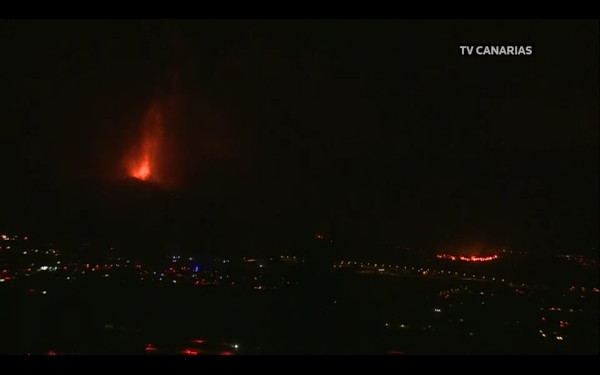
Peu avant le séisme, une nouvelle bouche éruptive s’était ouverte dans le secteur de Tacande, obligeant l’évacuation des habitants de plusieurs rues: El Espigón, Camino Nuevo et la partie supérieure d’Echedey. Le Cabildo de La Palma a signalé via son compte Twitter que le LP-3 est fermé à la hauteur d’El Paso. Les personnes qui traverseront la zone « sans motif valable » seront verbalisées
La lave émise par le volcan a déjà touché une centaine de maisons et a obligé l’évacuation de quelque 6 000 personnes.Un rayon d’exclusion de deux kilomètres reste en place autour du centre éruptif et des coulées de lave. La lave a ralenti sa progression vers la côte et ne devrait pas atteindre le rivage avant ce mardi matin.
L’UE a proposé son aide à La Palma et a activé son système de satellites Copernicus pour suivre l’éruption. La Commission européenne est en contact avec les autorités espagnoles pour offrir un soutien supplémentaire. La Présidente a promis que l’UE aiderait La Palma en activant le mécanisme européen de protection civile et également avec une aide « à moyen et long terme » pour collaborer à la reconstruction des zones endommagées.
Source: médias canariens.
++++++++++
10 heures: Les images satellites fournies par l’Agence spatiale européenne (ESA) révèlent que la lave émise par le Cumbre Vieja a détruit 166 bâtiments et recouvert à ce jour plus de 100 hectares. La lave a entraîné l’évacuation de quelque 6 000 personnes. Comme indiqué précédemment, un périmètre de sécurité de deux kilomètres autour du centre éruptif et des coulées de lave a été mis en place pour minimiser l’impact des projections et l’exposition aux gaz. Un habitant de Las Indias a été la seule victime officielle de l’éruption de 1971, suite à l’inhalation de gaz toxiques dans la région de Los Perchelès. On pense que c’est ce qui a également causé la mort du photographe Heriberto Felipe Hernández, de Santa Cruz de La Palma, décédé à l’hôpital avec des symptômes d’intoxication après s’être aventuré dans la zone de l’éruption.
Source: El Pais.
++++++++++
14 heures: Selon le président des îles Canaries, les dégâts sur l’île de La Palma sont « bien supérieurs » à 400 millions d’euros. Ce chiffre est celui qui, s’il est dépassé, permettra de bénéficier des fonds de solidarité de l’Union européenne. Le 21 septembre 2021 au matin, quatre nouvelles secousses ont secoué l’île, dont deux de magnitude M 3,2 et M3,0.
La lave a déjà englouti 166 structures et contraint 5 500 personnes à quitter leur domicile. Les scientifiques pensaient que la lave atteindrait la mer vers 20 heures lundi, mais elle a ralenti sa progression et on ne sait toujours pas si et quand elle atteindra l’océan, ni où elle le fera.
Le deuxième jour de l’éruption, l’Institut volcanologique des îles Canaries (INVOLCAN) a effectué de nouvelles mesures de la quantité de SO2 émise dans l’atmosphère. Le taux d’émission varie entre 7 997 et 10 665 tonnes par jour. Le suivi quotidien de ce paramètre est important pour analyser l’évolution du processus éruptif. Les dernières valeurs sont similaires et même légèrement supérieures aux valeurs enregistrées le premier jour de l’éruption. Cela s’explique par l’apparition d’une nouvelle bouche à Tacande.
Source: TV Canarias.
++++++++++
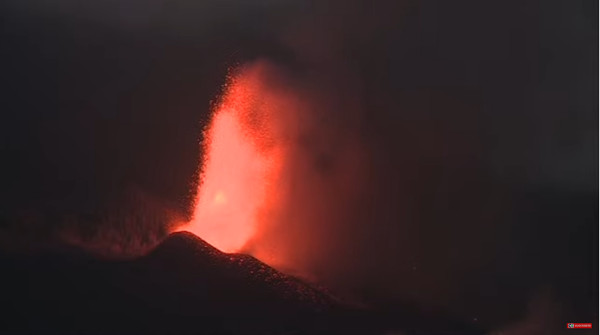
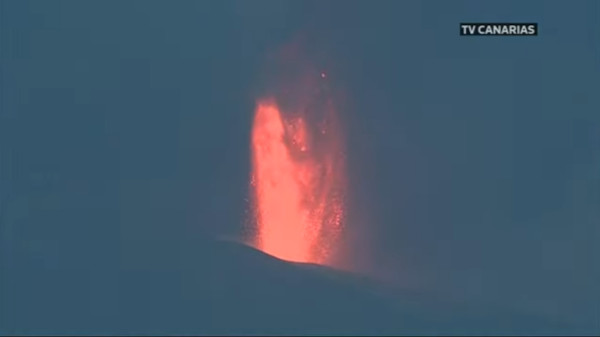
20 heures: Rien de très nouveau sur le front de l’éruption ce soir. La bouche la plus active émet en rugissant de puissants jets de lave. De toute évidence, il y a encore beaucoup de pression dans le conduit éruptif.
Le commissaire européen à l’environnement a confirmé que Bruxelles viendrait en aide à La Palma suite à la destruction subie pendant l’éruption du Cumbre Vieja. Les dégâts sont très importants et bien supérieurs aux 400 millions d’euros prévus pour recevoir l’aide de l’Union Européenne. La lave a entraîné l’évacuation de 6 000 personnes, a détruit 183 maisons et a déjà couvert plus de 100 hectares. Elle a ralenti sa progression vers la côte.
Le gouvernement espagnol a demandé aux entités bancaires d’accorder des facilités aux personnes évacuées, Le Premier Ministre est sur place; il va se rendre à New Yorl pour participer à l’Assemblée Générale des Nations Unies mais sera de retour le 23 septembre au moment de la visite du roi à La Palma.
Le parlement espagnol vient d’approuver des déclarations institutionnelles dans lesquelles, en plus de montrer sa solidarité envers toutes les personnes touchées par l’éruption, ils demande au gouvernement et à toutes les institutions d’apporter leur soutien .économique. à La Palma. Le communiqué du parlement souligne que, bien que l’éruption du Cumbre Vieja soit un phénomène naturel, les connaissances scientifiques et les moyens de protection civile ont permis d’éviter la perte de vies humaines.
Source: médias espagnols.

++++++++++
22 heures: Les volcanologues espagnols mettent en garde sur le risque d’effondrements du front de coulée qui atteint jusqu’à 12 mètres de hauteur. De gros blocs peuvent se détacher et atteindre de longues distances. Il y a aussi un risque de petites coulées pyroclastiques. PEVOLCA précise que la lave avance à une vitesse de 200 mètres par heure et que la déformation du sol dans la zone proche de l’éruption s’élève à 28 centimètres. Dans un premier bilan provisoire des dégâts matériels, 185 bâtiments auraient été détruits, dont 63 maisons d’habitation, selon le cadastre. A l’heure actuelle, 5 700 personnes ont été évacuées, dont les 200 de Tacande le 20 septembre. Seules 132 restent dans les hébergements provisoires.
L’éruption continue à présenter un dynamisme strombolien, dans une fissure orientée nord-ouest-sud-est. L’activité est actuellement concentrée dans quatre principales bouches éruptives. la dernière s’est ouverte vers 20 heures le 20 septembre. Les émissions de dioxyde de soufre (SO2) dans l’atmosphère se situent entre 8 000 et 10 600 tonnes par jour.
Source: médias canariens, PEVOLCAN.

—————————————————-
 08:00 am: An M 3.8 earthquake, the strongest since the start of the Cumbre Vieja eruption, was recorded on September 20th, 2021 at 9:32 p.m. IGN initially reported a magnitude of M 3.1, but subsequently elevated it.
Shortly before the earthquake, a new eruptive vent had opened in the Tacande area, forcing the evacuation of the inhabitants of several streets: El Espigón, Camino Nuevo and the upper part of Echedey. The Cabildo de La Palma reported via its Twitter account that the LP-3 is closed at El Paso. People who cross the area « without a valid reason » will be fined.
The lava emitted by the volcano has already affected around 100 houses and forced the evacuation of some 6,000 people. A two-kilometer exclusion radius remains in place around the eruptive center and the lava flows. The lava has slowed its progress towards the coast and is not expected to reach the shore until Tuesday morning.
The EU offered to help La Palma and activated its Copernicus satellite system to track the eruption. The European Commission is in contact with the Spanish authorities to offer further support. The President promised that the EU would help La Palma by activating the European Civil Protection Mechanism and also with « medium and long term » help to collaborate in the reconstruction of damaged areas.
Source: local news media.
++++++++++
10:00 am: Satellite images provided by the European Space Agency (ESA) reveal that the lava emitted by Cumbre Vieja has destroyed 166 structures and so far covered more than 100 hectares. The lava caused the evacuation of some 6,000 people. As previously stated, a two-kilometer security perimeter around the eruptive center and lava flows has been set up e to minimize the impact of projections and exposure to gases. An inhabitant of Las Indias was the only official victim of the 1971 eruption, following the inhalation of toxic gases in the area of Los Perchelès. This is believed to have also caused the death of photographer Heriberto Felipe Hernández, from Santa Cruz de La Palma, who died in hospital with symptoms of poisoning after venturing into the area of the eruption.
Source: El Pais.
++++++++++
02:00 pm: According to the president of the Canary Islands, the damage on the island of La Palma is « much higher » than 400 million euros. This figure is the one which, if exceeded, will make it possible to benefit from the solidarity funds of the European Union. On the morning of September 21st, 2021, four new earthquakes shook the island, two with magnitudes M 3.2 and M3.0.
Lava has already engulfed 166 structures and forced 5,500 people to leave their homes. Scientists thought lava would reach the sea around 8 p.m. Monday, but it slowed its progress and it is still not known if and when it will reach the ocean, or where it will do so.
On the second day of the eruption, the Volcanological Institute of Canary Islands (INVOLCAN) conducted further measurements to monitor the amount of SO2 emitted into the atmosphere. The emission rate ranges between 7 997 and 10 665 tons per day. Daily monitoring of this parameter is important to analyse the evolution of the current eruptive process. The last values are similar and even slightly higher than the values recorded for the first day of the eruption. They are consistent with the first 48 hours of the evolution of this eruptive process with the appearance of a new eruptive vent in Tacande.
Source: TV Canarias.
++++++++++
8 p.m .: Nothing really new tonight on the eruption site. The most active vent furiously emits powerful jets of lava. There is still a lot of pressure in the eruptive conduit.
The European Commissioner for the Environment has confirmed that Brussels will help La Palma following the destruction suffered during the Cumbre Vieja eruption. The damage is very significant and much higher than the 400 million euros planned to receive aid from the European Union. The lava evacuated 6,000 people, destroyed 183 houses and has already covered more than 100 hectares. It has slowed its progress towards the coast.
The Spanish government has asked the banking entities to grant facilities to the evacuees. The Prime Minister is on site; he will travel to New Yorl to participate in the United Nations General Assembly but will be back on September 23rd when the king is visiting La Palma.
The Spanish parliament has just approved institutional declarations in which, in addition to showing solidarity with all those affected by the eruption, they ask the government and all institutions to provide economic support. in La Palma. The parliamentary statement underlines that, although the eruption of Cumbre Vieja is a natural phenomenon, scientific knowledge and means of civil protection have made it possible to prevent the loss of human life.
Source: Spanish media.
++++++++++
10 p.m .: Spanish volcanologists warn of the risk of collapse of the flow front, which reaches up to 12 meters in height. Large blocks can break off and reach long distances. There is also a risk of small pyroclastic flows. PEVOLCA specifies that lava is advancing at a rate of 200 meters per hour and that soil deformation near the eruption amounts to 28 centimeters. In a first provisional assessment of material damage, 185 buildings were destroyed, including 63 residential houses, according to the land register. To date, 5,700 people have been evacuated, including 200 from Tacande on 20 September. Only 132 remain in temporary accommodation.
The eruption continues to present a Strombolian dynamism, in a fissure oriented north-west/south-east. The activity is currently concentrated in four main eruptive vents. The last one opened around 8 p.m. on September 20th. Sulfur dioxide (SO2) emissions into the atmosphere are between 8,000 and 10,600 tonnes per day.
Source: Canarian media, PEVOLCAN.

Probabilité de trajectoire de la lave, du rouge (très probable) au vert (peu probable) Source: IGN


 Claude Grandpey : Volcans et Glaciers