 Après Le Piton de la Fournaise (Ile de la Réunion), c’est au tour des volcans islandais d’être l’objet d’une surveillance accrue. Jusqu’à 100 capteurs différents, dont certains ont été installés cet été, seront utilisés pour surveiller les volcans en Islande dans le cadre d’un vaste projet de recherche financé par l’Union Européenne grâce à une subvention de 6,3 millions d’euros.
Des réseaux GPS, des sismographes, des radars, des capteurs capables de mesurer les variations de gaz volcaniques, les changements dans le champ électrique, l’expansion des volcans ainsi que les ondes sonores, seront placés sur les principaux volcans du pays, avec une instrumentation plus dense sur les plus actifs. Certains de ces capteurs n’ont encore jamais été utilisés en Islande, comme les capteurs d’ondes sonores qui ont été placés dans la forêt de Þjórsárdalsskógur cet été.
Avec autant de capteurs, on espère pouvoir prévoir le début d’une éruption plus longtemps à l’avance. On espère aussi que le déroulement d’une éruption sera anticipé avec plus de précision et que les prévisions de distribution de la cendre seront faites de façon plus détaillée.
L’éruption de l’Eyjafjallajökull en 2010 a montré qu’il était nécessaire d’améliorer les plans d’intervention et l’Islande est devenue une sorte de laboratoire d’expérimentation pour le reste du monde.
La modernisation des réseaux de surveillance volcanique sur le Piton de la Fournaise et en Islande me conduit à faire plusieurs remarques. Les volcans dans les deux pays ne sont pas les plus dangereux du monde et je pense qu’une plus grande priorité devrait être accordée aux « volcans tueurs », comme le Kelut ou le Merapi en Indonésie, qui sont une menace permanente pour les populations locales. Une fois encore, cela montre que les pays en voie de développement sont encore très négligés par leurs homologues industrialisés!
En ce qui concerne les nuages de cendre, même si le nouveau système permet de mieux les anticiper, je ne suis pas certain que les autorités seront en mesure de mieux les gérer. Comme je l’ai déjà écrit, si un autre volcan islandais « malpropre »vient à entrer en éruption, je suis sûr que la gêne causée au trafic aérien sera la même qu’en 2010 !
Source: Iceland Review. L’intégralité de l’article peut être lue avec ce lien:
http://icelandreview.com/icelandreview/daily_news/Volcanoes_in_Iceland_to_be_Monitored_More_Closely_0_402558.news.aspx
 After The Piton de la Fournaise (Reunion Island), it’s up to Icelandic volcanoes to be monitored more closely. Up to 100 different sensors, some of which were put in place this summer, will be used to monitor volcanoes in Iceland as part of an extensive research project sponsored by the European Union with a grant of 6.3 million euros.
The GPS monitors, seismographs, radars, sensors that pick up on volcanic gases, changes in the electric field, expansion of volcanoes and sound waves will be placed by all of the country’s main volcanoes, most densely around the most active ones. Some of these sensors have never been used in Iceland before, such as sound wave sensors that were placed in Þjórsárdalsskógur forest this summer.
With so many sensors, it is hoped that the start of an eruption can be anticipated a longer time in advance, that the development of an eruption can be predicted more accurately and that ash distribution forecasts can be made in more detail.
The volcanic eruption in Eyjafjallajökull in 2010 showed that there is need for better response plans and now Iceland has become some sort of an experimental laboratory for the rest of the world.
The upgrading of volcano monitoring both on the Piton de la Fournaise and in Iceland leads me to make several remarks. The volcanoes in both countries are not the most dangerous of the world and I think a greater priority should be given to “killer volcanoes” like Kelut or Merapi in Indonesia which are a permanent threat to local populations. If needs be, this shows that developing countries are still highly neglected by industrialised ones!
As far as ash clouds are concerned, even if the new system helps to anticipate them better than in the past, I’m not sure authorities will be able to manage them better. As I put it before, if another “dirty” Icelandic volcano comes to life, I’m quite sure the mess caused to air traffic will be the same as in 2010.
Source: Iceland Review. The whole article can be read at this address:
http://icelandreview.com/icelandreview/daily_news/Volcanoes_in_Iceland_to_be_Monitored_More_Closely_0_402558.news.aspx
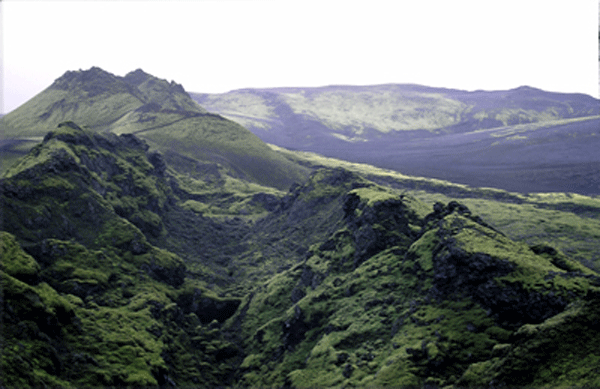
Fracture éruptive du Laki, à l’origine de la plus grosse éruption islandaise (Photo: C. Grandpey)

 On peut lire sur le site web Iceland Review un article intitulé L’Islande a-t-elle raté la dernière éruption volcanique?
 One can read on the Iceland Review website an article entitled Did Iceland Miss Latest Volcanic Eruption?


 Claude Grandpey : Volcans et Glaciers