 Au cours de l’histoire, les hommes on tenté à plusieurs reprises de détourner des coulées de lave qui devenaient une menace pour les zones habitées. La première tentative de ce genre a eu lieu en 1669, lorsqu’un flot de lave en provenance de l’Etna menaça la ville de Catane. Cette tentative fut largement infructueuse, en partie à cause de l’opposition des citoyens de Paterno. Des tentatives pour détourner la lave du Mauna Loa sur l’île d’Hawaii ont été réalisées en 1935 et 1942. Des digues de terre ont été construites à la hâte pour détourner des coulées du Kilauea en 1955 et 1960, sans grand succès.
Le premier détournement de lave positif a eu lieu en 1973 sur l’île d’Heimaey en Islande quand une coulée de lave a’a a pu être stoppée et un port sauvé en envoyant d’importantes quantités d’eau de mer sur la coulée de lave pour entraver sa progression.
Lors de l’éruption de l’Etna en 1983, des scientifiques ont réussi, pour la première fois, à utiliser des explosifs pour détourner une importante coulée de lave. Ces efforts ont été couronnés de succès mais ont posé un problème juridique. Comme me l’a expliqué H. Tazieff un jour, «sommes-nous autorisés à envoyer la lave sur une terre qui serait autrement épargnée?
Au cours de l’éruption de l’Etna de 1991 à 1993 qui menaçait la ville de Zafferana Etnea, des explosifs ont été installés dans des tunnels de lave dans la haute Valle del Bove. Il semble que l’opération ait été un succès, même si au moment où elle a eu lieu, l’éruption avait bien baissé d’intensité. Le succès de l’opération n’a jamais vraiment été prouvé.
Comme je l’ai écrit ci-dessus, une coulée de lave a été bombardée pendant l’éruption du Mauna Loa en 1935 à Hawaii car elle aurait pu menacer la ville de Hilo. Il se dit souvent que Thomas Jaggar, fondateur de l’Observatoire des Volcans d’Hawaï, a été capable d’arrêter la coulée de lave, mais tout le monde n’en est pas aussi sûr!
L’éruption a commencé le 21 novembre 1935. Six jours plus tard, l’ouverture d’une bouche à une altitude de 2 550 mètres sur le flanc nord du Mauna Loa a envoyé une coulée de lave a’a vers le nord. Dans le même temps, de la lave pahoehoe s’accumulait pendant deux semaines à la base du Mauna Kea, puis commençait à avancer vers Hilo à une vitesse d’environ 1,6 km par jour.
Le 23 décembre, craignant que la coulée atteigne le cours supérieur de la rivière Wailuku qui alimentait en eau la ville de Hilo, Jaggar appela les responsables de la base de l’armée de l’air américaine à Oahu et leur demanda de bombarder la source de la coulée de lave. Il espérait que les tunnels ou les chenaux de lave seraient détruits, empêchant ainsi la coulée de progresser, tout en alimentant une autre coulée qui recouvrirait la même zone. Le bombardement a eu lieu le 27 décembre et la lave a cessé de couler pendant la nuit du 1er au 2 janvier 1936.
Jaggar a publiquement félicité l’armée pour sa réactivité et sa précision technique pour le largage des bombes sur les cibles sélectionnées. À son tour, Jaggar a été félicité pour la réussite de sa tentative pour sauver Hilo.
Ce que l’on sait moins, c’est qu’un géologue de l’USGS, Harold Stearns, était à bord du dernier avion qui a largué les bombes sur les zones choisies par Jaggar. A 12h40 le 27 décembre, son avion a largué deux bombes de 270 kilogrammes (chacune avec 135 kilogrammes de TNT), mais elles ont raté leur cible d’une centaine de mètres.
Dans une lettre adressée à Jaggar en janvier 1936, Stearns s’est interrogé sur l’efficacité de la tentative de bombardement. Jaggar a répondu que l’examen de la source de la coulée montrait que « ce chenal a été brisé par les bombardements et de nouvelles coulées se sont déversés sur les flancs de l’amoncellement de matériaux …. Je n’ai aucun doute que cette perforation du tunnel source [par les bombes] a ralenti la progression du front … »
Stearns ne fut pas convaincu par la réponse de Jaggar. Dans son autobiographie parue en 1983, il a écrit au sujet du bombardement de la coulée du Mauna Loa: « Je suis sûr que c’était une coïncidence …. »
Aujourd’hui, la plupart des scientifiques sont d’accord avec les conclusions de Stearns. Le bombardement a-t-il, oui ou non, arrêté la coulée de lave du Mauna Loa en 1935 ? C’est toujours un sujet très controversé !
Source: USGS / HVO.
—————————————
 Throughout history, men have tried several times to divert lava flows that were becoming a threat to populated areas. The first attempt was this kind occurred in 1669, when a flow from Mount Etna volcano threatened the city of Catania. This attempt was largely unsuccessful, in part due to opposition by citizens of another town, Paterno. Attempts to divert lava flows from Mauna Loa Volcano on the island of Hawaii by aerial bombing were made in 1935 and 1942. Earthen barriers were hurriedly constructed in attempts to divert flows from Kilauea Volcano, Hawaii in 1955 and 1960, with little success.
The first successful lava diversion took place in 1973 on the island of Heimaey (Iceland), when a thick lava flow was impeded and a harbour saved by pumping massive quantities of seawater over advancing aa lava.
During the 1983 eruption of Etna, Italian scientists managed, for the first time, to use explosives to divert a major lava flow. These efforts were fairly successful, although they posed a legal problem. As H. Tazieff told me one day, “are we allowed to send lava on a land that would otherwise pe spared?”
During the 1991-93 eruption of Mt Etna that was becoming a threat to the city of Zafferana Etnea, explosives were lowered in tunnels in the upper Valle del Bove. It seems the operation was a success, but by the time it occurred, the eruption was far less intense and the success of the operation has never really been proved.
As I put it above, bombings of a lava flow were performed during the 1935 eruption of Mauna Loa in Hawaii in an attempt to stop a lava flow that might have threatened the city of Hilo. A widely-held belief is that Thomas Jaggar, founder of the Hawaiian Volcano Observatory, was able to stop the lava flow. But everybody is not so sure !
The eruption began on November 21st, 1935. Six days later, an unusual breakout at an elevation of 2,550 metres on the north flank of Mauna Loa sent a’a lava to the north. Pahoehoe lava ponded at the base of Mauna Kea for two weeks before advancing toward Hilo at a rate of about 1.6 km per day.
On December 23rd, fearing that the flow would reach the headwaters of the Wailuku River, which supplied water for the town of Hilo, Jaggar called on the United States Army Air Corps, based on Oahu, to bomb the lava flow source. His hope was that the lava tubes or channels could be destroyed, thereby robbing the advancing flow while feeding another flow that would re-cover the same area. The flow was bombed on December 27th, and lava stopped flowing during the night or early morning of January 2nd, 1936.
Jaggar publicly praised the Army for its responsiveness and technical accuracy in delivering the bombs to his selected targets. In turn, Jaggar was praised for his successful experiment and saving Hilo.
What is not widely known is that a USGS geologist, Harold Stearns, was on board the last plane to deliver bombs to Jaggar’s targeted areas. At 12:40 p.m. on December 27th, his plane dropped two 270-kilogram bombs (each with 135 kilograms of TNT), but they hit a hundred metres from their target.
In a letter to Jaggar in January 1936, Stearns questioned the effectiveness of the bombing. Jaggar wrote back that later examination of the flow’s source showed that “This channel was broken up by the bombing and fresh streams poured over the side of the heap…. I have no question that this robbing of the source tunnel slowed down the movement of the front….”
Stearns remained unconvinced. In his 1983 autobiography, he wrote about bombing the Mauna Loa flow: “I am sure it was a coincidence….”
Modern thinking mostly supports Stearns’ conclusion. Whether or not the bombing stopped the 1935 Mauna Loa lava flow remains a controversial topic today.
Source : USGS / HVO.


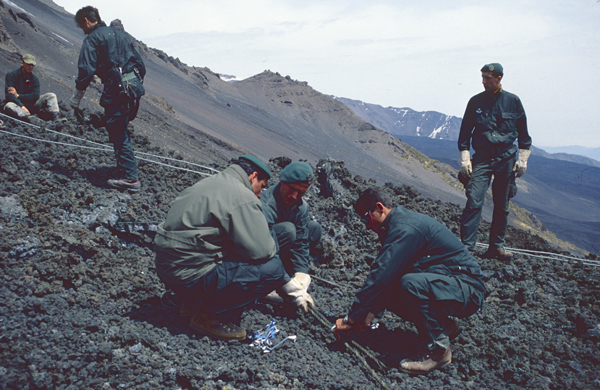
Préparation de l’opération « Thrombose » sur l’Etna en 1993.
(Photos: C. Grandpey)

 Un séisme de magnitude M 4,9 a été enregistré dans la partie nord de la caldera Bárðarbunguaskja à 19h24 (TU) le 30 janvier 2018. Le séisme est le plus puissant depuis la fin de l’éruption dans l’Holuhraun le 28 février 2015. Le 27 octobre 2017, deux autres séismes, chacun de M 4,7, avaient déjà été enregistrés et ils étaient à l’époque les plus significatifs dans la caldeira Bárðarbunguaskja depuis la fin de l’éruption. Les volcanologues islandais pensent qu’il est peu probable qu’il y ait une nouvelle éruption. Le 30 janvier 2018, trois séismes ont été enregistrés dans la partie nord-est du Bárðarbunga, avec des magnitudes de M 3,7, M 2,9 et M 3,8. Une trentaine de répliques ont été observées dans la région depuis le début de l’essaim qui a débuté juste avant 18 heures le 30 janvier.
 An M 4.9 earthquake was recorded on the north side of the Bárðarbunguaskja caldera at 7.24 pm on January 30th 2018. The quake has been the strongest since the volcanic eruption in Holuhraun ceased on February 28th, 2015. On October 27th, 2017, two earthquakes, each of them M 4.7, were already measured and they were at the time the strongest ones that had been measured in Bárðarbunguaskja since the end of the eruption. Local volcanologists think it is unlikely there will be another eruption. Earlier on January 30th, three earthquakes were measured on the north-east side of Bárðarbunga, with magnitudes of M 3.7, M 2.9 and M 3.8. Around 20-30 aftershocks have been measured in the area since the swarm that began right before 6 pm last night.






 Claude Grandpey : Volcans et Glaciers