Sangeang Api (Indonésie): Eruption en déclin // The eruption is declining

drapeau francaisLe volume de cendre émis par le Sangeang Api a commencé à diminuer mercredi, après plusieurs événements éruptifs qui ont laissé des milliers de personnes sans eau potable et provoqué l’annulation de vols intérieurs et internationaux à destination et en provenance d’Australie, de Singapour, de l’Est Timor et de Bali.
Les autorités locales indiquent que la cendre ne retombe plus sur les villages et les terres agricoles. De nombreux habitants qui avaient fui la région quand l’éruption a commencé ont regagné leurs maisons par bateau depuis leurs abris sur l’île voisine de Sangeang Darat, même si l’administration locale n’a pas encore approuvé leur retour.
En 1985, le gouvernement du président Suharto avait déplacé les habitants de Île Sangeang en mettant en place un programme de transmigration. Au cours des dernières années, plusieurs groupes d’habitants sont revenus sur l’île volcanique où ils pratiquent l’agriculture et l’élevage du bétail sur un sol particulièrement fertile.
Source: The Jakarta Post.

 ———————————————

drapeau anglaisThe volume of volcanic ash spewed by Mount Sangeang Api started to decrease on Wednesday, following eruptions that left thousands of people without clean water as well as the cancellations of domestic and international flights to and from Australia, Singapore, East Timor and Bali.

Local authorities indicate that volcanic ash is no longer falling upon village areas and farmland. Many residents who had fled the area when the eruption began have returned to their homes by boat from their shelters on neighbouring island Sangeang Darat, even though the local administration has not yet approved their return.

In 1985, then president Soeharto’s government displaced Sangeang Island inhabitants through a transmigration program. In the past few years several groups of residents have come back to the volcanic island to continue farming and raising cattle due to its fertile soil.

Source: The Jakarta Post.

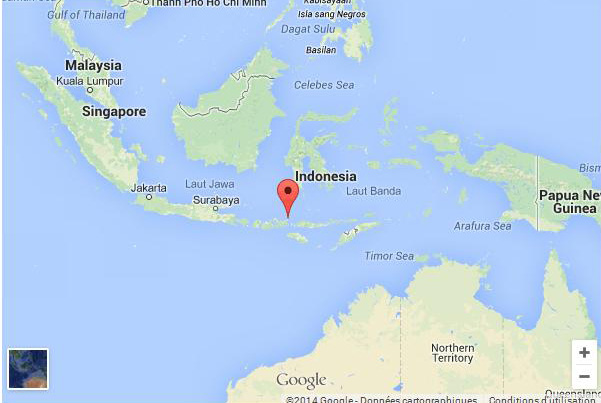
Sangeang Api (Petites Iles de la Sonde / Indonésie) // Sangeang Api (Lesser Sunda Islands / Indonesia)

drapeau francaisVoici quelques détails supplémentaires sur le Sangeang Api qui n’est certainement pas le volcan le plus connu d’Indonésie, mais qui est capable de perturber le trafic aérien quand une éruption se produit ! A ce sujet, les vols au départ et à l’arrivée de Darwin (Australie) devaient reprendre ce dimanche. Il est toutefois demandé aux passagers de contacter leurs compagnies aériennes car la situation pourrait se modifier en cas de reprise de l’éruption.

Le Sangeang Api est situé sur l’une des Iles de la Sonde. Il est entré en éruption vendredi à 15h55 (heure locale) en émettant des panaches de cendre volumineux de plusieurs kilomètres de hauteur. Suite à l’éruption, le niveau d’alerte a été relevé de II (Waspada ) à III ( Siaga) à 16 heures.
L’île Sangeang Api n’a pas de résidents permanents. Elle a été évacuée par le gouvernement à travers un programme de transmigration en 1985. 263 familles ont alors été déplacées vers la terre ferme, soit dans le sous-district de Wera, soit dans le village de Sangeang. Les habitants de Sangeang possèdent des plantations sur l’île volcanique où ils travaillaient quand l’éruption s’est produite. Ils ont dû être évacués vers leur village qui se trouve à six kilomètres du volcan.
Des fournitures ont été distribuées dans le village et il n’est fait état d’aucune victime de l’éruption.
Le Sangeang Api est entré en éruption à plusieurs reprises en 1911 et 1953 ainsi que pendant les périodes 1964-1967, 1985-1987 et 1997-1999.

 ——————————————-

drapeau anglaisHere are a few more details about Sangeang Api which is certainly not the best-known volcano of Indonesia, but which is able to disrupt air traffic when an eruption occurs! It should be noted that flights to and from Darwin were expected to resume this Sunday. However, passengers are advised to contact their air companies as the situation might change in case of a new eruption of the volcano.

Sangeang Api is located on an island in the Lesser Sunda Islands. It erupted on Friday at 03:55 p.m. (local time) spewing voluminous plumes of ash several kilometres into the air. Due to the eruption, the alert level was raised from II (Waspada) to III (Siaga) at 04:00 p. m.

Sangeang Api Island has no permanent residents. It was emptied by the government through a transmigration program in 1985 and 263 families were moved to Wera subdistrict or inland Sangeang. The people of inland Sangeang own plantations in the island, so that during the eruption they were working on the plantations and had to be evacuated to the mainland Sangeang village, six kilometres away from the volcano.
Supplies were distributed to the village, and there was no report of any casualty due to the eruption.
Mount Sangeang Api already erupted several times in 1911 and 1953 as well as in the 1964-1967, 1985-1987 and 1997-1999.

Sangeang_Api-blog

Vue du Sangeang Api depuis l’espace  (Crédit photo:  NASA)

Le Sangeang Api (Indonésie) perturbe le trafic aérien en Australie // Sangeang Api (Indonesia) disrupts air traffic in Australia

drapeau francaisSelon les agences de presse australiennes, le volcan Sangeang Api est entré en éruption à trois reprises depuis vendredi après-midi. Bien que le volcan soit situé à environ 1200 km à l’ouest-nord-ouest de Darwin, les vols vers et depuis l’aéroport international ont été annulés samedi.
Le directeur du VAAC de Darwin a indiqué que le nuage de cendre se dispersait en se dirigeant vers le sud, mais la situation pourrait changer à tout moment. Si une violente éruption se produisait dans les prochaines six à 12 heures, les conséquences seraient plus importantes à travers l’Australie. Pour le moment, des villes comme Brisbane ou Sydney ne sont pas susceptibles d’être affectées par le nuage de cendre. Cette dernière affectera Darwin au cours des prochaines 18 heures et sera probablement présente pendant un jour ou deux.
Elle se trouve dans une bande comprise entre 10 km et 15 km d’altitude, celle empruntée par les vols commerciaux.

Je me pose une question: Où sont les avions magiques et leur célèbre système AVOID censé pouvoir détecter les cendres volcaniques et informer les compagnies aériennes en conséquence?

 ———————————————-

drapeau anglaisAccording to Australian press agencies, Sangeang Api has erupted three times since Friday afternoon. Although the volcano is located about 1200km west-northwest of Darwin, flights to and from Darwin International Airport were cancelled on Saturday.

The manager of the Volcanic Ash Advisory Centre (VAAC) said the cloud was dispersing as it spread south but the situation could change at any time. Should a big eruption occur in the next six to 12 hours, longer effect is more likely across Australia. For the moment, places like Brisbane or Sydney are not likely to be affected by the ash cloud. The ash will affect Darwin for the next 18 hours and will probably hang around for a day or so.

The ash near Darwin is in a band between 10km and 15km in the air, which is the cruising altitude for commercial jet aircraft.

My question is : Where are the magic planes and their famous AVOID system supposed to be able to detect volcanic ash and inform air companies about the situation ?

Eruption du Sangeang Api (Indonésie)

drapeau francaisD’après plusieurs dépêches journalistiques, une violente éruption explosive s’est produite aujourd’hui 30 mai sur le volcan Sangeang Api. Bien que les estimations varient considérablement selon les sources ; il semble que le panache de cendre ait atteint une hauteur d’une vingtaine de kilomètres. L’île n’est pas habitée, mais il y a un bon nombre de terres cultivées. Il a été demandé à leurs propriétaires de se tenir à l’écart de l’île.

L’éruption a entraîné la fermeture de l’aéroport de Darwin (Australie) situé à 1200 km au SE du volcan et causé de grosses perturbations dans le trafic aérien.

La dernière éruption du Sangeang Api remonte à 1997-1999.

Sangeang map

Vous pourrez voir des images de l’éruption en cliquant sur ce lien:

http://www.dailymail.co.uk/news/article-2644253/Incredible-moment-huge-volcano-erupts-Indonesia-sending-ash-spewing-thousands-feet-sky.html

 —————————————–

drapeau anglaisAccording to several news reports, a violent explosive eruption occurred today May 30th at Sangeang Api volcano. Although the reports give different estimates, it seems the ash plume reached a height of about 20 km. The island is uninhabited but there are agricultural fields and people have been advised to stay away.

The eruption led to the closure of Darwin Airport (Australia), 1200 km SE of the volcano and caused disruptions in air traffic.

Sangeang Api’s last eruption took place in 1997-1999.

You can see images of the eruption by clicking on this link:

http://www.dailymail.co.uk/news/article-2644253/Incredible-moment-huge-volcano-erupts-Indonesia-sending-ash-spewing-thousands-feet-sky.html

Sangeang-blog

Vue du nuage éruptif du Sangeang