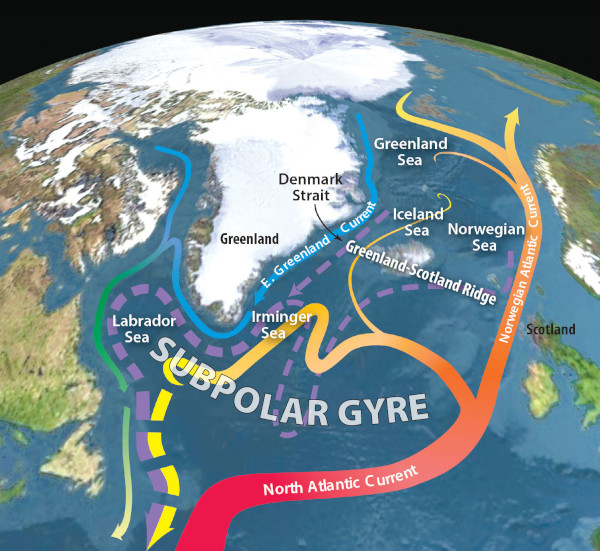
La mer d’Irminger, une partie cruciale de l’AMOC // The Irminger Sea, a crucial part of the AMOC

J’ai insisté à plusieurs reprises sur l’importance de la circulation méridienne de retournement de l’Atlantique (AMOC) pour réguler le climat et sur ce qui se passerait si cet énorme tapis roulant cessait de fonctionner. Dans une étude récente publiée dans Science Advances, des scientifiques ont identifié le moteur océanique qui joue le plus grand rôle dans la gestion des principaux courants atlantiques qui régulent le climat de la Terre.
La mer d’Irminger, au sud-est du Groenland, est l’endroit où arrivent les eaux chaudes qui transportent la chaleur vers le nord depuis l’hémisphère sud, puis retournent vers le sud en s’enfonçant le long du fond de l’océan. En tant que telle, cette région joue un rôle essentiel dans le fonctionnement de l’AMOC. L’étude explique qu’il est urgent de mieux surveiller cette zone particulière.
L’AMOC, qui comprend le Gulf Stream, maintient un climat tempéré dans l’hémisphère nord et régule les conditions météorologiques à travers le monde. Toutefois, en raison du réchauffement climatique, l’AMOC pourrait ne pas maintenir les températures stables très longtemps. Les recherches montrent qu’en se déversant dans l’Atlantique Nord, l’eau de fonte de l’Arctique réduit la densité des eaux de surface et les empêche de s’enfoncer pour former des courants de fond. Cette situation ralentit le processus qui alimente l’AMOC.
La mer d’Irminger est particulièrement importante pour maintenir ces courants de fond. On peut lire dans l’étude que « l’arrivée d’eau douce dans cette région non seulement inhibe directement la formation d’eau profonde – essentielle pour maintenir la force de l’AMOC – mais cela modifie également les schémas de circulation atmosphérique. » Une réduction de la quantité d’eau qui s’enfonce dans la mer d’Irminger a probablement des impacts plus importants sur le climat de la planète que des réductions du même type dans d’autres mers du nord.
La mer d’Irminger a une influence très forte sur la force de l’AMOC car elle régule la quantité d’eau qui s’enfonce pour former des courants profonds dans les mers voisines par le biais de processus atmosphériques. L’apport d’eau douce dans la mer d’Irminger améliore le flux d’eau douce dans la Mer du Labrador entre le sud-ouest du Groenland et la côte du Canada, par exemple. Une réduction importante de la formation de courants profonds dans la mer d’Irminger aura des effets en cascade sur la formation de courants profonds dans tout l’Atlantique Nord.
Les auteurs de l’étude ont examiné l’impact de l’eau de fonte sur l’AMOC à l’aide d’un modèle climatique qui simulait une augmentation de l’apport d’eau douce dans quatre régions : la mer d’Irminger, la Mer du Labrador, les mers nordiques et l’Atlantique Nord-Est. Les chercheurs ont pu détecter la sensibilité de l’AMOC à l’eau de fonte dans chaque région, puis ils ont identifié des changements spécifiques du climat de la planète liés à chaque scénario. Le rôle de la mer d’Irminger pour l’AMOC a dépassé celui des trois autres régions du modèle et a déclenché des réactions climatiques plus fortes. La réduction de la formation d’eau profonde a entraîné un refroidissement généralisé dans l’hémisphère nord, ainsi qu’une expansion de la glace de mer arctique, car l’eau chaude n’arrivait plus en provenance du sud.
La simulation a également montré un léger réchauffement dans l’hémisphère sud et a confirmé les conclusions précédentes selon lesquelles un AMOC plus faible perturbait très fortement les systèmes de mousson tropicale.
Source : Live Science via Yahoo News.

Vue des courants océaniques dans la mer d’Irminger (Source : Oceanography)

—————————————————-

I have insisted several times on the importance of the Atlantic Meridional Overturning Circulation (AMOC) to regulate the climate and what would happen if this huge conveyor belt stopped working. In a recent study published in Science Advances, scientists have pinpointed the ocean engine with the biggest role in driving key Atlantic currents that regulate Earth’s climate.

The Irminger Sea off southeastern Greenland is where warm waters that transport heat northwards from the Southern Hemisphere sink and then return south along the bottom of the ocean. As such, this region plays a critical role in powering the AMOC. The study highlights the urgent need for better monitoring in this particular location.

The AMOC, which includes the Gulf Stream, maintains a temperate climate in the Northern Hemisphere and regulates weather patterns across the globe. But due to climate change, the AMOC may not keep temperatures stable for much longer. Research shows that Arctic meltwater gushing into the North Atlantic is reducing the density of surface waters and preventing them from sinking to form bottom currents, thus slowing the machine that powers the AMOC.

It turns out the Irminger Sea is particularly important for keeping these bottom currents flowing. One can read in the study that « freshwater release in this region not only directly inhibits deep-water formation — essential for maintaining the strength of the AMOC — but also alters atmospheric circulation patterns. » A reduction in the amount of water sinking in the Irminger Sea likely has greater impacts on the global climate than reductions of the same kind in other northern seas.

The Irminger Sea has a disproportionate influence on the strength of the AMOC because it regulates the amount of water sinking to form deep currents in nearby seas through atmospheric processes. Freshwater input into the Irminger Sea enhances freshwater flow into the Labrador Sea between southwestern Greenland and the coast of Canada, for example, so a reduction in deep-current formation in the Irminger Sea has knock-on effects for deep-current formation across the entire North Atlantic.

The authors of the study examined the impact of meltwater on the AMOC using a climate model that simulated an increase in freshwater input in four regions : the Irminger Sea, the Labrador Sea, the Nordic Seas and the Northeast Atlantic. The researchers were able to detect the sensitivity of the AMOC to meltwater in each region, then identified specific changes in the global climate linked to each scenario. The role of the Irminger Sea for the AMOC outweighed that of the three other regions in the model and triggered stronger climate responses. Reduced deep-water formation led to widespread cooling in the Northern Hemisphere, as well as Arctic sea ice expansion, because warm water was not being brought up from the south.

The simulation also showed slight warming in the Southern Hemisphere and bolstered previous findings that a weaker AMOC would throw tropical monsoon systems into chaos.

Source : Live Science via Yahoo News.

Nouveau réchauffement stratosphérique soudain // New sudden stratospheric warming

Un réchauffement stratosphérique soudain (en anglais Sudden Stratospheric Warming ou SSW) est un phénomène météorologique pendant lequel le vortex polaire dans l’hémisphère hivernal voit ses vents généralement d’ouest ralentir ou même s’inverser en quelques jours. Un tel phénomène va rendre le vortex plus sinueux, voire le rompre. Le changement est dû à une élévation de la température stratosphérique de plusieurs dizaines de degrés au-dessus du vortex. Elle grimpe très rapidement, passant de -70/-80°C à -10/-20°C degrés (soit une élévation d’une soixantaine de degrés en quelques jours).  Pour rappel, la stratosphère est la couche atmosphérique située au dessus de celle où nous vivons – la troposphère – à une altitude située entre 10 et 50 km environ.

Durant un hiver habituel dans l’hémisphère nord, plusieurs événements mineurs de réchauffement stratosphérique se produisent, avec un événement majeur environ tous les deux ans. Dans l’hémisphère sud, les SSW semblent moins fréquents et moins bien compris.

En conséquence, un réchauffement stratosphérique soudain et ses implications pour le vortex polaire peuvent avoir de sérieuses conséquences sur le climat de nos latitudes. L’air froid peut se retrouver piégé dans le jet stream (frontière entre l’air froid polaire et de l’air doux des tropiques) et être décalé jusqu’à nos latitudes, dans des régions peu habituées à un froid glacial, comme ce fut le cas en mars 2018 en Europe ou en février 2012 en France. Ces épisodes de SSW ne semblent toutefois pas avoir de relation avec le réchauffement climatique actuel ; ce sont de simples événements climatiques ponctuels.

°°°°°°°°°°

Les températures à haute altitude au-dessus du pôle Nord montent actuellement en flèche ; elles ont atteint 10°C en à peine une semaine. Ce réchauffement stratosphérique soudain perturbe le vortex polaire, ce qui pourrait avoir des conséquences importantes pour les conditions météorologiques dans l’hémisphère nord au mois de mars.
Cependant, le phénomène est encore mal compris et les scientifiques, bien qu’ils aient réussi à prévoir cet événement de réchauffement il y a deux semaines, disent qu’il est trop tôt pour savoir quel impact cela aura sur la météo dans les latitudes inférieures. Ces événements de réchauffement, qui se produisent en moyenne deux hivers sur trois, ne se déroulent pas toujours de la même manière.
Il se dit que l’événement actuel pourrait déclencher une réaction en chaîne qui chamboulerait les modèles météorologiques. Par exemple, l’est des États-Unis a connu des mois de janvier et de février exceptionnellement doux. Certains précédents réchauffements stratosphériques soudains accompagnés de perturbations du vortex polaire ont provoqué des vagues de froid extrêmes et de violentes tempêtes hivernales.
La dernière fois qu’un réchauffement stratosphérique soudain s’est produit, c’était le 5 janvier 2021. Un peu plus d’un mois plus tard, une vague d’air froid jamais vue depuis 1989 a plongé le centre des États-Unis dans une période de gel historique, provoquant la mise à l’arrêt du réseau électrique au Texas, un bilan de 330 morts, et plus de 27 milliards de dollars de dégâts.
Les scientifiques interrogés sur l’événement en cours disent qu’il est trop tôt pour savoir s’il déclenchera des conditions météorologiques extrêmes ou modifiera de manière significative les régimes météorologiques en cours dans l’hémisphère nord.

Les premiers jours du mois de mars s’annoncent froids en France, avec un épisode de vent de nord-nord-est d’une longueur inhabituelle. Reste à savoir si ces conditions météorologiques sont liées à un réchauffement stratosphérique soudain.

Source: Météo France,The Weather Channel.

En cliquant sur ce lien, vous aurez une très bonne explication (en anglais) du réchauffement stratosphérique soudain et du comportement du vortex polaire.

https://youtu.be/VnlFFaF_l7I

——————————————–

A Sudden Stratospheric Warming (SSW) is a meteorological phenomenon during which the polar vortex in the winter hemisphere sees its generally westerly winds slow down or even reverse within a few days. Such a phenomenon will make the vortex more sinuous, or even break it. The change is due to a rise of several tens of degrees in stratospheric temperature above the vortex. It climbs very quickly, going from -70 / -80 ° C to -10 / -20 ° C degrees (an increase of about sixty degrees in a few days). As a reminder, the stratosphere is the atmospheric layer located above the one where we live – the troposphere – at an altitude between 10 and 50 km approximately.

During a typical winter in the northern hemisphere, several minor stratospheric warming events occur, with one major event occurring approximately every two years. In the southern hemisphere, SSWs appear to be less frequent and less well understood.

As a result, sudden stratospheric warming and its implications for the polar vortex can have serious consequences for the climate of our latitudes. Cold air can get trapped in the jet stream (border between cold polar air and mild tropical air) and be shifted to our latitudes, in regions not used to freezing cold, like this was the case in March 2018 in Europe or in February 2012 in France. However, these episodes of SSW do not seem to have any relation to current global warming; they are simple one-off climatic events.

°°°°°°°°°°

Temperatures at the high altitudes above the North Pole are currently soaring, jumping up to 10°C in barely a week. This SSW is disturbing the polar vortex, which in turn could have major implications for weather patterns across the northern hemisphere in March.

However, the phenomenon is still poorly understood and scientists, despite successfully predicting this warming event two weeks ago, say it is too soon to know what it will mean for the weather in the lower latitudes. These events, which occur in two out of every three winters on average, don’t play out in a prescribed way.

There has been some speculation that the current event could trigger a chain reaction that would reshuffle weather patterns. For instance, the eastern U.S. has seen an exceptionally mild January and February and some previous sudden stratospheric warming and polar vortex disruptions have precipitated extreme cold snaps and severe winter storms.

The last time a sudden stratospheric warming event occurred was on January 5th, 2021. Just over a month later, the most dramatic cold air outbreak since 1989 plunged the central U.S. into a historic deep freeze, causing the collapse of Texas’s power grid, claiming at least 330 lives and incurring more than $27 billion in damages.

Multiple experts interviewed about the ongoing event say it’s too soon to know whether this one will trigger extreme weather or meaningfully change prevailing weather regimes over the northern hemisphere.

The first days of March are expected to be cold in France, with an unusually long episode of north-northeast winds. It remains to be seen whether these meteorological conditions are linked to a sudden stratospheric warming.

Source: Météo France,The Weather Channel.

By clicking on this link, you will get a very good explanation of the Sudden Stratospheric Warming and the behaviour of the polar vortex :

https://youtu.be/VnlFFaF_l7I
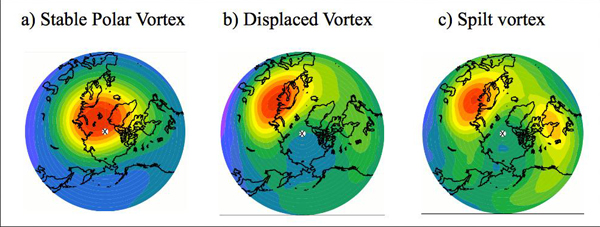
Variables de comportement du vortex polaire dans l’hémisphère nord : stable, décalé, rompu  (Source: Met Office)
Le mois d’octobre 2021 a été trop chaud // October 2021 was too hot

J’indiquais dans une note précédente qu’avec +0.661°C au dessus de la moyenne de 1901-2021, octobre 2021 était le troisième mois d’octobre le plus chaud des archives ERA5.
Les huit derniers mois d’octobre (2014-2021) se classent tous parmi les huit plus chauds jamais enregistrés.

Selon la NOAA qui prend en compte un plus large éventail de données, octobre 2021 est le quatrième mois d’octobre le plus chaud des 142 dernières années. L’agence explique que la température moyenne à la surface des terres et des océans dans le monde en octobre a été de +0,89°C au-dessus de la moyenne du 20ème siècle
Il convient de noter que l’hémisphère nord a atteint un nouveau sommet et enregistré son mois d’octobre le plus chaud jamais enregistré. L’Amérique du Nord a connu son deuxième mois d’octobre le plus chaud, derrière le mois d’octobre record de 1963.

La couverture de glace de mer était faible aux deux pôles en octobre 2021. Selon le National Snow and Ice Data Center (NSIDC), la couverture de glace de mer dans l’Arctique en octobre 2021 était de 158 000 kilomètres carrés en dessous de la moyenne.
La couverture de glace de mer en Antarctique en octobre 2021 était de 466 000 kilomètres carrés en dessous de la moyenne.
Source : NOAA.

———————————————–

I indicated in a previous post that with +0,661°C above the 1901-2021 average, October 2021 was the thrird hottest month of October of the ERA5 archives.

The last eight Octobers (2014-2021) all rank among the eight warmest Octobers on record.

According to NOAA which takes into account a wider range of data, October 2021 ranked as the fourth-warmest October in the last 142 years, The agency explains that average global land and ocean surface temperature in October was +0.89°C above the 20th-century average

It should be noted that the Northern Hemisphere hit a new high and logged its warmest October on record. North America had its second-warmest October on record, behind the record-warm October of 1963.

Sea ice coverage was sparse at both poles: According to the National Snow and Ice Data Center (NSIDC), the October 2021 Arctic sea ice extent was 158,000 square kilometers below average.

Antarctic sea ice coverage in October was 466,000 square kilometers below average.

Source: NOAA.

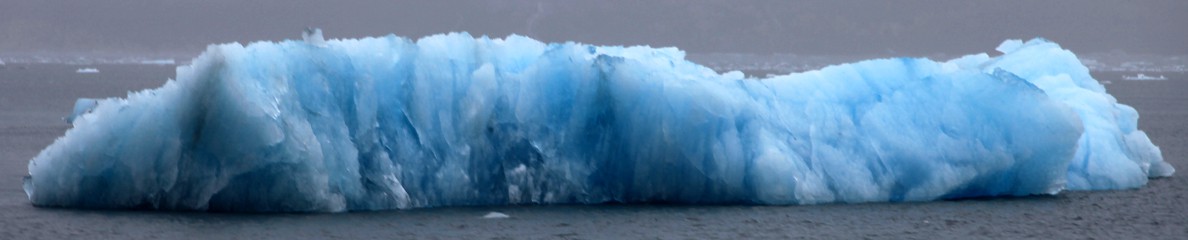
Couverture de la glace de mer dans l’Arctique en octobre 2021 (Source: NSIDC)

Faut-il s’attendre à un réchauffement stratosphérique soudain ? // Should we expect a Sudden Stratospheric Warming ?

Un réchauffement stratosphérique soudain (en anglais Sudden Stratospheric Warming ou SSW) est un phénomène météorologique pendant lequel le vortex polaire dans l’hémisphère hivernal voit ses vents généralement d’ouest ralentir ou même s’inverser en quelques jours. Un tel phénomène va rendre le vortex plus sinueux, voire le rompre. Le changement est dû à une élévation de la température stratosphérique de plusieurs dizaines de degrés au-dessus du vortex. Elle grimpe très rapidement, passant de -70/-80°C à -10/-20°C degrés (soit une élévation d’une soixantaine de degrés en quelques jours).  Pour rappel, la stratosphère est le couche atmosphérique située au dessus de celle où nous vivons – la troposphère – à une altitude située entre 10 et 50 km environ.

Durant un hiver habituel dans l’hémisphère nord, plusieurs événements de réchauffement mineur stratosphérique se produisent, avec un événement majeur se produisant environ tous les deux ans. Dans l’hémisphère sud, les SSW semblent moins fréquents et moins bien compris.

En conséquence, un réchauffement stratosphérique soudain et ses implications pour le vortex polaire peuvent avoir de sérieuses conséquences sur le climat de nos latitudes. L’air froid peut se retrouver piégé dans le jet stream (frontière entre l’air froid polaire et de l’air doux des tropiques) et être décalé jusqu’à nos latitudes, dans des régions peu habituées à un froid glacial, comme ce fut le cas en mars 2018 en Europe ou en février 2012 en France. Ces épisodes de SSW ne semblent toutefois pas avoir de relation avec le réchauffement climatique actuel ; ce sont de simples événements climatiques ponctuels.

Selon les météorologistes, il semble qu’un réchauffement stratosphérique soudain soit en préparation actuellement, avec un impact sur les conditions climatiques de l’hémisphère nord vers la mi-janvier avec l’arrivée d’un temps sec mais particulièrement froid à cause du blocage des hautes pressions par le vortex. Selon les météorologues, ces conditions froides devraient surtout affecter l’Europe du Nord et le Royaume Uni, alors que les conditions climatiques seront plus douces, humides et venteuses dans le sud de l’Europe.

La France devrait donc se trouver dans la zone tampon, avec des températures certes plus froides, mais pas extrêmement basses. De telles conditions semblent favorables à des chutes de neige.

Ces prévisions demandent toutefois confirmation et sont en grande partie régies par le comportement du vortex polaire, selon qu’il reste uniforme ou se brise en plusieurs morceaux.

Source: Météo France,The Weather Channel, The Watchers.

En cliquant sur ce lien, vous aurez une très bonne explication (en anglais) du réchauffement stratosphérique soudain et du comportement du vortex polaire.

https://youtu.be/VnlFFaF_l7I

————————————————

 A Sudden Stratospheric Warming (SSW) is a meteorological phenomenon during which the polar vortex in the winter hemisphere sees its generally westerly winds slow down or even reverse within a few days. Such a phenomenon will make the vortex more sinuous, or even break it. The change is due to a rise of several tens of degrees in stratospheric temperature above the vortex. It climbs very quickly, going from -70 / -80 ° C to -10 / -20 ° C degrees (an increase of about sixty degrees in a few days). As a reminder, the stratosphere is the atmospheric layer located above the one where we live – the troposphere – at an altitude between 10 and 50 km approximately.

During a typical winter in the northern hemisphere, several minor stratospheric warming events occur, with one major event occurring approximately every two years. In the southern hemisphere, SSWs appear to be less frequent and less well understood.

As a result, sudden stratospheric warming and its implications for the polar vortex can have serious consequences for the climate of our latitudes. Cold air can get trapped in the jet stream (border between cold polar air and mild tropical air) and be shifted to our latitudes, in regions not used to freezing cold, like this was the case in March 2018 in Europe or in February 2012 in France. However, these episodes of SSW do not seem to have any relation to current global warming; they are simple one-off climatic events.

According to meteorologists, it seems that a sudden stratospheric warming is in preparation now, with an impact on the weather conditions of the northern hemisphere around mid-January with the onset of dry but particularly cold weather due to the blockage of high pressures by the vortex. According to meteorologists, these cold conditions should mainly affect northern Europe and the United Kingdom, while the weather will be milder, wetter and windy in southern Europe. France should therefore be in the buffer zone, with temperatures certainly colder, but not extremely low. Such conditions seem favorable for snowfall.

These predictions require confirmation, however, and are largely governed by the behaviour of the polar vortex, whether it remains uniform or shatters into several pieces.

Source: Météo France,The Weather Channel, The Watchers.

By clicking on this link, you will get a very good explanation of the Sudden Stratospheric Warming and the behaviour of the polar vortex :

https://youtu.be/VnlFFaF_l7I

 Variables de comportement du vortex polaire dans l’hémisphère nord : stable, décalé, rompu  (Source: Met Office)