L’Indonésie et l’énergie géothermique // Indonesia and geothermal energy

drapeau-francaisL’Indonésie, avec ses innombrables volcans, détient environ 40 pour cent des réserves géothermiques mondiales, mais le pays a pris beaucoup de retard dans leur exploitation. Aujourd’hui, le gouvernement indonésien a l’intention de multiplier par cinq la production géothermique dans la prochaine décennie, bien que les obstacles soient énormes dans un pays qui croule sous le fardeau de la paperasserie et où les grands projets sont souvent retardés, voire annulés.
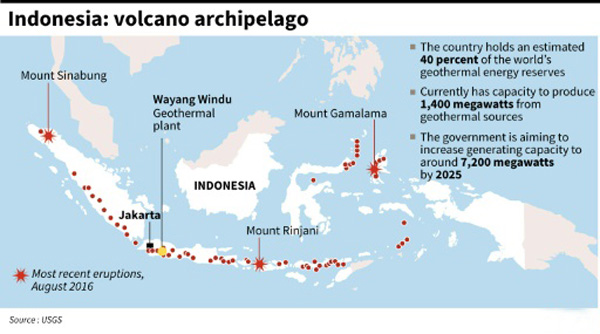
En Indonésie, la majeure partie de l’énergie électrique est générée à partir de ses abondantes réserves de charbon et de pétrole. A côté de cela, le pays a actuellement une capacité installée pour produire environ 1400 mégawatts d’électricité à partir de la géothermie. C’est suffisant pour fournir de l’énergie à 1,4 millions de foyers dans un pays où on en compte plus de 255 millions. Cela représente moins de cinq pour cent du potentiel géothermique estimé et place l’Indonésie loin derrière les deux principaux producteurs mondiaux que sont les États-Unis et les Philippines.
Toutefois, le gouvernement vise à accroître la capacité de production géothermique de l’Indonésie à près de 7200 mégawatts d’ici 2025, dans le cadre d’un plan plus vaste visant à stimuler le secteur des énergies renouvelables.

Le changement en matière de politique géothermique est dû à une nouvelle loi adoptée il y a deux ans et qui stipule que l’exploration géothermique n’est plus considérée comme une activité minière, comme c’était le cas auparavant. L’ancienne loi indiquait que l’industrie minière ne saurait être réalisée dans les vastes étendues de forêts protégées, censées contenir environ les deux tiers des réserves géothermiques de l’Indonésie.
Le gouvernement cherche également à amadouer les administrations locales en leur offrant jusqu’à un pour cent des recettes provenant de toute installation géothermique dans leur région.
Pourtant, les obstacles à la géothermie en Indonésie sont considérables. Bien que l’objectif prévu pour 2025 ne soit pas inaccessible, il sera extrêmement difficile à atteindre. L’un des problèmes les plus importants réside dans le coût d’exploration élevé. En effet, l’exploration de réserves géothermiques potentielles est une entreprise complexe qui demande beaucoup de temps et qui n’est pas toujours couronnée de succès. La construction d’une centrale géothermique coûte l’équivalent de 4 à 5 millions de dollars par mégawatt, contre 1,5 à 2 millions de dollars pour une centrale au charbon. Les investisseurs se sont également plaints du prix relativement bas offert par la compagnie d’électricité d’Etat pour acheter de l’électricité produite à partir d’une installation géothermique et qui, selon eux,  ne couvre pas la dépense initiale.
Pour couronner le tout, la bureaucratie compliquée de l’Indonésie réduit à néant de nombreux projet. 29 permis sont exigés de différents organismes gouvernementaux et ministères pour la construction d’une centrale géothermique. Les longues négociations avec de puissantes administrations locales peuvent également entraver le projet. L’article donne l’exemple d’une exploration géothermique qui a commencé sur un site en 1985 ; il a fallu attendre 15 ans pour que l’usine a commencé commercialiser de l’électricité. Les travaux sur une nouvelle unité pour accroître la production d’électricité ont été retardés en raison de négociations sur le coût .

Source : Phys.org.

————————————

drapeau-anglaisIndonesia, with scores of volcanoes, holds an estimated 40 percent of the world’s geothermal energy reserves, but has long lagged behind in its use of the renewable power source.

Now the government is pushing to expand the sector five-fold in the next decade, although the challenges are huge in a country where the burden of red tape remains onerous, big projects are often delayed and targets missed.

The majority of Indonesia’s power is generated from its abundant reserves of coal and oil. It currently has installed capacity to produce about 1,400 megawatts of electricity from geothermal, enough to provide power to just 1.4 million households in the country off 255 million. That is less than five percent of geothermal’s estimated potential and behind the world’s two leading producers of the energy source, the United States and the Philippines.

But the government is aiming to increase Indonesia’s generating capacity to around 7,200 megawatts by 2025, as part of a broader plan to boost the renewables sector.

A major part of the drive is a law passed two years ago that means geothermal exploration is no longer considered mining activity, as it was previously. The old definition had held up the industry as mining cannot be carried out in the country’s vast tracts of protected forests, believed to contain about two-thirds of Indonesia’s geothermal reserves.

The government is also seeking to sweeten local administrations by offering them up to one percent of revenue from any geothermal plant in their area.

Still, the challenges are enormous. While achieving the 2025 target may be possible, it will be extremely difficult. One of the biggest problems is the high exploration costs needed at the outset, as checking for potential geothermal reserves is a complex, time-consuming business, that is not always successful. Building a geothermal plant costs the equivalent of $4 to $5 million dollars per megawatt, compared to $1.5 to $2 million for a coal-fired power station. Investors have also complained about what they say is the relatively low price offered by the state-run power company to buy electricity from a geothermal facility, which they claim usually doesn’t cover the large initial outlay.

To top it all, Indonesia’s complicated bureaucracy puts many projects off. 29 permits are required from different government agencies and ministries for a geothermal plant, and time-consuming negotiations with powerful local administrations can also hamper progress. The article gives the example of an exploration that first began at a site in 1985 but it was not until 15 years later that the plant began producing electricity commercially, while work on a new unit to boost power generation has been delayed due to negotiations over cost.

Source: Phys.org.
indo

Source: USGS.

Montserrat sur la voie de la géothermie ? // Montserrat on the path to geothermal energy?

drapeau-francaisAprès s’être réveillé en juillet 1995, le volcan Soufrière Hills a dévasté une grande partie de Montserrat, transformé les deux tiers de l’île en une zone d’exclusion et enfoui Plymouth, l’ancienne capitale, sous une épaisse couche de cendre. Aujourd’hui, le volcan s’est calmé et Montserrat envisage d’utiliser la chaleur du sous-sol comme clé de voûte de son économie pour les années à venir.
Des tests effectués par des experts islandais ont révélé un potentiel prometteur pour alimenter l’île en énergie géothermique. Cette électricité verte et bon marché réduirait les factures pour les ménages; elle permettrait aussi de stimuler les investissements en mettant fin à plusieurs décennies d’électricité à des prix prohibitifs et des approvisionnements peu fiables en énergie fossile. Montserrat est actuellement dans l’obligation d’importer des combustibles fossiles coûteux pour alimenter cinq générateurs diesel très vieux et peu fiables, ce qui met l’île à la merci de la fluctuation des prix du pétrole. On espère aussi à Montserrat que le passage à l’énergie renouvelable fera grimper le nombre de vacanciers en mettant en avant les vertus écologiques.
Montserrat effectue des recherches en énergie géothermique depuis les années 1970, mais des doutes quant à la réussite des projets coûteux les ont empêchés de devenir réalité. En 2013, deux puits d’exploration ont été forés à des profondeurs allant jusqu’à 2900 mètres, avec des températures de 260 ° C. Ce projet de 13 millions de dollars a été financé par le Département britannique de Recherche et de Développement qui a accepté de financer le forage d’un troisième puits. Les deux puits existants devraient être en mesure de produire 1,5 mégawatts d’électricité chacun, ce qui est beaucoup plus que les besoins de l’île qui sont seulement de 1,7 mégawatts. Le seul frein à ce projet est la nécessité de réinjecter dans le réservoir le fluide géothermal utilisé, en sachant que l’un des puits pourrait être utilisé à cette fin.
Montserrat ne serait pas le premier pays des Caraïbes à utiliser la chaleur de son sous-sol. St Vincent, Ste Lucie, St Kitts & Nevis et la Dominique ont fait des progrès significatifs dans ce secteur. A Montserrat, on espère que le projet donnera à l’île et ses 5000 habitants une plus grande autonomie et réduira ainsi sa dépendance envers le Royaume-Uni. Un autre avantage de l’énergie géothermique serait l’utilisation de la chaleur résiduelle pour d’autres applications comme la réfrigération, le durcissement des blocs de béton et le séchage des produits agricoles.
Adapté d’un article de BBC News: http://www.bbc.com/news/world-latin-america-34648340

—————————————-

drapeau-anglaisStarting in July 1995, the eruption of the Soufriere Hills devastating a large part of Montserrat, leaving two-thirds of the Caribbean island an exclusion zone and Plymouth, the former capital city, buried deep in ash. Today, the volcano has quietened down and Montserrat might now use the volcano’s heat as a key to its future.
Expensive tests carried out by Icelandic experts indicate promising potential to power the island using geothermal energy. This cheaper, greener electricity would not only slash bills for householders; it could also stimulate external investment by ending decades-old problems of prohibitive electricity costs and an unreliable supply. Montserrat is currently wholly dependent on expensive fossil fuel imports to power its five very old and unreliable diesel generators, leaving it at the mercy of fluctuating oil prices. There are high hopes that switching to renewable energy would increase the number of holidaymakers by cementing its status as an eco-haven.
Montserrat has been looking into geothermal energy since the 1970s, but doubts about the success of the costly project prevented it from becoming reality. In 2013, two exploratory wells were drilled to depths of up to 2,900metres, striking temperatures of 260°C. The 13-million-dollar initiative was funded by the UK Department for International Development which has now agreed to pay for a third well to further the project. The two existing wells are thought to be capable of producing 1.5 megawatts of power each, which is much more than the 1.7 megawatts the island uses. The only obstacle to the project is that there is the need to re-inject spent geothermal fluid back into the reservoir. This means using one of the wells for that purpose.
Montserrat would not be the first Caribbean country to make use of its volcano in such a way.
St Vincent, St Lucia, Nevis and Dominica are among those making significant progress in the sector. At Montserrat, it is hoped the project would put the island and its 5,000 inhabitants on a path to greater self-sufficiency as well as reducing reliance on the UK. Another benefit of geothermal energy would be the possibility of using the waste heat for other things like refrigeration, curing concrete blocks and drying agricultural products.
Adapted from a BBC News article: http://www.bbc.com/news/world-latin-america-34648340

MontserratVolcan Soufriere Hills à Montserrat (Crédit photo: Wikipedia)

Système Géothermique Stimulé dans l’Orégon // Enhanced Geothermal System in Oregon

drapeau francaisDans plusieurs notes écrites sur ce blog en 2008, 2011 et 2012, j’ai expliqué qu’il existait un projet d’exploitation de l’énergie géothermique dans le secteur du volcan Newberry, au cœur de l’Oregon. Aujourd’hui, le projet est en passe de devenir réalité. Il est censé produire une énorme quantité d’énergie aux États-Unis. La société AltaRock Energy exploite la chaleur de la terre à trois kilomètres de profondeur et la transforme en une électricité fiable et rentable.
Quand les gens évoquent la géothermie, ils pensent en général à des ressources hydrothermales situées dans les zones volcaniques le long de plaques tectoniques. En fait, le potentiel de la géothermie est beaucoup plus vaste et géographiquement dispersé. Il existe un énorme potentiel pour les Systèmes Géothermiques Stimulés (SGS ou EGS) à travers les États-Unis et toute la planète.
Un système SGS fonctionne en forant le sol et en injectant de l’eau dans un système en boucle fermée destiné à créer des fractures dans la roche. On ajoute de l’eau pour absorber la chaleur émise par la roche, ce qui entraîne une production de vapeur qui remonte vers la surface et actionne une turbine.

Le Massachusetts Institute of Technology Group (MIT) qui a supervisé le projet recherchait une méthode pour produire 100 000 MW aux Etats-Unis par le SGS. Les chercheurs ont remarqué que la qualité de la ressource géothermique repose sur trois facteurs fondamentaux:
1) La relation température-profondeur (également appelée gradient géothermique), autrement dit la profondeur à laquelle il faut forer pour obtenir la chaleur nécessaire.
2) La perméabilité et la porosité de la roche réservoir. C’est un facteur important car cela concerne la zone de surface à laquelle l’eau (qui absorbe la chaleur nécessaire) est exposée.
3) La saturation en fluide. (La quantité de fluide dans la roche susceptible d’absorber la chaleur)
Comme le fait remarquer le rapport du MIT, le SGS est intéressant pour plusieurs raisons, notamment parce qu’il fournit de l’électricité pratiquement sans carbone et la roche source est abondante aux Etats-Unis.

Le groupe d’étude a indiqué que le potentiel de ce type de ressource géothermique était énorme et très rentable: Avec un investissement privé/public se situant entre 800 millions et un milliard de dollars sur une période de 15 ans, la technologie SGS pourrait être déployée commercialement sur une échelle de temps qui produirait plus de 100 000 MW d’ici 2050.
La technologie SGS est très différente de l’hydrofracturation pour le gaz naturel. On n’a pas besoin de percer latéralement, ni d’utiliser des produits chimiques ou du sable pour ouvrir les fractures dans la roche. En outre, aucune eau usée n’a besoin d’être éliminée. C’est la différence de température entre l’eau froide et la roche très chaude qui provoque les fractures. Ces fractures à leur tour aboutissent à une augmentation de surface pour le transfert thermique ultérieur de la roche vers l’eau. Une préoccupation du public a été la possibilité de voir apparaître des séismes, ce que l’on appelle la « sismicité induite ». Mais comme l’a démontré AltaRock en utilisant des mesures obtenues lors du projet Newberry, les stimulations provoquées par la technologie SGS déclenchent une «sismicité inférieure aux vibrations que subit un stade de football rempli de spectateurs lors d’un grand match de la NFL » (National Football League aux Etats-Unis).
Une autre différence est que la fracturation pratiquée par AltaRock utilise une boucle fermée. Une fois que le réservoir est initialement chargé, il n’est plus nécessaire d’ajouter d’eau, et les centrales peuvent alors produire de l’énergie pendant des décennies.

Dans l’Oregon, AltaRock est en train de construire l’une des centrales les plus importantes des États-Unis La société a foré jusqu’à 3.000 mètres dans la roche sèche et chaude, à 300 ° C, avec presque pas de perméabilité à la base, et elle a utilisé sa propre technologie pour créer un réservoir géothermique.
L’entreprise a un coût: 40 millions de dollars viennent d’investisseurs privés, complétés par 21,5 millions de dollars du Ministère de l’Énergie. Le projet est également soutenu par plusieurs institutions universitaires et scientifiques.
Il comporte plusieurs étapes (voir schéma ci-dessous). La première consiste à forer le premier puits d’exploration et d’injection. Ce puits fournit des informations concernant les températures de fond de forage et c’est le puits dans lequel l’eau est injectée pour fracturer la roche et créer le réservoir géothermique. Une fois que le réservoir est créé, d’autres puits de production sont forés ; ils seront reliés au premier puits de telle sorte que l’eau se déplace de l’un à l’autre. L’eau surchauffée (à environ 300 ° C) va remonter le long des puits de production vers la surface et la vapeur qui en résulte va passer par un générateur afin de produire de l’électricité.
En l’état actuel des choses, le projet Newberry a déjà vu l’achèvement du puits d’injection, la stimulation de la ressource, et la création de la perméabilité. La prochaine étape consistera à forer des puits de production qui auront une «communication» avec l’eau injectée dans le premier puits, créant ainsi un réseau en boucle fermée.
La géothermie haute température par stimulation pourrait devenir une technologie essentielle pour répondre aux besoins futurs des Etats-Unis en électricité, et elle peut être utilisée dans tout le pays.

Sources : Forbes.com & The Oregonian.

On pourra consulter un site en français qui explique fort simplement le principe des systèmes géothermiques stimulés:

http://www.connaissancedesenergies.org/fiche-pedagogique/geothermie-haute-temperature-par-stimulation

 ———————————————————–

drapeau anglaisIn several notes written on this blog in 2008, 2011 and 2012, I explained that there was a project to exploit geothermal energy at Newberry volcano, in central Oregon. Today, the project is in a fair way to become reality. It is said to hold the promise to producing an enormous amount of energy in the United States. The AltaRock Energy company is mining the earth’s heat three kilometres down and turning it into a reliable and cost-effective supply of electricity.

When most people think of geothermal, they envision the hydrothermal resources that are located in volcanic zones along tectonic plates, but the potential for geothermal is much larger and geographically dispersed. In fact, there is enormous potential for heat mining Enhanced Geothermal Systems (EGS) throughout the U.S. and the world.

EGS works by drilling a hole into the ground, and pumping water into a closed loop system to create fractures in the rock. Additional water is added to absorb heat from the rock, which turns to steam at the surface and drives a turbine.

The Massachusetts Institute of Technology (MIT) group which supervised the project was specifically looking at what would be necessary to produce 100,000 MW of EGS in North America, which would represent about 10% of overall US generating capacity. They noted that the quality of the geothermal resource is affected by three basic factors:

1)   The temperature-depth relationship (also referred to as the geothermal gradient), in other words, how deep you have to drill to obtain the requisite heat.

2)   The reservoir rock’s permeability and porosity. This matters because it affects the surface area that the water (which absorbs the necessary heat) is exposed to.

3)   The amount of fluid saturation. (How much fluid in the rock that can absorb the heat)

As the MIT report noted, EGS is attractive for several reasons, including the fact that it provides virtually carbon free electricity and the source rock resource exists widely throughout the United States.

The study group indicated that the potential of this resource was enormous and cost-effective: With a combined public/private investment of about $800 million to $1 billion over a 15-year period, EGS technology could be deployed commercially on a timescale that would produce more than 100,000 MW of new capacity by 2050.

EGS is a very different technology than hydro-fracking for natural gas. One doesn’t have to drill sideways, nor use chemicals or sand to open up fractures in the rock. Also, no wastewater is produced that needs to be disposed of. Rather, it’s the temperature differential between cold water and hot rock that creates the fractures. These fractures in turn result in enhanced surface area for subsequent heat transfer from the rock to the water. Another public concern has been the potential for creating earthquakes, referred to as “induced seismicity.” But as Altarock highlights using measured data from the Newberry project, EGS stimulations result in « seismicity that is lower than a packed football stadium during a big NFL game ».

Another difference from fracking is that AltaRock is using a closed loop. Once the reservoir is initially charged, no more additional water is needed, and the plants can then produce power for decades.

In Oregon, AltaRock is building one of the most important power plants in the U.S. The company has drilled 3,000 metres into hot dry rock, at 300°C, with almost no permeability at the bottom and used its own technology to create a geothermal reservoir.

The undertaking is not cheap: 40 million dollars are coming from private investors, complemented by a $21.5 million from the Department of Energy. The project is also supported by several university and scientific institutions.

It involves several stages (see image below). The first element involves drilling the initial exploratory and injection well. This well provides information concerning downhole temperatures and is the well into which the water is introduced to fracture the rock and create the geothermal reservoir. Once the reservoir is created, additional vertical production wells are drilled, and they will have connectivity to the first well so that water moves from one to the other. The superheated water (at about 300°C) will rise up the production wells to the surface and the resulting steam will course through a generator to create electricity.

At this point, the Newberry Volcano project has already seen completion of the injection well, stimulation of the resource, and the creation of permeability. The next step is to drill the producer wells that will have ‘communication’ with the water injected into the first well, creating the closed loop network.

Enhanced geothermal can be a critical technology in meeting the U.S. future electric energy requirements. And it can be located all across the country.

Sources : Forbes.com & The Oregonian.

Newberry-blog-2

Source: AltaRock

La géothermie entre en Indonésie // Geothermal energy enters Indonesia

drapeau francaisLe Parlement indonésien a voté il y a quelques jours une loi attendue depuis longtemps. Elle va permettre le développement de l’énergie géothermique et la mise en valeur de l’énergie qui se cache sous les quelque 130 volcans actifs de l’archipel. On estime que l’Indonésie détient environ 40 pour cent du potentiel géothermique de la planète mais qu’elle ne produit qu’une infime fraction de son énergie en convertissant la chaleur du sol en électricité. Le pays se situe loin derrière d’autres nations comme les Etats-Unis ou les Philippines.
La lenteur administrative et les tracasseries juridiques ont longtemps freiné l’industrie géothermique en Indonésie et empêché les investissements indispensables. Le gouvernement espère que la nouvelle loi permettra d’accélérer le développement de ce secteur. Elle stipule – c’est le point le plus important – que l’exploration de l’énergie géothermique et le développement des centrales ne sont plus considérés comme une exploitation minière. Ils étaient considérés en tant que tel auparavant de sorte que l’industrie ne pouvait guère s’engager dans des régions indonésiennes où la forêt est protégée et où il y a un fort potentiel géothermique, mais où l’exploitation minière est illégale.
On estime que l’Indonésie a un potentiel géothermique de plus de 28 000 mégawatts mais elle produit actuellement seulement un peu plus de 1300 MW de son électricité à partir d’une source d’énergie propre. La plus grande partie de son électricité provient du charbon et du pétrole.
Le coût élevé de la géothermie a longtemps été l’un des principaux obstacles à son développement. En effet, une centrale géothermique coûte environ deux fois plus qu’une centrale électrique au charbon et peut nécessiter de nombreuses années de recherche et de développement avant d’être opérationnelle. Mais une fois mises en place, les centrales géothermiques comme celle construite à Kamojang sur l’île de Java dans les années 1980 peuvent convertir la chaleur volcanique en électricité à un coût beaucoup plus bas – et avec moins de pollution – que le charbon.
Avec l’énergie géothermique, l’Indonésie devrait normalement réduire d’ici 2020 les émissions de gaz à effet de serre de 26 pour cent par rapport aux niveaux de 2005. L’Indonésie est le troisième plus grand émetteur de gaz à effet de serre dans le monde en raison de son utilisation de combustibles polluants pour produire de l’électricité et à cause de la déforestation galopante.

Source : Sky News.

 ——————————————

drapeau anglaisThe Indonesian parliament has just passed a long-awaited law to bolster the geothermal energy industry and tap the power of the archipelago’s some 130 active volcanoes. Indonesia is estimated to hold around 40 per cent of the world’s geothermal potential but it produces only a tiny fraction of its energy by converting underground heat into electricity, and lags far behind others such as the United States and the neighbouring Philippines.

Red tape and legal uncertainty have long held back the industry and obstructed much-needed investment, but the government hopes the new law will speed up the development of the sector. Most importantly, it stipulates that exploration for geothermal energy and development of plants is no longer considered mining. It was regarded as such previously, which meant the industry faced problems working in Indonesia’s vast areas of protected forest, where there is much geothermal potential but where mining is illegal.

Indonesia is estimated to have more than 28,000 megawatts of geothermal potential but is currently producing just over 1300 MW of its electricity from the clean source. Most of its electricity comes from coal and oil.

High cost has long been one of the major obstacles. A geothermal plant costs about twice as much as a coal-fired power station, and can take many more years in research and development to get online. But once established, geothermal plants like the one built in Kamojang on the island of Java in the 1980s can convert volcanic heat into electricity with much lower overheads – and less pollution – than coal.

With geothermal energy, Indonesia is expected to slash greenhouse gas emissions by 26 per cent from 2005 levels by 2020. Indonesia is the world’s third-biggest greenhouse gas emitter due its use of dirty fuels to produce electricity and to rampant deforestation.

Source : Sky News.

Bromo-blog-04

L’énergie du Bromo produira-t-elle un jour de l’électricité?  (Photo:  C. Crandpey)