 Sur sa page Facebook, Marco Neri (INGV Catane) a mis en ligne une image très intéressante du sommet de l’Etna qui permet de comprendre ce qui se passe au moment des épisodes éruptifs, souvent appelés paroxysmes.
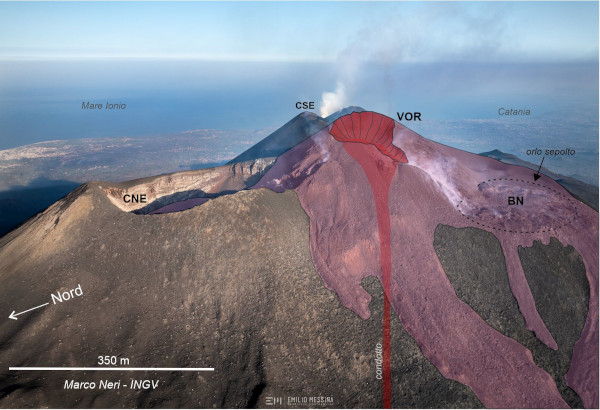
Ces derniers temps, c’est la Voragine, le cratère central, qui est la maîtresse des lieux, alors qu’il n’y a pas si longtemps, c’était le Cratère Sud-est qui pilotait l’activité éruptive.
L’image proposée par Marco Neri s’appuie sur une photo prise le 16 août 2024 par Emilio Messina Photography. On reconnaît parfaitement l’ensemble des cratères sommitaux avec la Voragine et, à ses côtés, la Bocca Nuova et le Cratère Nord-est, et le Cratère Sud-est un peu à l’arrière.
En regardant cette image, on comprend parfaitement pourquoi une coulée de lave déborde de la lèvre occidentale de la Bocca Nuova pendant les paroxysmes. Ce débordement est normal car la Bocca Nuova est pleine à ras-bord et n’existe pratiquement plus en tant que cratère visible.
On remarque que le fond du cratère Nord-Est est également rempli de lave provenant de la Voragine. Malgré tout, ce cratère possède encore une marge de sécurité avant de connaître le même sort de remplissage que la Bocca Nuova.
En constatant le remplissage de ces deux cratères (le Cratère Sud-est est épargné car à l’écart), je me demande si l’obstruction des conduits éruptifs ne pourrait pas déboucher un jour sur une forte activité explosive qui aurait pour moteur les gaz accumulés dans les conduits. A moins que la Voragine soit en mesure, à elle seule, de gérer cette situation.
°°°°°°°°°°
Ceux qui, comme moi, ont commencé à visiter l’Etna dans les années 1990 se rendent compte à quel point le sommet du volcan a été chamboulé. A cette époque, les quatre cratères étaient bien dessinés, à commencer par la Cratère Sud-est qui était né en 1971. J’ai souvenir d’un superbe cratère à l’intérieur duquel je suis entré à plusieurs reprises.
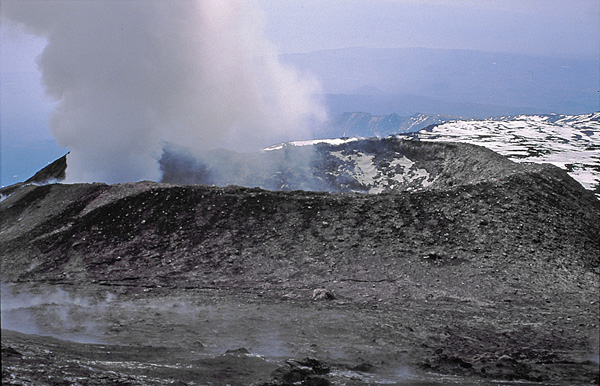
Cratère SE en 1995 (Photo: C. Grandpey)
Dans années 1990-2000 , il a subi de profondes transformations en reprenant du service. En 1997, j’ai vu naître le Nouveau Cratère SE sur le plancher du cratère que j’avais photographié en 1995.
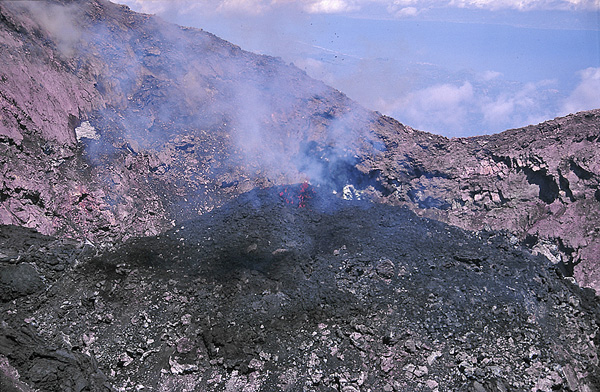
Le cône a considérablement grandi les années suivantes et il était méconnaissable quand je me suis rendu à son chevet le 1er janvier 2000.
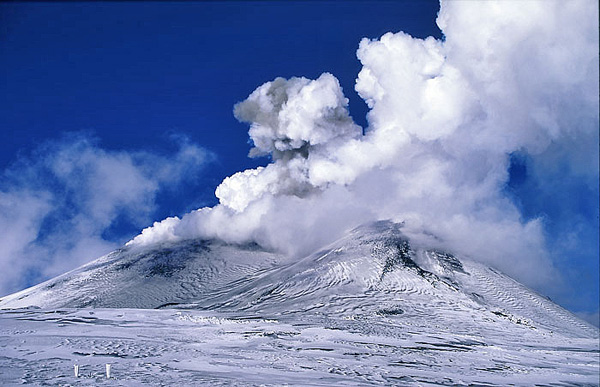
Photo: C. Grandpey
De la même façon la Voragine et la Bocca Nuova (née en 1968) cohabitaient harmonieusement, séparées par une paroi baptisée ‘diaphragme’ par certains.
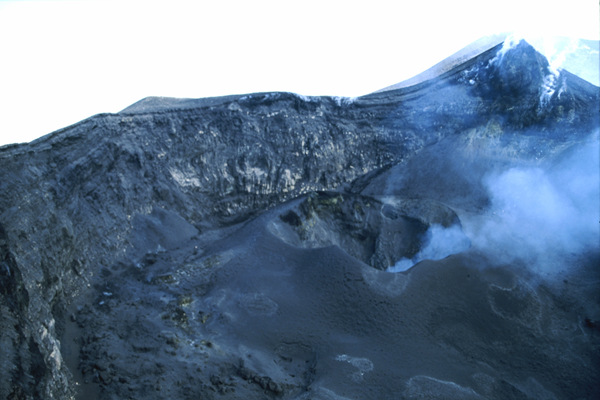
Photo: C. Grandpey
En 1998, une belle activité strombolienne animait la Bocca Nuova.
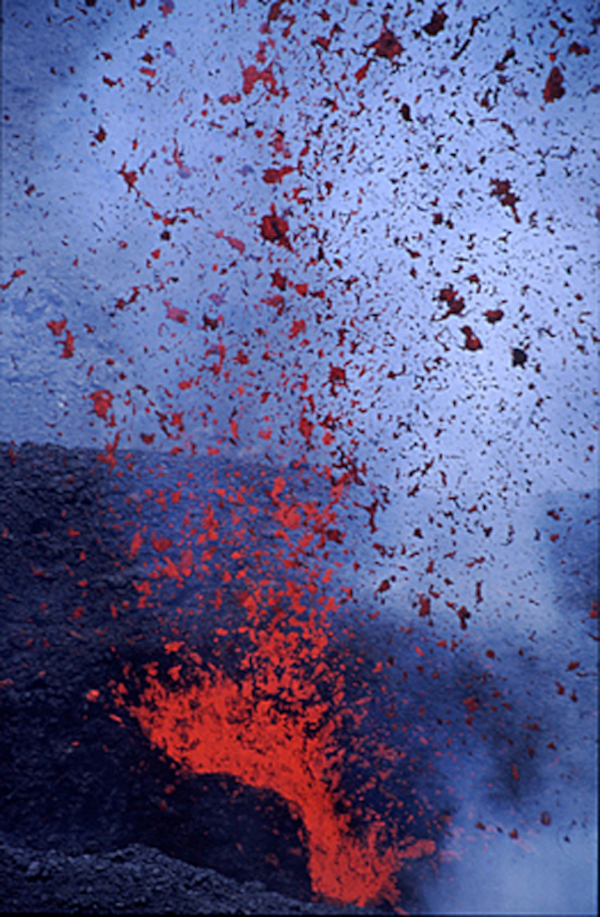
Photo: C. Grandpey
Un peu à l’écart, le Cratère Nord-est (né en 1911) était un gouffre au fond duquel on entendait parfois de fortes explosions. Dans les années 1990, le Cratère Notd-est était la point culminant de l’Etna.
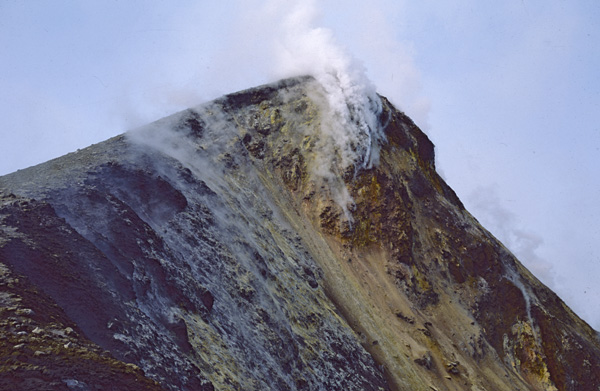
Photo: C. Grandpey
Depuis quelques semaines, c’est la Voragine qui a cet honneur avec 3369 mètres au-dessus du niveau de la mer, suite à l’accumulation de matériaux au cours des différents paroxysmes… et cette altitude n’est peut-être pas définitive!
L’Etna est vraiment un volcan extraordinaire!
————————————————
 On his Facebook page, Marco Neri (INGV Catania) has posted a very interesting image of the summit of Mt Etna that helps us understand what happens during eruptive episodes, often called paroxysms.
In recent times, the Voragine, the central crater, has been the center of this activity, while not so long ago, it was the Southeast Crater that was driving it.
The image proposed by Marco Neri is based on a photo taken on August 16th, 2024 by Emilio Messina Photography. We can clearly recognize the summit craters with the Voragine and, next to it, the Bocca Nuova and the Northeast Crater, and the Southeast Crater a little behind.
Looking at this image, we can perfectly understand why lava overflows from the western rim of the Bocca Nuova during paroxysms. This overflow is normal because the Bocca Nuova is full to the brim and practically no longer exists as a visible crater.
We note that the bottom of the North-East crater is also filled with lava coming from the Voragine. This crater still has a safety margin before being completely filled like the Bocca Nuova.
Seeing the filling of these two craters (the South-East Crater is spared because it is out of the way), I wonder if the obstruction of the eruptive conduits could not one day lead to strong explosive activity driven by the gases accumulated in the conduits. Unless the Voragine is able, on its own, to manage this situation.
°°°°°°°°°°
Those who, like me, began to visit Mt Etna in the 1990s realize to what extent the summit of the volcano has been turned upside down. By that time, the four craters were well-defined, starting with the Southeast Crater which was born in 1971. I can remember a superb crater which I entered several times. In the 1990s-2000s, it underwent profound transformations when it started erupting again. In 1997, I saw the New SE Crater being born on the floor of the crater that I had photographed in 1995.The cone grew considerably in the following years and was unrecognizable when I visited the volcano on January 1st, 2000.
In the same way, the Voragine and the Bocca Nuova (born in 1968) coexisted harmoniously, separated by a wall called a ‘diaphragm’ by some people. In 1998, there was a great deal of Strombolian activity in the Bocca Nuova.
A little further away, the Northeast Crater (born in 1911) was a chasm at the bottom of which one could sometimes hear strong explosions. In the 1990s, the Northeast Crater was the highest point of Mt Etna.
For a few weeks now, the Voragine has been Mt Etna’s highest point with 3369 metres above sea level, following the accumulation of materials during the various paroxysms… and this altitude may not be definitive!
Mt Etna is truly an extraordinary volcano!


 Claude Grandpey : Volcans et Glaciers