 Les scientifiques islandais du Met Office et de l’Université d’Islande adorent faire des pronostics et des prévisions éruptives. Lorsque l’activité a commencé sur le Fagradalsfjall en 2021, ils ont affirmé que l’éruption était le début d’un nouveau cycle éruptif qui pourrait durer des mois, des années, voire plus. En fait, l’événement a duré six mois (19 mars – 18 septembre 2021). Une nouvelle éruption a débuté le 3 août 2022, et une autre, plus courte, a commencé le 10 juillet 2023 et s’est arrêtée le 5 août de cette même année.
Cette fois, en 2024, le Met Office est persuadé que l’éruption actuelle à Sundhnúkagígar marque probablement la fin d’une série dans la zone proche de Grindavík, même si elle est entrée dans sa troisième semaine et se poursuit au moment où j’écris ces lignes.
L’éruption a commencé le 16 mars 2024. L’activité reste confinée dans deux cratères, avec une émission de lave constante et aucun signe montrant que l’éruption est sur le point de se terminer. La majeure partie de l’activité se déroule dans le plus grand des deux cratères. Une certaine pollution par les gaz est parfois observée à Grindavík et Hafnir.
Selon un professeur de volcanologie de l’Université d’Islande, certains signes laissent supposer qu’il s’agit de la dernière éruption d’un cycle qui a débuté en décembre 2023. La chambre magmatique la moins profonde, située sous Svartsengi, n’est plus alimentée. Cela signifie que le magma en provenance de la chambre magmatique profonde monte directement vers vers la surface. L’éruption pourrait prendre fin dans les prochains jours.
Source : Iceland Review.
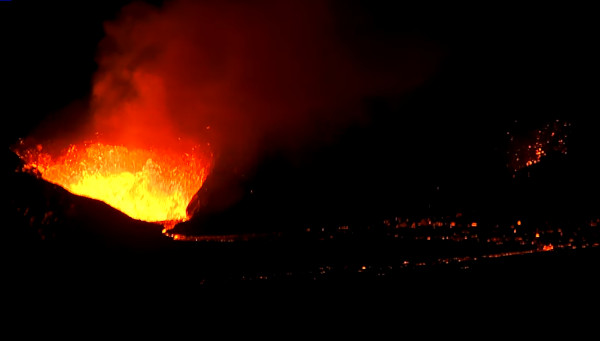
Image webcam de l’éruption le 1er avril 2024
—————————————————–
 Icelandic scientists at the Met office and the University of Icelad love making predictions. When activity started at Fagradalsfjall in 2021, they said the eruption was the start of a new eruptive cycle which might last for months, years or even more. Actually the event lasted six months (19 March – 18 September, 2021). A new eruption started aon August 3rd, 2022, and another short one began on July 10th, 2023 and stopped on Augsu 5th. .
This time, in 2024, the Met Office is persuaded that the current eruption in Sundhnúkagígar could mark the end of a string of eruptions in the area near Grindavík, although it is in its third week and still continuing.
The eruption began on March 16th 2024.Activity remains in two craters in the area, with steady lava flow and no immediate signs of the eruption ending. Most of the activity is ongoing in the larger of the two craters. Some gas pollution is sometimes detected in Grindavík and Hafnir.
According to a professor of volcanology at the University of Iceland, there are signs that this might be the final eruption in the cycle of volcanic activity which began in December 2023. The shallower magma chamber in the area, situated under Svartsengi, is no longer receiving magma from the eruption. Therefore, magma from the deeper magma chamber in the area is flowing to the surface and the eruption might come to an end in the next few days.
Source : Iceland Review.


 Claude Grandpey : Volcans et Glaciers