Islande : l’heure des pronostics ! // Iceland : time for predictions !

Les scientifiques islandais du Met Office et de l’Université d’Islande adorent faire des pronostics et des prévisions éruptives. Lorsque l’activité a commencé sur le Fagradalsfjall en 2021, ils ont affirmé que l’éruption était le début d’un nouveau cycle éruptif qui pourrait durer des mois, des années, voire plus. En fait, l’événement a duré six mois (19 mars – 18 septembre 2021). Une nouvelle éruption a débuté le 3 août 2022, et une autre, plus courte, a commencé le 10 juillet 2023 et s’est arrêtée le 5 août de cette même année.
Cette fois, en 2024, le Met Office est persuadé que l’éruption actuelle à Sundhnúkagígar marque probablement la fin d’une série dans la zone proche de Grindavík, même si elle est entrée dans sa troisième semaine et se poursuit au moment où j’écris ces lignes.
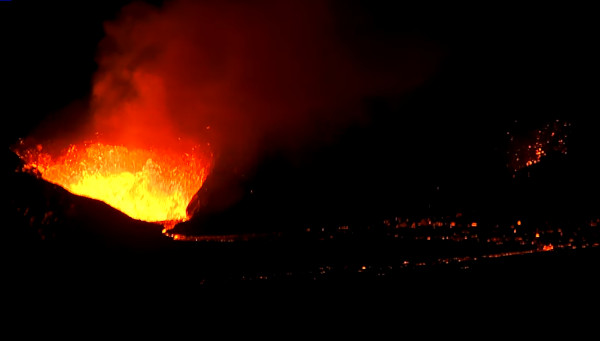
L’éruption a commencé le 16 mars 2024. L’activité reste confinée dans deux cratères, avec une émission de lave constante et aucun signe montrant que l’éruption est sur le point de se terminer. La majeure partie de l’activité se déroule dans le plus grand des deux cratères. Une certaine pollution par les gaz est parfois observée à Grindavík et Hafnir.
Selon un professeur de volcanologie de l’Université d’Islande, certains signes laissent supposer qu’il s’agit de la dernière éruption d’un cycle qui a débuté en décembre 2023. La chambre magmatique la moins profonde, située sous Svartsengi, n’est plus alimentée. Cela signifie que le magma en provenance de la chambre magmatique profonde monte directement vers vers la surface. L’éruption pourrait prendre fin dans les prochains jours.
Source  : Iceland Review.

Image webcam de l’éruption le 1er avril 2024

—————————————————–

Icelandic scientists at the Met office and the University of Icelad love making predictions. When activity started at Fagradalsfjall in 2021, they said the eruption was the start of a new eruptive cycle which might last for months, years or even more. Actually the event lasted six months (19 March – 18 September, 2021). A new eruption started aon August 3rd, 2022, and another short one began on July 10th, 2023 and stopped on Augsu 5th. .

This time, in 2024, the Met Office is persuaded that the current eruption in Sundhnúkagígar could mark the end of a string of eruptions in the area near Grindavík, although it is in its third week and still continuing.

The eruption began on March 16th 2024.Activity remains in two craters in the area, with steady lava flow and no immediate signs of the eruption ending. Most of the activity is ongoing in the larger of the two craters. Some gas pollution is sometimes detected in Grindavík and Hafnir.

According to a professor of volcanology at the University of Iceland, there are signs that this might be the final eruption in the cycle of volcanic activity which began in December 2023. The shallower magma chamber in the area, situated under Svartsengi, is no longer receiving magma from the eruption. Therefore, magma from the deeper magma chamber in the area is flowing to the surface and the eruption might come to an end in the next few days.

Source : Iceland Review.

Péninsule de Reykjanes (Islande) : des prévisions divergentes // Reykjanes Peninsula (Iceland) : divergent predictions

Dans une note publiée le 12 mars 2024, j’écrivais ; « le Met Office islandais affirme qu’il serait surprenant qu’il ne se passe rien cette semaine (du 11 au 17 mars). […] L’accumulation de magma sous Svartsengi continue d’augmenter régulièrement et a désormais atteint un volume plus élevé qu’au début du mois […] Si rien ne se passe cette semaine, cela signifiera que le comportement de intrusion magmatique s’est modifié. »

Finalement, l’éruption a débuté dans la soirée du 16 mars 2024. Le Met Office avait indiqué que l’accumulation de magma sous le secteur de Svartsengi continuait, et la lave a percé la surface au même endroit que le 8 février. Le Met Office avait répété qu’une éruption pourrait se déclencher très rapidement, avec un préavis de moins d’une demi-heure. Pour cette éruption, il a été d’une quarantaine de minutes.

Alors que le Met Office ne cessait de répéter que l’accumulation de magma sous Svartsengi déboucherait sur une éruption à court terme et avec un préavis très court, deux scientifiques islandais ont émis un point de vue différent. Ils estimaient qu’il faudrait une plus grande accumulation de magma sous Svartsengi pour déclencher une nouvelle intrusion. Utilisant les données du Met Office, leur analyse suggérait que l’activité observée actuellement près de Grindavík se terminerait entre le 1er juillet et le 15 août 2024.
Les données fournies par le Met Office incluaient le graphique montrant les cinq événements significatifs enregistrés depuis novembre 2023, avec trois éruptions et deux intrusions magmatiques qui n’ont pas abouti à des éruptions.

  (Source : Met Office islandais)

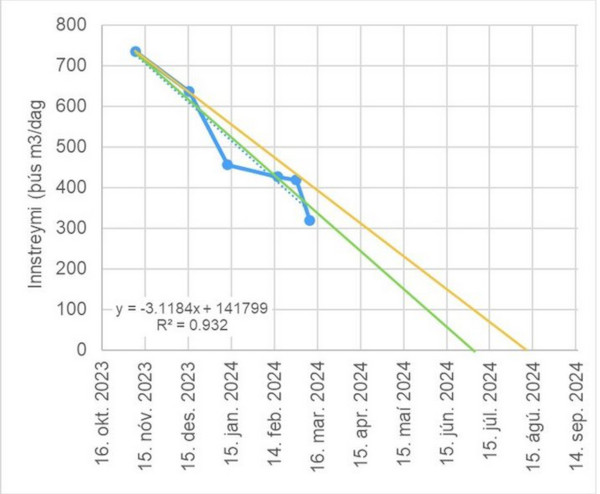
En utilisant ces données, les deux scientifiques ont mis au point leur propre tableau analytique permettant de prévoir la fin de l’activité actuelle. Leur graphique montre que l’afflux de magma sous Svartsengi a progressivement ralenti. En novembre, il atteignait plus de 700 000 mètres cubes par jour. Depuis cette date, l’afflux n’a cessé de diminuer. Les scientifiques pensaient que cet afflux de magma suivrait une tendance linéaire. Sur la base de cette tendance, ils prévoyaient que l’activité sur la péninsule de Reykjanes prendrait fin entre le 1er juillet et le 15 août 2024.

Graphique proposé par les deux scientifiques et montrant le ralentissement de l’afflux de magma

Finalement, c’est le Met Office qui avait raison…
Source  : Iceland Review.

Ces prévisions contradictoires ont le don d’agacer les habitants de Grindavík qui aimeraient avoir une image plus claire de l’avenir. Ils voudraient savoir si la prochaine éruption commencera à court terme ou cet automne. Une autre grande question est de savoir où elle se produira.
En fait, les différentes prévisions faites par les volcanologues ne conduisent à rien de concret. Les habitants de Grindavík disent qu’ils ont déjà dû faire face à de grands défis et que ces informations contradictoires n’arrangent rien. L’un d’eux a déclaré : « Certaines personnes disent que la prévision selon laquelle l’intrusion magmatique prendrait fin cet été est une bonne nouvelle. Je ne crois pas que ce soit fini, mais je ne suis pas un spécialiste en la matière. Nous avons connu une période extrêmement difficile mentalement et il faut rester les pieds sur terre. J’espère que tout cela se terminera le plus tôt possible, mais je ne le crois pas. »

Source : Iceland Monitor.

—————————————————

In a post published on March 12th, 2024, I wrote; “Iceland’s Met Office says it would be surprising if nothing happened this week (March 11-17). […] The magma accumulation beneath Svartsengi continues to increase steadily and has now reached a higher volume than at the beginning of the month […] If nothing happens this week, it will mean that the behaviour of magma intrusion has changed. »
Finally, an eruption started on the evening of March 16th, 2024. The Met Office had indicated that the accumulation of magma under the Svartsengi area continued, and it breached the surface at the same location as on February 8th. The Met Office had reiterated that an eruption could occur very quickly, with less than half an hour’s notice. For this eruption, the notice was around forty minutes.

While the Met Office repeatedly said the buildup of magma beneath Svartsengi wiould lead to an eruption in the short term and with very little notice, two Icelandic scientists offered a different view. They estimated that it would take a greater accumulation of magma beneath Svartsengi to trigger a new intrusion. Using Met Office data, their analysis suggested that the activity currently observed near Grindavík would end between July 1 and August 15, 2024.
Data provided by the Met Office included the graph showing the five significant events recorded since November 2023, with three eruptions and two magmatic intrusions that did not result in eruptions (see graph above).

Using this data, the two scientists developed their own analytical table to predict the end of the current activity. Their graph shows that the influx of magma beneath Svartsengi has gradually slowed down. (see graph above). In November, it reached more than 700,000 cubic meters per day. Since then, the influx has continued to decline. Scientists thought this magma influx would follow a linear trend. Based on this trend, they predicted that activity on the Reykjanes Peninsula would end between July 1 and August 15, 2024.

In the end, it was the Met Office that was right…
Source: Iceland Review.

These contradictory forecasts had the gift of annoying the residents of Grindavík who would like to have a clearer picture of the future. They wanted to know if the new eruption would start in the short term or in the autumn. Another big question was where the next eruption would occur.
In fact, the various predictions made by volcanologists do not lead to anything concrete. Grindavík residents say they have already faced big challenges and this conflicting information doesn’t help matters. One resident said: “Some people say the prediction that magma intrusion will end this summer is good news. I don’t think it’s over, but I’m not an expert on the subject. We have experienced an extremely difficult period mentally and we have to stay with our feet on the ground. I hope this all ends as soon as possible, but I don’t think so. »
Source: Iceland Monitor.

Eruption islandaise : un gros succès populaire, mais c’est fini! // Icelandic eruption : A very popular event which is over!

Il ne fait aucun doute que l’éruption du Fagradalsfjall a attiré des foules de touristes en Islande. Les derniers chiffres révèlent que près de trois fois plus de touristes étrangers ont visité l’Islande via l’aéroport international de Keflavík au cours de l’été 2021, par rapport à l’été 2020. La plupart d’entre eux sont venus des États-Unis (43%), suivis de l’Allemagne (9%). la Pologne (7 %), le Royaume-Uni et la France (5 % chacun).
Cependant, cette tendance va probablement décliner dans les prochains mois car l’éruption est terminée. Même si les volcanologues islandais refusent toujours de l’admettre définitivement, plus aucune activité n’est observée dans la Geldingadalir, la Meradalir ou la Nattaghi, et la sismicité a cessé dans la région de Keilir. D’ailleurs, le niveau d’alerte volcanique vient d’être abaissé à ‘Uncertainty’ qu demande de rester vigilant. Personne ne saura jamais si les derniers séismes ont été causés par une migration de magma ou s’ils avaient une origine tectonique.
Avant même qu’elle ne débute, la dernière éruption a été la source de nombreuses questions et hypothèses. Dès janvier 2020, des essaims sismiques ont été enregistrés au NE de Grindavik. Puis une inflation du sol a été observée autour du Mt Thorbjorn. Personne n’était en mesure de dire si ces événements avaient une origine volcanique ou tectonique. De nouveaux essaims sismiques ont été enregistrés sur la péninsule de Reykjanes au cours des mois suivants avec la même incertitude quant à leur origine. Plusieurs fissures se sont finalement ouvertes et la lave a apporté une réponse en perçant la surface dans la Geldingadalur le 19 mars 2020. Selon des scientifiques islandais, l’éruption était partie pour durer très longtemps, des mois, voire des années. Certains d’entre eux ont même dit qu’avec le temps, un volcan bouclier allait être édifié et qu’il dominerait la région. Les agences de voyages avaient déjà prévu des voyages en Islande pendant l’hiver pour admirer l’éruption avec les aurores boréales en toile de fond. Malheureusement, pour tous ces gens, l’éruption a lentement diminué au cours de l’été 2021 et aujourd’hui plus aucune activité n’est observée au niveau du cratère principal, à l’exception de quelques fumerolles….

Les autorités islandaises avertissent que le site de l’éruption est toujours dangereux, et il est conseillé aux visiteurs de ne pas marcher sur la lave récemment émise ou de s’approcher du cratère. Cependant, je ne suis pas sûr, comme l’a déclaré une scientifique islandaise, que « même s’il n’y a pas de nouvelle lave, il y a toujours de la lave qui coule sous le champ de lave noir ». La lave sous la croûte est peut-être encore rougeoyante, mais elle ne coule plus depuis longtemps! Le plus grand danger réside probablement dans les gaz volcaniques encore émis par le cratère.

————————————–

There is little doubt that the Fagradalsfjall eruption brought crowds of tourists to Iceland. The latest figures reveal that nearly three times as many foreign tourists visited Iceland via Keflavík International Airport in the summer 2021, compared with the summer of 2020. Most of them came from the US (43 percent), followed by Germany (9 percent), Poland (7 percent), the UK and France (5 percent each).

However, the trend is likely to decline in the coming months because the eruption has come to an end. Even if Icelandic volcanologists still refuse to admit it definitely, no more activity is observed in Geldingadalir, Meradalir or Nattaghi, and seismicity has stopped in the Keilir area. The alert level has just been lowered to ‘Uncertainty’. Nobody will ever know whether the latest earthquakes were caused by some magma migrration or if it had a tectonic origin.

Even before it started, the last eruption was the source of many questions and hypotheses. As soon as January 2020, seismic swarms were recorded to the NE of Grindavik. Then an inflation of the ground was observed around Mt Thorbjorn. Nobody was able to say whether these phenomena had a volcanic or tectonic origin. More seismic swarms were recorded on the Reykjanes Peninsula during the following months with the same uncertainty about their origin. Several fissures finally opened and lava pierced the surface in Geldingadalur on March 19th, 2020. According to Icelandic scientists, it looked as if the eruption was going to last a long time, months ans even years. Some of them even said that with time, a shield volcano would be built that would tower over the area. Travel agencies had already planned winter trips to Iceland to admire the eruption with northern lights in the background. Unfortunately, for these people, the eruption slowly declined during the summer 2021 and today no more activity is observed at the main crater, except a few fumaroles….

Icelandic authorities warn that the site of the eruption is still dangerous, and visitors are advised not to step on the fresh lava or approach the crater. However, I am not sure, as an Icelandic scientist declared, that « even though there’s no new lava, there’s still flowing lava underneath the black lava field. » The lava beneath the crust may still be red-hot, but it is certainly not flowing. The greatest danger probably lies with the volcanic gases still emitted by the crater.

A cause de la Covid-19, seuls les Islandais ont pu profiter des premières semaines de l’éruption, probablement les plus belles (capture écran webcam)

L’éruption islandaise : Et maintenant ? // The Icelandic eruption : What next ?

9 heures : L’éruption dans la Geldingadalur se poursuit mais son accès est actuellement interdit en raison des mauvaises conditions météorologiques et des émissions de gaz volcaniques. Un article paru sur le site Reykjavik Grapevine pose les questions habituelles auxquelles personne n’est en mesure de répondre: combien de temps cette éruption va-t-elle durer? Quelle forme pourrait-il prendre?

Un professeur de volcanologie et de pétrologie à l’Université d’Islande a déclaré que l’éruption pourrait se terminer «demain, au bout d’une semaine ou d’un mois». Je pourrais ajouter «dans un an»! Personne n’a jamais été en mesure de prévoir la fin d’une éruption, pas plus que son début. Souvenons-nous des questions que se posaient les scientifiques islandais quand la sismicité et l’inflation affectaient la péninsule de Reykjanes il y a quelques semaines. Les images satellites avaient révélé qu’un dyke magmatique se déplaçait sous la surface, mais personne ne pouvait dire si une éruption aurait lieu. La veille de l’éruption, un volcanologue avait déclaré qu’elle n’était pas imminente!

C’est pourquoi il est hasardeux de faire des prévisions sur l’avenir de l’éruption actuelle. Le professeur de volcanologie dit que cet avenir dépendra du débit de la lave: «s’il tombe en dessous de 3 mètres cubes par seconde, il est probable que l’éruption se terminera bientôt. Dans l’état actuel des choses, la lave se déverse entre 5 et 10 mètres cubes par seconde.» Au vu des images des webcams, on se rend compte que la lave émise est typique des volcans de points chauds, comme à Hawaii par exemple. Sa grande fluidité montre qu’elle a une température élevée et est pauvre en SiO2. Elle est issue du manteau terrestre.

Le professeur ajoute qu’il existe de nombreux exemples de ce type d’éruption fissurale en Islande. L’une d’elles, également à proximité de Fagradalsfjall, s’est produite il y a environ 14 000 ans. Les études ont montré que l’éruption a duré plusieurs siècles. Le problème est que toutes les éruptions sont différentes; se référer à une éruption survenue il y a 14 000 ans est sans intérêt.

Pour le moment, l’éruption est inoffensive et ne menace pas les zones habitées. La vraie question à poser aujourd’hui est: l’éruption peut-elle menacer la population? Pour cela, il faudrait d’abord que la lave remplisse la vallée, la Geldingadalur, avant de déborder sur les terres environnantes. Au train où vont les choses, ce n’est pas pour demain. Lorsque la lave a percé la surface, un éminent géophysicien islandais a expliqué qu’il s’agissait d’une petite éruption qui ne durerait pas longtemps. Les prochains jours nous diront s’il avait raison. La lave coule depuis 4 jours maintenant… Il faut juste attendre que le dyke magmatique se vidange.

A noter que ce matin l’activité semble décliner à l’intérieur du cône éruptif. On observe aussi une intensification du dégazage qui semble montrer que la pression a baissé dans le conduit éruptif et que les gaz se libèrent plus facilement.

22h30 : Contrairement à ce matin, les webcams montrent que l’activité éruptive est en train de s’intensifier considérablement ce soir, avec d’importants de lave sur les flancs du cône.

——————————————

9:00 am : The eruption at Geldingadalur continues but has been closed to visitors on account of poor weather conditions and then dangerous gas emissions. An article published on the Reykjavik Grapevine website asks the usual questions that nobody is able to answer: how long will this eruption go on? What shape could it take?

A professor of volcanology and petrology at the University of Iceland says the eruption could end “tomorrow, after a week, or after a month”. I could add “or after a year”! Nobody has ever been able to predict the end of an eruption, as well as the start of it. We just need to remember the questions Icelandic scientists were asking when seismicity and inflation affected the Reykjanes Peninsula a few weeks ago. Satellite images had revealed a magma dike was moving beneath the surface but nobody could tell whether an eruption would take place. The day before the eruption started, a local volcanologist had said it was not imminent!

So making predictions about the future of the current eruption is quite hazardous. The professor of volcanology says that this depends on the rate of the lava flow: “if it falls below 3 cubic metres per second, it will be likely that the eruption will soon come to an end. As it stands now, lava is pouring out at a rate between 5 and 10 cubic metres per second.” Judging from the webcam images, the emitted lava is typical of hot spot volcanoes, Kilauea (Hawaii) for example. Its high fluidity shows that it has a high temperature and is poor in SiO2. It comes from the Earth’s mantle.

The professor adds there are many examples of this type of fissure eruption in Iceland, the closest one near Fagradalsfjall being Þráinsskjöldur, which erupted about 14,000 years ago. Research has shown that that the eruption lasted a few hundred years. The problem is that all eruptions are different; referring to an eruption that occurred 14,000 years ago is pointless.

For the moment, the eruption is harmless and does not threaten populated areas. The real question to ask is: Can it some day become a danger to the people? For that, the eruption would have to fill the valley, Geldingadalur, before it pours out of it. At the rate things are going, this is not for tomorrow.

When lava first erupted, a famous Icelandic geophysicist said it was a small eruption that would be short-lived. The next days will tell us whether he was right. Lava has been flowing for 4 days now… We just need to wait for the magma dike to empty.

It should be noted that this morning activity seems to decline inside the eruptive cone. There is also an intensification of the degassing which seems to show that pressure has dropped within the eruptive conduit and that the gases are released more easily.  I wouldn’t be surprised if the eruption lived its last hours.

10:30 pm : Contrary to this morning, the eruption is intensifying tonight with significant overflows on the flanks of the eruptive cone.

L’éruption ce matin, avec une belle lumière et beaucoup de gaz…