Manchots et réchauffement climatique // Antarctica’s penguins and global warming

En mars 2018, faisant référence à une étude publiée dans la revue Nature Climate Change, j’écrivais que le réchauffement de la planète et la surpêche pourraient provoquer en Antarctique la quasi extinction des populations de manchots royaux d’ici la fin du siècle. L’étude expliquait que 70% des manchots royaux – soit 1,1 million de couples – pourraient disparaître ou être contraints de trouver de nouveaux sites de reproduction.

Un an plus tard, en avril 2019, on apprenait que la deuxième plus grande colonie de manchots empereurs avait presque disparu. La colonie de Halley, dans la mer de Weddell, était jusqu’à récemment la deuxième plus importante colonie de manchots empereurs au monde, avec jusqu’à 25 000 couples. Une étude publiée le 25 avril 2019 révélait que la quasi-totalité des poussins nés dans cette colonie étaient morts en raison de la fonte de leur habitat ces trois dernières années.

A côté de ces tristes nouvelles, d’autres font naître un certain optimisme. Un article mis en ligne sur le site Futura Sciences nous apprend que le réchauffement climatique pourrait avoir des retombées positives. Des chercheurs expliquent dans la revue Science Advances qu’en accélérant d’année en année la fonte des glaces en Antarctique, le réchauffement de la planète facilite la vie des manchots Adélie (Pygoscelis adeliae)  .

Les scientifiques ont marqué électroniquement 175 individus durant quatre saisons. Au moment de la disparition de la glace, les manchots se sont déplacés en nageant plutôt qu’en marchant, ce qui est moins énergivore pour eux et leur permet de raccourcir leurs durées de voyage. Il s’ensuit une chaîne de causes à effet : cette nouvelle situation leur permet aussi d’agrandir la zone dans laquelle ils s’alimentent et donc d’ingurgiter davantage de krill. Les adultes mieux nourris ont un plus grand succès de reproduction, et les oisillons ont une meilleure croissance…

—————————————-

In March 2018, referring to a study published in the journal Nature Climate Change, I wrote that global warming and overfishing could push the region’s king penguin populations to the brink of extinction by the end of the century. The study explained that 70% of king penguins – or 1.1 million pairs – could disappear or be forced to find new breeding sites.

A year later, in April 2019, we learned that the second largest emperor penguin colony had almost disappeared. Halley’s colony in the Weddell Sea was, until recently, the second largest emperor penguin colony in the world, with up to 25,000 pairs. A study published on April 25th, 2019 revealed that almost all of the chicks born in this colony had died due to the melting of their habitat in the last three years.

Besides this sad news, others arouse a certain optimism. An article posted on the Futura Sciences website tells us that global warming could have positive repercussions. Researchers explain in the journal Science Advances that by accelerating from year to year the melting of the ice in Antarctica, global warming is making the life of Adelie penguins (Pygoscelis adeliae) easier.
Scientists electronically tagged 175 individuals over four seasons. When the ice disappeared, the penguins moved by swimming rather than walking, which is less energy-consuming for them and allows them to shorten their journey times. There is a chain of cause and effect: this new situation also allows them to enlarge the area in which they eat and therefore to ingest more krill. Better-nourished adults have greater reproductive success, and chicks have better growth …
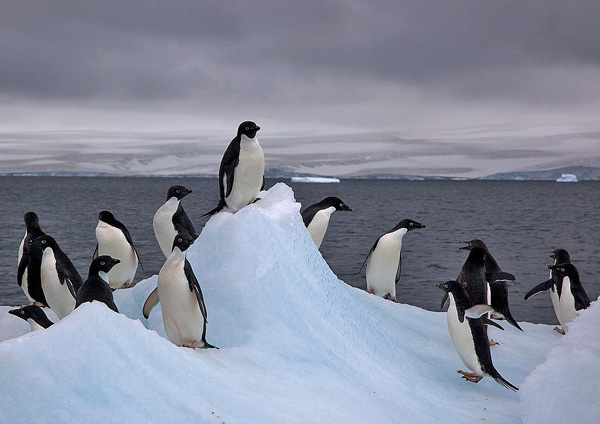
Manchots d’Adélie (Crédit photo : Wikipedia)
Le recul des glaciers de Heard Island // The retreat of glaciers on Heard Island

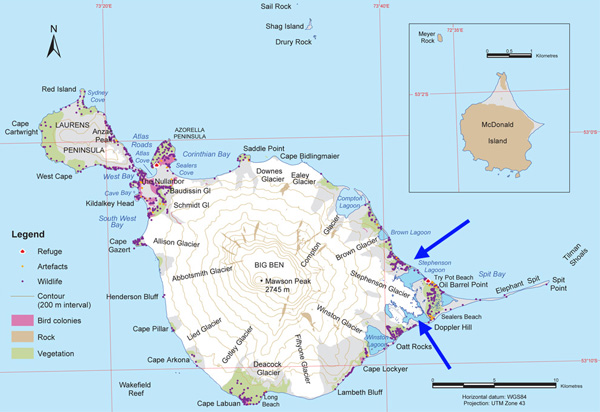
Heard Island est une île montagneuse de 368 kilomètres carrés qui fait partie du Territoire australien des îles Heard et McDonald. Elle se trouve à environ 4 100 km au sud-ouest de Perth et à 3 845 km au sud-ouest du Cap Leeuwin en Australie. 41 glaciers recouvrent les montagnes et 80% de l’île sont occupés par la glace. Heard Island est dominée par Mawson Peak, un complexe volcanique de 2 745 mètres d’altitude qui fait partie du massif du Big Ben. Une image satellite datant de juillet 2000 fournie par l’Université d’Hawaï montrait une coulée de lave active de 2 km de long partant du sommet de Big Ben.
Ce qui nous intéresse ici, ce sont les glaciers de l’île. D’une manière générale, nous savons que la fonte des glaciers façonne de nouveaux paysages et crée parfois de nouvelles opportunités pour la faune. C’est ce qui se passe à Heard Island où les glaciers Winston, Brown et Stephenson ont tous reculé considérablement depuis 1947, année où les premières cartes fiables ont localisé leurs fronts avec exactitude.
Le recul des glacier Stephenson et Winston (voir la carte ci-dessous) a été documenté de 2001 à 2018, ainsi que l’agrandissement de la lagune qui en a résulté.
Le recul du glacier Stephenson a commencé en 1971, date à laquelle son front s’est éloigné d’un kilomètre de la côte sud et de plusieurs centaines de mètres du côté nord.
En 1980, ce recul a entraîné la formation du lagon Stephenson.
En 2001, le glacier Stephenson avait deux branches distinctes se terminant dans deux lagons distincts, le Doppler au sud et le Stephenson à l’est. Il y avait de nombreux icebergs dans le lagon Doppler mais aucun dans le lagon Stephenson, preuve que le recul était en cours. Le glacier Winston terminait sa course là où le lagon s’élargissait.
En 2008, les deux lagons devant le glacier Stephenson étaient reliées dans la partie est par un étroit chenal ; ils étaient remplies d’icebergs suite à l’effondrement de la partie terminale du glacier.
En 2010, le glacier Stephenson n’atteignait plus le lagon Stephenson et, comme le glacier Winston en 2001, il se terminait dans le point étroit où le glacier entrait dans le lagon principal.
En 2018, le glacier Stephenson n’entrait plus dans le lagon principal. Le bras nord du glacier avait connu un recul de 1,8 km entre 2001 et 2018 et le bras sud s’était retiré de 3,5 km. Le lagon était dépourvu de glace pour la première fois depuis plusieurs siècles, voire plusieurs millénaires. La période de recul rapide due au vêlage d’icebergs dans le lagon était terminée et le glacier reculait maintenant plus lentement.
Le glacier Winston a reculé de 600 mètres entre 2001 et 2018. L’agrandissement global du lagon a été limité car le glacier s’est retiré dans une crique d’une largeur de 500 mètres.
La population de manchots royaux a fortement augmenté entre les années 1940 et le 21ème siècle, tandis que les effectifs de gorfous sauteurs, de manchots papous et de gorfous macaronis ont diminué au cours de la même période.
L’expansion des lagons Stephenson et Winston a été importante pour la faune, les manchots royaux et des cormorans ont également été observés. Le recul de ces glaciers sur Heard island suit un schéma de recul identique à celui d’autres glaciers situés sur des îles de la région antarctique: la Calotte glaciaire Cook à Grande Terre, l’île principale de l’archipel des Kerguelen ; les glaciers Hindle et Neumayer en Géorgie du Sud.
Source: AGU 100.

——————————————————–

Heard Island is a 368-square-kilometre bleak and mountainous island which belongs to the Australian Territory of Heard Island and McDonald Islands. It is located approximately 4,100 km southwest of Perth and 3,845 km southwest of Cape Leeuwin, Australia. Its mountains are covered by 41 glaciers and the island is 80% covered with ice. It is dominated by Mawson Peak, a 2,745-metre-high complex volcano which forms part of the Big Ben massif. A July 2000 satellite image provided by the University of Hawaii showed an active 2-kilometre-long lava flow travelling from the summit of Big Ben.

What interest us here is the glaciers of the island. More generally, we know that the melting of glaciers shapes new landscapes and sometimes creates new opportunitiess for the wildlife. This is what is happening on Heard Island where the Winston, Brown and Stephenson Glacier have all retreated substantially since 1947, a year when the first good maps of their terminus are available.

The retreat of the Stephenson Glacier and the Winston Glacier (see map below) has been studied from 2001 to 2018, together with the consequent lagoon expansion.

The retreat of the Stephenson Glacier began by 1971 when it retreated 1 km from the south coast and several hundred meters on its northern side.

This retreat by 1980 caused the formation of Stephenson Lagoon.

In 2001, the Stephenson Glacier had two separate branches terminating in two separate lagoons, Doppler to the south and Stephenson to the east. There were numerous icebergs in Doppler lagoon but none in Stephenson Lagoon, indicating the retreat was underway. Winston Glacier terminated where the lagoon widened.

In 2008, the two lagoons in front of the Stephenson Glacier were joined with a narrow eastern channel; the lagoons were filled with icebergs as a terminus collapse was underway.

By 2010, the Stephenson Glacier had retreated from the main Stephenson Lagoon, and like the Winston Glacier in 2001 terminated at narrow point where the glacier entered the main lagoon.

By 2018, the Stephenson Glacier had retreated from the main lagoon, the northern arm of the glacier experienced a 1.8 km retreat from 2001 to 2018 and the southern arm a 3.5 km retreat.  The lagoon was free of ice for the first time in several centuries if not several millennia. The period of rapid retreat due to calving of icebergs into the lagoon was over and the retreat rate would now be slower.

The Winston Glacier retreated 600 metres from 2001-2018.  The overall lagoon expansion has been limited as the glacier retreated up an inlet that is 500 metres wide.

The population of king penguins increased sharply from the 1940s into the 21st century, while rockhopper, gentoo and macaroni penguin numbers declined over the same period.

The expansion of both the Stephenson Lagoon and the Winston Lagoon has been important for wildlife, king penguins, and cormorants have also been observed.  The retreat of these glaciers follows the pattern of glacier retreat at other glaciers on islands in the circum-Antarctic region: Cook Ice Cap on Kerguelen Island,  Hindle Glacier and Neumayer Glacier in South Georgia

Source: AGU 100.

Vue de Heard Island et de ses glaciers (Source : Australian Antarctic Division)

Images fournies par le satellite Landsat et montrant le recul des glaciers Stephenson et Winston au cours des dernières années.

Le volcan et les manchots // The volcano and the penguins

Selon une nouvelle étude réalisée par le British Antarctic Survey et publiée dans Nature Communications, l’une des plus grandes colonies de manchots papous sur l’Ile Ardley, près de la Péninsule Antarctique, a été décimée à plusieurs reprises par des éruptions volcaniques au cours des 7000 dernières années. Les chercheurs ont étudié le guano déposé autrefois par les manchots et ont constaté que la colonie avait plusieurs fois frôlé l’extinction à cause des retombées de cendre d’un volcan sur l’Ile de la Déception située à environ 120 km au sud-ouest d’Ardley.
L’Ile Ardley héberge actuellement une colonie d’environ 5000 couples de manchots papous. Grâce à l’analyse chimique du guano extrait des carottes de sédiments provenant d’un lac de l’île, les chercheurs ont découvert l’histoire de la colonie. Les conditions climatiques sur l’Ile Ardley ont généralement été favorables aux manchots au cours des 7000 dernières années et l’équipe scientifique s’attendait à ce que la colonie affiche des fluctuations mineures suite au changement climatique et aux variations de la glace de mer qui l’accompagnent. Au final, ils ont constaté que le volcan sur l’Ile de la Déception a eu un impact beaucoup plus important que prévu.
Lorsque les chercheurs ont commencé à examiner les carottes de sédiments, ils ont été frappés par la forte odeur du guano dans certaines strates et ils ont pu voir parfaitement les couches de cendre volcanique en provenance de l’Ile de la Déception. En procédant à l’analyse chimique des sédiments, ils ont pu estimer le nombre de manchots sur l’Ile Ardley tout au long de la période et voir dans quelle mesure les oiseaux ont été affectés par les éruptions. Au moins trois fois au cours des 7000 dernières années, la population de manchots a été d’un ordre de grandeur semblable à aujourd’hui, mais elle a presque totalement disparu après chacune des trois grandes éruptions volcaniques. Il a fallu, en moyenne, entre 400 et 800 ans pour que la colonie se reconstitue durablement.
L’étude révèle l’impact sévère que les éruptions volcaniques peuvent avoir sur les manchots et à quel point il est difficile pour une colonie de se reconstituer complètement. Une éruption peut enfouir les poussins sous de la cendre ; alors que les adultes peuvent nager, les poussins sont trop jeunes pour survivre dans les eaux très froides. Les sites de nidification peuvent également être recouverts par la cendre et rester inhabités pendant plusieurs siècles.
Les techniques mises en pratique dans cette étude permettront aux scientifiques de modéliser les changements intervenus dans le passé dans la taille des colonies et prévoir comment d’autres colonies de manchots pourraient être affectées ailleurs, comme les manchots à jugulaire sur l’île de Zavodovski, menacés par les éruptions du volcan Mt Curry en 2016.
Jusqu’à présent, les changements intervenus dans les populations de manchots de la Péninsule Antarctique avaient été attribués à la variabilité climatique et aux fluctuations de la glace de mer, mais l’impact potentiellement dévastateur sur le long terme de l’activité volcanique n’avait jamais été pris en compte.
Source: British Antarctic Survey.

————————————

According to a new study by the British Antarctic Survey published in Nature Communications, one of the largest colonies of gentoo penguins on Ardley Island, near the Antarctic Peninsula, was decimated by volcanic eruptions several times during the last 7,000 years. The researchers studied ancient penguin guano and found the colony came close to extinction several times due to ash fall from Deception Island volcano, situated roughly 120km to the southwest of Ardley.

Ardley Island is currently home to a population of around 5,000 pairs of gentoo penguins. Using new chemical analyses of penguin guano extracted in sediment cores from a lake on the island, the researchers could discover the history of the penguin colony. Climate conditions around Ardley Island have been generally favourable for penguins over the last 7,000 years and the team had expected the local population to show minor fluctuations in response to changes in climate or sea ice. The surprising result was that the nearby Deception Island volcano had a far greater impact than originally anticipated.

When the researchers first examined the sediment cores, they were struck by the intense smell of the guano in some layers and they could also clearly see the volcanic ash layers from nearby Deception Island. By measuring the sediment chemistry, they were able to estimate the population numbers throughout the period and see how penguins were affected by the eruptions. On at least three occasions during the past 7,000 years, the penguin population was similar in magnitude to today, but was almost completely wiped out locally after each of three large volcanic eruptions. It took, on average, between 400 and 800 years for it to re-establish itself sustainably.

The study reveals the severe impact volcanic eruptions can have on penguins, and just how difficult it can be for a colony to fully recover. An eruption can bury penguin chicks in toxic ash, and while the adults can swim away, the chicks may be too young to survive in the freezing waters. The nesting sites can also be buried, and may remain uninhabitable for hundreds of years.

The techniques developed in this study will help scientists to reconstruct past changes in colony size and potentially predict how other penguin populations may be affected elsewhere, like the chinstrap penguins on Zavodovski Island, which were disturbed by eruptions from the Mt Curry volcano in 2016.

Changes in penguin populations on the Antarctic Peninsula have been linked to climate variability and sea-ice changes, but the potentially devastating long-term impact of volcanic activity has not previously been considered.

Source: British Antarctic Survey.

Source: British Antarctic Survey

Manchot papou (Crédit photo: Wikipedia)

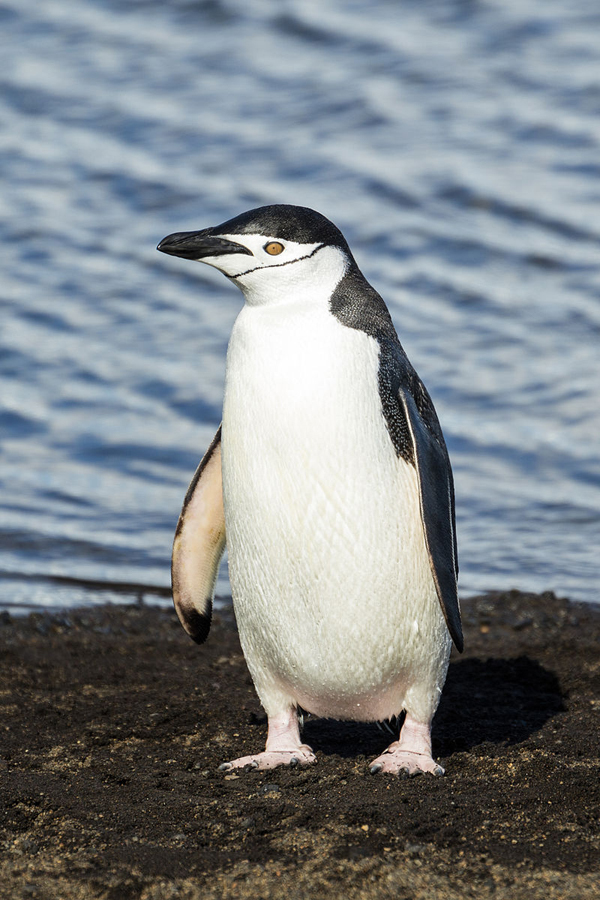
Manchot à jugulaire (Crédit photo: Wikipedia)

Le volcan et les manchots // The volcano and the penguins

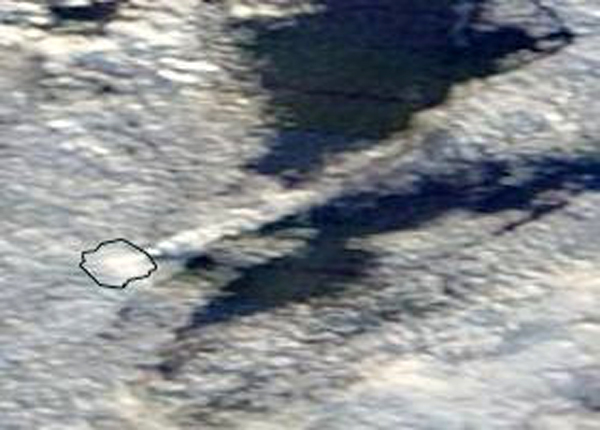
drapeau francaisTrès peu de gens ont entendu parler de l’Ile Zavodovski. Elle a 8 km de large et est inhabitée par les hommes. C’est l’un des lieux les plus reculés sur Terre. C’est la plus septentrionale de la chaîne des îles Sandwich du Sud. Elle est dominée par un volcan, le Mont Curry qui culmine à 551 mètres. Les seuls êtres vivants sur l’île sont 1.2 millions de manchots à jugulaire (la plus grande colonie du monde) et près de 200.000 gorfous dorés qui sont sous la menace du volcan actuellement en éruption. On craint pour les manchots en raison des colonnes de cendre émises par le volcan et que l’on aperçoit sur les images satellites.

Zavodovski Island 13 June 2016

Panache du Mt Curry le 13 juin 2016 (Source: NASA)

L’île est si isolée que les scientifiques du British Antarctic Survey indiquent qu’il ne sera pas possible d’évaluer l’impact de l’éruption avant une expédition prévue en Décembre 2016 – Janvier 2017. Au pire, les manchots – hauts de 55 cm à l’âge adulte – pourraient être enterrés vivants sous la cendre, être brûlés ou souffrir de difficultés respiratoires. Le danger vient surtout du fait que l’éruption a commencé au cours de leur mue. Au cours de cette période, qui peut durer six semaines, les manchots ne sont pas revêtus d’un plumage étanche et ils ne peuvent donc pas aller dans l’eau. Le volcan se trouve à quelques centaines de mètres des colonies de manchots à l’est, au sud et au nord de l’île, et la cendre est poussée vers l’est par les vents dominants.
Les manchots à jugulaire sont une espèce sub-antarctique qui vit à proximité, mais pas sur le continent. Ils sont environ 7,5 millions dans le monde avec une espérance de vie d’une vingtaine d’années. Ils pondent deux œufs chaque année et les poussins mettent trois à quatre ans pour devenir adultes. Ils nichent sur la surface du sol et se nourrissent de krill et de poissons.
Source: The Guardian.

—————————————-

drapeau anglaisVery few people have heard about Zavodovski Island. It is 8 km wide, uninhabited by humans, and about as remote a place as you can find on Earth. It is the northernmost in the chain of the volcanic South Sandwich Islands, and its dominant feature is Mount Curry volcano. The only living beings on the island are1.2 million chinstrap penguins (the world’s largest colony) and nearly 200,000 macaroni penguins that are at risk from the volcano that is currently erupting. There are fears over the penguins’ fate due to the columns of ash and smoke drifting from the volcano and that have been captured by satellite images (see above).

The island is so remote that experts at the British Antarctic Survey (BAS) say it will be impossible to assess what impact the eruption has had until an expedition visits in December 2016 or January 2017, but the risk to the penguins is that at worst they could be buried alive in ash, burned or suffer breathing difficulties. The danger to the 55-centimetre-tall chinstraps comes from the fact the eruption began during their moulting season. During this time, which can last six weeks, the penguins are not waterproof and cannot go into the water. The volcano is hundreds of metres from the penguin colonies to the east, south and north of the island, and the ash is being blown eastwards by prevailing winds.

Chinstrap penguins are a sub-Antarctic species that live close to, but not on, the continent. There are around 7.5 million globally, and they live for about 20 years, breeding two eggs each year, with chicks taking around three to four years to mature to adults. They nest on the surface of the ground, and feed on krill and fish.

Source : The Guardian.

Manchot jugulaire

Manchot à jugulaire.

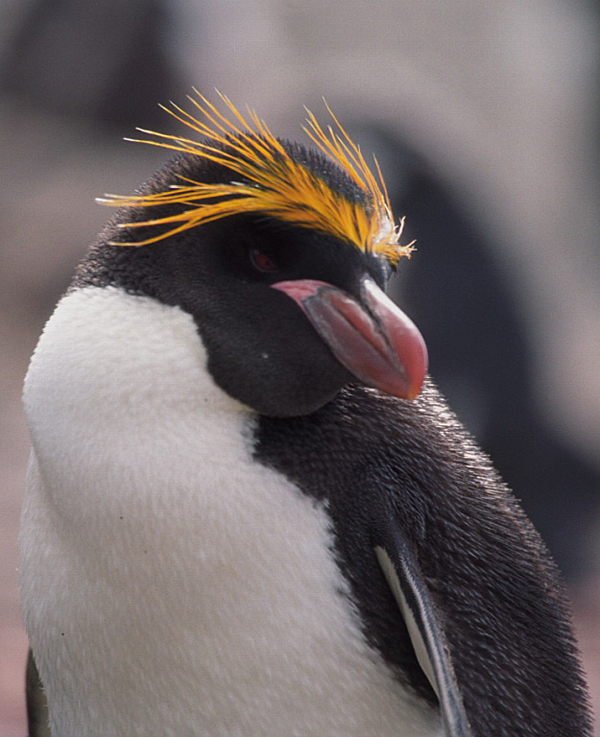
Gorfou

Gorfou doré

(Crédit photo: Wikipedia)