 Aujourd’hui, de nouvelles technologies sont utilisées pour étudier les systèmes hydrothermaux de Yellowstone. Il y a une vingtaine d’années, j’ai participé à une campagne de mesures de la température des sources chaudes dans le Parc, sous l’égide de l’Observatoire volcanologique (YVO). J’utilisais un thermomètre qui m’a permis de relever les températures d’une vingtaine de sources. Aujourd’hui, la situation est différente. Des capteurs radio ont été installés à divers endroits du Yellowstone Geyser Basin ; ils enregistrent automatiquement les températures des chenaux d’écoulement des geysers, des bassins hydrothermaux, des sols et même de l’air. Les données sont ensuite transmises quotidiennement par radio et Internet aux bureaux de l’USGS à Menlo Park, en Californie, où elles sont archivées et mises à la disposition du public sur le site web de l’Observatoire Volcanologique de Yellowstone.
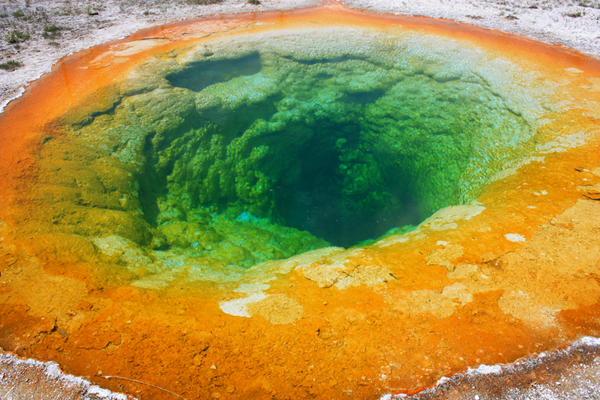
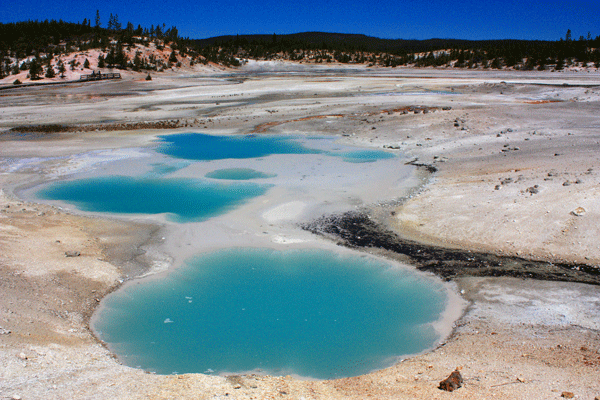
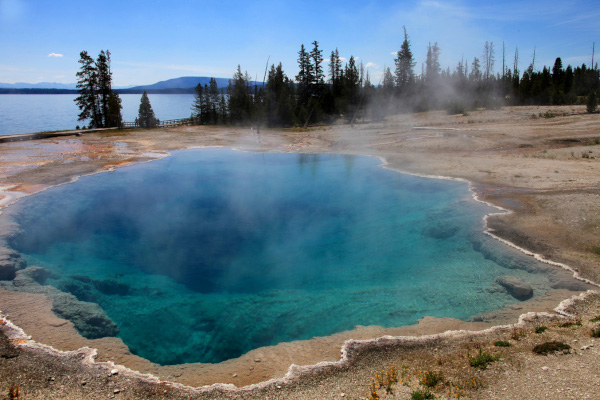
Morning Glory Pool, l’une des innombrables sources chaudes de Tellowstone (Photo: C. Grandpey)
Le dernier numéro des Yellowstone Caldera Chronicles , une chronique hebdomadaire rédigée par des scientifiques de l’Observatoire, est consacré à l’étude de l’eau et des roches dans le sous-sol de Yellowstone. Par le passé, les géologues effectuaient des forages pour étudier les conditions géologiques et hydrothermales du sous-sol, notamment en 1967-1968. Cependant, forer dans un système hydrothermal actif est une opération complexe et dangereuse, avec le risque d’une libération brutale de vapeur et d’eau chaude pendant les opérations de forage. La plupart des anciens forages ont été scellés, mais les diagraphies et carottes de roche extraites ont fourni de précieuses informations.
Ces dernières années, la géophysique est devenue une technique essentielle pour imager le sous-sol et étudier le système hydrothermal de Yellowstone sans avoir recours au forage. Des méthodes telles que la sismique, la magnétotellurique, l’électromagnétisme et la gravimétrie permettent aux scientifiques de déterminer les propriétés fondamentales des fluides et des roches. Les méthodes d’imagerie géophysique sont idéales pour le Parc national de Yellowstone car elles sont non invasives : il n’est pas nécessaire de perturber le sol pour étudier le système hydrothermal souterrain.
L’Université du Wyoming utilise depuis une dizaine d’années des méthodes géophysiques terrestres pour imager les réseaux hydrothermaux situés sous les sources chaudes et les geysers de Yellowstone. En 2018, un groupe d’étudiants a parcouru plus de 3 kilomètres avec un encombrant matériel géophysique afin de recueillir différents types d’images du sous-sol sous Sentinel Meadows, un bassin hydrothermal actif du Lower Geyser Basin.
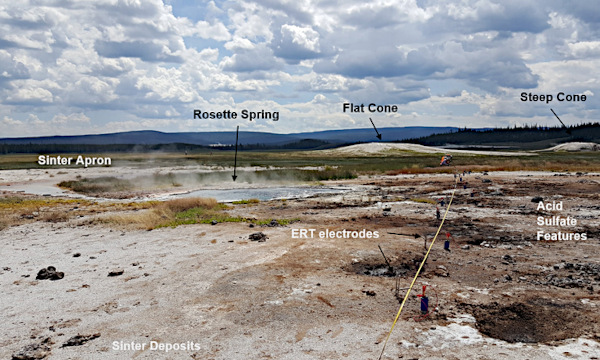
Un ensemble de données a pu cibler le réseau hydrothermal sous la source Rosette (Rosette Spring, également appelée Bison Pool) grâce à la tomographie de résistivité électrique (TRE). L’eau hydrothermale étant conductrice, cette méthode est particulièrement efficace pour en réaliser l’imagerie en sous-sol. Les étudiants et leurs enseignants ont déployé cinq lignes parallèles de capteurs électriques autour de Rosette Spring afin de mesurer la résistivité du sous-sol. Cela a permis d’obtenir une image des eaux hydrothermales souterraines sans forer ni endommager la surface.
Source : YVO
Les résultats de la tomographie de résistivité électrique indiquent la présence d’eau hydrothermale près de la Rosette Spring à une profondeur de 5 à 10 mètres. Cependant, aucun conduit ne semble relier cette eau à la surface. Cela signifie que l’eau hydrothermale alimentant la source circule probablement à travers un réseau dense de petits canaux dans les dépôts glaciaires qui constituent la géologie de surface de la région. Ces canaux sont si étroits qu’ils sont difficiles à observer avec l’équipement utilisé par l’équipe de terrain. De plus, la ligne de TRE la plus proche de la source Rosette présente un signal plus résistif, caractéristique de dépôts de geysérite formés par le refroidissement et la précipitation de la silice par l’eau chaude de la source. Ceci démontre que les dépôts de silice observés en surface s’étendent en sous-sol jusqu’à une profondeur d’environ 7 mètres. L’image TRE ne révélant aucun conduit ou structure tubulaire reliant les eaux profondes à la surface, l’origine de l’eau de Rosette Spring demeure un mystère.
Les recherches se poursuivent afin de comprendre comment les eaux hydrothermales circulent depuis les réservoirs profonds jusqu’à l’émergence des sources chaudes de Yellowstone. Les géologues de l’Observatoire volcanologique de Yellowstone nous expliquent que de nouvelles données géophysiques haute résolution apporteront sans aucun doute de nouveaux éclairages concernant le système d’alimentation en eau chaude de Yellowstone.
L’intégralité de l’étude se trouve à cette adresse :
Source : USGS, Observatoire volcanologique de Yellowstone.
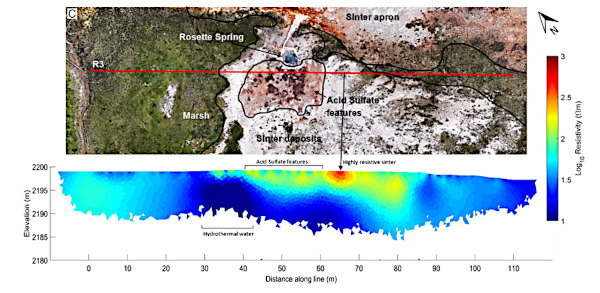
 Parmi les résultats de tomographie de résistivité électrique du sous-sol de Rosette Spring figure une coupe transversale de la ligne R3 comparée aux images de Google Earth. Les anomalies de résistivité élevée (du jaune au rouge) près de la surface correspondent à des dépôts de geysérite en surface. À côté de cela, la zone plus profonde à faible résistivité (bleu foncé) est interprétée comme étant constituée d’eau hydrothermale alimentant la source. (Source : Wyoming State Geological Survey)
 Among the surface imagery and subsurface electrical resistivity tomography results from Rosette Spring, there is a cross sectional view of line R3 compared to Google Earth imagery. High-resistivity anomalies (yellow to red) in the near-surface correlate with white sinter deposits on the ground surface. In contrast, the deeper, low-resistivity zone (dark blue) is interpreted as hydrothermal water that feeds Rosette Spring. (Source : Wyoming State Geological Survey)
—————————————————-
Today, new technologies are being used to study the hydrothermal systems at Yellowsrone. Two decades ago, I participated in a campaign to measure the temperatures of the hot springs under the auspices of the Volcanological Observatory (YVO). I used a hand-held thermometer and collected the readings for about two dozen springs. Today, things are different. Radio-equipped sensors have been installed at different spots within the geyser basin, recording temperatures within runoff channels from geysers, hot pools, soils, and even air. The data are saved by the sensors and are then transmitted daily via small radios and the Internet back to the USGS offices in Menlo Park, California, where they are archived and distributed to the public on the Yellowstone Volcano Observatory website.
The latest issue of the Yellowstone Caldera Chronicles, a weekly column written by scientists of the Yellowstone Volcano Observatory (YVO) is dedicated to the study of water and rocks that are underground in Yellowstone.
In the past, geoscientists drilled boreholes to investigate subsurface geologic and hydrothermal conditions, most recently in 1967–68. However, drilling into an active hydrothermal system is complicated and risky. Many of the holes can erupt with steam and hot water during drilling operations. Most of the old boreholes were sealed, and the drilling logs and rock cores that were extracted provided valuable information.
More recently, geophysics has emerged as a key technique to image the subsurface and study the Yellowstone hydrothermal system without drilling into it. Methods such as seismic, magnetotelluric, electromagnetic, and gravity allow for scientists to determine fundamental material properties of fluid or rock. Geophysical imaging methods are ideal for Yellowstone National Park because they are noninvasive, meaning you do not have to significantly disturb the ground to learn about the subsurface hydrothermal system.
The University of Wyoming has been using ground-based geophysical methods for a decade to image the “plumbing systems” below hot springs and geysers in Yellowstone.
In 2018, a group of students hiked more than 3 kilometers with a very heavy collection of geophysical equipment to collect multiple types of subsurface images beneath Sentinel Meadows, a hydrothermally active drainage in Lower Geyser Basin. One data set targeted the plumbing system beneath Rosette Spring (aka Bison Pool) using electrical resistivity tomography (ERT). Hydrothermal water is electrically conductive, which makes this method very effective at imaging hydrothermal water in the subsurface. The students and instructors laid out five parallel lines of electrical sensors across Rosette Spring to measure the resistivity of the subsurface, which yielded an image of the hydrothermal waters below the ground without requiring any drilling or other damage.
The results from the ERT survey show that there is hydrothermal water near Rosette Spring about 5–10 meters down, but that there is no distinct pipe or conduit leading to the pool at the surface. This leads to the important conclusion that the hydrothermal water feeding the pool likely travels through a dense network of small pathways in the glacial deposits that make up the surface geology in the area. Such pathways are so small that they are hard to see with the equipment that the field team used. Additionally, the ERT line nearest to Rosette Spring shows a more resistive signal indicative of white sinter deposits that are created by the hot spring waters cooling and precipitating silica. This demonstrates that the white sinter deposits seen at the surface extend into the subsurface to a depth of about 7 meters. Because the ERT image does not show a resolvable conduit or pipe-like structure from deeper water to the surface, it remains a mystery as to how Rosette Spring gets its water, and research continues into how hydrothermal waters travel from deep reservoirs and emerge as hot springs in Yellowstone. YVO geologists say that new high-resolution geophysical data will undoubtedly continue to provide insights into Yellowstone’s hot water plumbing systems.
Just click on this link to find the study :
Source : USGS, Yellowstone Volcano Observatoty.
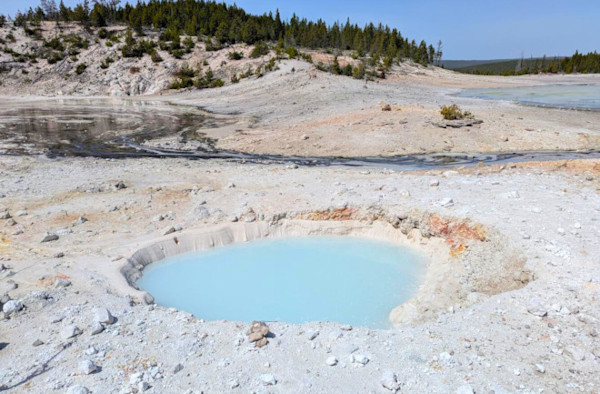
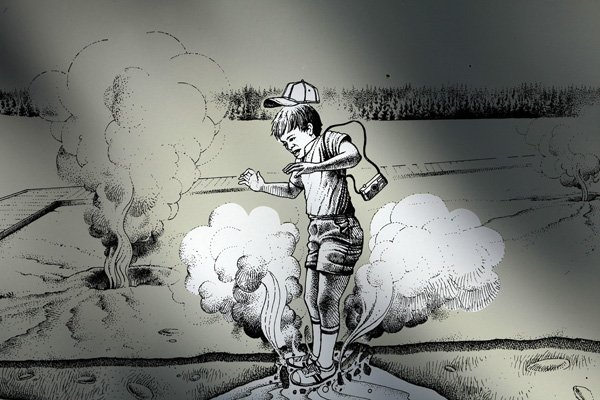
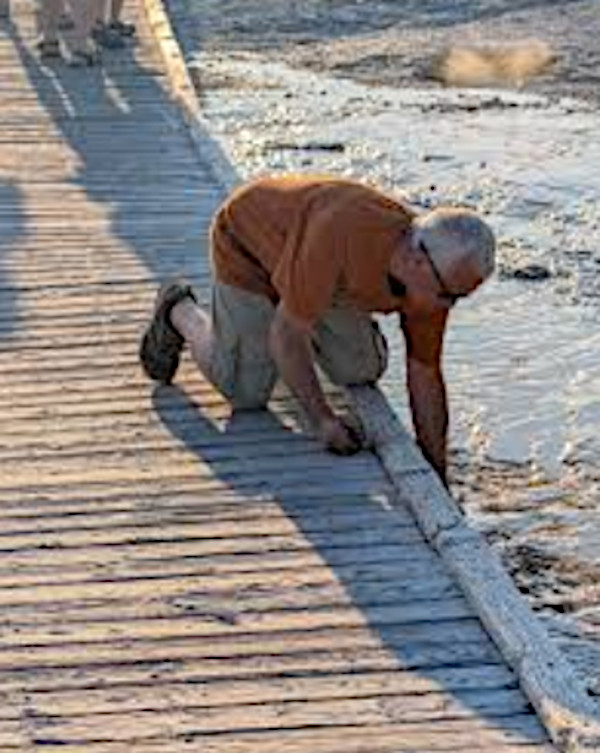
 Les autorités du Parc national de Yellowstone en ont assez du mauvais comportement d’un nombre croissant de visiteurs et ont décidé de sévir. De plus en plus de touristes s’approchent trop près de la faune, avec des accidents de plus en plus fréquents. D’autres visiteurs ont été vus en dehors des les sentiers, en train de se promener à proximité de sources hydrothermales avec le risque d’être gravement brûlés ou même de mourir, comme cela s’est produit dans le Norris Geyser Basin il y a quelques années.
 Authorities in Yellowstone National Park are getting fed up with the misbehaviour of more and more visitors to the Park. There are repeated incidents of tourists getting too close to the wildlife with ensuing accidents . Other visitors have been seen leaving the trails and boardwalks to go and walk close to geothermal sources with the risk of being badly burnt or even dyng, as happened at Norris Geyser Basin a few years ago.
 En juin 2022, des précipitations sans précédent ont provoqué d’importantes inondations, des glissements de terrain et des coulées de boue dans le Parc national de Yellowstone. Les routes, les systèmes d’approvisionnement en eau et d’évacuation des eaux usées, les lignes électriques et d’autres infrastructures essentielles ont subi de gros dégâts.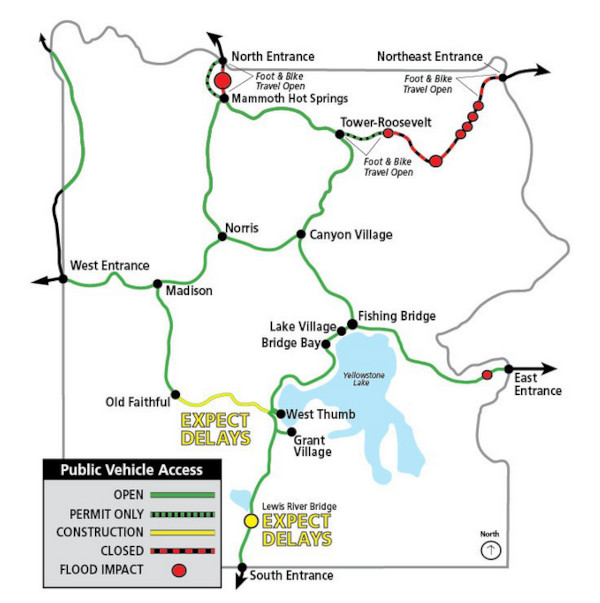
 In June 2022, unprecedented amounts of rainfall caused substantial flooding, rockslides, and mudslides within Yellowstone National Park. Historic water levels caused severe damage to roads, water and wastewater systems, power lines, and other critical park infrastructure.
