 Comme je l’ai écrit dans une note précédente, on sentait que le Met Office islandais et la Protection Civile n’étaient pas vraiment d’accord avec la décision d’autoriser les habitants de Grindavik à rentrer chez eux. Aujourd’hui, l’inquiétude s’ajoute à ce désaccord. Si l’accumulation de magma se poursuit au même rythme qu’actuellement dans la région de Svartsengi, sa quantité atteindra cette semaine le seuil jugé nécessaire pour déclencher la prochaine intrusion, voire une nouvelle éruption. Le Met Office prévient également qu’une éruption pourrait se déclencher avec très peu de préavis, moins de 30 minutes.
De son côté, la Protection Civile fait remarquer qu’il sera difficile d’évacuer des endroits comme Grindavik ou le Blue Lagoon car une éruption peut démarrer très vite et personne ne peut dire exactement où elle aura lieu. Des sirènes ont été installées et alerteront la population si nécessaire.
Une réunion d’information pour les habitants de Grindavík est prévue aujourd’hui 26 février ; ils recevront des informations sur l’état des infrastructures de la ville.
Source : Iceland Monitor.
Le Met Office décrit trois scénarios possibles :
1) Une éruption semblable à celles du 8 février et du 18 décembre, avec des séismes soudains et intenses suivis d’une éruption entre Sýlingarfell et Stóra-Skógfell. Le préavis serait de trente minutes, voire moins.
2) Le deuxième scénario serait semblable à l’éruption du 14 janvier à Hagafell, avec une coulée de lave atteignant en une heure les digues de terre autour de Grindavík. Le préavis serait d’environ une à trois heures.
3) Le troisième scénario serait le pire des cas pour Grindavík. Une éruption se produirait au sein même de la ville. Il y aurait un préavis d’une à cinq heures entre les premiers séismes et le début de l’éruption.
Ces scénarios sont basés sur les interprétations des dernières données et sur l’évolution observée lors des événements précédents dans la zone de la chaîne de cratères de Sundhnúkur. Le Met Office répète que le processus de chaque éruption est très difficile à prévoir avec une parfaite précision.
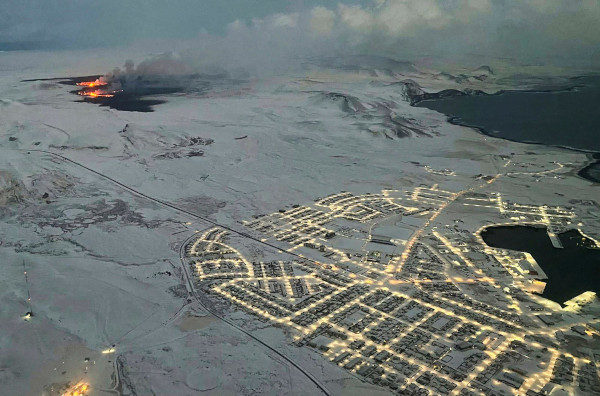
Personne ne sait si, quand et où se produira une nouvelle éruption. Grindavik n’est pas à l’abri d’un tel événement (Crédit photo: Iceland Review)
————————————————–
 As I put it in a previous post, one could feel that the Icelandic Met Office and the Civil Protection did not fully agree with the decision to allow Grindavik residents to go back home. Today, anxietu adds to this disagreement. If the accumulation of magma continues at the same rate as now in the Svartsengi area, the amount of magma will reach this week the threshold that is believed to be needed to start the next intrusion, or even a volcanic eruption. The Met Office also warns that an eruption could start with very little notice, less than 30 minutes.
The Cicil Protection says it will be difficult to evacuate places like Grindavik or the Blue Lagoon as the warning can be very short and no one can say exactly where the eruption will occur. There are warning sirens in place that will be blown if necessary.
An information meeting for the residents of Grindavík is planned for today February 26th ; residents will receive information about the state of the town’s infrastructure.
Source : Iceland Monitor.
The Met Office outlines three possible scenarios:
1) An eruption similar to those of February 8th and December 18th, with sudden and intense earthquakes followed by an eruption between the mountains of Sýlingarfell and Stóra-Skógfell. The warning time would be thirty minutes or even less.
2) The second scenario would be similar to the January 14th eruption which took place by Hagafell with a lava flow reaching the barriers around Grindavík within an hour. This would give a warning time of approximately one to three hours.
3) The third scenario would be the worst case scenario for Grindavík. An eruption would occur within the town itself. There would be a warning time of one to five hours from the first earthquakes to the start of the eruption.
These scenarios are based on interpretations of the latest data and the observed development of the previous events at the Sundhnúkur crater row area. The Met Office repeats that every aspect of an eruption is very difficult to predict with perfect accuracy.

 Claude Grandpey : Volcans et Glaciers