 On peut lire sur le site « geology.com » un article très intéressant sur l’indice d’explosivité volcanique (VolcanicExplosivity Index, ou VEI en raccourci).
http://geology.com/stories/13/volcanic-explosivity-index/
L’indice d’explosivité volcanique est une échelle utilisée pour comparer les éruptions volcaniques entre elles. Il a été mis au point en 1982 par Chris Newhall de l’USGS et Stephen Self de l’Université d’Hawaii. C’est un instrument très précieux, car il peut être utilisé à la fois pour définir les dernières éruptions dont les scientifiques ont été témoins et les éruptions historiques qui se sont produites il y a des milliers ou des millions d’années.
Le principal facteur utilisé pour déterminer le VEI est le volume de matériaux pyroclastiques émis par le volcan, que ce soit la cendre, les tephra, les coulées pyroclastiques, ou d’autres types d’éjectas. La hauteur de la colonne éruptive et la durée de l’éruption sont également prises en compte dans l’attribution d’un niveau VEI.
L’échelle VEI commence à 0 pour les éruptions qui produisent moins de 0,0001 kilomètre cube de matériaux. La plupart de ces éruptions sont de très petite taille ; elles peuvent être effusives plutôt qu’explosives.
Les éruptions de VEI 1 produisent entre 0,0001 et 0,001 kilomètres cubes de matériaux. Au-dessus du VEI 1, l’échelle devient logarithmique, ce qui signifie que chaque échelon représente une augmentation de 10 fois la quantité de matière éjectée. Ainsi, les éruptions de VEI 2 produisent entre 0,001 et 0,01 kilomètres cubes d’éjectas. Celles de VEI 3 en produisent entre 0,01 et 0,1 kilomètres cubes. On peut voir l’échelle de VEI 0 de VEI 8 dans le schéma qui figure dans la partie droite de la page.
Comme chaque échelon correspond à une augmentation de 10 fois de la matière éjectée, il y a une énorme différence entre la taille d’une éruption sur le bas d’un échelon et une éruption sur le haut d’un autre. Pour cette raison, un « + » est souvent ajouté à des éruptions qui sont connues pour être dans la partie supérieure de l’échelon. Par exemple, l’éruption du Katla (Islande) le 12 Octobre, 1918 a reçu un « VEI 4 + » parce qu’elle avait un VEI 4 très élevé.
Il s’agit là d’un résumé rapide de l’article du site « geology.com ». Même s’il est rédigé en anglais, je vous conseille de le lire dans son intégralité, car il donne d’autres informations intéressantes, en particulier sur les grandes éruptions.
———————————————–
 One can read on the website “geology.com” a very interesting article about the Volcanic Explosivity Index (VEI).
http://geology.com/stories/13/volcanic-explosivity-index/
The Volcanic Explosivity Index is a scale used to compare volcanic eruptions with one another. It was developed in 1982 by Chris Newhall of the United States Geological Survey and Stephen Self of the University of Hawaii. It is a very precious instrument because it can be used for both recent eruptions that scientists have witnessed and historic eruptions that happened thousands to millions of years ago.
The main characteristic used to determine the VEI is the volume of pyroclastic material ejected by the volcano, whether ash, tephra, pyroclastic flows, and other types of ejecta. The height of the eruption column and the duration of the eruption are also considered in assigning a VEI level to an eruption.
The VEI scale begins at 0 for eruptions that produce less than 0.0001 cubic kilometre of volcanic material. Most of these eruptions are very small in size and can be effusive rather than explosive.
Eruptions rated at VEI 1 produce between 0.0001 and 0.001 cubic kilometres of ejecta. Above VEI 1, the scale becomes logarithmic, meaning that each step in the scale represents a 10-fold increase in the amount of material ejected. VEI 2 eruptions produce between 0.001 and 0.01 cubic kilometres of ejecta. VEI 3 eruptions produce between 0.01 and 0.1 cubic kilometres of ejecta. The progression of the scale from VEI 0 to VEI 8 is shown in the diagram at right.
Because each step of the scale is a 10-fold increase in material ejected, there is an enormous difference in the size of an eruption on the low end of a step and an eruption on the high end of a step. For this reason, a « + » is often added to eruptions that are known to be on the upper end of their step. For example, the eruption of Katla (Iceland) on October 12th, 1918 was rated at VEI 4+ because the eruption was a very strong VEI 4.
This is a rapid summary of the article. I would advise you to read it completely as it gives more interesting information, especially on major eruptions.


En 1980, l’éruption du St Helens (0,25
Normal
0
21
MicrosoftInternetExplorer4
/* Style Definitions */
table.MsoNormalTable
{mso-style-name: »Tableau Normal »;
mso-tstyle-rowband-size:0;
mso-tstyle-colband-size:0;
mso-style-noshow:yes;
mso-style-parent: » »;
mso-padding-alt:0cm 5.4pt 0cm 5.4pt;
mso-para-margin:0cm;
mso-para-margin-bottom:.0001pt;
mso-pagination:widow-orphan;
font-size:10.0pt;
font-family: »Times New Roman »;}
Normal
0
21
MicrosoftInternetExplorer4
km3 de matériaux émis) avait un VEI 4.
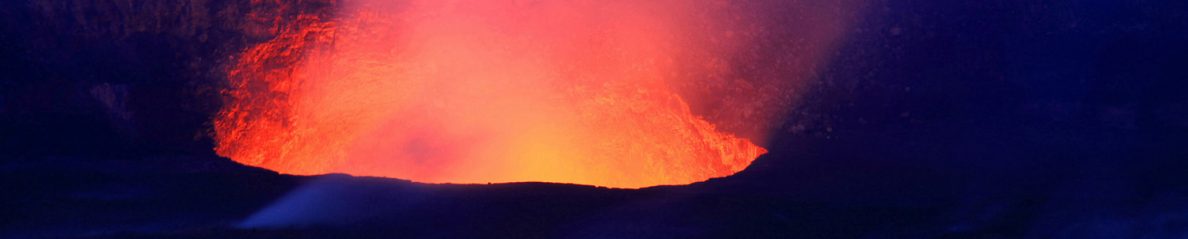
 L’Alaska Volcano Observatory indique qu’un essaim sismique a débuté sur le volcan Semisopochnoi – l’un des plus reculés des Iles Aléoutiennes – à 10h00 (heure locale de l’Alaska) le 9 Juin et s’est intensifié hier 12 Juin vers 12h00. La poursuite de cette activité sismique anormale pendant la nuit a incité l’AVO à faire passer l’alerte aérienne à la couleur Jaune et le niveau d’alerte volcanique à « surveillance recommandée ». Aucune activité éruptive n’est actuellement observée.
 The Alaska Volcano Observatory indicates that a swarm of earthquakes at Semisopochnoi volcano – one of the farthest volcanoes of the Aleutians – started at 10:00 (Alaska local time) on June 9th and increased yesterday, June 12th, at approximately 12:00. The continuation of this anomalous seismic activity through the night prompted AVO to raise the Aviation Colour Code to YELLOW and the Volcano Alert Level to ADVISORY. No eruptive activity is currently observed.

 Claude Grandpey : Volcans et Glaciers